
Listen to this episode of The Food Blogger Pro Podcast using the player above or check it out on Apple Podcasts or Spotify.
This episode is sponsored by Clariti.
Welcome to episode 591 of The Food Blogger Pro Podcast! This week on the podcast, Bjork interviews Cyd Converse from Mediavine and The Sweetest Occasion.
Last week on the podcast, Bjork chatted with Yvette Marquez. To go back and listen to that episode, click here.
What Successful Food Creators Have in Common Right Now
Cyd Converse started her food blog in 2008 and has been working at Mediavine for the last 6.5 years. She was recently promoted to the Director of Publisher Advocacy and Partnerships, and sits down with Bjork for this interview to talk through the recent shifts in search, how creators can adapt, and what successful creators have in common right now.
Bjork and Cyd talk about the current state of the industry, the rapid pace of changes, the decline in predictability, and how many creators are feeling burnt out. Cyd also shares her advice for content creators — leaning into email, updating old content, and leveraging video, to name a few. This is the perfect interview for anyone feeling like they’re weathering the current search changes alone and looking for actionable steps to take to get back on the right track.
Three episode takeaways:
- Prioritize your email marketing strategy — Cyd explains why traffic from your email list is more desirable to advertisers, how you can use email to make the most of the content you already have, why you should experiment with cadence, segmentation, and the types of emails you send, and how to get started collecting email addresses if you don’t already.
- The common traits of creators who are thriving right now — From her conversations with creators, Cyd has found a few things that most creators who are doing well despite AI Overviews have in common — a recognizable voice, expertise, and trust with readers. You want to become the go-to resource for recipes within your niche and keep your audience coming back for you.
- Why you should focus on updating old content — Cyd talks about the shift she has seen from churning out a high volume of new content to instead optimizing and repromoting the content that is already doing well for you (especially the posts with the highest RPMs).
Resources:
- Mediavine
- The Sweetest Occasion
- Tastemaker Conference
- TopHatRank
- Email Cyd
- Follow Cyd on Instagram
- Join the Food Blogger Pro Podcast Facebook Group
Thank you to our sponsors!
This episode is sponsored by Clariti.
Clariti is a content organization and optimization platform that helps you uncover SEO insights and monitor performance improvements by analyzing your WordPress and Google data in real-time — so you can audit your content, understand performance, and see real opportunities instead of guessing.
And it doesn’t stop at insights. Clariti helps you turn what you’re learning into actual projects and tasks — so you can go from analysis to action and actually get stuff done.
Go to clariti.com to learn more.
And, if you’re a Mediavine publisher, Clariti has a dedicated partnership just for you. Just go to clariti.com/mediavine to see what’s included.
Interested in working with us too? Learn more about our sponsorship opportunities and how to get started here.
If you have any comments, questions, or suggestions for interviews, be sure to email them to [email protected].
Transcript (click to expand):
Disclaimer: this transcript was generated using AI.
Bjork Ostrom: If you’ve ever opened Google Analytics or Google Search Console and then just looked at it for a little bit and closed the tab because it felt overwhelming, this is for you. And here’s the thing, it’s not just analytics or search console, it’s also WordPress. Maybe you’re trying to find a post quickly, understand how it’s performing. And after a while, you’re jumping from tab to tab, trying to piece together information about how your content is doing. It really is one of the hardest parts about growing a content business. It’s getting clarity. It’s not always necessarily effort, it’s just knowing what you should do next because your data is scattered, your priorities are getting fuzzy, and you’re staying busy, but you’re not confident that you’re working on the right things. That’s why we created Clariti. It’s C-L-A-R-I-T-I. Clariti is a content organization and optimization platform that pulls all that messy data into one clear place so you can audit your content, understand performance, and see real opportunities instead of just guessing.
And it doesn’t stop at just insights. Clariti helps you turn what you’re learning into actual projects and tasks. So you can go from analysis to action and actually get stuff done. It’s not about quick wins or hacks, it’s about building a calmer, more sustainable system so you can grow with clarity and confidence. Go to C-L-A-R-I-T-I to learn more. And if you’re a Mediavine publisher, Clariti has a dedicated partnership just for you. Just go to clariti.com/mediavine to see what’s included.
Emily Walker: Hey there. This is Emily from the Food Blogger Pro team and you are listening to the Food Blogger Pro Podcast. This week on the podcast, we are welcoming Cyd Converse from Mediavine and the food blog, The Sweetest Occasion. Cyd started her food blog back in 2008 and has been working at Mediavine for the last six and a half years. She was recently promoted to the director of publisher advocacy and partnerships and sits down with Bjork for this interview to talk through the recent shifts in search, how creators can adapt, and what successful creators have in common right now. Bjork and Cyd talk about the current state of the industry and the rapid pace of changes, the decline in predictability, and how many creators are feeling burnt out. Sid also shares her advice for content creators from leaning into email to updating old content and leveraging video just to name a few.
This is the perfect interview for anyone feeling like they’re weathering the current search changes alone and looking for some actionable steps to take to get back on the right track. Stay tuned to the end of the episode to hear what you can expect in the Food Blogger Pro membership for the month of October. But for now, I’ll just let Bjork take it away.
Bjork Ostrom: Cyd, welcome to the podcast.
Cyd Converse: Awesome, Bjork. Thank you so much for having me. I’m actually fangirling a little bit. I’ve been a
Bjork Ostrom: Subscriber
Cyd Converse: For a long time, so
Bjork Ostrom: I’m really
Cyd Converse: Excited to be here.
Bjork Ostrom: Yeah, you’re in one of these great positions, somebody that we love to interview on the podcast because you kind of have this dual role. We talk about this idea of, in sports, a player coach. It’s somebody who’s played, but then they’ve also, they’re a coach and it’s this really unique dynamic. You kind of have a version of that in the blogging world where you’re like blogger ad tech. You have this deep experience. 2008 I think is when you started your site as a publisher, so you really understand that world, but you’ve also been working at Mediavine and understand the world of ad tech, and you actually have moved into this role kind of like a publisher advocate role. And you can talk a little bit more about that and then we’re going to get into the specifics of talking about the state of the industry.
Bjork Ostrom: But one of the things that I pulled from a quote from you was, “The role exists to translate industry shifts into guidance publishers can act on.” And I think people just want that right now. Publishers are like, “What can I act on? As the industry shifts, what can I do?” So tell us a little bit about what you are thinking about within this role, what your job is within it, and then we’re going to talk about the tactical actionable things that we can be thinking about as publishers.
Cyd Converse: So the new role title technically is Director of Publisher Advocacy and Partnerships at Mediavine. I’ve been at Mediavine for six and a half years and have had a few different roles and have recently shifted into this role. But in truth, I have been a publisher advocate forever because that publisher lens is the one that I’m looking through at all times. So as you mentioned, I started my site in 2008. I was in my mid-twenties when I started
Bjork Ostrom: Publishing. Yeah, we’re coming up on 20 years.
Cyd Converse: Rumor has it that I may be pushing my mid – 40s now, but don’t tell anyone I admitted that on the record. But point being, I’ve spent my entire adulthood, my entire career thinking about content, thinking about traffic, thinking about audience, and it’s a perspective that’s just baked into the core of who I am at this point. So what’s really exciting about this new role I’ve stepped into is that I now officially get to be that person at Mediavine raising my hand saying, “Hey, have we thought about this?” The simplest way I can describe it is that I am striving daily to be the ear on the ground and the finger on the pulse of what our publishers and publishers across the industry are facing. So my job really, as I see it, is to bring what publishers are actually experiencing to the table in real time, their needs, their concerns, and the things keeping them up at night.
Cyd Converse: Because when we hear it early, we can move and pivot early. So if publishers are telling us something is shifting under their feet, we want to know immediately so we can meet them where they are. And the Mediavine team has always been really passionate about building tools and partnerships and resources that benefit publishers, but I definitely can lend a unique experience where I can be like, “Hey, we know that’s not actually how people do things or do we know that this is the way publishers are thinking about things when they look
Bjork Ostrom: At
Cyd Converse: Their dashboard in the morning?” And so I just think it’s helping to enrich conversations and allowing us to think a little bit more strategically about what we’re building and how we’re moving forward.
Bjork Ostrom: Yeah. My guess is part of that comes from your experience as an individual doing that, thinking about that, the things that keep you up at night, the things that are stressful. But even in our short conversation before pressing record here, it sounds like a lot of that, especially within the role, is actually going out and interfacing with creators and bloggers. It’s conferences, it’s meetups. You talked about doing a keynote at the Digital Tastemaker conference that they did. So you’re able to also then pick up on the conversations that creators and bloggers are having and bringing to you. What would you say that looks like right now? What is the state of the industry or maybe the mental state of the creator? Because I think people want to hear, people know what it’s like for them, but it’s kind of an isolating job. What is it like for other people who are out there from the conversations that you hear?
Cyd Converse: One of the events that I mentioned to you earlier was a small publisher retreat with about 25 mostly food-oriented bloggers that I attended last week. And I had a number of conversations, small group conversations, but also had one-on-ones with about a dozen or so creators who’ve been in the game, a lot of them for 10 plus years. And I think the reoccurring sentiment right now is folks are tired and they’re wondering how to best leverage their time and how to best leverage their resources right now, wanting to know how much time should I be spending on new content and where are the opportunities that perhaps I’m missing? And I think it is really isolating when you are in your own kitchen or in front of your own laptop creating content or perfecting a recipe and nobody in your neighborhood does what you do.
Bjork Ostrom: So
Cyd Converse: Other publishers, whether you know them or not, are your colleagues or your coworkers. And I think that that seems to be the shared sentiment right now is folks are still really passionate about what they’re doing and determined to stay the course, but just sort of wondering what that looks like and where they go from here.
Bjork Ostrom: Yeah. One of the things that I’ve felt is you and I both have been in this world for a really long time. We’ve seen multiple changes. We’ve seen the industry shift, but I don’t think we’ve ever seen it, or at least I feel this, tell me if you feel this, I don’t think I’ve ever experienced it shift. So it’s one thing to change, but then also to speed up in the way that it is. And it feels like both of those things are simultaneously happening where the playbook is changing, algorithms are shifting, that’s always been true, but it also feels like, and I think primarily because of AI, it feels like things are also speeding up, like the pace of things is speeding up. Does that feel true? And in the conversations you’re having, do you feel like that connects to the burnout at all?
Bjork Ostrom: Or talk a little bit about shifts and changes and then pace as well from the conversations you’ve had with creators.
Cyd Converse: I think that’s a really great observation because I do think that that is absolutely contributing to it. I think especially for folks who have been in the game a bit longer and there was a lot of predictability, that loss of predictability is unsettling, but then it feels like you’re trying to grasp at what’s next and how to adapt and how to evolve and then it’s already changing again. And so I definitely think that that speed is a factor that folks are feeling, that they don’t have a chance to wrap their heads around something before things have potentially moved on to the next thing.
Bjork Ostrom: So
Cyd Converse: I think you really hit the nail right on the head with that one. I think that’s definitely, it’s a double-edged thing that folks are maybe not struggling with, but grasping, grappling with
Bjork Ostrom: Right
Cyd Converse: Now.
Bjork Ostrom: Yeah. One of the huge shifts that’s happened is around search, and that’s kind of been one of these algorithms that has changed, a predictable playbook, still hard five years ago, 10 years ago, but it was more predictable, I think. There’s obviously along the way some very big algorithm shifts and changes that happened that caused certain sites to drop out, but generally it didn’t look as… The changes weren’t as significant as they are or have been over the last year or two. Example being Google Search. If you look at December 2025 to December 2024, this is from actually a PR release related to your position talking about Google Search falling 34%, Google Discover falling I think 20% plus traffic. When you look at that from the Mediavine perspective and the creator perspective, what advice are you giving to people who have had this clear playbook around I create content, Google searches that content, they surface that content and people click on it and go to it.
Bjork Ostrom: And now I create content, Google in this case scans that content and potentially surfaces that as an AI overview depending on what type of content it is. And then people don’t even go there at all. They just read it in Google and then they don’t click. So for people who have experienced that, who have experienced the feeling of working the same amount or working harder but getting less results, what’s the advice that you’d give to those people and how are you approaching those conversations?
Cyd Converse: I think I would first say that as someone who’s lived the experience of being a full-time blogger, not just watching numbers in some sort of vague sense, that 34% of Google traffic being gone is not an abstraction. That’s someone’s groceries bill, that’s someone’s mortgage payment. I feel that in my gut anytime I think of that, when I hear on behalf of someone else or I feel that anxiety and I carry that anxiety with. So I just want to say first and foremost, I think we throw around these numbers and we forget that these are connected to real people and real
Cyd Converse: Small businesses and families. And that’s part of the perspective that I’m always bringing to our team is we’re looking at numbers and we’ve got an incredible team of engineers and data analysts and all the people and we’re always watching the things through that lens. And so we’re seeing these shifts, but these shifts have real impact on real people and real families, and that is something that I always keep centered. And I think when we think about discoverability, we used to really think of in terms of ranking, how does a piece of content rank and how can we get it to rank? How can we improve it in ranking? And now it’s really more about how you can be citable and how you can think about being the source. So when I’m having conversations lately, and I’ve had a whole bunch lately, which I’ve been super fortunate to do, is I’ve really been encouraging people to lean into that, flex your expertise.
Cyd Converse: Why is it you who is writing this specific recipe? Is it because it was your grandmother’s recipe and it makes you think of your grandmother? Or are you a grandmother and this is the recipe that your grandkids are going to remember you by? Why is it you? And center yourself in that work and realize that showing up for as who you are in your expertise and your knowledge and building that trust with your audience, everyone talks about email, but email, email, email, thinking about developing an email strategy if you don’t have one, thinking strategically about how to build a more robust email strategy if you’re playing around with email and just leaning into how you can develop those relationships one-on-one with your community and doing that by really centering yourself and your own work.
Bjork Ostrom: Yeah. When you say citeability, what does that mean?
Cyd Converse: I think of that as if an AI platform or an AI tool is going to tell someone how to make gluten-free carrot cake and you know that you are the expert in gluten-free carrot cake, you want to be the source that AI can’t produce the answer without. They can’t surface that information without coming to you because you are the authority in this area. So really thinking about what are those things that you know through lived experience that ChatGPT or another AI platform can’t replicate. AI tools are really good at surfacing information and synthesizing information, but they’re not great at living in a kitchen testing a recipe. And so when I think about siteability, I think about being the source that an AI tool or some other form of discovery has to come to find the information.
Bjork Ostrom: Yeah. It’s one of the interesting things that I think a lot about for different businesses that are selling things differently, like for Pinch of Yum as an example, we are selling the content and so we’re trying to get people to click and come to the content. Mediavine companies or brands, most of them, that’s probably the primary mechanism that they’re earning money is through that click that then the discoverability, I think that piece is really important that you pointed out, which is it kind of doesn’t matter where you’re getting discovered as long as you’re getting discovered and as long as that discovery results in a click, we’re seeing that shift and change with AI overviews. Sites are being cited a little bit more, but still maybe not getting the same amount of clicks. But it’s much more detrimental for a site where the click is the transaction as opposed to the purchase of the product.
Bjork Ostrom: Because for a company that is selling a thing like high protein cereal, for example, their playbook looks different because it’s like, man, if they show up, it kind of doesn’t matter if or how they’re showing up as long as it’s a positive representation in an AI overview because the eventual transaction is the purchase of a product if somebody’s searching for high protein cereal. For somebody who’s creating content, these AI engines can shave off the value and present that in the overviews, whether it be Claude or ChatGPT. I don’t know if you’ve seen some of the stuff that Claude’s released now of actually having a recipe card in the chat if you are surfacing. It’s not a recipe card for the individual creator, but it is a cooking experience within Claude. And for anybody listening, it would be a good thing to try and trigger, which is you’re starting to see some of the early stages of these AI tools trying to get that.
Bjork Ostrom: So all that to say, do you have thoughts on or advice or even what are you hearing from other people in terms of their eagerness to show up and get traffic from AI sources like ChatGPT, Claude, AI overviews? An example for Pinch of Yum was we just looked at this report from ChatGPT and it’s like in, I don’t remember the exact numbers, but this is close to what they were. In July, we had 1900 page views from ChatGPT, and then in August we had 3,500. So it’s growing, but it’s still such a small number. And my guess is there’s more value being passed off in the interactions in ChatGPT from our content than we are getting from the clicks over. So what are you seeing, what are you advising in regards to openness to AI scraping your content, including it with the hope that they do cite your content versus having putting in your robots.txt or even we just had in our hosting a conversation yesterday around a hard block on AI crawling, which we haven’t done yet, but thoughts on that?
Cyd Converse: My instinct right now is I would not block. I think it is, to your point, it is a growing source of referral traffic. I think that is something that we should all be paying attention to and kind of monitoring and seeing where that goes. I definitely am talking with more publishers who are curious about the idea of how they can grow that as a traffic source with some intentionality. I was speaking with someone last week actually who had that exact question, and the interesting thing is that she’s got a really niche content that she’s really got an authority around a specific baked good where she tends to surface a lot. And so I challenged her, how do you know that you’re not being cited? Have you gone and checked the tools for some of the types of content types and pieces that you know that you excel at, that you have traditionally been your cornerstone content?
Cyd Converse: And are you seeing how it’s citing you or not or who is it citing inside of you? Because I think sometimes we overthink things and I think sometimes we just need to go look. So if you know that you have content, a specific specialty area, especially if you’ve got a site that’s more niche or a few posts or recipes that are really big, I would one, go see what ChatGPT or Quad or your AI platform of choice is citing and then compare it to your content and then check your analytics and be mindful and watch it because I think the story for so long has been that AI is ripping off content, and I think we can debate that or not. I don’t really think we have to debate that much, but I don’t think many of us have spent much time actually looking to see, am I benefiting in any way?
Cyd Converse: So I think that would be my advice is step one, look and see and be familiar with that and then watch it, monitor it and see if you have opportunity there to leverage it intentionally.
Bjork Ostrom: Yeah, it’s so hard. I think that we’ve felt this to block anything, it feels like we want to be discovered, but also we don’t want our content to be trained and used without compensation. And so it’s not an answer, it’s just an acknowledgement of there’s this really hard spot for content creators to sit right now and trying to figure it out by having conversations like this. And I don’t think there’s a right or wrong answer right now, but continually trying to understand it I think is the best approach. Analytics and then also using the tools like what does it look like once a month in ChatGPT to do some type of adjacent to your content prompt? So if you have a recipe that’s really popular, maybe do a prompt around that and see how things are cited, see what comes up, try to get it to create an actual walkthrough of a recipe, see what that looks like, because I think that our understanding of it then informs the decisions that we make.
Bjork Ostrom: Tell me about email. So you talked about email being really important. When I look back at our arc as creators, there’s a long stretch where we didn’t really do much with email. I think over the last five years we’ve started to focus more on email, and I think that’s been true for a lot of creators. What are you seeing as the email strategies that are working well for creators right now? What does that look like?
Cyd Converse: I think it completely depends on where you’re starting. So any email is better than no email, and I think that the strategy is going to be so individual to every individual site and every audience, but I think a lot of people are sending email very successfully, and I think a lot of people are still feeling timid about it or they’re not feeling aggressive about it or they don’t have a strong point of view or strategy behind it. And I think that falls to a few things. When you are churning out content and churning out content, the idea of creating one more piece of content in the form of an email, whether that’s daily, weekly, biweekly, whatever your cadence is, it can feel so overwhelming when you are in just the daily grind of pumping out content. So I think one mindset shift that I’m encouraging people to think about is just how could you use email to leverage that great content that you already have and get more eyes on that content?
Cyd Converse: So it’s just a great time to think about content or to think about email if you haven’t already, or to play with cadence, to play with segmentation, to think about different types of emails you can send. Maybe one is a roundup, maybe one is no image at all and just a blurb about a recipe with a link that entices people to click through. I think what resonates with everyone’s list is going to be different. We have publishers who are sending weekly emails with great success. We have publishers who are sending two emails a day and seeing
Cyd Converse: Incredible success. So I think getting in there, not being afraid to mess up, understanding that unsubscribes are going to come with email no matter what, and the folks who are left behind are going to be the folks who are engaged with your content and just playing with the frequency and the types of emails that you’re sending and just playing with it the way we used to play with content back in the day without overthinking it. I think we have a real tendency when we’ve been doing this for a while to just overthink everything instead of just experimenting and playing and seeing what sticks.
Bjork Ostrom: Yeah. I listened to this interview with Seth Godin maybe a week or two ago, and he talked about something that resonated with me regarding being a creator. He talked about it, I think within the context of a book. He’s an author obviously and has written a lot of books, but he talked about how when we look at a review, and I think this would include an unsubscribe, and if it’s negative, it doesn’t necessarily mean that we are a bad creator. It probably means that that wasn’t a good creator-consumer match. And so when it comes to email, one of the things I think about is if you as a creator make the decision that you want to publish an email every day and you want to send that, and you get a bunch of people, or I don’t know, a bunch, whatever that means, 5%, who unsubscribe as you start to publish more, doesn’t mean you’re a bad creator, it just means that those people weren’t a match for the new way that you want to be creating.
Bjork Ostrom: And so I think my encouragement to other people who are looking to shift or adjust isn’t to hold too tightly to some of those, whether it be a follower or a subscriber or whatever it might be. If you’re confident that you want to shift or change how you are approaching things, it’s not going to mean that every single person’s going to be a match for how you’re creating moving forward, and that’s okay. That’s how the world works, and sometimes we have these people who are a good fit for what we’re doing, and other times they aren’t. But I do think strategically, email’s so important. You can control it in a way that you can’t control a lot of the algorithmic type of content on social. And the other piece is, just from an advertising perspective, the first-party data is really important and allows advertisers to advertise differently.
Bjork Ostrom: Can you talk about that at a high level why email is helpful from a first-party data perspective, or is that getting more into the ad tech world for you? Okay.
Cyd Converse: No, no, no, I can’t. Yeah, there’s certain technical questions. I would definitely kick it, but no, I think first-party data is information that you collect directly from your audience, so on your site or in your channels in some ways with their knowledge. So it’s data that belongs to you, not Google or Facebook. And so with email newsletter signups, when a reader subscribes to your email list, you’re getting their email address and they’ve opted into what cadence or however you’ve got it set up, but then you can use that to send your targeted emails, but ad partners can use it in a privacy safe way to show more relevant, higher paying ads basically. So advertisers like knowing who they’re advertising to. So anytime they have the opportunity to get in front of an audience that is a known identity where they know who they’re speaking to, they’re going to pay more.
Cyd Converse: That’s basically the high level. It converts higher because the advertiser has a higher chance of getting in front of the exact audience that they’re looking to reach.
Bjork Ostrom: And that happens on the click. And so from what I understand, so if you send out an email and it goes to 10,000 people, and let’s say 500 of those people click on something in the content, when they click, at least within Kit with Mediavine in this case, this exists for rapids as well, there’s information on the URL that’s appended, and that information passes the data back, correct me if I’m wrong on any of this, back to Mediavine to say, “Hey, here’s who this person is. This person has acted like this, has looked at this, is interested in this. Therefore, advertisers feel more confident, therefore they spend more.” So for you as a publisher, that’s important because every time somebody clicks, the value of that visit is going to be higher when they’re identified. And so not only are you getting more reliable traffic, but if you get clicks, those clicks are going to be able to create you more income per visit.
Bjork Ostrom: So another reason why email is so important. What are you seeing for people who are having success getting email signups? I think that’s one of the things that’s hard to do is like, “Great, I want to do email, but what if I only have 2,000 people? Or what if I have zero people, where do I start?”
Cyd Converse: Definitely making sure that you have some sort of email signup form on your site, specifically if you can have it in content. So at Mediavine, we have our spotlight subscribe tool, which is an incredibly effective tool. It sort of slides up mid-content, sort of like a mid-content ad unit, but you can brand it to your site, your content, you can have Your own verbiage on there, inviting folks to be a part of that. So some sort of on-page email signup, they still tend to work very effectively. And if it’s not something you want to run on your whole site, I would investigate ways that you could at least get it on your top performing content where you have most of the traffic anyway and start collecting those. It’s going to be the most effective way.
Bjork Ostrom: Yeah. Can you talk a little bit about that spotlight feature for those who aren’t familiar, what that looks like and how that works?
Cyd Converse: Yeah, so pretty much it’s a Mediavine specific tool called Spotlight Subscribe, but it allows you through your dashboard to set up what you want it to say, how you want to collect those emails. You can choose an image, you can have it branded, it can say whatever you would like it to say. And as you scroll up the page, it sort of stops as a mid-roll partway up. So it’s like a little pop-up window, that’s what we call it Spotlight Subscribe where it sort of briefly stops the content. If folks aren’t interested, they can continue scrolling right through it, but it just is a prompt. So for Pinch of Yum, it would be like, “Hey, love this recipe. Well, get all of your favorite recipes right here.” And then people keep scrolling and they stay right in the content. So it doesn’t act like a pop-up, it’s just a momentary pause in the page and then it’s very unobtrusive.
Cyd Converse: So again, if readers are not interested, they can just go right on by it. But because it’s branded by the site, it tends to work really well for people because it’s really clear this is Pinch of Yum inviting you to sign up for the email newsletter, not some kind of random looking thing.
Bjork Ostrom: Yeah. I feel like anything that we are doing that places an emphasis on a certain area of the site or in this case it’s almost like a literal spotlight where everything grays out and then you can see the email signup is the one thing that’s not grayed out. It calls attention to that. And especially if this is an important thing for you, worth doing. So for people who do want to place an emphasis on email moving forward, it’s like, all right, figure out how you can do that. I know somebody who has a finance related site does tens of millions of revenue, which he talks about publicly, and email is the only focus that they have. And so they’ve done, they’ll not paywall things, they’ll email wall things. So you click three times and then eventually you hit a page that says, “Hey, want to keep reading, enter your email,” because they know their main source of income is through email.
Bjork Ostrom: And so as that becomes more important, you can think about other ways to do that and force email upon people. If your content’s free, how are people paying for it? They’re paying for it with information, with ads. There’s a lot of different ways. I’m
Cyd Converse: Going to be so bold as to say as a user of the internet too, I think that we have scroll fatigue. I already feel like average internet users are getting a little bit of AI fatigue.
Bjork Ostrom: And
Cyd Converse: So I think that the idea of an email that I’ve hand selected to be in my inbox, listen guys, I know I’m not your average use case, but the idea of an email that I’ve hand selected to be in my inbox, it’s kind of cutting through all the other noise and all the other content that we’re being bombarded with constantly that I know is exactly these are the recipes I love, this is the content that I love, and I want to take time to engage with that. I think that there’s something to be said for that right now, that it helps people to get that direct line to you and they may be craving that without even you knowing it. So it’s a great time to really
Bjork Ostrom: Think
Cyd Converse: About how you leverage that relationship or build that relationship.
Bjork Ostrom: That’s great. One of the things that is true, we’ve talked about it, you’ve acknowledged it, is in a lot of these conversations there are people who are experiencing burnout, fatigue, people are working long hours, the industry’s changing, things are shifting. That is real and true and felt. We have those conversations. I’m seeing that often. I’m interested in the other side of it. You probably also have some conversations with people who are thriving, whose sites are doing well, who are really excited about the work that they are doing. Are you able to pinpoint any kind of common traits for people who have creator type businesses that are thriving right now? Maybe traffic is going up, maybe you just sense in them an energy and an excitement.
Bjork Ostrom: Talk a little bit about that because I think it’s easy to acknowledge the hard parts of it, but what about weed? There’s probably a majority of people who are feeling the drag of the industry shifting if you’ve been doing it for a while, but I also know, man, there’s a lot of people that we talk to who are doing great and figuring it out. And I want to know from you, are you having some of those conversations and even broadly speaking within the Mediavine network, what are you seeing as common traits for people who are thriving?
Cyd Converse: First of all, you’re absolutely right. There are people who are not as impacted by others and there are people who are having a great time right now. If I had to distill it down, I think there are a few things that growing sites or sites that have recovered well or maybe weren’t hit as hard by some of these changes have in common. I would say one, that’s a really recognizable voice.
Bjork Ostrom: Like a voice, meaning it’s a personality, it’s a strong brand, it wasn’t transactional content.
Cyd Converse: Yeah. So back in the day when I was publishing daily, I had a good friend of mine who would read every single morning my posts are going live and she’s there first thing. She was one of my OG cheerleaders when I was just starting this thing and
Bjork Ostrom: She used to
Cyd Converse: Say to me, “When I read your post, it’s like I’m talking to you. You
Bjork Ostrom: Write,
Cyd Converse: You speak.“ And she’s like, ”When you make a joke or you’re funny and you’re writing, I’m laughing out loud.” So really having a voice that’s strongly you, whatever that is, you don’t have to be sarcastic like I am, you can be whoever exactly you are, but a voice that’s just completely recognizable even if you strip the other stuff away from it, an audience that shows up on purpose and then deep underlying trust with that audience. I think these are where some folks are having incredible success right now. I think the era of winning by publishing the most is over, but if your readers know you as the place for vegetarian holiday recipes, then they’re absolutely going to come back for your vegetarian stuffing recipe at Thanksgiving. If your community knows you for the easiest, most foolproof weeknight dinners, the ones that even picky eaters will love, you can bet that you’re going to see them again and again.
Cyd Converse: So when your readers know you, they trust you and they seek you out intentionally. I think you’re positioned to keep growing even as the industry continues to shift. And I think that’s really what we’re seeing in conversations and anecdotally and just seeing the sites that are continuing to thrive. I think those are the key differences. For a while there, we were all sort of churning content out that was kind of scripted or templated. And I had a conversation actually with Arsen from Top Hat Rink earlier this week, and I was telling him how my site that’s like little teeny tiny site at this point, great need of the site redesign that’s happening behind the scenes right now, but my site traffic is up 24% year over year, year to date, which is kind of crazy to me, but also not because I think I am of that era where I call it blogging from the soul.
Cyd Converse: We were in the content and we were sharing stories and I know there’s all the memes and running jokes on the internet about food bloggers telling you all about their great grandmother’s
Cyd Converse: Whole life history to get to a recipe. But there’s something to be said for that style of blogging that we all engaged in back in 2010 and 2012 and around that time period. And I think that is part of why my site has seen some growth. And I think that’s some of the commonality that we’re seeing across the board is the people who haven’t been hit as much, their voice is really present in that content and the content isn’t templated to that system we all subscribe to for a while of how to churn out SEO perfect content. Do this, include these 10 FAQs and you’re guaranteed to rank on this piece of content.
Bjork Ostrom: And
Bjork Ostrom: A lot of times I think the result of it was that you would, and that was the interesting thing is it worked for a long time. And I think the unfortunate reality was a lot of that type of content was the type of content that then was surfaced in AI overviews. So then it’s kind of like transactional type content. And one of the things that we saw was, and maybe this is what you’re speaking to a little bit too, is we saw a lot of sites who maybe weren’t that great at that type of content or just didn’t do it, one or the other, but they had a really strong social following. And I think a lot of that has to come back to this idea of branded search and who knows to what degree that played into some of the shifts in the algorithm.
Bjork Ostrom: But I do think that there’s now more than ever this collective consideration around the entire brand and the representation of the brand. And I think on the very far end of the spectrum was purely keyword focused websites that maybe had zero social presence, had zero email presence. And this isn’t bad. Again, it worked, but people who were really good at writing SEO content. And I had a lot of people that I knew outside of the food world as well, majority outside of the food world who were really good at creating that type of content. A lot of those people would create affiliate content, they’d work with an expert, they’d have a whole formula they’d follow to get a piece of content that would then rank well. But so much of that was either gobbled up by an AI overview or people going to ChatGPT or Claude to get the answer for the best running shoe for them.
Bjork Ostrom: So we’ve seen that shift in a really significant way. And I think your point is an important one around brand and story, not because it works from a search perspective, but just because it works from a connection perspective for people who are creating content online. If somebody feels connected, there’s a higher chance that they’re going to seek that out in a search result or navigate to it through social media, that kind of discoverability path. So I think it’s a really important one, this holistic content creator. The other thing that you referenced was this idea of churning out new content. Can you talk a little bit about the shift that you’ve seen around approaching older content versus just trying to get new content out the door?
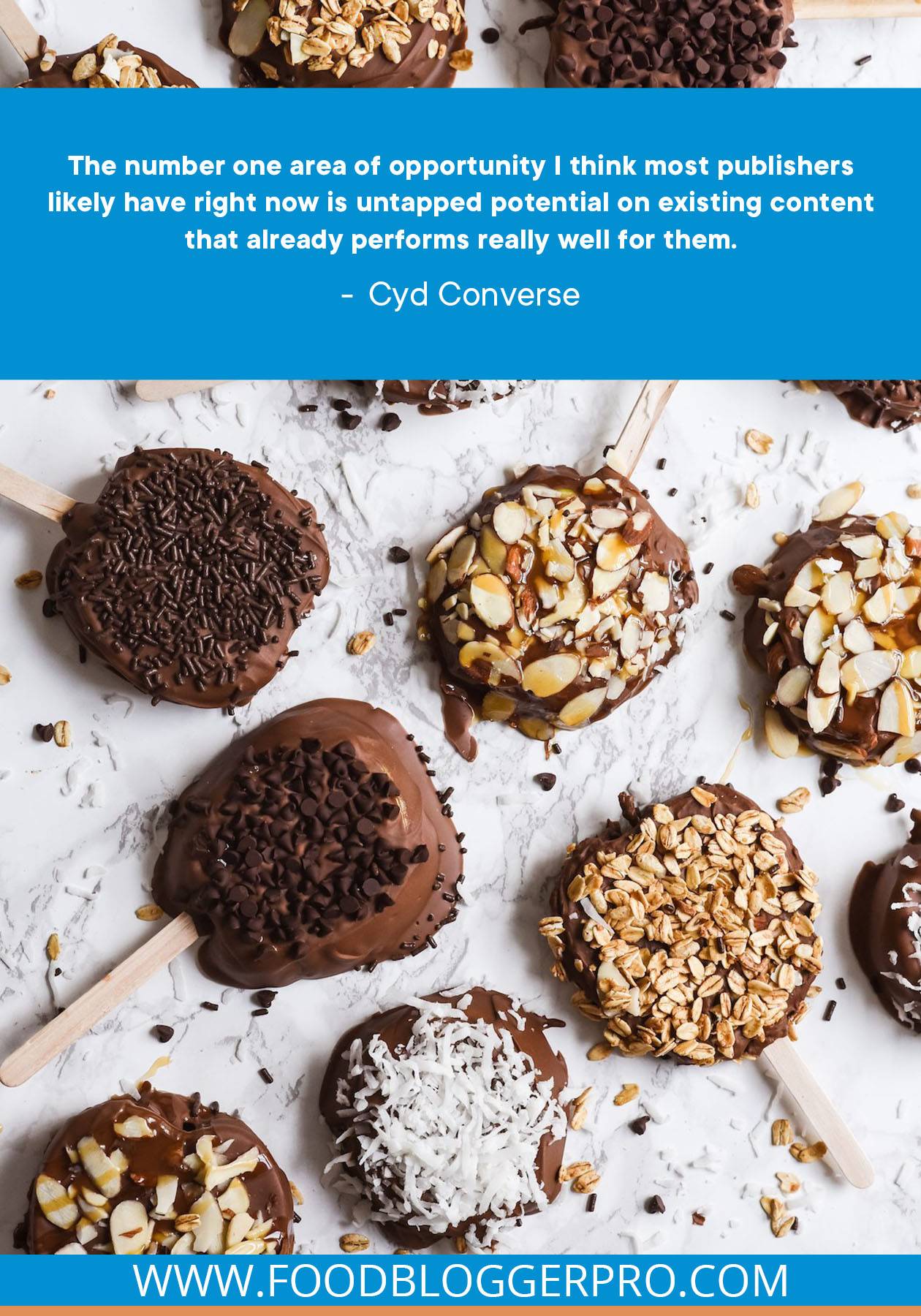
Cyd Converse: I think the number one area of opportunity I think most publishers likely have right now is untapped potential on existing content that already performs really well for them. I think it’s less about having to have a recipe a day for some sites, depending on the size of your site and the goals, maybe it’s not even a recipe a week. Obviously you still want to be creating new content. You still want to be sending those signals that the site is active and full and fresh to borrow a retail term. But I think there’s a lot that you can do to make sure that you’re maximizing the content that you have. I think one of the things I’ve been kind of preaching a bit lately is making sure that if you have video that you’ve created, if you create video, if you created video in the past to make sure that you’re leveraging video everywhere that you can, including on your site.
Cyd Converse: I’m sure that other ad partners do as well, but Mediavine, we didn’t used to because it wasn’t a thing. But as of last year, or I don’t remember exactly when it was, but we now support vertical video. It’s not that vertical video necessarily converts at a higher CPM, but what it does do is it allows you to repurpose content you likely already made. So back in the day we used to make horizontal video that we wanted to embed on a page. Maybe you were trying to have a YouTube, then everything turned to vertical video, and I think we stopped thinking that your site was a place where you could put video, but that’s very much the case. So we think thinking about what resources you already have in your content library that maybe you haven’t leveraged in a while, re-promoting those, thinking about seasonality, get your email list going, be promoting those old posts and just thinking about how you can get more eyes on the content that you already have that performs really well and using that as part of your process.
Cyd Converse: So when you’re thinking about what new content to create, also be thinking about the older content that’s already doing really well for you because for most of us, it’s like 10 posts probably make you the majority of your money, maybe a handful more depending on how seasonality plays in there. And just really making sure that those posts are in great shape and that you’ve optimized them in every way you can and that you’re re-promoting them at every opportunity to do so that makes sense. When we used to think about an Instagram feed, which I think for a lot of us was one of the first social media platforms that garnered us a lot of success, we would think about this idea of a grid, this perfectly manicured grid. And I think we sort of had this mental block where it felt like if you put it out there once, you weren’t supposed to speak about it again because it was old and it was done.
Cyd Converse: And the reality is a post could be 10 years old on your site and it is a brand new piece of content. That is a brand new recipe to somebody who’s never seen it before.
Bjork Ostrom: To most people, 99% of the people who are aware of you.
Cyd Converse: Yeah. 100%. So thinking about how you can get more eyes to that content that’s already performing well. So if you’re a monetized site, sure, go look at the posts that are getting the most traffic, but look at the site that are the posts that are making you the most money and see what you can do to get even more eyes there. And I think that’s an interesting balance where we no longer have to think about churning and churning and churning out the content, but balance it with letting the content that you have be an earning opportunity for you.
Bjork Ostrom: I think that’s an important point and a distinction that’s worth calling out, which is you might have a post that is the highest traffic post for you. And so net dollar amount, it might be making you the most, but what you talked about is the post that is earning you the most. And I think by that you meant highest RPM. And so it might not have the highest traffic, but it is working the hardest for every visit that comes to you. And I think that’s an important distinction because one page might be earning half of what another page could be. And I think for some people it’s like, oh, there’s a dashboard and you can see that. But can you talk about the why behind that? Help people understand what’s happening where you have at a high level, one page might be earning X dollar amount, I’ll just make up numbers, $50 RPM, but then another one is a $80 RPM.
Bjork Ostrom: What’s happening there that’s causing one page to outperform from an earnings perspective, if you can speak to that at a high level?
Cyd Converse: At a high level, there’s a lot of variables. So a lot of it is going to go back to where’s the traffic coming from? What is the seasonality and who the advertisers are that are showing up on the page? So unfortunately, there’s no great formula for why does one page make more than another? A lot of it is just really going to come down to the audience. Who are the readers that are showing up and engaging with that piece of content? Where are they coming from? And seasonality has a huge hand in it. So interestingly, typically my top performing posts, I actually talked about this when I was presenting at Tastemaker yesterday, Virtual Tastemaker, but my top performing post on my site is a bacon recipe and I don’t eat bacon because I don’t eat meat. And I’m very forthcoming at the very beginning of
Bjork Ostrom: This
Cyd Converse: Post. Why is the vegetarian giving you a bacon recipe? Well, because I live with boys who like bacon and
Bjork Ostrom: Who
Cyd Converse: Make this all the time. So it’s hilarious because it’s absolutely the post that historically I’ve made the most money on. And so most times of the year, that is the post that I’m making the most money on. It’s just got great traffic. It continues to.
Bjork Ostrom: And
Cyd Converse: Q4, that tends to be different. It still tends to be in my top five or six, but it tends to shift quite a bit. And so seasonality has a huge, huge hand in it too. But a lot of it is where’s the traffic coming from? Who’s landing on the page and what are the advertisers targeting? And it’s just very different site to site and
Bjork Ostrom: Content
Cyd Converse: To content.
Bjork Ostrom: For people who haven’t explored that area of their advertising dashboard, it’s a good place to look into. Even for myself, this was maybe five or six years ago now. I was at a conference and somebody was like, “And for us, we earn a lot more from Pinterest.” And I was like, “Oh, I’ve never thought of that.” And I went and looked and I was like, “Oh yeah, Pinterest, for whatever reason, maybe it’s like people who are coming there have more of a buyer mindset, and so therefore you earn more for traffic from Pinterest.” And so it’s a good thing to understand because I think that, again, it will allow you to nudge and shift priorities to think about how you’re promoting content, what content you’re promoting, even to think about what piece of content am I going to go and refresh and update? If you’re not churning out new content, how do you make a decision on what to update?
Bjork Ostrom: That would be a great place to look for that. Yeah. Absolutely agree.
Cyd Converse: Yeah, I was just going to say I completely agree. And I think on the Pinterest thing, just one note that I think that again, it’s where’s the traffic coming from and it’s what is their intention? For a food site, I think specifically, Pinterest is certainly not what it was 15 years ago. It also has shifted and changed, but folks are still using Pinterest very regularly to seek out recipe content. And so when they’re referring through Pinterest to your site, there’s an intentionality behind that that I think advertisers see, and that is part of why for many sites that those referrals can convert higher.
Bjork Ostrom: Yeah. It’d be impossible to do, but I would love to run an A/B test of zero AI content on Pinterest versus today just to see would Pinterest be the same as it was five, 10 years ago? How much of it has to do… It feels like the majority of it has to do with just the amount of AI slots that exists on there.
Cyd Converse: I was on Pinterest when it was invite only beta.
Bjork Ostrom: And
Cyd Converse: At one point, I think at my peak, my site was pulling around a million page views a month, and so much of that traffic was coming from Pinterest.
Bjork Ostrom: Pinterest, yeah.
Cyd Converse: So I certainly do miss –
Bjork Ostrom: The good old days.
Cyd Converse: Pinterest. They were a lot of fun. You could post a new post, you could publish a pin in the morning, and by noon have a hundred thousand page views on a brand new post. And it was a fun ride, and I’m happy that I had the chance to ride that wave while it lasted.
Bjork Ostrom: It’s just another great example of the fact that things change in the industry, and the only way to continue doing what we’re doing is to pivot and shift along the way, which is why I think this conversation is such a good one. What would your encouragement be to people who are maybe… We talked about thriving, what does that look like, the people who are having success? What would your advice be to people who feels like they’re in the grind? They’re maybe feeling burnout, maybe feeling like they’re working harder than they’ve ever worked and maybe getting less results. What’s your advice to that creator as we close out our conversation today?
Cyd Converse: My advice is get in the kitchen, specific to food bloggers, have fun again, spend some time exploring, go try a new restaurant, get out of your head a little bit, and try to reconnect with that thing that brought you joy. I have a lot of fun styling photos, and then sometimes my kitchen is trashed and I’m stressed out about the whole thing, but I find great joy in the crafting of the images and trying new things and testing things out on my neighbors. So I would say just try to have fun with it again and reconnect with that thing that brought you joy that is going to translate through your work. And I personally always get really, really fired up and get a lot of energy from being in a room with other publishers. So if you have the opportunity virtually, if need be, I know it’s not always accessible for folks to travel, but if you have the opportunity to go to a conference or a retreat or meet up with people in person, if you live in a city where you can meet up with other folks once a month for lunch or a coffee date, I think, again, back to the idea that most of us don’t have coworkers in our house if we’re doing this in our kitchen in Minnesota or our kitchen in upstate New York.
Bjork Ostrom: And so
Cyd Converse: Getting with other people and sharing energy and encouragement and ideas and rooting back into that community, which is what food blogging and lifestyle blogging has always been so incredible for, I think that will hopefully give you the energy boost you need to keep pushing.
Bjork Ostrom: Love that. Cyd, I’m so glad that you have this position. I feel like advocating for publishers is such a wonderful thing, and even just giving publishers and creators a channel to talk about things and to process things is so great and so needed. So if people want to connect with you, get ahold of you, you have your site, but obviously within the context of Mediavine as well, what’s the best way to do that?
Cyd Converse: You can email me cyd at mediavine dot com, which is just C-Y-D at mediavine. And I would really love to hear from you. I’d love to know what’s going on in your world and what you’re trying and what’s working, and it would be my pleasure to hear from you.
Bjork Ostrom: Awesome. Thanks so much for coming on.
Cyd Converse: Thanks, Bjork.
Emily Walker: Hey there, this is Emily. Thank you so much for listening to that episode of the Food Blogger Pro Podcast. If you enjoyed the episode, please take a moment to leave a rating or review or share the episode with your community. Since we are kicking off a brand new month, I wanted to pop in and let you know what you can expect in the Food Blogger Pro membership this month. If you didn’t already know, we have a membership site where we offer hundreds of courses, a member forum, monthly live Q&As, monthly coaching calls with members, lots of tools and deals and discounts just for Food Blogger Pro members. We would love to have you join us. You can head to foodbloggerpro.com/membership to learn more and sign up. This October, we kicked off the month with a new coaching call that we released on Thursday, October 1st.
In this coaching call, Bjork sits down with Rachel Davis, the creator of our handcrafted home, to talk through growing her two-year-old food blog centered on from scratch cooking, baking and sourdough. Next up on Thursday, October 15th, we will be releasing a brand new course all about how to turn one recipe into content for every platform. I think this will be a really useful, actionable course for lots of our members. We hope you’ll get a ton out of it. Last up, on Wednesday, October 21st, we are hosting a live Q&A, all about brand deals and getting paid what you’re worth. This Q&A will be with the wonderful Sam Adler from Frosting and Fettuccine. That’s it for this month. It’s going to be a really great one. If you are already a Food Blogger Pro member, we will see you in the membership, and if not, we hope you’ll join us.
We’ll see you back here next week for another podcast interview. Bjork will be chatting with Aaron from The Forked Spoon. Have a great week.