
Listen to this episode of The Food Blogger Pro Podcast using the player above or check it out on Apple Podcasts or Spotify.
This episode is sponsored by Clariti.
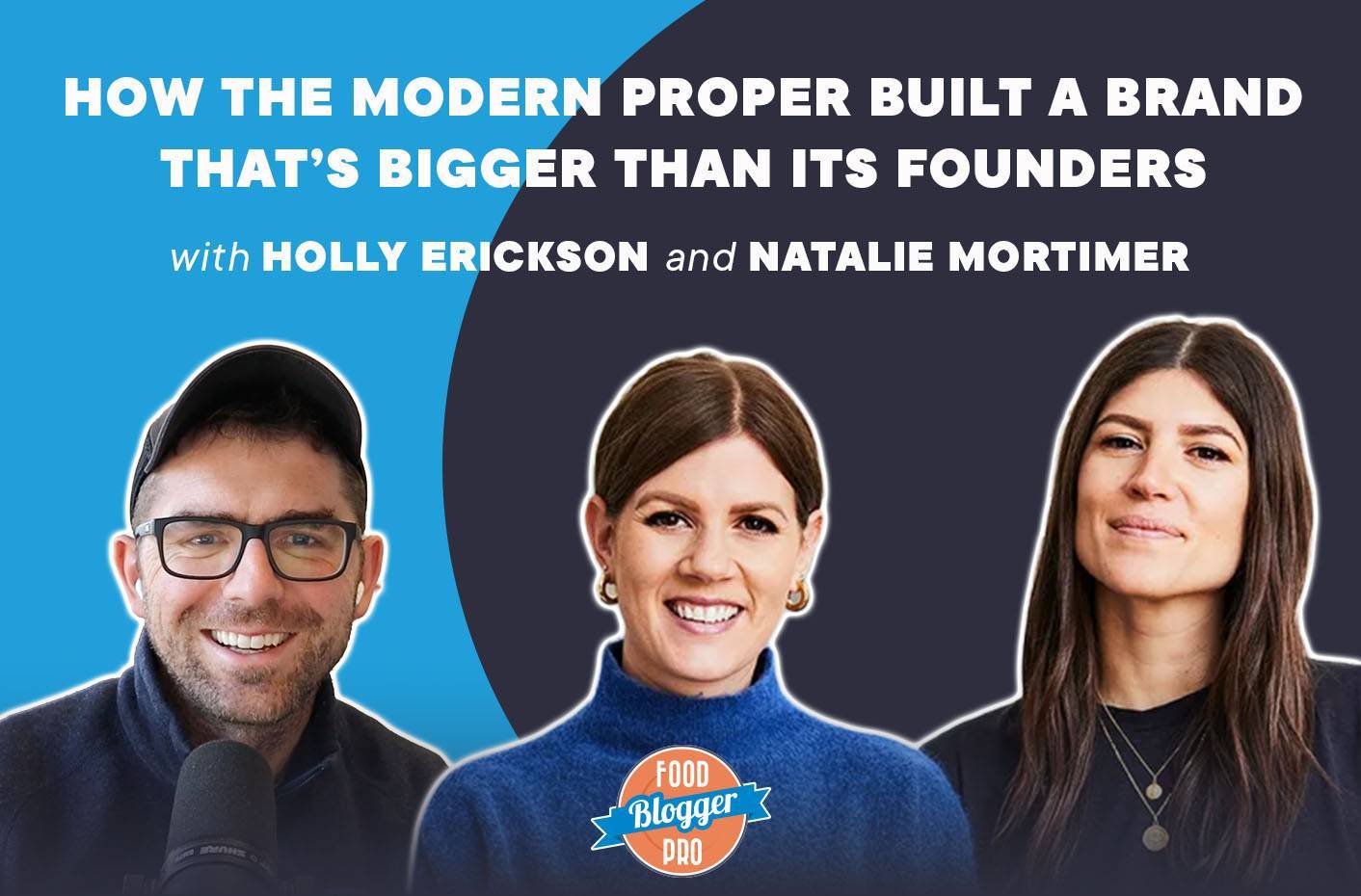
Welcome to episode 595 of The Food Blogger Pro Podcast! This week on the podcast, Bjork interviews Holly Erickson and Natalie Mortimer from The Modern Proper.
Last week on the podcast, Bjork chatted with Emily Christensen. To go back and listen to that episode, click here.
How The Modern Proper Built a Brand That’s Bigger Than Its Founders
Holly Erickson and Natalie Mortimer started out with their own food blogs and a catering business they ran together. In 2013, they teamed up to launch The Modern Proper, partly to keep each other accountable and consistent. When Instagram took off for them in 2016, the brand really started to grow. Today, they run a business with a team that includes a writer, a project manager, a photographer, and a recipe developer.
In this interview, Holly and Natalie share what they’ve learned from working as business partners for over a decade, why their first hire was a writer, and what it’s like working with an executive strategy consultant. They also talk about letting go of some of the mental load, how they deal with negative comments, and why they launched Weeknight Dinner Club on Substack, which has grown to 90,000 subscribers. This is a great listen for anyone thinking about a brand beyond their blog, or looking for a new way for readers to find them.

Three episode takeaways:
- Why they built a new discovery path on Substack — Holly and Natalie launched Weeknight Dinner Club, a Substack that sits alongside The Modern Proper brand, so they could share more creative recipes that aren’t driven by keywords. They talk about how their voice and recipes differ on Substack, how the newsletter is evolving, what growth has looked like as it reached 90,000 subscribers, how social media turns followers into subscribers, and why getting people to upgrade to paid is so hard.
- How a distinct brand voice gives you freedom to grow — By defining The Modern Proper’s voice and brand clearly, Holly and Natalie have been able to hire people who create content that still sounds like them. That has helped them let go of some of the mental load that comes with running the business.
- What it’s like working with an executive strategy consultant — They explain why they brought on a consultant, how that person helps them choose the right KPIs to focus on, and how they get support with work-life balance as two business partners.
Resources:
- The Modern Proper
- Well Plated
- The Modern Proper Cookbook: Simple Dinners for Every Day
- Register for our free Instagram Strategy Q&A on November 19th!
- Follow Holly and Natalie on Instagram and Substack
- Join the Food Blogger Pro Podcast Facebook Group
Thank you to our sponsors!
This episode is sponsored by Clariti.
Clariti is a content organization and optimization platform that helps you uncover SEO insights and monitor performance improvements by analyzing your WordPress and Google data in real-time — so you can audit your content, understand performance, and see real opportunities instead of guessing.
And it doesn’t stop at insights. Clariti helps you turn what you’re learning into actual projects and tasks — so you can go from analysis to action and actually get stuff done.
Go to clariti.com to learn more.
And, if you’re a Mediavine publisher, Clariti has a dedicated partnership just for you. Just go to clariti.com/mediavine to see what’s included.
Interested in working with us too? Learn more about our sponsorship opportunities and how to get started here.
If you have any comments, questions, or suggestions for interviews, be sure to email them to [email protected].
Transcript (click to expand):
Disclaimer: this transcript was generated using AI.
Bjork Ostrom: If you’ve ever opened Google Analytics or Google Search Console and then just looked at it for a little bit and closed the tab because it felt overwhelming, this is for you. And here’s the thing, it’s not just analytics or search console, it’s also WordPress. Maybe you’re trying to find a post quickly, understand how it’s performing. And after a while, you’re jumping from tab to tab, trying to piece together information about how your content is doing. It really is one of the hardest parts about growing a content business. It’s getting clarity. It’s not always necessarily effort, it’s just knowing what you should do next because your data is scattered, your priorities are getting fuzzy, and you’re staying busy, but you’re not confident that you’re working on the right things. That’s why we created Clariti. It’s C-L-A-R-I-T-I. Clariti is a content organization and optimization platform that pulls all that messy data into one clear place so you can audit your content, understand performance, and see real opportunities instead of just guessing.
And it doesn’t stop at just insights. Clariti helps you turn what you’re learning into actual projects and tasks. So you can go from analysis to action and actually get stuff done. It’s not about quick wins or hacks, it’s about building a calmer, more sustainable system so you can grow with clarity and confidence. Go to C-L-A-R-I-T-I to learn more. And if you’re a Mediavine publisher, Clariti has a dedicated partnership just for you. Just go to clariti.com/mediavine to see what’s included.
Emily Walker: Hey there, this is Emily and you are listening to the Food Blogger Pro Podcast. This week on the podcast, we are welcoming Holly Erickson and Natalie Mortimer from The Modern Proper. Holly and Natalie started out with their own food blogs and a catering business they ran together. In 2013, they teamed up to launch The Modern Proper, partly to keep each other accountable and consistent. When Instagram took off for them in 2016, the brand really started to grow. Today, they run a business with a team that includes a writer, a project manager, a photographer, and a recipe developer. In this interview, they share what they’ve learned from working as business partners for over a decade, why their first hire was a writer, and what it’s like working with an executive strategy consultant. They also talk about letting go of some of the mental load, how they deal with negative comments, and why they launched Weeknight Dinner Club on Substack, which has grown to 90,000 subscribers.
This is a really great listen for anyone who’s thinking about a brand beyond their blog or looking for a new way for readers to discover them. Without further ado, I’ll just let Bjork take it away.
Bjork Ostrom: Holly, Natalie, welcome to the podcast.
Natalie Mortimer: Hi, thanks for having us. Yeah, excited to be here.
Bjork Ostrom: We’re going to be talking about your journey of building a brand, and it coincides with something that we’ve heard a lot of people talk about in the era of AI, which is this idea of it’s important not just to build content, it’s important not just to search for keywords, it’s important to build a brand. And I’m excited to hear from the two of you around the mindset that you took with not only building a brand, but building a business. But before we get there, I want to hear about how you started. My guess is that it was maybe a little bit different than the usual story that we hear, which is somebody who just was excited about maybe publishing content here and there, and they got together and started doing that, but maybe that’s what it was. But my guess is that as you started this, there’s maybe a little bit more intention behind it and thinking about how do we build this into a thing even when you first got started.
Bjork Ostrom: Is that a correct assessment, Holly, or am I off on that?
Holly Erickson: Yes, that is correct. When Natalie and I first started, we both had separate blogs and we were both sharing on them sort of infrequently at the time just as a hobby. And I had moved back into town. We were doing a lot of catering together at different events. And yeah, I think our intention was always to grow something and earn money from it, and we decided to do it together.
Bjork Ostrom: What were the blogs that you were working on before that point? Was it food related, it sounds like, and then you were also doing catering. Was that kind of the world that you lived in or was it different?
Holly Erickson: Yeah, I was using mine more as when we did our catering stuff, if people asked for a recipe, then I would share on that. And then Natalie’s was more creative, coming up with recipes, hosting and stuff like that.
Bjork Ostrom: Yeah. So in this general category of hospitality, food, and so I can see how from that the modern proper evolved, what did those early conversations look like? Because I know a lot of people think they want to have a partnership. They’re like, “Hey, let’s work on this together.” But then as soon as you get into it, you very quickly realize there’s different ideas for vision, there’s different ideas for business structure, there’s different ideas for how things should be published. So Natalie, can you talk about some of those early conversations around how you came together to form a shared vision for the site?
Natalie Mortimer: Yeah, that was definitely an evolution over the first few years, but the initial idea, Holly and I have kids that are right around the same age. We were doing life together. We both shared a passion for hosting. We were doing the mom group, the mom meetups, and also looking for a little bit of a side hustle. So we had talked about our individual blogs that neither of us were consistently tending to, as Holly mentioned, very infrequently posting. And we’re like, “If we did this together, then there would be accountability for consistency despite our busy lives and despite raising kids.” So my husband who works in development said he would put together a blog for us if we came up with our first 10 recipes or our first 10 posts. And at the time we thought we would sprinkle in a little bit of crafts, a little bit of lifestyles, parties, which full circle, that’s all anyone wants to see now is parties and people gathering.
Natalie Mortimer: So we were a little all over the map, I would say maybe the first two years and try to post as consistently as we can. I had a baby in that first two years and then a few years later Holly had one, but by then we were a little bit more established in our routine. So moved houses a couple times that paused things and then we got nominated for a Saver Blog award under the category of weeknight dinners.
Holly Erickson: Most inspired weeknight dinners. I just looked.
Bjork Ostrom: Yeah, there you go.
Natalie Mortimer: Most inspired weeknight dinners.
Bjork Ostrom: What was that again? What was that thing that we were –
Natalie Mortimer: Similar Blog Awards. What was that?
Bjork Ostrom: No, just it’s funny that you had to go back and remember what it was that you were nominated for. Like you had to go up and look back what the award was that you achieved.
Natalie Mortimer: What year was that?
Holly Erickson: 2016.
Natalie Mortimer: 2016. And we had started in 2013. So then in 2016 we got nominated for that award. Our Instagram had started to take off. We were one of the very early food personalities in Instagram, so I’m assuming that’s probably where we got the recognition from. And we were like, “Oh wow, okay. People don’t want long, elaborate –
Holly Erickson: Bolded paper hearts.
Natalie Mortimer: Snow meals or paper hearts. Yeah. They don’t want crafts. They don’t want to hear about our trip to the peach farm with our children. They just want weeknight dinners.“ So we flipped the narrative and we’re like, ”Let’s just see where we can take this.” And we honed in on that. And then it has been a slow evolution since then of how we define that, the things that we offer. At first, we though we would just provide just meals and dinners and we realized the questions came up like what kind of salad dressing should I put with this? So we’re like, okay, we need some basic stuff too. So we went not just weeknight dinners, but all food for Monday to Friday and the weekends and holidays.
Bjork Ostrom: So I think people who are listening who have ever attempted to do a partnership or in a partnership would realize this. It’s a hard thing to do. It’s hard to just build a blog and to build a brand and to build a business for a decade plus. It’s also hard to do in a partnership. Also, there are some great advantages from it. Lindsay and I, it’s a version of a partnership, but can you talk about the things that you’ve learned for anybody else who’s interested in potentially working with somebody else? And maybe Holly, you can speak to that a little bit. Along the way, what are some of the things you’ve put in place? What are some of the things that have been most helpful? Right now, I know that you guys are together and you’re in the same place, and my guess is that’s a helpful thing to do, to be able to connect, to be in the same place, to work on something.
Bjork Ostrom: What have you learned from a partnership perspective that’s been super helpful that has allowed you to continue to build this for a decade plus?
Holly Erickson: Well, I can think of a few things I’ve learned, but the initial thing that came to my mind is one of our first hires was a writer because in the beginning it was like Natalie was writing one post and I was writing another, and we just have such different styles of writing and we wanted the modern proper to be us together. So it was kind of like having this writer came up with she really became the voice of the modern proper and we were able to use her to tell our shared story. And then most recently, so that was our first hire and our most recent hire has been, she’s an executive
Natalie Mortimer: Strategy consultant.
Holly Erickson: And so it’s sort of like, not to go full circle right in the beginning of this conversation, but it’s like we’ve been doing this for 13 years together and it’s so fun to have a strategy person where it’s like Natalie can bounce something off and I can bounce something off and Natalie can say, “Hey, I’m going to take that on and I’m going to say I’m going to take that on.” And then we have this person who keeps us accountable because we’re really doing life together. And so sometimes over the 13 years we’ve been in business, it’s like we might have a conversation about something that’s great, but then it’s like, “Hey, you going to be at so-and-so’s house this weekend?” And then she’s been so great to help keep us on track. And so I think, I don’t know if that explains what I’ve learned, but it’s like in marriage, we jokingly call each other work wives often.
Holly Erickson: It’s like sometimes you just need a third person too to help you move forward with an idea or grow bigger or something.
Bjork Ostrom: Yeah, I can see that. I’ve never thought about that. I’ve never heard somebody talk about it, but I can see that being extremely beneficial in a work partnership like this where you have somebody who sits in the middle and you are all able to have this conversation around, “Here’s a vision that I have, here’s an idea that I have, here’s how I want my role to shift and adjust.” It’s one of the things Lindsay and I are constantly talking about is if it’s just you, then you make a decision and you shift your role. You work less, you work more, you launch a new thing, you launch something adjacent that takes time away from your main thing. All of these things, if it’s just you, you do it. You don’t have to mediate with somebody. For Lindsay and I, it’s like we have to have these conversations around Lindsay saying, “Hey, I’m in a season where our daughter can go to three-day kindergarten.
Bjork Ostrom: Maybe I just take two days and I’m with her during the week and then work on at nights a little bit more.” And so there’s a little bit more of us having a shared vision. I would imagine in your position, it’s nice to have somebody who sits in between and helps you navigate those conversations. What is that person’s role on your team? What is the name? Does the role have a name?
Natalie Mortimer: It
Holly Erickson: Doesn’t
Natalie Mortimer: Have a
Holly Erickson: Name.
Natalie Mortimer: Strategic advisor, when we first brought her on, it was a year ago, roughly a year ago, we were meeting with her. We were doing a 90-minute call a week, and then we got to a place where like, okay, two weeks. And then over the summer we just did monthly and we’ve just been monthly. We just met with her this week and potentially we’re taking on some new concepts and some new ideas that not ready to share yet because we don’t know if they’re going to go out in the world. But we definitely talked about bringing her on in a higher capacity to help us define and establish our roles within that new concept. And I do think it is really beneficial. Like Holly said, we’re work wives. We’re also just really good friends. And I think our kids are all really good friends. Our kids are at each other’s houses doing sleepovers and birthday parties and have mixed groups.
Natalie Mortimer: We share a huge community of friends together. I think that’s probably unique in partnerships. So if Holly has something going on that I know from the outside, yeah, she should have breathing room. I’m not holding her to this standard of work comes first. And Holly and I both agree that family always comes before work. And we got into this because we wanted to provide more for our family. What a waste it would be if this job pulled us away from our family. And we want to be good moms. We want to be present parents. We want to be good friends. We want to be an active part in our community and overworking or expecting too much of the other person takes away from our personal vision.
Bjork Ostrom: Yeah. It’s like our businesses can serve us. We can also serve our businesses. And sometimes when you cross over, it’s a thin line and sometimes you need to serve your business in order for it to serve you. And when you have two people in different life situations, it becomes increasingly complex to navigate that. What a cool thing to have that person. I’ve had a business coach before for a season. It was helpful. I can imagine even more helpful in your situation. And I would imagine for other people listening, it would be a good thing as well. Can you talk about what that process was like in finding somebody? And I would imagine it would have to be somebody who’s a good fit.
Natalie Mortimer: I mean, Holly, yes. She kind of found us.
Bjork Ostrom: Sure.
Natalie Mortimer: It was…
Holly Erickson: Can we name drop on this phone call?
Bjork Ostrom: If you’re okay with it, that would be great. Yeah.
Holly Erickson: Our friend Erin Clark from Well Played In, we had had lots of conversations with her about looking for this person and sort of what we wanted this role to be. And she was like, “I have a fantastic lady.” She’s never worked with food website bloggers before, but because she has such a close relationship with Erin, she’s like on our first call, we were like, “Oh, she knows. She knows. She hears stories. She knows what goes on behind the scenes.” So we have found her to be such
Bjork Ostrom: A great
Holly Erickson: Fit
Bjork Ostrom: And
Holly Erickson: Would definitely recommend if you’re in a partnership or just on this point. And she just really helps keep the strategic juices flowing or whatever.
Bjork Ostrom: Yeah. Can you share some examples of what that looks like? So you get on a call, it’s 90 minutes, you’re talking about things. What are some of the… Whether it’s partnership, but also I think to your point, sometimes there are people who either are in a marriage relationship and their spouse, albeit loving, kind, gracious, probably doesn’t get it, probably doesn’t understand. So I think that’s one situation. Or somebody who’s not in a marriage relationship or dating relationship, and so you really are on your own or you have a partnership and you’re trying to navigate things. All of those situations would be a great candidate to work with somebody who can come alongside you and not only listen, but then be strategic, give advice. I think of my friend Barrett Brooks, who does a lot of creator coaching. He’s worked with some food creators and I know he talks or the people he works with, I had conversations with some of them, talk about, “Man, for the first time I took a vacation for 10 days and I didn’t check my phone for my work phone.” Things like that that are really important.
Bjork Ostrom: Can you talk about some of the breakthroughs that you’ve had by having some of those conversations?
Natalie Mortimer: Yeah. Yeah. She does a really good job at setting up… Well, two things that come to mind is she does a great job of helping us choose KPIs. And I think sometimes when you’re either working on your own or you’re in a partnership, you can have ideas for days, but what she’s good at is listening to Holly and I ideate, come up with our best ideas, let us just talk.
Bjork Ostrom: Yeah, which is so helpful.
Natalie Mortimer: Takes notes. It’s also nice to have someone that takes notes when you are ideating and then condense all those and stop you and say, “Okay, I just want to stop you right there. Let’s sit with that idea for a minute.” So she does a lot of that. “This seems like a really good idea. I can see your body language change. You seem very excited about that. Holly, what’s your opinion on that? ”We can bounce back and forth and kind of get in the weeds. Is this a good idea? Is this something we should run with? And then from there, she helps us set those KPIs. Hey, by the next time –
Bjork Ostrom: Can you talk about for those who aren’t familiar with KPI, what that is?
Natalie Mortimer: Key performance indicator.
Bjork Ostrom: Yeah.
Natalie Mortimer: So
Bjork Ostrom: The example being…
Natalie Mortimer: The benchmarks of,“ Yeah, it was a great idea. What are you going to do with it? And how do we define whether that was a good use of your time or not? ”So she helps us create like,“ Great, you want to start sending out this type of newsletter. We’re going to let this idea die if it doesn’t hit this benchmark. What’s that benchmark? ”And she forces us to create what’s a good benchmark for that? She takes notes and then reminds us like,” Hey, next time we meet, this is the performance goal I want to see.
Bjork Ostrom: “So a KPI could be something like,” Hey, we want to send out two newsletters a week. If somebody’s not sending out newsletters ever, we want to track something and this is going to be the indicator of if it’s successful or not. “It could also be downstream technically, so it could be like we want to get to a hundred thousand people who are visiting the site based on the newsletters we’re sending. In your work with KPIs, what have you found to be most helpful for other people listening to point to and say,” Here are the ways that we’ve used KPIs in a way that, number one, helps the business grow, and maybe number two, doesn’t feel like an additional burden that then we have to be subservient to within the business of like, oh, I have to do this KPI that I committed to that it actually maybe creates more freedom or more growth, whatever it might be.
Bjork Ostrom: So what have you learned about KPIs specifically that has been helpful that other people might be able to learn from?
Holly Erickson: Well, we hired her literally the same month that we got our Substack up and running. Basically this time last year we were doing both. We had sort of built out the Substack and we were ready for it to go and we had her. So she has really helped us keep track of where we though we would be, where we are now, what we can do better, sort of jogging our memory, but also giving us lots of ideas on how maybe we could shift gears when we didn’t think. And then some things just in those conversations come up that it’s like, “Whoa, that’s such a great idea. Let’s put that into play.” So besides looking back at her notes, I don’t think that we’re strategically keeping track of any specific KPI or any sort of indicator like that, but it’s just each twice a month or monthly we’re meeting with her and we’re sort of going over like, “Okay, last call, this is where you guys were at and let me know where you guys are at, whether it’s RPMs, whether it’s just…”
Natalie Mortimer: Did you have that meeting you wanted to have with your ad representative and how did that conversation go? And it’s good to stay on top. We’re ideating, these ideas are coming to us. They obviously are important to the growth of our business. She’s there to say, “So what are you doing about it? Let’s have five goals.” And then working backwards, our oldest kids are 16 now and we’ve got two and a half years, maybe a little bit more with our kids in our house. We want to save her that time. And so a conversation that comes up with her often is how little can we work? So she’s helping us slowly step away and watching the numbers stay the same, which –
Holly Erickson: And build the team. She’s helped us through
Natalie Mortimer: A few
Holly Erickson: Hires.
Natalie Mortimer: Yeah. She’s heard us talk about, okay, if this is the fourth conversation I’ve heard you talk about this pain point, what are we doing about it? You need to send out a call and I want you to interview five people in the next two months for this.
Bjork Ostrom: Yeah,
Natalie Mortimer: That’s great. And just see what happens and explore that. And she just gives us the little nudge we need to make some of those decisions. And I think sometimes, I think when you own your own business, there’s a guilt that comes with not working as hard as possible. And I think she’s really given both of us permission to say, “Hey, let’s look at the numbers. Nothing’s changing. It’s okay to step back a little. It’s okay to hire someone to do that and not have as much control when your family is your number one priority.”
Bjork Ostrom: Number one. Yeah, the number one.
Holly Erickson: Or she’ll see that something’s so streamlined in our business that she’s like, “Okay, it’s time to hand that off to somebody else.”
Bjork Ostrom: What do you mean by streamlined?
Holly Erickson: Okay, most recently, our admin gal, well, I don’t even know. She’s more than an admin gal, but she will build out a bunch of stuff for us in Google Docs or Asana or whatever we end up using. She most recently took over Substack and putting those together because she puts together the back end of our blog posts on our website. And so that was something that’s like, I think MC really was like, “I think this is something that you can… Oh, you’re still up throwing this together the night before it’s going live? You can give this to somebody else.” Or really encouraging us to hire for different recipe development for some of the more basic recipes or that was such a hard one to give up. And now we have someone on our team that’s doing four recipes a month, and we’re still in the coaching, figuring out how it’s going to work with us, but it’s like we’ve switched roles so often and taken on different things, whether it’s photography or social or recipe development.
Holly Erickson: And so it feels like it’s like, “Oh, I can give this up. It might stretch me a little in the like, ooh, I’m so nervous to give that piece of our business up.” But she has just been really like, “If you’re going to grow, continue to grow, it’s like you need to not be the one who’s doing all of the work.”
Bjork Ostrom: Yeah, unless you never want to be with your family or be working all the time. You could, that would be an option, but it’s not for most people in most seasons of life, not the most desirable. It sounds like within that role, and to put a bow on that conversation, which I think is an important one, that it’s somebody that not only listens, that hears, but also nudges and says, “Okay, so what? You have this idea, what does that mean? Where are you going to go with it? Hey, I’ve heard you say this five times. Is it time that we just let this die because nothing has happened with it? Or is it time that we actually put some numbers behind it, which I can check in with you on? What an important role. So a good takeaway for anybody who feels like maybe they’re kind of stuck in that way or wants to have somebody to help unlock growth potential, whatever it might be, such an important role.
Bjork Ostrom: I want to talk more about the team, knowing that that’s been an important part of how you’ve been able to buy back some of your time. I saw in the notes as we were filling out notes for the podcast interview, you used that phrase, which is such a great phrase, when your business gets to the point where you have some income that you can invest back into it, one of the things you can buy is time back to yourself.
Bjork Ostrom: And the thought that I often have is I have my business and we’re running our business and there’s a million other different businesses out in the world. Some of them are giant trillion dollar companies, some of them are smaller, they’re just kind of side hustles. All of those businesses can run without me, right? So all of those millions of businesses have capable people who are figuring it out whether they own it or whether they don’t own the business and they’re growing that business and that business is successful, and it doesn’t need me to be a part of those. That same mindset could be applied to what I’m doing as long as I’m willing to give up some of the things that I’m holding tightly to within the business, and it could just become another one of those businesses that exists within the world that doesn’t need me.
Bjork Ostrom: But that’s a hard transition to make for many different reasons. Number one, because a lot of it is personality driven in the type of work that we do, but I want to hear what you’ve learned along the way as you started to release some of the day-to-day responsibilities that you’ve taken on in order to buy back your time. What did that look like when you first started to have those conversations around buying back your time? And maybe Natalie, you can start.
Natalie Mortimer: We’re still looking for one role that’s going to hopefully really buy back a lot of my time, but maybe Holly is the better one to answer this. But I mean, we’ve slowly found people… Our writer has a writing for us. If she’s listening to this, she’ll be sad if I get this date wrong, but I think it’s at least eight years, maybe more.
Holly Erickson: We had a short period without her, but then she came back to us.
Natalie Mortimer: Yeah, I think we had 10 months or a year without her, and we used kind of a collaboration of several writers in that time, and it was a lot of editing, and then she came back and was like…
Bjork Ostrom: Welcome back. Yeah.
Natalie Mortimer: I really enjoyed this job, so I’m really –
Bjork Ostrom: Wonderful writer.
Holly Erickson: She’s taking on so much more than writing these last few years with SEO and some different discover posts.
Natalie Mortimer: And she knows our voice, she knows the backend, she knows the industry. She writes, she has a degree in food writing, so she understands the heart of it and the research, the element, the culture piece of it, the storytelling. So that was our first hire. That a huge relief for Holly and I because neither of us… We liked having a voice, but neither of us enjoyed writing. And then once we brought her in, we brought in our gal, Teresa, who, I would say she’s our project manager, so she sets the due dates for everyone. She takes the concept and fills out the chart for all the due dates for everything that needs to get done in order to push that live, that recipe live. And then the biggest creative one for me to let go was letting go of the photography. I remember just coming to Holly and being like, “I just don’t think I can do…
Natalie Mortimer: I’m not enjoying it at all anymore, and I just want to let it go.” And I found this gal that I think would be a good fit. We had tried two other photographers that were not a good fit. I reached out to her, had a phone call. It was great. I think she’s been photographing for us for five years now, Gail, who is our photographer now. And that was just to put away the photography equipment and feel like I never had to pull it out again.
Bjork Ostrom: Did you like it at one point?
Natalie Mortimer: Huh?
Bjork Ostrom: Did you like it at one point? Yeah.You enjoyed it at one point and then it got to the point where you didn’t enjoy it?
Natalie Mortimer: Yeah. I think it was as our business grew and I felt like I was torn between clearing out our inbox, answering potential partnership, having conversations, trying to strategize our next move, and being in the kitchen and taking photographs and in light room, it felt like I was doing too many… The variety of my job became too stressful.
Bjork Ostrom: Yeah. And I think it’s an important point because I’ve been thinking about this even with how I relate to the work that I’m doing, which is that as our life changes and as the business changes, we need to let go of some of the things we previously maybe enjoyed and to be okay saying, “I used to enjoy this, now I don’t. I’m not going to try and push through it. I’m just going to pass it off or maybe not do it.” I think the three options are you just don’t do it, you have somebody else do it, or you have software or now AI do it or you do it, so it’s like four. So what does that look like? Photography?
Natalie Mortimer: Yeah, I wouldn’t ever take our photos.
Bjork Ostrom: Yeah. You are now confident that you’re not going to do that anymore. I think when you’ve been building business as long as you two have, you have multiple iterations like that. So I want to talk more about that, but any other roles that would be important to point out on the team that have been helpful? As you’ve grown?
Natalie Mortimer: We’ve had some important roles brought on this year that more contribute to her task.
Holly Erickson: Yeah. I never thought, like I said earlier, we’ve switched roles so many times. There’ve been times where Natalie’s taken on all of the social or all the photography and I’ve taken on all of the recipe development and maybe she’ll still… I think before we did the cookbook, because you were photographing all of the sponsored work, you were doing the sponsored recipes. There were times where we weren’t living in the same city, so that was a part of it too. But then once the cookbook came out, it was like we split that fifty fifty, divided it up. And then there have been times where Natalie would be like, “Okay, I’m feeling really inspired and I’m wanting to have ownership in the recipes again.” It’s like, okay, great, let’s shift, let’s do this. So because there’s two of us, I never really though that we would get to the point where we had a recipe developer on our team.
Holly Erickson: But as so many people know, it’s like a lot of us are playing this SEO game. It’s gotten tricky. Over the last few years we’re like, okay, with all these people on the team, it’s like the photographer touches a post, Natalie and I both touch posts. Theresa, our project manager, she’s touching the posts and it’s like you add up how much a piece of content costs to put out into the world and you’re like, okay, we’re spending about this much money to put this out on the blog on our website. And so it’s like in thinking about that, this was before we started the Substack, even this conversation was taking place. It’s like, okay, if we’re putting these creative, we’re doing so many sort of more SEO, maybe this is something that would fit well with us and we might be able to rank for it.
Holly Erickson: And then we’re like, we want to keep doing creative recipes. We want to just do the things that people aren’t going to be searching for. So then it’s like we’re putting those out and unless you are really promoting those all the time on socials, it’s like, who’s really going to find this? Because most people are just coming from Google to one specific blog post. They’re not coming and searching, I wonder what they’ve got going on this last month or whatever.
Bjork Ostrom: Direct traffic to your site and then searching for it. The discovery path for a site like yours would be Google primarily. And what you’re saying is in doing creative recipes that aren’t keyword forward, the question then is what’s the discovery path?
Holly Erickson: Yeah. But we know that that’s what we want to keep doing. We want to keep doing –
Bjork Ostrom: It’s the most inspiring work. Yeah.
Holly Erickson: Yeah. It’s the thing that we both –
Natalie Mortimer: It’s why we got into this.
Holly Erickson: Enjoy. So when we switched to Substack, it was like, okay, we’re going to do this many. We have so many creative recipes on our site already and we’re constantly revamping them a little bit and pulling some stuff to the front, just updating some stuff here and there seasonally or whatever. And some of our most beloved recipes that are on the site, they’ll stay on there. But when we decided to start a Substack, we’re like, okay, we’ll put our creative recipes over here. And some of them will be under a paid tier, but some of them will be free and this is what we’ll do. And so as we did that for the last year, we thought it really would be helpful for us if we hired somebody to do recipe development, but it’s really hard to hire sometimes. It’s lots of interviewing. And then it’s like with a role like recipe testing, it’s like, well, I want to taste this food.
Holly Erickson: So then they have to be local. Anyways, we put it out there thanks to our strategic advisor. She’s like, just put it out there. This is your job.
Bjork Ostrom: You’ll learn along the way. It might not be exactly what you want.
Holly Erickson: Yeah. Yeah. So there was a gal that we both knew who had catered some of our friends’ weddings. She had catered Natalie’s sister’s events. Natalie’s like, oh my gosh, I tasted this one recipe that she created and it was so good. And we’ve tasted her food and stuff. Her husband was a chef previously. Anyways, we were like, okay, let’s try this. And so far we’re like four recipes in that she’s developed, but it’s going really, really well. And she’s wanting to take on more work. I think we’re really excited to have her as a part of our team. And she’s taking on other things too. I used to field all the negative comments because the positive ones, our gal Teresa would answer a lot of those like, we’re so glad you love the recipe. Thanks for sharing this. And then she’ll send us some of the best ones like, oh my gosh, you guys, this is so sweet.
Holly Erickson: You have to read this one. But then I would field a lot of the negative ones because they’re based on, hey, this really didn’t work out for me or I didn’t love this. Is there a way to switch this up? And it’s like somebody who has the experience that she’s owned a catering company and she has a lot of experience in restaurants and she knows food so well, just as much as Natalie and I do. So she has been so helpful and we hope she’s with us for a long time.
Natalie Mortimer: A long time.
Holly Erickson: Yeah.
Natalie Mortimer: And I think when you bring someone on that is in a creative capacity, like a photographer or even a recipe developer and that, I don’t know, people listening to this is like, what, you have a recipe developer? And it’s like, well, Holly and I, we’re two people that have spent 13 years creating one voice. Our hope is that our voice and brand identity is clear enough that we can bring someone in to replicate that. It’s not just me. I’m not the modern popper. Holly’s not the modern proper. The modern popper is an entity.
Holly Erickson: And I left this part out, but Natalie and I are still doing the creative recipes. We’re still taking on the creative, the ones that are really creative and it’s like, oh, this is what I’m really cooking for my kids for dinner. And if it passes the best, then it’s going to go on Substack.
Bjork Ostrom: It’s one of the great freedoms that you get in developing a brand that has a brand voice. And the difference between there’s a spectrum and the spectrum would be personal brand, which would be maybe Kim Kardashian, all the way to brand brand, which would be Coca-Cola. You don’t think of a person when you think of Coca-Cola, but you maybe think of a brand. With Kim Kardashian, maybe Skims would now be in that, but generally you think of that as a personal brand. And one of the things we get to do as creators is figure out where do we land on that spectrum? I think one of the things that you get in landing in the quartile that you do, which is maybe the third or fourth quartile within our world of brands, which is more brand focused than just personal brand, but obviously you are a part of it as well, is that you have that freedom to build something where you can say, “Hey, we’re going to bring somebody in.
Bjork Ostrom: We’re going to make sure that they understand the brand voice. We’re going to make sure that all the content that’s created is within the box that we want content to be created in.“ But the great thing about what you’ve done is then you create more freedom for yourself. As you figure out how to have other people step into these roles, it becomes more of you have a business, you might be the board chair of that business. It’s not there yet obviously, and maybe you never want it to be there, but you have that freedom. Have you felt that each step along the way where you bring somebody in and now suddenly you don’t have to do the photography and suddenly you don’t have to do all of the recipe development and you can start to pick and choose a little bit more, ”Hey, we still want to work.
Bjork Ostrom: We still want to do creative things, but we’re going to pick what those are. And then the other things that need to get done, we’re going to bring somebody in.” What has that felt like each step along the way as you’ve brought somebody in?
Natalie Mortimer: I think for me, I think especially when it’s the creative side of something, when there’s negative comment, it’s hard to remove yourself and not be like, “It’s me. Why am I not self-developing? Why am I not progressing?” And you hear the voices of commenters or even just Google or the algorithms that are changing, why is my content not landing? And I think it is really hard to protect yourself from not wearing that as so much personal identity. I think letting go of some of that creative stuff allows us to move into more of a strategic role and look at it and say, not criticize the person’s work that’s creating it, but just saying objectively looking at something and asking yourself why it’s not working without taking it personally. And I think that for me, that’s the role that I now want to be in. And I joke that I’m getting too old for this.
Natalie Mortimer: I have other things that are more important than feeling like – Learning how to knit. Learning how to knit or be a quilter. I’d really like to be a quilter. It’s been on my list for the last two years.
Bjork Ostrom: Looking at the paint dry instead of scrolling through comments, anything other than having to respond to a negative comment. But I hear what you’re saying, which is, and I don’t know if this is a version of what you’re saying, but I feel this where you don’t necessarily want to carry the mental load of some of the things that previously existed. It’s not even for me, I don’t even feel it necessarily within the what is the work I’m doing always, but it’s what are the things that are occupying my head space? And there are things that I want to purge that are occupying my head space. And for me, it’s just as much around the actual work as the head space and how do I get more head space that I enjoy and less that I don’t so then I can move through the day in a way where I’m mentally lighter.
Bjork Ostrom: And it feels like it’s both of those things. Does that feel true?
Natalie Mortimer: Yeah.
Bjork Ostrom: For anybody who’s in that world right now and they feel like they are coming up against those things, what would your advice be for them to maybe detach themselves from the output of the work and look at it more as the work itself and not like, this is me and people are saying mean things about me?
Holly Erickson: Yeah. I mean, not to get too woo-woo, but I think of it a lot in the sense when people say, oh, the energetics behind the thing or whatever. It’s like when you offload something, whether it’s a person or this idea that somebody thinks something of you when you actually can, I don’t know if it’s journaling or how other people get that out, but it’s almost like you have to just either fully offload it, fully pick up the thing and get rid of it if you don’t like it. Or yeah, I don’t know, besides journaling, other ways to get it out of your subconscious that you are at fault for something or somebody doesn’t like you because of a certain thing or if it’s not going well, I think you just… Because we’re sort of talking about offloading a role and feeling more freedom like, oh, we want to take the summer off and be with our kids.
Holly Erickson: How do we offload that? But then if it’s an idea that somebody has about the modern proper, for example, sometimes it’s like you have to figure out a way therapeutically to offload that.
Bjork Ostrom: Yeah. One of the things I heard Seth Godin talk about, he was being interviewed, I think it was on a diary of a CEO podcast, but he talked about this idea that if you get negative comments, he publishes a lot of content online, blog posts, things like that. If you get negative comments, it’s realizing not that it’s necessarily a bad thing, but that person isn’t a good fit for the thing that you were creating. And I thought, okay, I can see that. You leave a negative review on a movie and it’s like, there are people who really love that movie and there are people who didn’t, probably not a good fit for whoever was looking at that movie and saying, “This is a crummy movie.” But it is something that I think we all have to deal with as we’re publishing content on the internet and part of it’s exposure to therapy, part of it is intentional separation and realizing there’s only so much that you can take.
Bjork Ostrom: Some of it is role assignment, but all of this I think is super helpful. Oh yeah, go ahead.
Natalie Mortimer: I think also asking yourself, what are the most important metrics I need to measure? And I would say if the metric that is the most important to you is to be loved by the general public –
Bjork Ostrom: By everybody.
Natalie Mortimer: You’re probably a little misaligned and I would say you maybe need to do some deeper digging.
Bjork Ostrom: That’s great. One of the mindsets that I’ve though about in the past year is what is it like to have an investor mindset with a business? And I think it’s not the only mindset that you want to have, but to your point, it allows you to look at it and say, “Okay, what are the decisions that I need to make in service of the business as opposed to just how I feel about a thing?” So I think that’s really great. What are the numbers? What are the things that you need to track? What are the things that you can look at and say, “What’s my goal and are those matching up?” It comes back a little bit to that KPI conversation. One of the things I want to make sure that we have a little bit of time to talk about is Substack. I know that you talked about this evolution of wanting to do more creative work, more creative recipes.
Bjork Ostrom: I think a lot of people who have been creating for a long time can relate to that where there was this season where you could, and then suddenly it became about Google as the main mechanism for discovery. How do you create something that has maximum discoverability on search? It’s going to be a broad keyword that a lot of people will search for. Okay, I got to do this recipe, but it feels like a slog and soul sucking.
Bjork Ostrom: But all of us or many of us are creators and creative and want to create unique, cool things that maybe you experience when you go out to a restaurant or you have an idea for. Substack, it feels like has been a great tool or medium for people to do that type of creation. I saw that you have maybe almost 90,000 subscribers and you said you’ve launched it within the year. Amazing. What was that transition look like? Did you port your email list over? Do you have two separate email lists? Talk a little bit about what you’ve learned with Substack and how you got started with that. And maybe Holly, you can talk a little bit to start.
Holly Erickson: Okay. Yeah. I mean, we originally were like this whole thing that we’ve touched on already that we want to have a spot for our creative recipes. So we kind of threw it around for a while before we decided to actually go for it. So I can’t remember, did we do what we did for the website where we got a certain amount and then put them all out at the same time? I think we put a dinner guide on there. We had a couple dinner guides.
Natalie Mortimer: I think maybe four or five.
Holly Erickson: Yeah, four or five pieces of content got them out last October we started. And yeah, we pulled our newsletter subscribers over and sent an email basically saying we’re giving you a free subscription and if you don’t want it, you can just unsubscribe. This is where all of our creative recipes are going to live. And it’s ever evolving.
Bjork Ostrom: How did it start and what is it right now?
Natalie Mortimer: Yeah, I can kind of talk about that and then Holly can share the next iteration of what we see it being. We came up with the idea of the weeknight dinner club. We could have called it the Modern Proper, but we feel like we have a pretty strong presence on the Modern Proper and we wanted it to be something different that was cousins to the blog, not necessarily… Yeah, their best –
Bjork Ostrom: Not like an email list in a new service provider. It’s like an adjacent brand to Moderna.
Natalie Mortimer: An adjacent brand, similar voice, a little bit more casual, a little bit no SEO. And it’s really refreshing to not have to write for SEO. And I also think, I mean, there’s the longstanding joke of you have to read through these horrific personal stories before you can get to a recipe on the internet. Well, Substack is a place, people that are on that platform, they’re not looking to skip the story. They want the story that goes along with the recipe. In fact, that is the product that sells more. So the evolution of that has been Holly and I have created this really distinct voice for the modern proper that we didn’t carry directly over, but we stayed adjacent to on Weeknight Dinner Club. And we’re now realizing there has to be more voice and what does that look like for us to each have our own individual voice?
Natalie Mortimer: And that has been kind of the evolution of what is the voice over there? And so I’ll let Holly talk about an idea that just came to us last week that we are full sense going for this next iteration.
Holly Erickson: Yeah. Even on the website, maybe a year or two ago, we started splitting it up like, okay, these all need little personal stories. Why did I pick this recipe to go up? Even if it’s something that’s more SEO friendly, that’s like chicken and dumplings, it’s like, “Oh, well, Natalie, tell us why you picked this recipe to go. Why did you create a version of a modern proper version of this to go up on our website?” And so our writer has been like, “Okay, give me a little…” We have a template and that it’s like, “Give me a little blurb of why this recipe is important to you.” So yeah, it’s like our creative recipes are over there. The posts are a little bit more personal story and then here’s how I do it or here’s what… So for me personally, I don’t do gluten. I have a kid who doesn’t do dairy, and so it’s a little bit more like tips and tricks and substitutions and little fun things in there.
Holly Erickson: But on a conversation with our strategic advisor just last week, we were talking back and forth about these other potential revenue streams and different things that we were thinking of. And then we were kind of just like, “Well, we’ve been doing the Substack for a year and we basically have just been doing… It is different than the recipes on the website and the posts on the website, but it is just like we have been doing the same thing. One of the things that we wanted to, not to go back, but one of the things that we wanted to do with Substack in the very beginning was we had been putting out these recipe dinner guides with grocery shopping lists and stuff. We’ve been doing them around the holidays at first, and then we started doing them like, let’s do one for Galentine’s Day, let’s do one for the spring, let’s do one…
Holly Erickson: And those are, originally, it was maybe a newsletter lead where it’s like, “Hey, sign up a newsletter, get this thing.” But we were like, “Oh, these could all live on Substack under the paid subscribers. They could have access to all of these amazing dinner guides.” And so we were like, “Okay, for Substack, we’ll offer this and this and this. It’ll be the creative recipes, it’ll be the dinner guides and whatnot.” So this latest idea that we had that I think we’re kind of ahead on recipes, we work a couple months ahead, so I think people will start seeing it in December, January. But we called it the Weeknight Dinner Club, and it’s kind of like we’re just putting creative recipes up there and kind of like, “Here’s why I chose this recipe or here’s what I love about this recipe, and here’s how you can make it your own or whatever.” But we’re like, “Okay, we’re basically, we have so much content on Substack now that we feel like we can do.
Holly Erickson: Most people on Substack are doing one new recipe a week, and then they’re doing notes and they’re doing other stuff and they’re promoting.“ So we were like, ”What if Natalie’s doing two creatives, I’m doing two creatives, and then we’ve got a recipe developer that we’re working with?“ And we’re still ideating those posts and stuff. She’s not choosing them at this point. Maybe we’ll get to there, but we still have some creative voice in that as well. But we’re like, ”Man, we really do host so much individually and some things together that we’re like, what if we turn each of our four posts a month in Substack into its own little dinner guide where it’s like, hey, it might be a bourbon and sweet potato sheet pan dinner, like a bourbon chicken sweet potato dinner.” But it’s like, what else would you serve with that? And if you were having another family come over or your neighbors come over or you maybe took some kids home from school that day, you got them over, it’s like what other things could you prep ahead, have somebody else bring and actually make that into a quick little…
Holly Erickson: I was having a conversation with somebody and they’re like a weeknight, having people over on a weeknight.
Bjork Ostrom: Can’t imagine.
Holly Erickson: Over all the time on a weeknight, they’re there for an hour and a half. We’re not talking stay till midnight and everybody feels drained in the morning. We’re talking about grab some carnitas and whip together some guacamole and salsa and everybody shares tacos together. It’s not a huge dinner party, but it’s like how can we turn each of our creative recipes into a little moment, like a little weeknight dinner club where it’s like somebody might bring the whipped feta and the pita bread, and then I might whip up our chicken shorma sheet pan dinner a couple days ahead of time and have it ready to go in my Ziploc bag. And then the new recipe on Substack might be a tahini salad with falafel croutons or something that we’re kind of making, here’s the meal, here’s how to make it sort of into a fun little weeknight dinner club moment.
Holly Erickson: And if we’re encouraging people to do that just once a month, to have a neighbor over, to have a friend over on a night, then that’s sort of how we’re living our lives anyway.
Bjork Ostrom: The world’s a better place if people are doing that.
Holly Erickson: We’ll see if it…
Bjork Ostrom: If it happens.
Holly Erickson: If people love it or maybe we’ll talk to you a year from now.
Bjork Ostrom: Sure. Well, that’s part of what it is, is you’re trying things out.
Holly Erickson: Yeah.
Bjork Ostrom: Can you talk a little bit about how you make a decision? Do you still have your other email list with Modern Proper?
Natalie Mortimer: Yeah.
Bjork Ostrom: And how do you make a decision on when to point people to which place, Substack versus your newsletter?
Natalie Mortimer: Yeah, so great. They just run completely separate. We merge that list in and we’ve not merged a second list in. I’m about to send out a draft, just drafted it. Instead of merging the next one, we’re going to email everyone on the list and let them know because I’m like, if you’re in this industry, you often are scrubbing your email list. It’s growing fast. I would say there’s several thousands of people that probably have no idea that we have a Substack.
Bjork Ostrom: Yeah. Is there a reason that you wouldn’t take those people and email them from Substack and say opt-in versus opt-out? Hey, we also have this. I know you signed up for this newsletter. This is another adjacent one. You can unsubscribe if you want. Because you did it the first time, would there be a reason not to do that the second time?
Natalie Mortimer: It makes me a little nervous, to be honest, because I want to keep our open rate where it’s at on our Substack, and it’s been pretty solid, but I know we were moving over a email list that had a lot of OGers on it. Probably a lot of the people that jumped on this year jumped on for one recipe. We don’t have gated print, so I think people are not coming to us just to get one singular thing. I think they’re coming to our site and are actually interested in our site as a whole. I’m like, “I want more from the modern proper.” But yeah, I think, I don’t know. I get a little nervous with pushback because that Substack community can have some really strong opinions.
Bjork Ostrom: Totally. Yep. And I think there’s different regulations depending on country and whatnot in terms of email lists and all that more complicated than just making the decision or not. Do you have a paid version of Substack?
Natalie Mortimer: Yes.
Bjork Ostrom: And have you found that when I had a conversation with Substack a few years ago, they’re like, “We tell people there’s a 5% conversion rate. If you have a hundred people, five people will sign up for paid.” It’s like, okay, it’s nice to have that as a percentage. It’s really hard to apply that broadly across the board. Have you found that to be true with new signups or old signups? Can you help quantify for people who are interested in Substack and they say, “Hey, I want to grow to a thousand people.” Is it realistic to say 50 of those would become a subscriber?
Natalie Mortimer: I think if you’re growing from within the app and not bringing anyone over where you have free content already existing, maybe. We’ve grown quite a bit. We have a lot of our subscribers are from within the app. I would say, I think I just looked this up, was probably 10,000 of our subscribers are over the last year from within the app.
Bjork Ostrom: They’ve just discovered you because they’re in Substack, they come across your content,
Natalie Mortimer: Because sometimes when we do a big push on social, we have the benefit of already having a large social following and the video does really well. We get a lot of new subscribers on one day and then we pop up on the bestseller list and we get recommended to people who are new to the app. So we’ve grown through that.
Bjork Ostrom: Bestseller list on Substack?
Natalie Mortimer: Yeah.
Bjork Ostrom: Yeah. Got it.
Natalie Mortimer: It is hard to convert to paid. I will say that it just is.
Bjork Ostrom: Sure.
Natalie Mortimer: And I think those numbers are inflated. Holly and I just went on a brand trip with everybody there had a Substack and there was most everyone, I would say, at least five of them had really strong Substack presence where they don’t even have websites. And it was encouraging to talk to them because it’s all over the map. Some people have an easy time converting, some people don’t. And the answer across the board was, where do your highest conversions come from? And they all said social media, Instagram or TikTok.
Bjork Ostrom: So on your social, are you pointing everybody to Substack now? You’re not pointing anybody to your actual newsletter and it’s just through your site that people sign up for the newsletter?
Holly Erickson: Yeah, we never really pushed our newsletter a lot from our socials, but we have been taking Newsletter a lot more seriously the last couple years, and we have a lot of five, whatever recipes that you’ll enjoy. It’s on our website, so then people sign up through there.
Bjork Ostrom: Yeah. So it’s almost like the newsletter people, which makes sense if it’s Modern Proper, Modern Proper’s there, it’s a Modern Proper newsletter. Social almost becomes a bifurcation of both Modern Proper, but also here’s the Weeknight Dinner Club. When you do a recipe reel, let’s say, is your decision whether to send people to the site or Weeknight Dinner Club, whether it’s a creative recipe, which is something that’s not going to get search traffic, or whether it’s something that is more SEO focused and then it goes Modern Proper, what does that split look like?
Natalie Mortimer: We do not have any crossover of content on Substack and the Modern Proper.
Bjork Ostrom: It’s all separate.
Natalie Mortimer: It’s all separate.
Holly Erickson: So whatever we’re sharing – Unless it’s an old recipe that is one of our favorites on the site that it’s seasonal and not a lot of people would know about it. Once a month we would be like, put it on Substack.
Bjork Ostrom: Yep. So if it’s creative, it goes to Weeknight Dinner Club. If it’s another one, if it’s a model proper website, that’s where there’s no crossover. Yeah. Which I think it’s one of the things that food creators struggle with, which is if you are going to have a Substack, is it all separate? Is it some of it the same? What’s the hard line? And I think if we’re to do it –
Holly Erickson: We do the exact same content and just offer it for, “Hey, you can either have it on my website with ads or you can pay and have it not over here on Substack and you won’t have any ads on it.”
Bjork Ostrom: So occasionally there’ll be a duplicate that would exist in both places?
Holly Erickson: Yeah.
Bjork Ostrom: Yeah. And the difference being the monetization mechanism for it, which makes sense. You guys do such an incredible job, and I know that we’ve been aware of all that you’ve done and what you’ve been building for such a long time and continue to do such good work. A lot more that we could talk about. We could have five different interviews talking about all the different… One of the things is you have such a beautiful site and a different way that you’ve structured your site, and even just the interactions of your site and the design of your site is so well done. We didn’t get to that. I won’t keep you for another hour to talk through the other things, but really appreciate you both.
Natalie Mortimer: Do you want to hear from your husband on that?
Bjork Ostrom: Yeah, okay. Yeah. Okay. Yeah, we’ll have him on. Really appreciate you both, Holly and Natalie, and continued success in all that you do. Thanks for coming on.
Natalie Mortimer: Thanks for having us. Thanks, Jark.
Emily Walker: Hey there, this is Emily again. Thank you so much for listening to that episode of the podcast. If you enjoyed the episode, please leave a rating or review wherever you listen to podcasts and share the episode with your community. Since we are kicking off a brand new month, I wanted to pop on and let you know what you can expect in the Food Blogger Pro membership this month. If you aren’t yet a Food Blogger Pro member, you can head to foodbloggerpro.com/membership to learn more about the membership and join us. We have a busy month coming up. We are kicking off the month with a live Q&A Tuesday, November 3rd for our members. This Q&A is all about brand deals and getting paid what you’re worth, and we’ll be joined by Sam Adler from Frosting and Fettuccine to chat all about brand outreach, setting your rates, negotiating, and maintaining relationships with brands.
Emily Walker: Again, that Q&A is on Tuesday, November 3rd at 1:30 PM Eastern Time, and we hope to see you there. Next up on Thursday, November 5th, we are releasing a brand new coaching call with Gem Menti from the Fruity Gem. The video and audio replays of that coaching call will be available on the live page within the Food Blogger Pro membership. On Thursday, November 12th, we’ll be releasing a course update to our Kit course, covering everything you need to know about how to use Kit most effectively for your business. Last up on Thursday, November 19th, we are hosting a public live Q&A with Micah Kinney from Joy to the Food, all about a framework for growing on Instagram. She’ll be answering all of your questions about growing your following, developing a content strategy, maximizing revenue, growing without new content, and filming and editing short form videos.
Again, this Q&A is available and open to the public. If you would like to register for free, the link will be in the show notes. That’s it for us this week. We hope you’ll join us in the membership and we will be back here next week for another great episode with Carolyn Shelby from Yoast. Thanks so much for listening. Have a great week.