
Listen to this episode of The Food Blogger Pro Podcast using the player above or check it out on Apple Podcasts or Spotify.
This episode is sponsored by Yoast.
Welcome to episode 577 of The Food Blogger Pro Podcast! This week on the podcast, Bjork interviews Emily Baksa from Craveworthy Copy.
Last week on the podcast, Bjork interview Rebecca Blackwell. To go back and listen to that episode, click here.
How to Stop Relying on Traffic and Start Building a Business
Most food bloggers think about monetization in terms of ads, sponsored content, and affiliate marketing. But what if your content could do something more — actively nurturing readers into buyers and building a business that doesn’t depend entirely on traffic?
In this episode Emily and Bjork dig into the full picture of how to build a content ecosystem that converts — from the copy on your homepage to your email opt-ins to the products and experiences you sell. They talk about why your email list is the single most powerful connection-building tool you have and why you should focus on solving problems and offering solutions for your audience.
Bjork also shares how Pinch of Yum made the leap into selling meal plans and got comfortable with selling — and why starting simpler than you think you need to is almost always the right move.
Three episode takeaways:
- The three types of content every food blogger needs (and how they work together) — Emily breaks down the content framework she uses with food creator clients: visibility content (getting found), connection content (fostering relationships), and trust-building content (positioning you as the go-to resource). She and Bjork talk about how these three types of content form a marketing funnel and how shifting your focus from generating more traffic to building a more loyal audience changes everything about how you show up as a creator.
- How to get started selling products — Whether it’s a meal plan, course, membership, or digital download, Emily makes the case that most food bloggers are closer to selling a product than they think. She walks through how to use lead magnets as beta tests to validate a concept before you invest in building it out and why solving one problem really well will always outperform trying to solve ten problems at once.
- How to get comfortable with selling and overcome the identity crisis that comes with it — For many food bloggers, the leap from free content creator to product seller comes with a real psychological hurdle. Bjork and Emily discuss how a focused niche makes both your marketing and your products stronger and how to position and market yourself in a way that feels authentic rather than salesy.
Resources:
- Craveworthy Copy
- Plays Well With Butter
- 1000 True Fans
- GRO (formerly Grocers List)
- Tastemaker
- Manychat
- Pinch of Yum
- Follow Emily on Instagram and LinkedIn
- Join the Food Blogger Pro Podcast Facebook Group
Thank you to our sponsors!
This episode is sponsored by Yoast.
Thanks to Yoast for sponsoring this episode!
If you’re a food blogger, you’ve probably spent years mastering traditional SEO — optimizing for Google, tracking rankings, and monitoring your traffic. But here’s the big question: how does your brand show up inside AI answers? Are you being cited in ChatGPT, Perplexity, or Gemini… or completely left out?
That’s where Yoast comes in. Included with Yoast SEO AI+, Yoast SEO Brand Insights scans how your brand appears across AI platforms like Perplexity, Gemini, and ChatGPT. You can:
- See when (and if) you’re mentioned in AI-generated answers
- Track sentiment around your brand
- Compare your visibility to competitors
It’s a whole new layer of search visibility — beyond traditional rankings. Use code foodblogger10% at checkout for 10% off Yoast SEO Premium, Yoast WooCommerce, and Yoast SEO AI+.
Interested in working with us too? Learn more about our sponsorship opportunities and how to get started here.
If you have any comments, questions, or suggestions for interviews, be sure to email them to [email protected].
Transcript (click to expand):
Disclaimer: this transcript is generated using AI.
Bjork Ostrom: If you’ve been blogging for a while, you’ve probably become very accustomed to spending a lot of time on traditional SEO. Optimizing posts, updating old content, and tracking to see if that helps you show up in Google search results. And tools like the Yoast SEO Premium plugin have helped make that process a lot easier for WordPress creators. But now there’s a new place people are searching, AI tools like ChatGPT, Gemini, and Perplexity. And a lot of creators have no idea how their sites are showing up in those answers. That’s where Yoast SEO AI Plus comes in. If you upgrade to Yoast SEO AI+, you can see if your brand is actually being mentioned in AI generated responses, whether AI is speaking positively about your content and how often your site appears compared to other sites. And it now scans across ChatGPT Perplexity and Gemini. If you want to discover how your site is appearing in AI responses, head to Yoast and use the code Foodblogger10%. That’s F-O-O-D-B-L-O-G-G-E-R 10% at checkout for 10% off Yoast SEO Premium, Yoast WooCommerce, or Yoast SEO AI Plus.
Emily Walker: Hey there, this is Emily from the Food Blogger Pro team, and you are listening to the Food Blogger Pro podcast. This week on the podcast, we are welcoming Emily Baxa from Craveworthy Copy. Most food bloggers think about monetization in terms of ads, sponsored content, and affiliate marketing. But what if your content could do something more, actively nurturing your readers into buyers and building a business that doesn’t depend entirely on traffic? In this day and age, I think this sounds particularly amazing. In this episode, Emily and Bjork dig into the full picture of how to build a content ecosystem that converts from the copy on your homepage to your email opt-ins and the products and experiences you sell. They talk about why your email list is the single most powerful connection building tool you have and why you should focus on solving problems and offering solutions for your audience.
Bjork also gets into how Pinch of Yum made the leap into selling meal plans and got comfortable with selling and why starting simpler than you think you need to is almost always the right move. If the thought of selling a product makes you super uncomfortable, you won’t want to miss this episode, Emily offers some really practical tips for getting over the psychological hurdle that many food creators who are used to giving away most of their content for free have when they start selling products. We hope this episode will give you some inspiration for diversifying your income and without further ado, I’m just going to let Bjork take it away.
Bjork Ostrom: Emily, welcome to the podcast.
Emily Baksa: Thank you, Bjork. I’m excited to be here.
Bjork Ostrom: Yeah. You have a business in the world of food, as many people do on this podcast. Yours is interesting though in that you are partnering with food bloggers, food creators, bringing some of your experience, both culinary. That’s one of the cool things about your experiences is you have experience in the world of food in restaurants, but then also your experience with words and marketing. We’re going to be talking about products. How did all of those things come together? Let’s get a little bit of background before we get into some of the practical steps.
Emily Baksa: Yeah, that’s a good question. And a long story that I’ll try to keep succinct and interesting. Yes, I had kind of this accidental fall into the world of food service and hospitality, literally just to escape a torturous PR agency job.
Bjork Ostrom: Yeah. It’s like it wasn’t so much you wanted to go somewhere. It’s like you wanted to get out of somewhere.
Emily Baksa: Correct. And I was happy to have another option. And the reason I had the option was because I had done some work with the chef actually at the college where I went to school. So I had a good relationship with him and I enjoyed that experience. And I basically just took the job so I could just do something else and I can get out because I had a background in education in PR. And while studying it was great and felt really aligned, actually practicing it at a bottom of the totem pole agency world was just not quite for me. So I started working for literally the first time in a real kitchen, be scared to walk around and not really sure how to figure things out.
Bjork Ostrom: Asking, “Can I touch this knife?”
Emily Baksa: Yeah. Yeah. Yeah. Not wanting to step in the wrong place and run into the catering chef. That was a big adjustment for me. But what ended up happening was over the course of several years and many iterations was the background that I had developed for myself in PR and communications. I had never really found a place to apply it. And I think that was part of my problem and why the job didn’t really land for me at that time and why I felt lost post-grad. But when I started working in this culinary universe, all of a sudden it was like an aha, like, oh my gosh, these skills that I have that I studied and got a degree in, I can put these to practice in this space because food touches so many of the things that I care about. I had also studied environmental policy and sustainability, so I was really kind of passionate in food systems.
Emily Baksa: And so learning how to exercise the skills I had in this industry became kind of the way, the accidental way that I found myself here. And ultimately, I had a lot of good experiences working in a lot of different places and a lot of different college and university campuses, but then I wanted to work for myself and get to choose who I was promoting and working with. So I took the experiences working with chefs and dieticians and brands and retailers and all those kind of partnerships, but then made a decision to work for myself so I could kind of continue to promote a lot of those same things, but get to be my own boss and choose exactly who in the food space I was collaborating with.
Bjork Ostrom: So were you doing PR related work in the food world? So you had the PR job, didn’t like that. You started to do work within kitchens, kind of culinary work on the ground in the kitchen. What was the transition from that to bring your communications PR stuff back into it?
Emily Baksa: Yeah. So the roles within the kitchens was a marketing role. I was
Emily Baksa: Operating within the kitchen environment. And I had to learn how to speak the language and literally navigate through the spaces and understand who were the decision makers and how to get people to … I was running events, I was running social media accounts, I was running websites. It was kind of like an umbrella marketing kind of a role where you’re kind of doing a little bit of everything. Sometimes marketing gets … People don’t always know how to define marketing and it can get really, really broad. So that is kind of how I translated those communications type skills into a food world. That makes sense. And then- Was it
Bjork Ostrom: For the college or was it for the food division within the college?
Emily Baksa: Yeah, for the college or the contracted food service operation at the college. So we were operating on college campuses.
Bjork Ostrom: Multiple college campuses. And you’re like … So then were you creating content for other colleges that might hire this company to do the food services for them? Was that your audience?
Emily Baksa: Yeah. I was creating content for mostly students and prospective students.
Bjork Ostrom: Got it. So
Emily Baksa: I was
Bjork Ostrom: Working- Here’s why the food at this college is awesome.
Emily Baksa: Yeah. And here’s how … I mean, college dining programs are huge recruitment tools and they’re very impressive. I think a lot of times our version, even like … I mean, I don’t know what it was like when you went to school, but I guarantee it’s way more glamorous now. It was way more glamorous than when I went to school. Tons of events and experiences and students are interested in food. Young Gen Z students really want food to be a part of their college experience. And so my role along with the teams was really like, how do we connect with them? How do we build trust and make their experience like a really great one? And part of that is in our messaging and how they’re aware of things, keeping them in the loop and also building experiences for them. So I did that for six or seven years at over a dozen campuses, over a series of iterations and places.
Emily Baksa: So it was a really great learning environment because I got to work with retail managers, chefs, dieticians, students, people of all different ages, all under this umbrella of food, which is really cool.
Bjork Ostrom: And food and marketing food really. You had food as the kind of medium and you were taking that and figuring out how do we use this as a tool to kind of sell people on attending this school? Is that more or less? Yeah.
Emily Baksa: Yeah, essentially the dining program is a sales tool. So how are we supporting our campus partners in recruitment by making our dining program as great as possible and helping to sell the dining program to them through prospective students. And then when our students are there, retaining them and keeping them happy.
Bjork Ostrom: It’s interesting. It’s like what we’re going to be talking about is products, how food creators can use products within their business. Really, I think you think of attending a school and it’s a product and the product, the difference is like instead of maybe $25 or $50 or $300, the product is $25,000 or $50,000 depending on the school. And so all of these different elements go into these considerations that students have and families have around what college they’re going to end up on. So what did that look like for you after this six or seven years to say, Hey, I have this experience. I know now that I want to be entrepreneurial, I want to pick my own clients. I want to work with people that I’m excited to work with. How did you make that happen? Did somebody reach out to you and say, “Hey, you’re kind of good at this.
Bjork Ostrom: Can you help me with it? “ And it organically came about or was it more like, ”I know I want to do this and I’m going to make it happen.”
Emily Baksa: Yeah, it was a little more of, I know I’m going to do this and I want to make it happen, but it was also highly motivated by COVID. I think that I’m a classic entrepreneur during COVID, campuses literally shut down. So all of a sudden it was like, “Okay, what am I going to do for myself?” And also I saw so much opportunity because a lot of times people who are very good at food, they’re creatives, the people that I connected with the most, like the real food people in these environments are so good at what they do and really not good at helping people understand it. So because they’re different skills and also they work crazy jobs, so there’s not really a lot of spare time for communicating, marketing, connecting. You’re just kind of a little bit of trying to survive and make it happen, but you’re making magic in the process.
Emily Baksa: So I was watching all of this and being like, “People need somebody like me to help them become known, to grow their influence, to build connections with people and they just don’t have the time and somebody like me could really offer a valuable skillset.” So I saw that opportunity for sure and then just kind of got almost forced into it because of COVID, but was happy to do it anyways. And then as far as getting connected to creators, it was actually another kind of accidental thing. Life is just a bunch of accidents that bring us places. I kind of entered it thinking I would work more with brands, consumer packaged good brands or products. And then I got my first outreach from a food blogger who wanted help writing her blogs. And she found me because my website was ranking well in SEO. So she was like, “You must know too about SEO.”
Bjork Ostrom: Was it racing well for food copywriting?
Emily Baksa: Yeah, I think I was the top ranking site for food copywriter for the first few years of my business. I had taken a course and I had kind of learned about how to launch an online business, which had helped me. And I had the skill. I was already doing a lot of the things, creating websites, writing content, doing outreach, all those types of things that an entrepreneur would do, but I was doing them for somebody else. So all of a sudden I was kind of putting that energy into myself. And when she reached out, I was literally like, “Huh, I never thought of this before.” And then we’ve literally worked together ever since.
Bjork Ostrom: Oh, that’s so cool.
Emily Baksa: Yeah. So she helped me kind of understand that persona, this community that I’m now exclusively a part of. I work exclusively with Food Bloggers now, was very similar to the personas that I was witnessing and kind of identifying that need in the chefs and the other creatives and even nutritionists and dieticians, like I mentioned in the spaces that I was used to collaborating with, just in a different zone, operating online, but very much having a very similar set of needs and very similar skills and struggling with that concept of positioning themselves, marketing themselves, building connections online versus building connections on campus and in community, but very similar kind of experiences.
Bjork Ostrom: Yeah. Can you share who it was that you were working with?
Emily Baksa: Yeah, that’s Jeff Larson from Plays
Bjork Ostrom: All of Butter. Yeah, she’s in Minneapolis. No, you guys are
Emily Baksa: Amazing.
Bjork Ostrom: She’s great. Yeah. Yeah. And I saw her listed on your website, so that’s kind of who I though it might’ve been. Nice. That’s awesome. Just as great. So it sounds like the original thought, even what you were ranking for was copywriting, and that is obviously a kind of division within the broader marketing. How do you think of what you’re doing now? Because in one sense, it almost sounds like, I think of, I think his name was Brian who came alongside The Beatles and was like their manager and really helped them as extremely talented musicians grow into what they were. And it sounds like a little bit of what you’re saying is you really like the idea of that. Coming alongside somebody who’s a creative, who isn’t necessarily thinking about marketing and working to figure out how do we grow this business? How do we get you known?
Bjork Ostrom: But then there’s also copywriting, which is like a very specific kind of vertical that’s still very important, but more focused. So what does your role look like now in how you partner and work with food bloggers or creators?
Emily Baksa: Yeah. Well, first of all, I always have had this thought that I think we create too many segments of marketing communications. When you go to college, you can study journalism or advertising or PR, but ultimately they operate best as a cohesive system. It doesn’t make sense to silo them to me. It makes sense from an academic learning standpoint, you can’t necessarily learn at all. But in the universe of just promoting yourself, you need a little bit of a dash of everything. So when I think about myself as a copywriter, part of the reason why that is a service that I originally offered is because I was helping people literally write and create the content because in a digital universe, that’s what they kind of needed. But copywriting is, I think sometimes, especially I notice a lot of creators confuse copy and content. So content writing is like, I’m just writing- Blog
Bjork Ostrom: Post. A
Emily Baksa: Blog post. Yeah. And it just sits there. And we’re content creators, so that makes sense to me that they think that way. But the nuanced difference is copy is really more of a strategic marketing tool because copy always encourages somebody to take a next step. It’s part of building a journey. So rather than just publishing something and then never having it do anything again, you’re intentionally trying to create content that weaves into itself and builds really an ecosystem of places that people want to engage and stick around and stay. So for me, when I first started and some of my first requests were for blog writing, it was great. I loved writing them, but I always had this thought in my head of like, what are we doing here? Where are we trying to get people to go next and how are we fostering more connections?
Emily Baksa: So over time, I really started to challenge my clients on some of that thought processes more. And that’s how I’ve kind of, I think, evolved in the scope of my business to really more of what I consider and often reference as a digital marketing expert who still often helps people do so through intentional writing and copy and content creation because we can’t just rely on top of funnel visibility platforms anymore. We need to be thinking more about how do we take people one step deeper, how do we loop them into our world, continue to nurture a connection, and then ultimately foster more trust. And I think nothing has really proved that more since the past few years with technology evolutions too. So that’s how I see the way that I support my creative partners now, is really building those deeper layers that keep people within your world and loyal to you because that’s what’s going to make creatives last and not get replaced by AI and whatever else is looming
Bjork Ostrom: Out there. I think of in reference a decent amount, this idea of Kevin Kelly long ago had this article on the internet on building something on the internet, which is a thousand true fans. And the whole premise is like, if you as a creative can find your 1000 true fans, you can create a sustainable, successful business. And I think translated practically, what does that look like? Well, maybe it looks like your thousand true fans are paying $100 a year to be a part of your community or for a product that you come out with three times a year. You can play the numbers game with that pretty easily because it’s an easy round number. My guess is what you saw, let me know if this is an example concretely of what was happening, which was people creating content and a really specific example, “Hey, I’m going to go do some keyword research.
Bjork Ostrom: I see there’s an opportunity here for this blog post to rank. Now I’m going to make this recipe. I’m going to document it. I’m going to publish it. ” And that was where it ended. It was almost like I’m going to create this thing and I’m going to try and get people to visit here through search or maybe social. And if they do that, that is success. And then I’m going to go and do it again and I’m going to hope that people continue to come back because that is going to make me money from ads and rinse and repeat, rinse and repeat, which works, but also eventually everything changes and now it doesn’t look the same as it did five years ago. And generally speaking, this isn’t true for everybody, but generally speaking, if you look across the board, search traffic is going down, not up.
Bjork Ostrom: People are using different types of search, social algorithms are changing. So with that in mind, then what? That piece that you talked about around taking the next step, bringing people in, engaging with them on a deeper level, what does that practically look like?
Emily Baksa: Yeah. So I kind of simplify a basic journey for a food content creator into three steps. It’s visibility content, connection content, and trust building content. So you’re totally right. What I was witnessing was everyone spending 99% of their effort just trying to be seen and then rinsing and repeating and doing over again. So that’s social media and blogs. Those are what I call visibility content. You’re just trying to be known. It’s building awareness. And this is really the basics of a marketing funnel too, if you want to get really technical. This is top of funnel kind of content.
Bjork Ostrom: And top of funnel, if people can visualize it, it’s like the widest, the most exposure for your business is going to be the free content that is on the platforms that people just see.
Emily Baksa: Yes. And you need that stuff because you have to generate awareness somehow.
Bjork Ostrom: You have to be discovered somehow.
Emily Baksa: Exactly. So you’re always going to need that, but the next step in taking that awareness is really then having people building more connection with people. So as we move down the funnel, it gets smaller, which means not everyone is going that sees your social post or sees your blog is going to want to enter an inner circle, but that’s okay because that’s just the nature of how this funnel structure works. So to me, that ultimate connection building tool is your email list. And that’s why people have, I think, really acknowledged the value of email in recent years. But again, when I started, nobody was really emailing. You kind of had an email list maybe, but you definitely weren’t emailing regularly. Most people weren’t making any effort, this was five years ago, weren’t making any effort to really grow it besides putting a little box on their website that says, “Get all my recipes.” And so a few years ago, I think people started to really acknowledge like, “Oh, actually this tool is really valuable because I can create that bridge between all the people who see me and then welcome them into a controlled channel where I can continue the conversation with them more directly and more consistently and more reliably.” So to me, email is definitely like that’s the value of email there.
Emily Baksa: But then taking really, that’s just you’re nurturing people. You’re fostering relationships, you’re going from, I’ve seen you once to like, now I’m used to hearing from you regularly and I’m kind of getting to know you. But the next step further to me in a trust building standpoint is then really asking people to go the extra mile with you, which often comes from paid products and because nothing really symbolizes trust more than like, “Hey, I’m going to give you money for your expertise.” And when people get to that stage, you have a really solid understanding of like, these people are loyal to you and you’ve built an element of authority and expertise and that’s where products can come into place, memberships, meal plans, courses, experiences. These are kind of things that food content creators haven’t really thought about because we’ve been so used to just giving everything away for free, but a lot of people are making this shift because we’re realizing the value it brings from a trust building standpoint and a revenue standpoint.
Emily Baksa: And also literally every other industry does this. It is not a not tested practice at all. Literally every other industry builds funnels that nurture readers into buyers and creates trust and community with people. So that’s a lot of what I am aiming to help more food content creators do because I think it’s an enormously missed opportunity.
Bjork Ostrom: Yeah, that’s great. Two things I’d be interested in double clicking on when you talked about the progress or progression through visibility and then from visibility, a little bit more of a higher touchpoint to be known from creator standpoint or creator to follower standpoint. And you mentioned email being really important. How do you get people to actually be on your email list? What are you seeing that is working well in a way that is sustainable, but also different than just putting a little box on your post and hoping that people sign up for it?
Emily Baksa: Yeah. I think it comes down to one core thing is you have to offer something helpful in exchange for their content information. You want to reward people for joining and really make it feel worth their while. And people aren’t really going to be motivated to join without something in return. That’s just like, we’re all selfish and that’s okay. We’re motivated by our own advantages. So that’s where opt-ins and lead magnets play a really big role is can you create something that’s a little bit more specific that offers a solution to people in your community that you know that they need and just give it to them in exchange for their email. You can do that through your website with the box or the popup, but also a lot of people are doing that a lot more on social media now. Tools like Grocers List makes this way easier.
Emily Baksa: I’m a big Grocers List fan because as a marketing person, I met Ben at Tastemaker and I had a fangirl moment with him for like 30 seconds. So I was like, thank you so much because as a marketing person, this is game changing. This is the automation that we’ve all kind of missed. I really understand its value and-
Bjork Ostrom: That’s great. Grocers list is a sponsor. We’re happy to have him on the podcast. We’ve also invested in the company and so huge fans of Ben and what he’s up to. The great thing about the product is that it’s food specific. And so there’s also DM tools that exist, ManyChats, another popular one. But what’s helpful anytime that you’re specific to an industry, the language, the way that people interact, all of that is baked in, so to speak, in a way that you can’t with the huge enterprise type products. And so they do a great job with that. Can you talk about … And I think the point that’s important with that is it removes the friction around the tool side in order for you to then be able to focus on the product side of it, not even like paid product, but in this case, like the free product that you’re giving in exchange for email, but it still has to be, the tool itself isn’t going to convince people to sign up.
Bjork Ostrom: It’s going to remove the friction for you as you create a really compelling thing that your audience actually needs. So can you maybe give an example of things that you have seen, you don’t have to be specific, but that aren’t actually super compelling or really helpful. And then maybe some examples of an opt-in or a lead magnet, something that is really compelling that you’re like, oh, they did a really good job of understanding what their readers or their audience needs.
Emily Baksa: Yeah. I think in its most basic form, a not helpful thing is about you, and a helpful thing is about your audience. I think that there’s a strong tendency, obviously, because we are kind of in our own heads, running our own businesses, to position ourselves almost as the offer, like my top 20 recipes or my most viral cookie recipes or that kind of stuff. That can work if you have immense loyalty and trust, but if you are building that with people, that doesn’t really offer much to them. You want to make the offer feel more like it’s about who you’re giving it to than who it’s coming from. And that’s just often the same thing. It can be the same thing just kind of positioned differently.
Bjork Ostrom: I think about within the context of Food Blogger Pro even saying my top 10 learnings from the past year versus how to grow your blog in the year ahead. And it’s like both are, it’s not like one is bad, it’s just one is more compelling because it’s within the context of a problem solution that somebody who’s looking at it is trying to make the decision, “Do I want this? ” And my guess is the closer you get to somebody’s problem and presenting a solution, the more likely they will be to be compelled to sign up for that.
Emily Baksa: Absolutely. Yeah. You want to be as helpful as possible. And I think we all have that innate desire. I’ve never met a food blogger who doesn’t want to be helpful, but a lot of times it just requires more of an innate understanding in who your community is and who you’re talking to, which can be surprisingly difficult for some people. I think that when we’ve thought about really broad keywords and social presence and big following and all these things, it’s created a lot of exposure, but sometimes it’s made muddy waters. It’s like we have to be a little bit more intentional on like, well, who’s actually there? What do they need? What are they struggling with? How do I respond to them and build that kind of understanding with people? But the pro as being a food content creator is a lot of you have loyal followings and communities that some brands would absolutely kill for.
Emily Baksa: And you have the ability to know and understand because a lot of them are in your corner, people are in your corner.
Bjork Ostrom: What do you mean by that?
Emily Baksa: A lot of food content creators have immense followings,
Bjork Ostrom: Like large-
Emily Baksa: Plus
Bjork Ostrom: People, large presence plus people who are interested in the success of the creator. Is that what you mean by in their corner?
Emily Baksa: Yeah. Yeah. And really, because human to human connection is so much more powerful than brand to human connection.
Bjork Ostrom: And therefore are willing to interact and give you information. Is that what you … Is that where you’re going with that?
Emily Baksa: Yeah. In my experience, interact and if you are trying to build more offers, resources, services to them, respond and engage. That’s definitely what I’ve witnessed with people. A lot of my clients have Of fans who are their regulars like, “Oh, that’s Susie. She’s been with us since the beginning.” Still comments on Instagram Reels. And that is such a unique thing
Bjork Ostrom: That
Emily Baksa: I think is really special.
Bjork Ostrom: So a little bit more on that. Do you have some examples of what that deliverable actually looks like? So for somebody who conceptually, I think a really great takeaway is think about them, not you. So how are you going to help your audience? What’s going to be most helpful for them? I think within the context of that idea, figuring out ways to actually ask surveys, even if it’s within Instagram polling people and asking what’s the number one thing you struggle with? What’s the thing you’d be most interested in? If you could have magic wand and could fix something, what would you fix? Gathering that type of information and then framing it up in a way where it’s like, “Hey, how is this going to be helpful for you, you- based language as opposed to me based language?” But then what does that look like in terms of an actual deliverable?
Bjork Ostrom: Is that a PDF usually, like a little mini site that you send people to? What have you seen work best for the lead magnet component?
Emily Baksa: Yeah. I mean, keep in mind it’s free. So it doesn’t have to be, and it should not be complicated. That’s always the number one. Simpler, the better. You don’t need to build an all- encompassing resource and offer it away for free. I always just lean towards what’s the most conducive means of learning. A lot of times people do give PDFs because people like to print things or offer them. I’m a big fan of depending on the content, if it’s a more complex educational moment. I love trickling information just out through an email series. I’ve done some lead magnets on how to learning how to grill as a woman, taking the intimidation factor out of grilling. Putting that all in a PDF would kind of be a lot. But instead you could break down key elements like how to light your grill, how to marinade meats, how to clean your grill and trickle them into six or seven emails that people could keep saved in their inbox and continue and click out to your site to learn more.
Emily Baksa: So that’s one way I’m a big fan, but really just how can you help make the message come across as easy as possible? That’s always what I think.
Bjork Ostrom: It’s less of here’s the best medium and more of what is the best medium for what you’re trying to teach. And if it’s like my favorite kitchen utensils, it maybe is just like a list with links.
Bjork Ostrom: If it’s more complex, similar to a college course, you’re not going to cram all of it into a week, you spread it out, you trickle it out. So that is in service of connecting with people, helping people, letting people know that you have their best interest in mind. And eventually then as you work your way through the funnel, you get to a point where you say, “Hey, we’ve gotten to know each other. I’ve helped you out. Here’s something that I think you might like and that you would need to pay for though.” Can you talk about maybe some of the hesitations that you’ve seen people have when they come to that point? Because I think we’re really great at doing free blog posts and pumping out social media content and doing videos and sending emails now. We’re doing more of that. But then it’s like sending emails and asking somebody to buy something.
Bjork Ostrom: Oh man, that feels different. Are people not going to like me? Is my audience going to be mad? My guess is that those are some of the things that you’ve seen or heard people talk about. Anything that you could distill it down to some common themes that you’ve seen?
Emily Baksa: Yeah. No, this is a huge mindset hurdle. And it really just stems from it’s not really the way our industry has been built, but just because it hasn’t been built that way doesn’t mean it’s wrong. I want to remind people that this is actually a very natural pathway for pretty much every other industry out there. But at the same time, that doesn’t dismiss that it can feel a little bit challenging. I think I’ve helped many different creators launch digital products, sell items directly to their audience. And some of the key themes that I notice people struggle with are definitely ones that would feel relatable to anyone listening here too. It’s this concept of asking for money is greedy. You’re going to all of a sudden I’m going to not sound like myself and I’m going to sound like a pushy marketing person and- I hate marketing.
Emily Baksa: Yeah. And I hate marketing, so why would I do that? Yeah. And it’s going to turn people off compromising my identity. There’s this kind of identity crisis that comes from this moment, which is totally fair. I think where a lot of people get through it is they just start to understand that selling is actually just another form of helping. And it’s an opportunity to offer more in- depth information without sacrificing yourself because as creators, we tend to give away so much. I think it’s totally fair at this era of time when so many of us have been doing this for sometimes decades to really acknowledge I’m an expert with valuable insights and it’s okay to ask to be properly compensated for that. And I can do that in a way that’s still very much in service to my audience, not just in a self-serving way.
Emily Baksa: That’s definitely a really big one.
Bjork Ostrom: I think within that, one of the things that we think about if ever we have something that we’re selling, which we have a lot of different things that we sell, is making sure that we’re always giving people the option to get out. Like, “Hey, if you get this and you realize it’s not for you, our goal isn’t to trick you. Our goal is to help.” And in order to do this sustainably as a business, we have to make money from it that applies in different contexts, but we also don’t want you to get into it and feel like you’ve been tricked by us marketing a thing and then feel like, “Wait, this isn’t for me. ” And so it’s always been super helpful for us to say, “Hey, if this isn’t for you, no matter what it is, software, meal plan, we get it and no pressure.
Bjork Ostrom: We want there to be zero consideration around, am I going to buy this and then feel like it’s not a good fit?” If you do, and it’s very rare that that happens, but if you do, just let us know and we’ll refund your money. And that’s been a nice mental escape hatch for us in selling things to reassure people we’re not trying to trick you into buying a thing only for you to realize that you don’t want that thing, but not have a way to get your money back. And so that’s been super helpful for us.
Emily Baksa: Totally. When you guys made, because I know you guys sell meal plans, Pinterfield was one of the first people I really saw going for this and it made me happy because so many people look up to you guys. So I think people witnessing you making this leap felt really impactful for the industry and validating through me. But when you made that decision, did you grapple with that kind of feeling of like, “Oh my God, how do we go from selling?” Was there a struggle there until you found that match?
Bjork Ostrom: I can’t speak too much for Lindsay. I think most of it was on her. And then Jenna does a great job on our team helping with that as well. I think part of it is we had always kind of dabbled with selling certain things way back in the day, we had a food photography ebook that we sold, and that was two or three years after we started. So we were comfortable with it. We knew the process. I think the biggest thing was just making sure that it was just a different standard. And it was not so much of a feeling of pressure on the marketing side, it was more so a feeling of pressure around, if we publish a recipe, we know that we can jump in and just edit it and change an ingredient if the salt is double of what it should be or something, but it’s different when you are sending out a PDF.
Bjork Ostrom: It’s not quite like a cookbook. It’s definitely not that because you could just send out another one if you needed to have an update. But that’s, I think what we felt more than anything was just wanting to make sure that if people are paying for a thing, that we know that the standard of what they’re buying is extremely high quality. And when it’s free, the bar is pretty low. If somebody’s like, “I don’t like this, ” then it’s like, “Well, it’s free.” And if somebody is buying a thing and they’re like, “I don’t like this, ” or, “This was low quality,” or whatever, that feels like a bigger issue. And so we just, in the process of creating meal plans and putting those together, just wanted to make sure that it was a really high standard, that it wasn’t like an afterthought. And what we found in the process is it does require a lot of time and discipline- Meal plans
Emily Baksa: For sure.
Bjork Ostrom: Yeah. But it’s also great. And like you said, we get people all the time who reach out and are like, “Are you going to do that again?” That was super helpful and just tons of positive feedback on the way along the way. And so for anybody who’s thinking about doing a product, I think your point around it can help people is really true. And I think anybody who does that will see that and feel that and as long as you kind of get over that psychological barrier. So
Bjork Ostrom: In terms of a delivery mechanism, can you talk about that? If you do have something that you’re thinking about that you’re excited about that you think you could offer for sale, it’s kind of blue ocean. You could do membership, you could do PDF, there’s all sorts of options for how you could package content together and sell it. Do you have kind of a direction that you’d point people to in terms of like where to start? Member Kitchens is a sponsor and they help people put together your recipes and offer them for sale. And what are your thoughts on kind of a entry level step for people who are interested in starting to sell things?
Emily Baksa: Yeah. So my answer’s kind of similar to your question about the lead magnets. Think more about what you’re going to help people solve and then build the concept to whatever the most conducive learning format is. And here’s a fun little hack too that really ties our whole conversation together really nicely. One of my favorite ways to help clients identify products for sale is actually looking at really high performing lead magnets. And some of the most successful products I’ve helped people launch came directly from lead magnets turned product and why does that work? Because lead magnets are basically beta tests. It’s like you’ve validated a concept for a deliverable that people have expressed a lot of interest in. And what you can do is you can then take that bite sized free thing,
Emily Baksa: Add a lot more value, and then consider charging for it. And as you … So the format can be similar. It can evolve depending on, again, what that concept kind of is. But I think a lot of people tend to think PDF, because we write blogs, we tend to make lead magnets that are PDFs. Selling PDFs can work. I’ve seen PDFs definitely sell. That’s been most of what I’ve helped clients launch eBooks, real plans do PDF downloads. People do still really like the tangible factor of that. They love people, customer customers, they love printing things still. It doesn’t matter how technologically advanced. People love printing stuff, especially for cooking. So there’s definitely, I think, a misunderstanding that PDFs aren’t going to be profitable. They can be. I’ve seen them be profitable for sure. But as you alluded to, there’s so many more evolving formats of platforms that allow you to communicate information now, like memberships, courses are obviously much more advanced.
Emily Baksa: I’ve seen people starting to sell experiences like trips together or dinner outings for local friends, which is kind of cool. People are really dabbling in some other unexpected ways. I was talking with someone who was putting together more of a dinner concept that included playlists, like Spotify playlists and stuff. You can get really dynamic with it, but I always like to encourage people, again, start Sensler because it’s much easier to bite that off and learn through the launching process without building something really, really complicated. Going through the process of launching is a whole new skillset to learn, and that’s totally okay. You don’t need to make it more complicated by also trying to build a 20 module course. I would not recommend that right away, but you can create a really helpful meal plan, PDF, and that helps solve a really important solution for your audience that you’ve identified, learn the skill and then go from there.
Emily Baksa: It’s just kind of a stepping stone into the world.
Bjork Ostrom: Yeah. I think it’s one of the things that we can sometimes get confused with, myself included, which is if we offer more content that will be perceived as better. And I think one of the things that I need to constantly remind myself is actually oftentimes less is better if it helps people get the transition or transformation they want quicker. And that could mean five videos that walk people through the process of how to go from a chaotic kitchen to an organized kitchen. And if you’re able to do that really succinctly in a way that people have success and they spend 25 minutes doing that, five minutes per video, that could be incredibly valuable and probably more valuable than if it was 105 minute videos, even though potentially it maybe seems like, oh, that’s really good because I have more content and then people will think that this is better.
Bjork Ostrom: It’s actually like less is better often, but it’s hard because it sometimes feels like, wait, if somebody pays for this, I want to give them more.
Emily Baksa: Yeah. But you’re actually just overwhelming people
Emily Baksa: And you’re making your marketing message really murky. It is so much easier to communicate one transformation than 10 transformations. If you try to communicate 10 transformations in one sale, you’re just going to confuse people and they’re going to be like, “This sounds like a lot. I’m a little overwhelmed.” You want to make it sound easy. You want to make it sound valuable. And I’m glad you mentioned this because I think this is very much a symptom of giving away content for free because I think we tend to think that we’re just used to churning immense content out constantly and not asking anything of anyone from it.
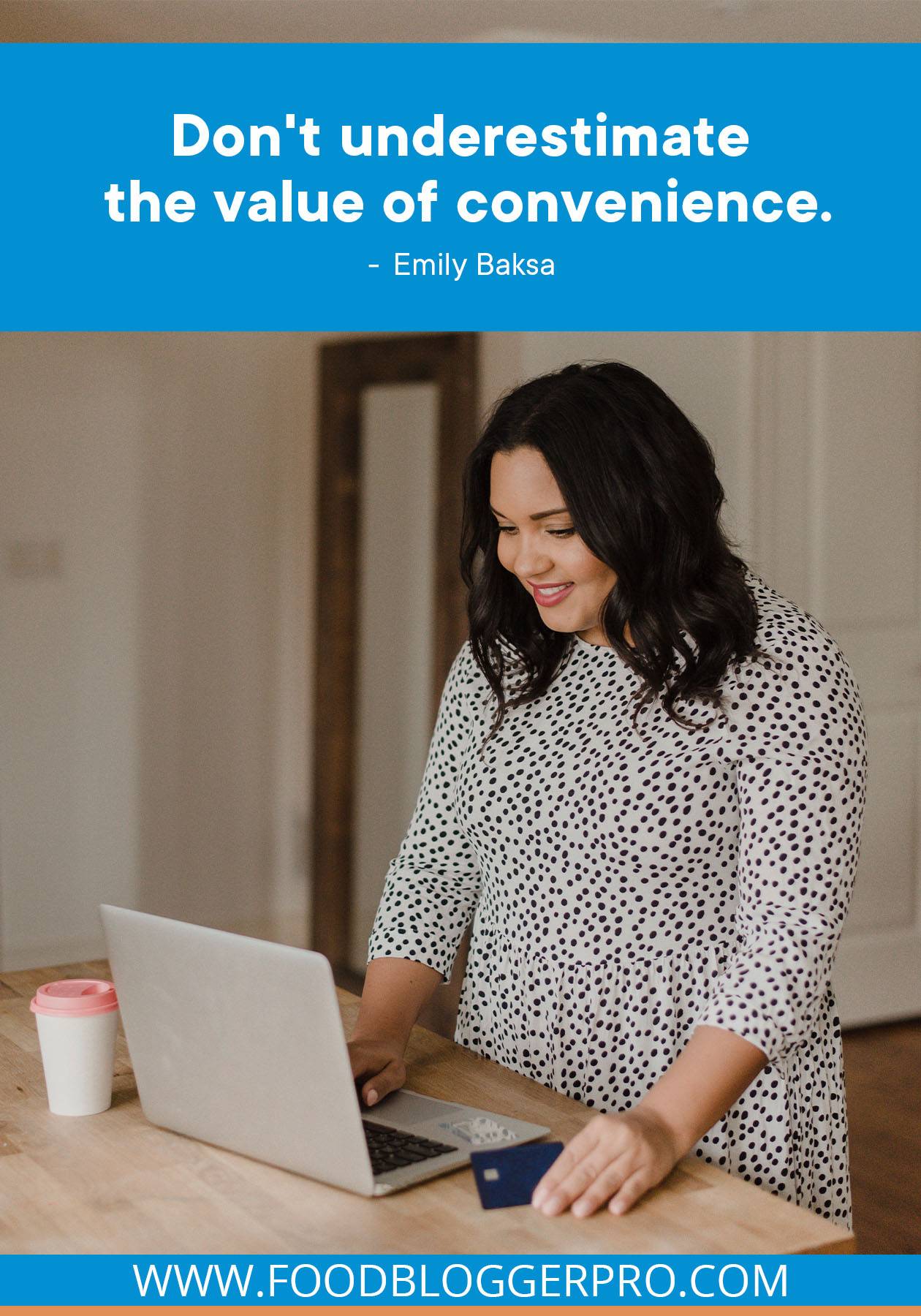
Emily Baksa: And that’s how I think we’ve built our sense of self-worth is like, I will provide as much information as possible. But I think the reframe that we really need right now is don’t think in quantity, think and quality and don’t underestimate the value of convenience because if you can create something that is really easy to use and convenient and really brings people from A to B seamlessly, that is actually way more valuable than dumping a ton of stuff on them when you really make an impact in people’s lives in that regard. And that’s what a product should do.
Emily Baksa: The value of asking for money comes more from, you’re transforming someone with this, right? I always encourage my clients when we’re thinking of concepts and ideas and is like, how does somebody’s life get better from this? If we can’t really clearly answer that question, it might not be the right topic here. We need to go back to make sure that that message is going to be so clear to understand because for me as a marketer and a copywriter, I need to know that to help you promote that. If that’s not clear, then it’s really hard for the potential buyer to understand that too.
Bjork Ostrom: Yeah. I think that piece that you just talked about for me as a marketer and copywriter is the last piece that I’d be interested in talking about because there’s a shift that’s required with us as creators once we … And I think this is really important as we think about the next five years. I’ve had multiple conversations about this even just this week with different creators, but also our team. As we pivot and shift from thinking about how do I get more traffic to how do I get more people who follow me who’d be interested in the things that I’m selling?
Bjork Ostrom: And that’s a shift because we are going from, and I’ve talked about this before, I don’t think it’s exactly clear, but all attempts to communicate it. We are going from marketing our content, “Hey, check out this recipe, go visit this. This recipe’s awesome, go make it, ” to being content marketers. We are creating content in order to market a thing. And so the comfortable thing for the majority of creators who listen to this podcast is marketing content, but now we need to shift and pivot and start to think about how is our content going to market our product? And that’s a significant shift in mindset. How do you see people doing that well and what are your recommendations for people to start to think about introducing some of that content marketing into their content rhythm?
Emily Baksa: Yeah, that’s really good. You’re onto something there.
Bjork Ostrom: Okay.
Emily Baksa: I’ll
Bjork Ostrom: Continue to workshop it. Yeah,
Emily Baksa: You’re getting there, workshopping it. Yeah. Yeah. No, I think, I mean, honestly, marketing content too, even to go back from one tiny smidge step, some people struggle with even just that. So if that feels hard too, yes, this mindset shift is difficult. I think, but it is the way of the future because content marketing as in building content that intentionally creates stepping stones in a journey to build trust, which is what we were talking about earlier too, requires intention. It’s an understanding of sequence. It’s how are we going from one pillars to the next? How are we taking people through that journey? And I think it’s really just about, it really requires a good understanding of not just who your audience is, but who you are. And I think that that is sometimes where that mindset shift feels really hard because sometimes I think people … I mean, I ask clients this question a lot, like, “What are you known for?
Emily Baksa: ” Not just what is your niche, but what makes you unique in this space? And people can answer, but a lot of the answers are similar. I see a lot of the same answers. So I think this innate understanding of like, well, what content do I want to actually be known for and create has to come first and have a little bit of alignment in the people you want to attract. And then you use status. Do you an example with
Bjork Ostrom: That? What do you hear a lot and then how could you drill down to get closer to something that’s not what everybody else is saying?
Emily Baksa: Yeah. Well, the most basic answer is healthy recipes. I can’t stand it when people tell me their niche is healthy recipes. I’m like, I don’t consider that a niche. Yeah.
Bjork Ostrom: So then what would be-
Emily Baksa: Some of my follow-up questions to them are like, “Well, what is your definition of healthy?” And that can be sometimes it’s really clinical. It’s really more like nutrition-based. Sometimes it’s more actually abundance. It’s like, to me, healthy is having a little bit of everything and having no restrictions, which is kind of different. But I do hear a lot of people say that because it’s more of a healthier mindset than a healthier intake of vitamins. And then I also often ask them, “Well, what are you not? ” Because sometimes that’s almost the easier way to get to it. Within a healthy category, it’s like, “Are you a gluten-free expert?” No. Okay. Or, “Do you eat red meat?” There’s so many different versions of that kind of, and it’s really about rooting into what are your own values as an individual, whereas I think we’ve traditionally been creating content, marketing content, as you said before, to keyword demands and what the internet is asking of us, and it’s gotten us a little scattered.
Emily Baksa: It’s like, okay, if we stopped trying to satisfy everyone else and satisfy search engines, if you really just were making the things that you really wanted to make, the things that felt healthy to you and the things that you would want to share with family, what is that?
Bjork Ostrom: And the interesting thing with that is the discoverability piece, like we talked about at the top of the funnel, then probably shifts, which I think is naturally happening right now anyways, but it was almost like in a world where keyword research and ranking high worked well, and there’s still sites that get a ton of search traffic and make money from that, but I think this is more like forward looking. And so if that’s shifting, then where will you get discovered? Where are people going to actually see your content? Where’s top of funnel? They might discover it via Google from doing a keyword research, but I think my bet more so over the next five to 10 years is they’re going to be discovering it on social platforms and social platforms aren’t keyword driven. They’re algorithmically driven. But in terms of the follow, does somebody
Bjork Ostrom: Sign up for your email list? Does somebody click to follow you, which debates around how beneficial that is in a content algorithm world as opposed to a social algorithm world. But assuming that’s incrementally beneficial to get a follow, how are people making those decisions? I think almost always people are making those decisions based on whether that person is going to either be entertaining based on the type of entertainment that they want to see, educational, based on the type of things that they want to learn or helpful based on the problems that they have. And in order to do that, you have to have a specific niche and a specific offering, which is why I think a lot of times you see success with certain platforms that have that really focused niche. An easy one right now is like high protein. So if you are a high protein creator, meal plan, high protein, meal prep, high protein, and you have these delicious meals that you’re doing meal prep and it looks really good.
Bjork Ostrom: People are trying to eat high protein. What’s the likelihood that somebody’s going to follow you? Probably pretty high because there’s a lot of people who are interested in eating high protein because that’s a wave that’s really prevalent right now. And so I think it’s maybe just like an observation and permission for people to let go of this idea of, “Hey, I see this opportunity to rank for a thing and narrow your focus in order to get to something that allows people to filter themselves in or out quickly in order then to sign up for an email list or to buy a product.” So do you see things in a similar way or does it resonate? Anything you’d push back on with that?
Emily Baksa: No, I agree with you. I think it’s better. It’s a classic talk to everyone you talk to nobody and it’s better if people get so afraid that restricting themselves means they’re going to limit themselves and that’s just because we’re used to high volume, right? But what I have to remind people is restricting is actually increasing quality. So honing in your focus is going to make the people you connect with higher quality people. I would rather have you connect with less people who are actually more aligned with who you are than a ton of mixed bags, mixed misaligned people because then you’re going to have a really hard time trying to connect with that group because it’s going to be totally all over the place. And if you can instead be really more intentional about saying no to who doesn’t belong here, no hard feelings, it’s not a big deal.
Emily Baksa: It’s just like these people are more of my people and that’s who I want to welcome into my little content universe who I want on my email list because those people are going to be more likely to buy a product from me because we’re really aligned in values and interests and I’m serving their needs directly. So yes, totally. I would very much agree with that. I think that it’s just another bit of a mental reframe and understanding that it’s actually more to your benefit to be a little more specific.
Bjork Ostrom: Yeah. Love that. I think it’s super important for us to be talking about this stuff and thinking about it, especially as we think about what does it look like to have a creator-based business over the next one, two, three, four, five plus years. And so love that you’re doing this work, Emily. If people want to connect with you and work with you, can you talk about how you are working with creators? Do you have packages or is it like ongoing partnership? What does that look like?
Emily Baksa: Yeah, so you can find my website, emilybaxa.com. My last name is B-A-K-S-A, a little bit of a tricky one. And yes, I help my clients in two different ways. A growing part of my business right now is coaching. So helping support people just through a lot of these transitions and these strategic planning in their marketing plans and marketing funnels and launching things. So I have one-on-one, one hour coaching sessions that you can just book with me and we could jump in on together. And I also have a recurring coaching subscription that people could join as well too if they want more continuous support. But I’m also available too, and I have some team members who help me to actually help you create some things as well. So I still have a bit of that kind of copy and execution part of my heart that I just can’t let go because there’s so much fun there.
Emily Baksa: And that’s when I really get to know people’s businesses. So those are kind of the two ways to collaborate and we can always mix and match them a little bit too.
Bjork Ostrom: Cool. That’s great. Emily, thanks so much for coming on. Really appreciate it.
Emily Baksa: Yeah, thank you so much. It’s fun to talk to another marketing nerd.
Bjork Ostrom: We can run out another time. Love it.
Emily Baksa: Yeah, sounds good. Thanks, Bjork.
Emily Walker: Hey there, this is Emily. Thank you so much for listening to that episode of the podcast. As always, if you enjoyed our interview with Emily, please take a moment to rate or review the episode or share it with your community. We’ll be back next week with an interview with Josh Gale from the food blog, The Chef Out West. He is a relatively new content creator and has had huge success building his content business over the last year and is here to share all of his advice with you. We look forward to that interview, but in the meantime, hope you have a wonderful week.