
Listen to this episode of The Food Blogger Pro Podcast using the player above or check it out on Apple Podcasts or Spotify.
This episode is sponsored by Clariti and Raptive.
Welcome to episode 586 of The Food Blogger Pro Podcast! This week on the podcast, Bjork interviews Timothy Pakron from Mississippi Vegan.
Last week on the podcast, Bjork chatted with Jeremy Carrasco. To go back and listen to that episode, click here.
Reinventing Yourself as a Creator
Timothy came to food blogging by way of studio art and his passion for fresh produce, not the blog itself. He started sharing his photography and vegan recipes on Instagram first, built an audience there, and landed a cookbook deal before he ever put much focus into a blog. In this conversation, Bjork and Timothy talk through what it looks like to build a body of work around a strong personal point of view, and why story and connection have carried his career from Instagram to a thriving blog, and now a second cookbook (Garden Variety)!
They also chat about the practical side of running a content business today: how Timothy is adjusting to a search and social media landscape that keep shifting under everyone’s feet and how he thinks about his blog less as a static archive and more as an ecosystem that needs constant tending. If you’re trying to figure out how to stand out with your story or navigate a creative career that has real ups and downs, this episode is for you.
Three episode takeaways:
- Treat your blog like an ecosystem — Timothy doesn’t think of his site as a place where posts go live and stay untouched forever. In this episode he shares why constant refinement, from new photos to rewritten copy, keeps older content fresh and performing well, and how he audits his site to help spot which posts need some love.
- Your story is your differentiator — With a background in studio art, Timothy has always leaned into what makes his perspective his own. He talks about his passion for the creative process, being intentional with how he shares his story and connects with his audience, and why that connection matters more as content gets easier to produce at scale.
- Watch the industry without falling into comparison — Timothy and Bjork chat about how to stay aware of what other creators are doing without letting it take over your time or creative confidence. Timothy talks about drawing inspiration from other people’s success instead of measuring himself against it, and why he sees his creative expression as something no one else can replicate.
Resources:
- Mississippi Vegan
- Garden Variety Cookbook
- Pinch of Yum
- Keysearch
- Mississippi Vegan Gumbo
- Jeremy Finds AI
- Raptive
- Mediavine
- Pinch of Yum Income Reports
- Ugmonk
- Follow Timothy on Instagram
- Join the Food Blogger Pro Podcast Facebook Group
Thank you to our sponsors!
This episode is sponsored by Clariti and Raptive.

Thanks to Raptive for sponsoring this episode!
Building a creator business isn’t getting any easier. Between AI, constant platform changes, and the pressure to keep growing, it can feel like you’re running just to keep up.
That’s why we’re excited to partner with Raptive. Raptive works with thousands of the web’s leading independent creators—including us—to help them earn more, grow smarter, and build sustainable businesses for the long term.
They combine industry-leading advertising with personalized guidance, data-driven insights, and a team that’s constantly helping creators adapt to changes in search, AI, and the broader digital landscape. They’re also leading the charge to protect creator content and advocate for a future where independent creators can continue to thrive.
And now it’s easier than ever to join. If your site gets at least 25,000 monthly pageviews, you can apply to become part of the Raptive creator community and get support that’s designed to grow with your business.
To learn more or apply, visit raptive.com/fbp.
Clariti is a content organization and optimization platform that helps you uncover SEO insights and monitor performance improvements by analyzing your WordPress and Google data in real-time — so you can audit your content, understand performance, and see real opportunities instead of guessing.
And it doesn’t stop at insights. Clariti helps you turn what you’re learning into actual projects and tasks — so you can go from analysis to action and actually get stuff done.
Go to clariti.com to learn more.
And, if you’re a Mediavine publisher, Clariti has a dedicated partnership just for you. Just go to clariti.com/mediavine to see what’s included.
Interested in working with us too? Learn more about our sponsorship opportunities and how to get started here.
If you have any comments, questions, or suggestions for interviews, be sure to email them to [email protected].
Transcript (click to expand):
Disclaimer: This transcript was generated using AI.
Bjork Ostrom: If you’ve ever opened Google Analytics or Google Search Console and then just looked at it for a little bit and closed the tab because it felt overwhelming, this is for you. And here’s the thing, it’s not just analytics or search console, it’s also WordPress. Maybe you’re trying to find a post quickly, understand how it’s performing. And after a while, you’re jumping from tab to tab trying to piece together information about how your content is doing. It really is one of the hardest parts about growing a contents business. It’s getting clarity. It’s not always necessarily effort, it’s just knowing what you should do next because your data is scattered, your priorities are getting fuzzy, and you’re staying busy, but you’re not confident that you’re working on the right things. That’s why we created Clariti. It’s C-L-A-R-I-T-I. Clariti is a content organization and optimization platform that pulls all that messy data into one clear place so you can audit your content, understand performance and see real opportunities instead of just guessing.
And it doesn’t stop at just insights. Clariti helps you turn what you’re learning into actual projects and tasks. So you can go from analysis to action and actually get stuff done. It’s not about quick wins or hacks. It’s about building a calmer, more sustainable system so you can grow with clarity and confidence. Go to C-L-A-R-I-T-I to learn more. And if you’re a Mediavine publisher, Clariti has a dedicated partnership just for you. Just go to clariti.com/mediavine to see what’s included.
Bjork Ostrom: Timothy, welcome to the podcast.
Timothy Pakron: Hi, thank you so much for having me. I’m so thrilled to be here.
Bjork Ostrom: Yeah, so thrilled to have you here. This is gonna be a fun conversation because you have had it you’ve listened some fo to some Food Blogger Pro podcasts. Before we press record, one of the things that you were talking about was early on, as you were listening to some of these podcasts, kind of the state of mind that you were in, the feeling that you had as you were starting to listen to some of this. And I said, wait, let’s pause there. Let’s capture this on the podcast.
Timothy Pakron: Mm-hmm. Mm-hmm.
Bjork Ostrom: Because I think it’s helpful for people for two reasons, and then you can describe it. Number one, I think there’s a a lot of people who can relate. And number two, I think it’s a great way to paint the arc to show the story of what can happen if you continually show up, make a little bit of progress every day. We talk about this tiny bit better every day forever. It feels like your story is an example of that. But take us back to those first few weeks, those first few months, maybe it was the first year when you were listening through the podcast.
Timothy Pakron: Yes.
Bjork Ostrom: Things that you were feeling, trying to figure out, hey, what does it look like to be a creator on the internet?
Timothy Pakron: Yeah, yeah. Well, I remember I think the way I would describe it was it would put me in a tizzy because I would listen to the the podcast and I would I would be like, my gosh, I’m not doing any of this. And I’m not doing it like I’m doing everything wrong. And there was a lot of terminology I didn’t know. I didn’t know what a plug-in was. I didn’t really
Bjork Ostrom: Yeah.
Timothy Pakron: I mean, I I had heard page views, but I didn’t really understand it. I definitely didn’t know what SEO was. I didn’t know what keyword research was. So you have to understand, when I started my my food career, it was predominantly on Instagram, when Instagram was only photography. And pretty pretty quickly on, I got a cookbook deal. So, like my blog when I got my my first book deal had maybe five recipes on it. And so
I switched gears into the cookbook direction. And then once that first cookbook came out, that’s when I started focusing on the on the blog because I had fellow blogger friends tell me that, you know, because I was kind of joking about sharing recipes. I was like, I share one maybe once a month. And they were like, well, we have to share more than that because that’s how we make our money. And I was like, well, what do you what do you mean make your money? And that’s when I started to understand that it actually could be a career.
Bjork Ostrom: Mm-hmm.
Timothy Pakron: And it was the Pinch of Yum income reports that really was eye-opening for me because and I’m so thankful that y’all shared that. And I really appreciate y’all being transparent. And that’s why I I try to be transparent with with numbers and stats, because we have to help each other. And so when I learned that, I started listening to the podcast. And at the time I had a Squarespace blog, and it was beautiful, I I will say, yeah.
Bjork Ostrom: Hmm. Yeah, yeah.
Bjork Ostrom: Mm-hmm.
Bjork Ostrom: Looked good. Yeah. It’s a great platform for like a portfolio of content to display it.
Timothy Pakron: Ex and that’s my background is is like photography and painting, yeah, and and and going to you know majoring in studio art. So I I loved the look of it, but for traffic SEO, I learned it wasn’t great. And so then I switched to WordPress, and that’s when I started listening to the podcast, and I definitely was overwhelmed. But over time, episode by episode, you know, you could take
Bjork Ostrom: Photographer.
Timothy Pakron: I would take away probably one thing that I could do, like an actionable plan. And and over time, you know, you start to get a grip on it and you start to have a better understanding of it. And you know, there’s a learning curve with all of this. It’s like writing cookbooks. It’s like you get better at it, you you create your own and I know y’all talk about this, you create your own processes that that work. And and so over time I I got better. And and so now my
Bjork Ostrom: Mm-hmm.
Timothy Pakron: blog is super tightened up. It’s super clean. I call it Riff Raff. Like, thank you. I I really appreciate that. but there was a lot of riffraff, you know, you know, obscure blog posts with recipes that you know what’s gonna be searching for and and or just, you know, and I I remember I was uploading really high file sizes to the blog, like unbelievable.
Bjork Ostrom: Hmm. It looks great. Yep.
Bjork Ostrom: Sure. Like big images, yeah, that would take forever to download and they yeah.
Timothy Pakron: Like I remember when web designer was like, What are you doing? But no one told me. I just didn’t I didn’t know.
Bjork Ostrom: Right. Well, and the only way that you figure it out is by doing it. And I think that’s one of the key pieces in the process is I’ve learned for myself. you know, an example is we were interested in real estate. And I was like, I want to get into real estate. What’s the best way to get into real estate? I could listen to like a lot of podcasts, I did. I could read books, I did. But the thing that was most helpful was like buying something and figuring out now what do you do?
Timothy Pakron: Mm.
Bjork Ostrom: And I think it’s so similar for people who enter into the world as a creator, especially when you get into some of the technical components on a blog when you’re running that, it’s so much information. The best way to learn is to do, but it really is overwhelming when you first get started. How did you balance in those early stages the overwhelm of kind of the like technical business?
requirements along with the like creative requirements to continually put out content. Because there are some instances, you know, Pinch of Yum would be an example. I’m naturally kind of interested in some of the technical stuff. Lindsay’s not. And that allows her to like create at scale. And then like I’m having conversations with our ad network or trying to figure out some of the SEO considerations. The majority of people
Timothy Pakron: Mm-hmm.
Timothy Pakron: Mm. Mm.
Bjork Ostrom: probably don’t have something by chance where they just have somebody in their life, whether a partner or a friend or somebody that they hire who’s gonna naturally work out that way. So what was it like for you? And then when did you start to bring people in if you did to to help with some of that stuff? Or are you still doing a lot of it on your own?
Timothy Pakron: Yeah. Yeah. I definitely I definitely have noticed that there’s a lot of great success stories of bloggers that have that partnership where you know, one person is more in charge of the back end stuff and the other person is the is the creative part. and so I’m definitely doing it all. I do have one assistant that will come work with me sometimes and she’s a great
emotional I call it emotional support, just to like, you know, go in the back end of WordPress, try to figure something out. and and that’s one thing I I will mention too that is beneficial with with AI is using that as a resource to help me better understand some of these back end things because it has been helpful. As much as I was opposed and against AI for so long.
Using Gemini as a resource to help me understand some things, I mean it’s it’s it’s like a ver it’s like a virtual assistant chap, you know, chat bot and of course it’s not a hundred percent accurate, but it sure has helped me. It sure has helped me. And and
Bjork Ostrom: Massively impactful.
Bjork Ostrom: Mm-hmm.
Bjork Ostrom: Mm-hmm.
Yeah. Can you talk about how you use it? Cause I think it’s always interesting to hear from other creators what that looks like. I can share a little bit too kind of in my world what it what that looks like. But I would love to hear from you what it looks like to have kind of that assistant that you’re partnering with. You’re not outsourcing everything to it, but it’s like helping maybe see things that you wouldn’t see or
Think of ideas or even like audit. I think it’s really good at auditing things. what is what does that look like for you and how have you found it most helpful?
Timothy Pakron: Yes.
Timothy Pakron: Well, I’m almost embarrassed to even talk about my AI use just because I’m such a passionate creative and like I would never dream of of of asking AI to create a an image for me or to, you know, cre write something, create a logo, like anything creative that it’s just like it’s offensive to me. But I also understand that you know, as someone who
Bjork Ostrom: Yeah. Write blog post, yeah.
Bjork Ostrom: Uh-huh.
Timothy Pakron: runs a business on the internet, like we have to, we have to stay on top of it. And so I quite literally started using Gemini in a way of, Gemini, my blog needs to make more money. I need financial security. I need you to help me get traffic to the blog. What are three actionable things I can do right now to help me with my blog traffic now that search has changed because of AI? And it will bring up suggestions. And then I can piggyback off of
Bjork Ostrom: Mm-hmm.
Timothy Pakron: What it recommends. what I have done, some actionable plans already is I just went back and updated my top 10 performing posts on my blog. And I would ask Gemini, how can I update this to be more because at the end of the day, I I was using Key Search to do keyword research, and now that’s completely shifted. And I also understand that.
Bjork Ostrom: Mm-hmm.
Timothy Pakron: You know, even though we’re so familiar with Googling something and getting like the 10 links, that’s gone. And like you can try to hang on to it, you can try to put minus AI, but the shift is already happening. You’re really already using AI whether you want to or not. And so
Bjork Ostrom: Mm-hmm.
Bjork Ostrom: Yeah. In a AI overview in a recap that’s yeah. It it mm.
Timothy Pakron: It’s search is changing and it’s changed. And and I understand like having this more, I’m sure there’s a better term for it, but having more of this conversational search with something like Jim and I or Chat GBT that already has a kind of a grip on what you’re all about and what you’re doing. I think it just refines what it’s offering to you. And so I so yeah, so opt so optimizing my top 10 posts.
And I I did implement some changes and I can see the the traffic and the ad revenue going up with those. And to be completely honest, to c to be completely honest, they made the post better. You know, it was like you need a like I had a high I have a high protein roundup and it was like you need to organize this better. There needs to be a table of contents, you know, your headings are all over the place. and you need to word it in a way that you know is
Cause I think at one at at one point in time, you know, high protein vegan meals would have been a hot key keyword. But now it I changed it to 20 high protein vegan meals, delicious and filling. And so I it I just made it more robust. And what it actually taught me was the attention to detail I put into my cookbooks, I need to be putting on my blog. And
Bjork Ostrom: Mm-hmm.
Bjork Ostrom: Sure. Yeah.
Timothy Pakron: I I need to be making my blog post resources for people. And so it’s helped me to view it as more as a blog post as more of a resource and a landing page for someone who’s interested in it. And I enjoy that. And I think that it’s that kind of work does stimulate me because I have to ask myself, okay, if I was looking for high protein vegan meals, what how would
Bjork Ostrom: Mm-hmm.
Timothy Pakron: how what would make it more digestible for me and more interesting for me. And so so yeah, so I would say using Gemini or ch or w whatever you would call your AI virtual assistant, using it in an ethical way to help refine. But I’ve also had arc I’ve also had arguments with Gemini because I said, I said, can you recommend a vegan gumbo? Because I have a killer vegan gumbo that’s like I’m known for.
Bjork Ostrom: Yeah, and yeah.
Bjork Ostrom: Mm-hmm.
Bjork Ostrom: Yeah, sure.
Timothy Pakron: And it offers a Frankenstein recipe. And I’m like, why are you offering Frankenstein recipes? You’re you’re refining how search is working. Send someone to a reputable blog post where they’ve tested it. Like you’re so smart. Like you’re so you’re so ahead of it. Like, what are you doing? Why aren’t you why aren’t you recommending because the recipes need to be tested?
Bjork Ostrom: Mm-hmm.
Bjork Ostrom: Yeah. You idiot.
Bjork Ostrom: Mm-hmm. Mm-hmm. Yeah, it’s one of the obvious I mean, some of the when you get into certain corners of AI, it’s really interesting to see how it responds. That being an example where it’s serving up a recipe that it thinks will, you know, be an answer to what you need, but it’s like it’s not gonna be as good as if you go to somebody who’s tested it, who knows how to make it, who’s been making it for years, who has like reviewed it and
You also see some of those examples of s especially with people interacting with like ChatGPT voice. I don’t know if you’ve seen these, but like it’ll be a guy and he’ll be like, Hey ChatGPT, like I’m stuck in the belly of a whale. What do I do? And it’s like it walks through his conversation with Chat GPT. So it’s like people testing the edges of kind of where do these things start to fray a little bit. And I think that’s an example. But but like
Timothy Pakron: Mm.
Bjork Ostrom: Counter to that, I think your point around using it wisely is really good because whether we like it or not, the current reality is that we are able to get access to some of the most senior level, C-level executive type thinking at $20 a month, $100 a month, $200 a month.
And and there’s all different opinions on like how that was achieved. A lot of it was achieved by training on the open web and creator data and scanning books. And all of that is we feel the downside effect of that because then there’s AI overviews and then there’s recipes that are surfaced. And that’s a reality. The other reality is that we have close to super intelligence available to us.
Timothy Pakron: Mm-hmm.
Bjork Ostrom: At an incredibly low cost. And so then what do we do as creators to use that? And then where is the line that we draw to say we’re not going to have it go all the way in just running the blog or doing an AI video and creating it for us? And almost, you know, part of it is ethics, like you talked about. I also think part of it is just competitive advantage, it’s novelty. And as this was a con a conversation I was having with I
Timothy Pakron: Yeah.
Bjork Ostrom: I think his handles Jeremy finds AI, but it’s somebody who Jeremy has built this account over the last few years where he analyzes AI videos. And in that conversation that I was having with him, one of the things that he said is one of the downsides in being an AI creator, because I asked him, like, what is it? What about being an AI creator? Like somebody who sits behind a keyboard and creates AI content. And he said, the defensibility of that is almost zero. Because as soon as somebody figures out
Timothy Pakron: Mm.
Bjork Ostrom: I talked about these fashion accounts where there’s like two women standing side by side and like talking about their fashion. It’s AI. but like these accounts are able to grow really quickly. As soon as somebody figures that out, 9,000 other people will be like, Okay, easy. I’m just gonna feed the same prompt, build the same process, upload the same video. And so I think that part of it is just like, how do you stay novel? How do you stay interesting? How do you stay unique as a creator?
Timothy Pakron: Mm-hmm.
Bjork Ostrom: Part of it is the ethics of it, but part of also it’s the business strategy of it. And that was one of the things you alluded to was like using it up to a point and then saying, How do I really lean into my story and my connection and my audience? So talk about what that looks like for you and how you’re intentional with thinking about connecting with people, sharing your story, even within your book. I have a copy of it here. You know, you
Timothy Pakron: Yeah.
Bjork Ostrom: open the page, you know, one of the first pictures, you know, it’s like you standing in front of the garden here. And it’s like that type of stuff, that story, and I think we connect with that, that’s unique and and novel. And so what does that look like for you and how are you intentional as a creator and weaving that into what you’re doing?
Timothy Pakron: Mm-hmm.
Timothy Pakron: Mm-hmm.
Timothy Pakron: Yeah. Well, I just I wanted to piggyback off something you said with like the ethical use of AI because my goal is it if I’m gonna use it, I wanna help it to refine what I’m offering. I want it to r like, you know, help amplify to get my my creative content out into the world. But whenever I find AI content that and I feel tricked or I feel duped, that that icky feeling.
Bjork Ostrom: Yeah, yeah.
Timothy Pakron: That’s what I don’t want anything to do with. And that’s what I think it’s it’s
Bjork Ostrom: And I think it’s universal. Like I think people feel that when they yeah.
Timothy Pakron: And I don’t care if it’s getting better. I don’t care. It’s like, well, God, the video’s getting better. It’s like, so what? Like it’s icky. And it’s like we have to come together as humans and be like, no, we can do better than this. So I’m hoping that we’re in this, we’re in this position where even how, you know, AI will suggest a Frankenstein recipe, I’m hoping we’ll get to the point where it’ll stop doing that. It’ll start pushing towards people that, you know, reputable people.
and we’re just kind of the floodgates were opened. I mean, it they really were. It’s like all of a sudden we’re inundated with all this. And and so I think we’re trying to sort through a mess. But but yeah, I I guess where I come from is I’m such a passionate creative and I love telling stories and I love weaving in my past experience, my life experience, and I love weaving that into my
creative process. And so I I’m just really I’m I’m just trying to to get my content out there so that people can see it. And so you know more than anybody that this market’s really saturated. And so I have to tap into my my unique point of view, my perspective, and then and just figure out the best way to package it up and present it.
To the world. It’s just like with this cookbook, you my new cookbook garden variety. The creative process of it is so fun and I love it. But that’s just a little fraction of it. Now I’m in the book launch mode and the pre-order mode and the book tour mode. And there’s it’s there’s so much more that you have to to to focus on and be good at. So and just like with blogging, I learned that you have to have a thick skin and you have to be, you have to
Be a go-getter and be excited by being stimulated by things you don’t know how to do because the create like working in the kitchen and taking pictures is the fun part. And so, and I learned that by blogging, like you, and you have to enjoy it. And luckily, I’m to the point where I actually do enjoy tightening up the blog, making my website a beautiful landing page, making sure that when someone goes there,
Timothy Pakron: It’s an enjoyable experience as much as it can be when there’s ads. and then I also am excited by logging into Raptive and seeing my ad revenue go up and seeing my hard work, seeing results. And that’s what’s that’s that’s what’s so inspiring and keeps me going. So at this point, I don’t even know what you asked. I’m just like, I have I’m not gonna monologue over here.
Bjork Ostrom: It’s great. It Yeah. It I think that piece ties back to this idea of where you started being overwhelmed, feeling like there was so much. And if you continually show up, you continue to work on things, you continue to figure things out, eventually you get to a point where maybe you have a cookbook, you have a beautiful website, you’re able to log in to a dashboard and see that your site earned a substantial amount of money the day before.
And that is a really incredible thing, but that momentum takes time. it takes effort, it takes consistently showing up. and were there unlocks for you along the way that allowed you to kind of level up? Like were there things that you learned, things that you did, you know, you talked about this idea of
Timothy Pakron: Mm-hmm.
Bjork Ostrom: kind of trying to show up every day, maybe it’s listening to a podcast and taking away one little nugget, thing something that you could implement, which I think is a great mindset to have. You’re not trying to do everything. You’re not trying to, you know, grow your site to I was talking to somebody within the FoodBlogger Pro community today. We do these site audits where we talk through their site and their business. And, you know, she had maybe like a million collective social media followers, but had just kind of really started working on her site within the last year.
Timothy Pakron: Mm-hmm.
Bjork Ostrom: And she’s like, what are some of the things that I can do to grow it? I’m like, like you’ve got a lot of time. you know, one year feels like a lot, but actually, like, it’s three years, it’s four years, it’s five years once you can finally look back and say, like, okay, all of this work that I’ve collectively put in is starting to kind of pay dividends. But what were the things for you that you felt like were unlocks along the way that allowed you to level up your creator business?
Timothy Pakron: Mm-hmm.
Bjork Ostrom: that you look back on and you’re like, these were the most important things that I did to get me to where I am today.
Timothy Pakron: Mm.
Yeah. Well, I wanna make it clear too, like I was the beginning of my food career, like after my first cookbook came out, I was really focusing most of my energy on Instagram. And so I was getting so Mississippi Vegan came out 2018. And so and so by the end of 2018 I moved to New Orleans and I like started building my garden and
Bjork Ostrom: And when was that about time wise?
Timothy Pakron: I started really I started getting brand deals with with brands like larger brand deals like like a nine month brand deal where I had to do a batch of content each month with co with big contracts and it was life changing to me. And so and during that time I would share recipes on the blog, but it wasn’t a priority. And so but what I think really
Bjork Ostrom: Mm-hmm.
Timothy Pakron: triggered like me needing to focus more on the blog was when the periods where brand sponsorships didn’t come in because it’s not consistent. And then all of a sudden you’re scrambling. And so then you’re like, my blog’s making, you know, $300 a month. That’s great. But I can’t live off of that. And Yeah, like I’m gonna really need the garden and I’m gonna have to like scale back and and you know,
Bjork Ostrom: Yeah. You’re gonna really need your garden.
Timothy Pakron: Be frugal, but
Bjork Ostrom: But then the next month you might earn fifteen thousand or like but it’s brand and sponsored money, so it it comes and goes. Is that what you’re getting at?
Timothy Pakron: Yeah, I I guess what I’m trying to get at is what one one of the biggest motivations and shifts with the blog was was having the inconsistency with the brand’s spar partnerships. and so that really that was a big push for me. And then listening to Food Blogger Pro and hearing different creators talk about when they reach that point of financial stability, just even
Bjork Ostrom: Mm-hmm.
Timothy Pakron: Even thinking the thought financial stability, like financial freedom, where you can just focus on what you’re passionate about and you don’t have to worry about living paycheck to paycheck. Or in my situation, it wasn’t even paycheck to paycheck, it was like, you know, contract to contract. And so that was a huge spark for me. And and also, you know, and y’all talked about this at length on the podcast, but
Bjork Ostrom: Yeah, brand deal to brand deal. Yeah.
Timothy Pakron: You know, owning your mailing list, owning your website. and it’s just really empowering to to own those to own those two things. And, you know, I also so during this time on Instagram when the landscape was changing so drastically because of TikTok, it got to the point where I started to feel really defeated because I was like, I don’t want to be a short form video.
content creator full time. Like, sure, I’m I’m good at it. I can do it. Like, you know.
Bjork Ostrom: Mm-hmm.
Photography was who like your ethos. That’s who you were.
Timothy Pakron: That’s what you have to understand when I started Instagram, all you could do was post a picture. You could post one picture.
Bjork Ostrom: Yeah. And that’s what you studied in school, that was your history. That’s like yeah, it was perfect match. It probably yeah.
Timothy Pakron: And yeah. So when I so when I started the Instagram, I was able to, and I had I’ve been vegan since I was 20. So I’m 40 now. So it’s been 20 years. But at the time I’d, you know, I’ve been vegan for a long time. I had vegan translations of dishes that I grew up eating. And so when I was sharing, you know, these vegan translations of southern comfort food or southern ingredients, it was really, I think, refreshing to people. And at the time, Instagram wasn’t saturated.
Bjork Ostrom: Mm-hmm.
Timothy Pakron: So I had a I had a strong point of view that was unique. And I I had I had photography skills. I had to learn how to style food and ingredients and make it interesting, but I love being stimulated in that way. I love challenging myself. So I started finding cookbooks that really inspired me and food stylists that inspired me. And and and so yeah, so it was it was that passion for
just loving produce and vegetables and and loving the art of food photography that really started all of this. And so, and and that’s what I have to remind myself, like all this hard work, all the back end work, all the nitpicky digital electronic work, I work so hard at that and do that so I can have that precious time where I get to go harvest something in the garden and make something and take a picture. And but you can’t do that without the other one.
Bjork Ostrom: Mm, mm.
Timothy Pakron: And so my biggest advice to creators is figuring out how to have a healthy relationship with both and figuring out how to be interested in the backend stuff. And I think I did maybe go in the direction of, I can outsource this, but it’s like, but then you have to pay someone to do that. You have to learn how to do it yourself and and enjoy it. And now I can say I do enjoy it. I actually can log into WordPress and
Bjork Ostrom: Mm-hmm.
Timothy Pakron: can see things that I need to do and making my website as tight and organized and clean and elegant and beautiful as possible, just like my cookbooks, it excites me. And so I’m just thankful that I got to that point. But if someone doesn’t get to that point, it might not be a good it might not be like a good gig for them, you know?
Bjork Ostrom: Yeah.
It’s in
Bjork Ostrom: Yeah, for sure. Like I think I think your point in exploring the potential of reframing how you’re looking at something is a really good one. Not in service of perpetual pursuit of enjoying something that you don’t actually enjoy. You might come to the end and just be like, actually this just really isn’t a good fit for me. But maybe it is, you’re just looking at it wrong. One of the things that I think of
As a correlation, even with what I hear you saying as an example, is it feels like you are describing some of the characteristics of a good gardener. Like things are tight, things are tidy, like I’m taking care of it, like I’m showing up. It’s like almost like weeding. Like you are taking care of this thing and making sure that the old stuff that was not very good and wasn’t flourishing is removed.
Timothy Pakron: Mm-hmm. Yeah.
Bjork Ostrom: And you’re preserving the things that are really good and and letting those have the space to breathe and might grow. And I think of a friend who I was having a conversation with, and he was in a hard season, a hard stretch of life, and he was trying to figure it out. And he was an incredible designer. And I was like, dude, you are an amazing designer. What if you just approached this with a designer kind of headspace? And
Timothy Pakron: Mm-hmm.
Bjork Ostrom: He was like, yeah, like what if this was a design problem? I’m a designer. This is what I do. And that like framework allowed him to approach it differently. And so for anybody, I think your point here is a really good one. For anybody who’s feeling like they are stuck in a thing that they don’t enjoy, what if you layered on something that you do enjoy as the framework for viewing it? Whether it be you’re a designer or maybe you’re a photographer and you have a way of viewing the world.
Timothy Pakron: Mm-hmm.
Bjork Ostrom: What if you’ve used that lens to approach the thing that maybe you thought that you didn’t like, that maybe you would if you approached it a little bit differently?
Bjork Ostrom: Before we continue, let’s take a moment to hear from our sponsors.
Building a creator business isn’t getting any easier. Between AI constant platform changes and the pressure to keep growing, it can feel like you’re running just to keep up. That’s why we’re excited to partner with Raptive. Raptive works with thousands of the webs leading independent creators, including us, to help them earn more, grow smarter, and build sustainable businesses for the long term. They combine industry-leading advertising with personalized guidance, data-driven insights, and a team that’s constantly helping creators adapt to changes in search AI in the broader digital landscape. They’re also leading the charge to protect creator content and advocate for a future where independent creators can continue to thrive. And now it’s easier than ever to join. If your site gets at least 25,000 monthly pag views, you can apply to become part of the Raptive creator community and get support that’s designed to grow with your business.
To learn more or apply, visit raptive.com/fbp. Thanks again to Raptive for sponsoring this episode.
Bjork Ostrom: Talk to me about your site. You know, you talked about raptive earnings, you talked about kind of the tension in the early stages of not really knowing what any of this stuff is. Was there a point where you had a feeling around an unlock with your site, with your business that felt like, hey, I did it? Like,
I got to that point after this struggle of trying to figure it out. you know, for some people it’s like the first time they had money deposited from Raptive into their bank account is like, wow, what a great feeling that is, or whatever, you know, advertising company you’re using, or, you know, landing a book deal is that for some people. Was there that moment for you in your journey where it was like, hey, this is a pretty significant moment I and I’ve felt it and realized it.
Timothy Pakron: Yeah.
Timothy Pakron: Yeah, for sure. So when I s first started, I was with Media Vine because at the time I think I had twenty thousand page views. And then I always whenever I go to a a food blog, I always scroll down to the very bottom because it’ll say a raptive partner. And because I I love attention to details. I love the details. And so I was always just like drooling over being a raptive,
Blogger, I was like, God, it just seems so cool to be to be a Raptive partner. Cause at the time it meant you had to have a hundred thousand page views. And I and I I I think at the time I was like at 30 or 40,000. And I was like, they’re never gonna, I’m never gonna get there. And then I got an email from Raptive. And at the time it was called Raptive Rise. And they said, Hey, we love your content, we love your blog. we have this new
Early admission program called Raptive Rise for people that have 50,000 page views. Would you like to join? And that was like a big deal to me because I I I really wanted to be with Raptive. And so that was that was a big moment for me. And I know that they’ve they’ve lowered the amount of page views. I think now it’s easier to get in, but at the time it meant a lot to me. and
I I still don’t think they’ll give you the a Raptive partner unless you have a hundred thousand page views. So I’m I’m not at a hundred thousand yet, but I’m gonna get there. But the other thing that happened was I started talking to my blogger friends and I realized they had a catalog of 600, 700, up to a thousand recipes. And like I said, like I was telling you, I went more the cookbook route. So
You know, my first book had like a hundred and twenty-five recipes. This new book has like a hundred and thirty. Let’s just say to to be fair, 200 recipes. Those recipes could be on the blog, which would add to my, you know, I think I have maybe maybe like 150, close to 200. But I think it was that moment where I was like, I’ve just I haven’t been able to really build up my my recipe catalog. And so
Timothy Pakron: It’s like, of course, I’m not going to be earning as much as as people that that have it. And and that’s not to say that there aren’t bloggers that have over a thousand recipes and have three cookbooks. Some people are just r are really good at it all. But you know, most of my blogger friends that are doing really well, they kind of put most of their effort into building that recipe catalog. And so I’ve learned that yeah. So I’ve learned that I have to be patient with myself, not compare myself
Bjork Ostrom: Mm, mm-hmm.
Bjork Ostrom: Mm-hmm. On their site.
Timothy Pakron: to other people and and also take value in the fact that I’m building my my name, my reputation. So with my cookbooks, you build authority, you build reputation. So that way when people find your blog, there’s a brand recognition. And the thing about recipes is it’s kind of an intimate situation. Like someone’s following your instructions. They’re spending their hard earned money on ingredients, their time.
Bjork Ostrom: Mm-hmm.
Timothy Pakron: And it’s personal. And I’ve learned like doing book events and meeting people, you know, they run up to me, give me a hug, and they’re like, my God, like, you know, every weekend me and my partner make one of your recipes. And it’s so touching that, and you realize in that moment, like, wow, this is really personal. And so, and so that that that is that keeps me going and and makes me realize that this medium is.
Bjork Ostrom: Mm-hmm.
Timothy Pakron: It’s so much more than just the creative visual part. It’s like these recipes are actually coming to life in people’s homes. And so, yeah.
Bjork Ostrom: Yeah. There’s a definite there’s different types of income that we get as creators. One is financial income. We talk about that because it’s the easiest to quantify, it’s easiest to track, it’s easiest to know the difference that it’s making if you are able to do something full time. But there are other ways that we earn income as creators, both in ways that we’re getting deposits and also withdrawals. Like, and I think we need to be very aware of how are we getting
Timothy Pakron: Mm.
Bjork Ostrom: non-financial income from the work that we are doing. The example of somebody coming up to you at an event and like giving you a hug and saying, We make your recipes all the time. Like what does that mean for you? A lot. How do you quantify it? I don’t know. but it definitely is a deposit in your life. Similarly, I think, you know, I could think of many different instances where I know business owners, creators, whatever it might be,
Who have had like significant financial deposits, but have had withdrawals, sick significant withdrawals, non-financial withdrawals in their life that result in them being in a really hard place. Like it their business has not given to them in other areas. And I think it’s important that we’re aware of those things. one of the areas that ex that exists, and you mentioned it, is the idea of comparing yourself to others. Can you talk about
Timothy Pakron: Mm-hmm.
Timothy Pakron: Mm.
Bjork Ostrom: How you have approached that as a creator. You know, they talk about this idea of compare and despair. how do you how do you how do you stay aware of what’s happening within the industry, but also protect yourself from the downside psychologically of seeing somebody else’s successes and wondering what, you know, what if that was me or why not me, or all those different questions that we ask ourselves.
Timothy Pakron: Well.
Timothy Pakron: Mm-hmm.
Mm-hmm.
Timothy Pakron: Mm-hmm.
Timothy Pakron: Yeah, it’s a it’s a mental gymnastics being a content creator, being a person on the internet, and also being a cookbook author, because we’re constantly exposed to I mean, everyone’s talking about what they’re doing and and kind of, you know, presenting what they’re doing, trying to sell what they got going on. And and you can you can view it as inspiration or you can view it as comparison and feeling frustrated and
If I ever get into that mindset, I quickly try to brush it off because it’s a waste of time. It’s a waste of time. Like my life and my my creative expression is so unique to me. Like I I have to stay focused on what I’m doing and and I have to be inspired by other people’s success. But what’s happened before, and it’s funny, is I’ll meet someone, say a younger
not necessarily younger in age, but earlier content creator or they’re early on in their process. And they’ll ask me, like, how did you, you know, get a book deal or how did, you know, your photography so great. And I’ll hear kind of like the R, like and and not necessarily a negative comparison, but they kind of feel like, how am I ever going to get to that? And so it’s it’s a good reminder to know that like, you know, you may be the
you may see someone and and compare yourself to their success, but other people are doing it with you. And so you have to take it with a grain of salt. I understand that these thoughts are going to come into to your mind, but like I said, it’s mental gymnastics and you have to just you can allow yourself to feel it for a moment, but you need to brush it away and then find inspiration from their success. Because once you shift that perspective and you’re like, you know, like even like with the income reports with Pinch of Yum.
Bjork Ostrom: Yeah.
Timothy Pakron: Like I could just sit here all day and be grumpy and fussy, like I can’t believe they’re making this much money from their block. Like it’s like like boo-hoo. Get over it. Like it that if if you can’t have a thick skin and be inspired by someone else’s success, this is not the career for you. Like this is not the career for you. If you, you know, you have to be a tough cookie to be able to to do this. And and I really respect anyone that can put themselves on the internet because it’s it’s a doozy, you know, it’s
Bjork Ostrom: Yeah.
Bjork Ostrom: Yeah. Yeah. And I think part of it too is, you know, we’ve been doing it for different versions of it for sixteen years. Part of it is do you have the personality for it? Part of it is repeat exposure. Have you been through it enough to like feel it and to work through it and then to get to the other side and do it again? and but none of it makes it any easier. one of the things that I think about
Timothy Pakron: It’s tough, so
Bjork Ostrom: in the context of successes. And this is really within the last maybe couple of years that I’ve maybe settled on this is like for myself or for others, coming to this realization that like a good thing can be both good or bad, or a bad thing can be both good or bad. And I’ve talked about this on the podcast before, but this idea of the parable of the Chinese farmer, I won’t go into like the specifics of it, but it’s like,
It’s this analogy, it’s this story of this person who has these things happening in their life and there’s a good thing, and everybody’s like, Wow, that’s so awesome. And they’re like, Maybe. And then it turns out the next day it leads to a bad thing, but then the bad thing leads to a good thing. And I and it allows me to like loosen my grip on things. And you know, the most extreme example is like winning the lottery.
Timothy Pakron: Mm-hmm.
Bjork Ostrom: And I think we all know that as this really extreme example of a good thing that actually ends up being really terrible for people in their life. and there’s also stories of things that were bad things in my life, hard things, it that had some downstream effects that were good. It’s not that the thing was good, the thing was still bad, but like the downstream effect was it of it was good. And so it’s one of the things I think about as it relates to.
You know, being in this world where ex we’re exposed to all of these things is just even for myself, I’m like, Hey, this is good, but like that doesn’t mean down the line there’s not gonna be something kind of hard that comes from it or a hard thing happens and it’s like, This is hard, but maybe there’ll be a good thing that comes from it. but it’s easier said than done. Yeah.
Timothy Pakron: Mm.
Well, we need the contrast. We need the contrast. If we don’t have if we don’t have the contrast in the bad with the good, how are we going to appreciate the good? And and I don’t regret anything. Like everything that’s happened in my career, even though I’ve had some really dark times, it’s all a part of, you know, not to sound cliche or cheesy, but it’s all a part of my journey. It’s all a part of
And everything has happened divinely. Like it it truly has. Like every every bad thing, I can attach it and and connect it to something that is brilliant and amazing. And I’ve had so many magical synchronistic events that have happened in my career that are just the most profound, beautiful, full circle moments. And so I have to always remember like I wouldn’t change anything because if I change one little thing, then some of those things wouldn’t have happened. And
Bjork Ostrom: Hm.
Bjork Ostrom: Mm-hmm.
Timothy Pakron: yeah. So again, it’s the mental gymnastics. And you just have to kind of, you know, really you have to just be an advocate for yourself and your mental health. And and that was the other thing I was going to point out with with balancing all of all of this. You have to, if you need to take time away from something. And so that’s what I would do with the blog whenever I got overwhelmed or frustrated, is then I would focus on other aspects of my job that I really do enjoy. And then
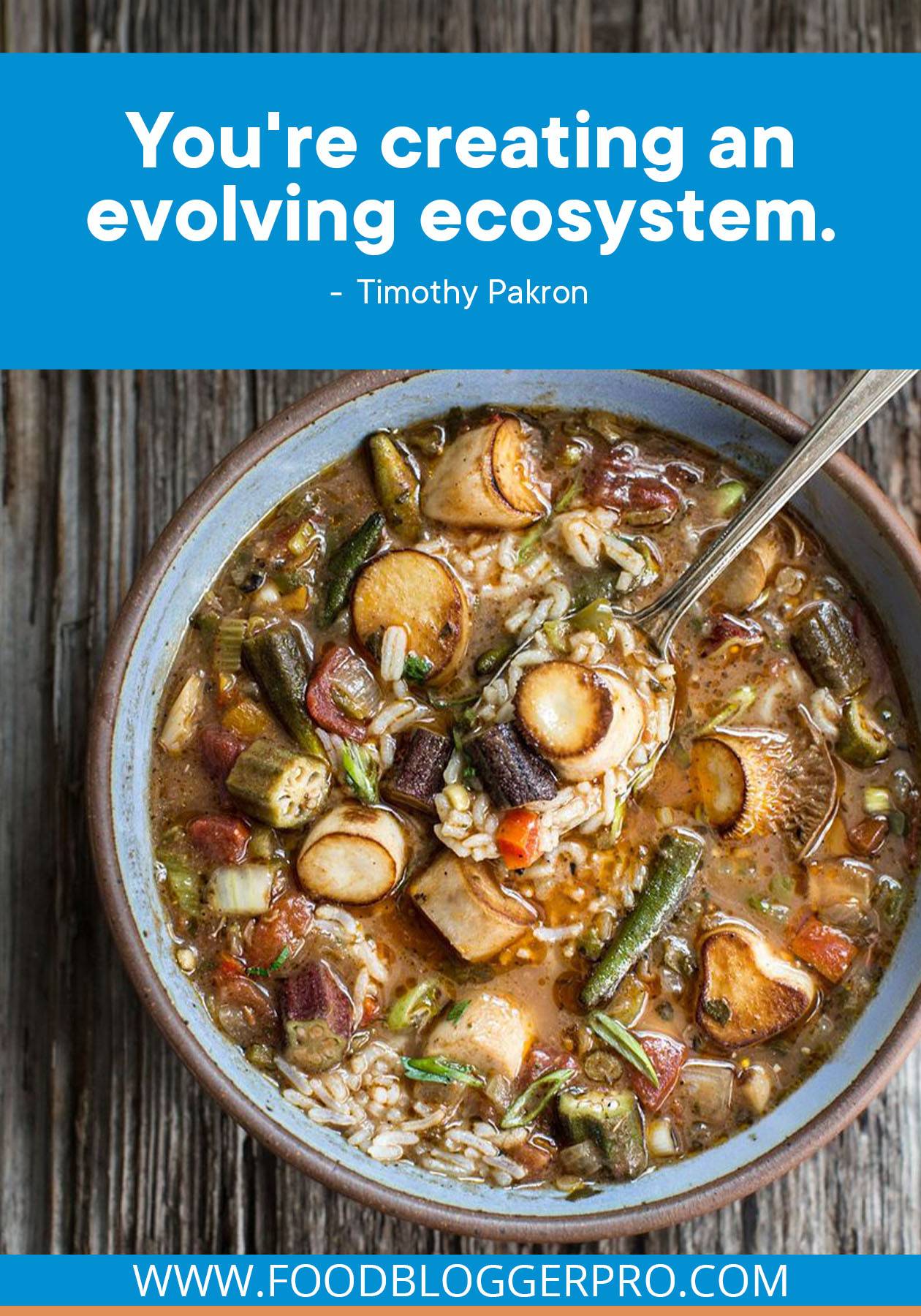
The next day you wake up and it’s like, okay, I’m gonna log back into WordPress and and try to get some of these things done. And but just one thing I wanted to say to anyone listening who’s a new blogger, who’s starting WordPress, who’s starting food blogging, just know the gig isn’t I’m gonna work on a recipe, post it, and then move on to the next. You’re creating an ecosystem and you’re going to have to update that recipe, you’re gonna have to keep an eye on it, and you’re gonna have to, you know.
Bjork Ostrom: Mm. Mm-hmm.
Timothy Pakron: continue to refine it and perfect it and things are gonna change and you’re gonna have to you’re gonna have to to come back to it. And so you can’t look at it as you know, and like during my book launch these past few months, like I haven’t really been focusing much new content on that blog. I’ve been focusing on refining what I do have. And I there’s it’s it’s been beneficial. But my biggest advice is that you’re creating an a an evolving, ever changing, you know, ecosystem.
off your work and and if that sounds over like if if that doesn’t sound interesting to you, then this is not the career for you.
Bjork Ostrom: Yeah. It’s something that definitely has changed. You know, ten years ago, the way that you would approach content would be you’d create something, you’d publish it, you’d maybe send out an email, talk about it on social. I think of it more now along the lines of almost like writing a song. You write a song, you have this song, but really after you record it, you’re like ten percent of the way done with it. Like if you are a musician, that is
Timothy Pakron: Mm. Yeah.
Bjork Ostrom: Inning number one of the life of that. And it will probably live for a really long time. It’ll have seasons where it’s like more popular or less popular. You’re probably gonna in some way kind of tour on it. It might be included on your sets. you know, I think maybe one of the differences where the analogy falls apart a little bit is like if you have a post, you’re probably gonna be changing and evolving that. Maybe it’s like remixing a song.
But like the core recipe itself is probably going to live and evolve with you as a creator. It’s not necessarily one and done. And I think that’s really important for people to be aware of that. different in the recipe world than in other worlds. Like if you’re a tech writer, you know, it’s like if you’re producing if you’re B K B H D, K B H D. He’s like a
tech gadget reviewer. Like his stuff I think probably spikes and then, you know, there’s three months and then it drops off. But like for our world, that’s that’s not true. It like these recipes can live for a really long time. one of the things I wanted to hear you talk about was the transition from photography to video. And we talk on the podcast around how a lot of times what we’re trying to do is we are trying to be aware of a wave.
Timothy Pakron: Mm.
Timothy Pakron: Mm.
Bjork Ostrom: A wave being something in the industry that’s happening. It could be a medium that’s working really well. It could be a platform that’s working well. It could be a type of content that people are really interested in. So we’re looking for waves. And then we are also trying to be really good surfers. And so how do you become a good surfer? How do you find a good wave? When you find both of those things, that’s a really amazing place to be in. And I and one example I think for you is.
A photography-based platform where you are sharing about vegan food, like and maybe typical southern recipes that have like this vegan twist to them. That was a wave, and you’re able to surf that. And suddenly the tides shift, the the beach sand changes, the platform algorithm shifts, and it looks different. You can still surf.
Timothy Pakron: Mm. Mm.
Bjork Ostrom: But like it’s gonna be, it’s gonna look a little bit different. Like maybe you get a different surfboard, the wave changes. What was that like for you to transition as a creator? To speak frankly, it’s like photography to video. It’s photo based platform to video based platform. Some people are just like, that’s not me, and they’re done. But you didn’t. You made the transition. What was that like for you to transition as a creator to be video forward?
Timothy Pakron: Mm.
Timothy Pakron: Mm. Mm.
Timothy Pakron: It was a booger. It was really tough. it was it was really, really tough. what I noticed was
Bjork Ostrom: Yeah.
Timothy Pakron: There was once TikTok blew up, there was a huge shift to Instagram and this massive push to short form video. And why I resented it so much was there was a cheapening to the quality. And you have to understand, I was sharing in feed on Instagram my my I was representing you know my body of work photographically and I loved it. And I had I had fantastic engagement and it was really exciting.
But I was doing Instagram stories very actively and I loved Instagram stories. That’s that form of video is so much more refreshing and fun and rough around the edges because it’s temporary. It’s not permanent. But what I noticed with TikTok and the influence of TikTok was it was trying to capture that energy of Instagram stories in feed as a permanent video. And
Bjork Ostrom: Mm-hmm.
Timothy Pakron: I was like, well, I don’t want to showcase my personality in a permanent feed situation like that. I know I could. I know I could roll out of bed and start talking to the camera while I’m drinking coffee and talk about whatever. Because I would do that on Instagram stories. But then I felt this pressure to do it in feed and interrupt this beautiful body of photography that I had been building for the last decade. So luckily.
Bjork Ostrom: Yeah.
Timothy Pakron: Luckily, I feel like, you know, and I feel like Instagram was having a major identity crisis for a long time. And I still kind of feel like it is a little bit, but now there’s been a resurgence with like carousels, and you can put together 20 slides of beautiful photography. And I’ve been doing that for my book launch, and they’ve been performing beautifully. And I’ve been getting great engagement and people are excited. And I haven’t had to create one video about the book for my in feed.
Bjork Ostrom: Mm-hmm.
Timothy Pakron: And so that’s been really inspiring and refreshing to me because that’s that’s what I love the most is sharing photography. But now that I’ve been able to do more, I’ve been able to balance the photography, I can do videos. And the thing is, is I’m I do enjoy doing videos. I’m good at it. They just take they use a different muscle in your brain. And so when I was inundated with, you know, and I and I was always trying to create high quality videos.
And so that was the learning curve because it was like I didn’t know about audio. I didn’t know how to really edit. And so the the toughest transition for me was trying to figure out my voice using the medium of video and not not going the direction of the rough around the edge in the moment, you know, video like Instagram story vibe. Does that make sense? Like you do you understand what I’m like?
Bjork Ostrom: Yeah. Yeah. Well, I think the I think it’s good for other creators to hear somebody else talk through their struggle in the evolution of a platform. Lindsay’s I mean, if she was on right now, she’d be like, Every six months, I have like a little bit of like a creator identity crisis. Like, what’s working right now? How do I want to create? What feels like genuine?
And it feels like it’s a lot of going back to the drawing board and figuring out, okay, now what? Like part of it is just what’s going to work on the platform, but also part of it is like, how do I wanna be showing up as a creator? And I think it’s one of the things that is, you know, true inherently in everything that we’re doing is if you are a creator, necessarily you need to be creative. And so what does that mean?
If you are entering into a platform that feels unknown or restrictive or like a medium that isn’t the medium that you’re used to. And it it’s the same platform. You look at it and it looks the same, but like photography to video is a massive shift. Like you don’t have a lot of people who are like, I’m a photographer and a videographer. Like more and more you’re probably getting that, but generally you have somebody who specializes, they’re like, I do photography. I’m a wedding photographer.
Timothy Pakron: Mm-hmm.
Timothy Pakron: Mm.
Bjork Ostrom: You don’t have a lot of people who are wedding photographers and wedding videographers, like because they’re so different. The mediums are so different. And so I think it’s important for us to talk about those shifts and changes. because it’s real and we feel it. And I think the option that you have as a creator is like, okay, I’m gonna pivot, I’m gonna go into this, I’m gonna try and learn it. Maybe it’s partnering with somebody else and bringing them in to kind of help with it. Sometimes it’s just like waiting it out and saying.
Hey, I’m okay to see where this goes for the next year and make a decision after that, after things settle. But I think it’s important to hear just because we all will experience that if we wait long enough. We will have a thing that works. We will have a playbook that we can use. It will feel really good because we’re locked in. We do it on repeat. And then it changes. And it doesn’t feel good to go backwards, but I think.
Timothy Pakron: Mm.
Timothy Pakron: Mm-hmm.
Bjork Ostrom: If we are going to continue to do this for decades, not just years, we have to get comfortable going backwards and like relearning how to surf on a new board. and it’s not always easy. And so that’s why I appreciate you sharing that.
Timothy Pakron: Yeah, yeah, it yeah, it’s no, I I agree. And and you know, I think now that I feel now that carousels and the push for kind of bringing some still stillness back to Instagram, even though you’re putting music on carousels, I think that’s been that’s been the best shift for me. Cause there was a moment where I was like, Well, screw this, I’m just gonna leave the platform. Like I didn’t sign up for this, I don’t know if I wanna do this anymore.
but I do feel like there’s a there is a shift back to stillness. And that’s what I miss the most about the old Instagram. And that’s why I like threads, because you’re more reading and there’s a stillness and it doesn’t feel so chaotic. That’s my biggest gripe with with Instagram now is you open it up and it’s like, like, my God, there’s so much like my God. So, but yeah, there I mean, have you felt that shift where I think people are kind of craving to
Bjork Ostrom: For sure, for sure. Yeah.
Timothy Pakron: stop on a post, spend some time with it. You know, that’s why carousels with copy are becoming popular and and trying to tell a story with a carousel. You know, it it it’s so funny ’cause 2014, it’s like you could post one square image. You couldn’t even edit the copy. Now you have to post twenty images that are really good and you have to figure out how to how to stop people because everyone’s attention span is just completely shot. And
Bjork Ostrom: Mm-hmm.
Bjork Ostrom: Mm-hmm, mm hmm, mhm.
Bjork Ostrom: Yeah. Yeah. I think we’ve I think we’ve felt that. I think one of the things that’s always interesting is like how much of that is driven by human behavior versus platform behavior. Like even with carousels, carousels, I think, speaking really tactically, are working well for a lot of people. is that because user users are changing or is it because the platform is prioritizing that? I honestly don’t have a good answer. I don’t know.
Timothy Pakron: And so
Timothy Pakron: Mm.
Bjork Ostrom: But I do think I just had a conversation with my friend Jeff, who has a company called Ug Monk, and their whole premise is analog. I do think that as things become more chaotic digitally, as things become as AI becomes kind of more prev prevalent in what we do, there will be an interest in analog things as like a counterculture pushback against what people are experiencing in their digital life. So I I definitely do think there is something there.
That’s maybe a good transition as we close out to talking about your cookbook, one that you can hold in your hands. I think this, I think this you can flip the pages, you can write on it, you can you can feel it, you can hold it. it’s a beautiful cookbook. and I think this episode is maybe coming out the day that it is published. but tell us more a little bit about the cookbook and where people can find it and maybe a little bit of a background on it, just to make sure that we get a little plug for that.
Timothy Pakron: Yes. You could actually feel it, yeah. It’s not yeah.
Thank you.
Timothy Pakron: great.
Timothy Pakron: Yeah, no, I appreciate it. Yeah, I mean, honestly, the cookbook represents that very passion that I felt when I first started Instagram and when I first started sharing food photography because I fell in love with people that were because there wasn’t many content creators at the time that were telling a story with ingredients in a recipe. So you could like look at this shot of, you know, some tart that was made with in the springtime with these beautiful peas and garlic scapes and
These flowers, and it was like, my God, you could like feel this moment in time. And it just shows you the beauty and power of a still image. And so all of that passion that I felt and and the merging of all my creative processes is celebrated in garden variety. And it’s particularly meaningful because when I started my Instagram, I was living in New York and I would go to the Union Square Green Market and I learned about all this unique produce.
And I would just photograph the produce and share it. And it was so thrilling to me. And that actually inspired the very ingredients that I grow in my garden today. And so it’s this beautiful full circle moment, just merging, you know, my veganism, my creative processes, and all my life stories and my passion for not just photography, but I I love to write, I love to curate a collection, I love to refine, and I love to obsess over a body of work.
It’s something that I crave. And so this book was three and a half years in the making. And and so that’s that’s really what it represents to me. It represents my that passion that I have for the creative process and also my passion for for fresh produce and cooking with the seasons. I just that’s what started all of this. I wouldn’t be here if I didn’t have that that love affair with fresh produce. And so
Bjork Ostrom: Hmm. Hmm.
Bjork Ostrom: Yeah. It’s awesome. I I th I talk pretty publicly about this. I am I wouldn’t consider myself quite food illiterate, but like I’m the I’m close to that, which people be your pinch of yum. I’m like, no, Lindsay’s pinch of yum. as I was looking through this, I was like, you know what? I wanna try making one of these recipes. So it was inspiring for me, to look through it. And so maybe what I’ll do is I’ll surprise Lindsay one night. I’ll be like, Do you want me to make? And then she’ll be Yeah, what are you gonna make? And I’ll just
Timothy Pakron: That’s what’s celebrated in the book.
Timothy Pakron: Yeah, Lindsay’s Vinciamo.
Timothy Pakron: Wow.
Bjork Ostrom: What would your recommendation be? What would be the rest best one for me to
Timothy Pakron: Ooh, make her make her the toasted pumpkin seed guacamole. It’s it’s not hard, but you ch you char a pepper and you kind of mash that in. And then when you toast the pumpkin seeds, you toast them to the point where they’re like almost burnt. There’s and they get super crunchy and crispy. I every time I make it for someone, they like they can’t stop talking about it. And it’s so simple. It’s so simple, but
Bjork Ostrom: Okay. Yeah.
Bjork Ostrom: Lights out. Yeah. Yeah.
Timothy Pakron: And I would love for Lindsay to see the book because she’s been a huge inspiration. Like she’s just she’s a huge, you know, you know, person in the in the food blogging world. And so, I just yeah, that would be such a special treat to know that she got it you made her a recipe from the book.
Bjork Ostrom: Yeah.
Bjork Ostrom: We got we got these shipments. I’ll set this one on her desk so she’ll see it. I’ll give her that background and really appreciate it. So Timothy, thanks for coming on, sharing your story. really appreciate it. And excited excited to make the guacamole.
Timothy Pakron: Thank you so much. Yeah, absolutely. Thanks for having me.