
Listen to this episode of The Food Blogger Pro Podcast using the player above or check it out on Apple Podcasts or Spotify.
This episode is sponsored by Clariti.
Welcome to episode 566 of The Food Blogger Pro Podcast! This week on the podcast, Bjork interviews Adam Gallagher from Inspired Taste.
Last week on the podcast, Bjork chatted with Ashlea Carver. To go back and listen to that episode, click here.
What Food Bloggers Need to Know About AI Search and the Fight for Fair Traffic
Adam and Joanne Gallagher have been running Inspired Taste since 2009 — long enough to have lived through every major shift in how Google works, from early SEO best practices to AI Overviews. But what’s happening right now feels different, and Adam isn’t staying quiet about it.
In this episode, Adam and Bjork dig into the current state of search from the perspective of a creator who has spent 15+ years playing by Google’s rules — only to watch those rules change in ways that feel fundamentally unfair to creators.
This is also a conversation about what comes next — equal parts anxiety and optimism — and what creators can actually do right now to advocate for a more fair and sustainable version of AI-powered search.
Three episode takeaways:
- What AI Overviews are doing to your traffic — Adam breaks down what position zero actually means and how AI Overviews are affecting the gap between impressions and click-through rates. He and Bjork also unpack the strange irony at the heart of the current moment: Google spent years penalizing creators for scaled content, and is now surfacing AI-generated recipes — essentially the definition of scaled content — at the top of search results.
- Why Adam chose to block AI crawlers from Inspired Taste — Adam shares the reasoning behind his decision to block ChatGPT, Perplexity, and Claude from crawling his site, and why he believes creators have both the right and the responsibility to push back on how their content is being used.
- What you can do now to improve the future of search for food creators — Adam shares what he believes needs to change in how Google handles AI Mode and AI search results to make them more fair for creators, and why he thinks advocacy could actually move the needle. He also talks about the importance of communicating directly with your audience about what’s happening to help them understand why supporting independent creators and seeking out real, tested recipes matters (watch the two Reels linked in the Resources section to see how Adam and Joanne are doing this at Inspired Taste).
Resources:
- Inspired Taste
- AI Slop Recipes Are Taking Over the Internet — And Thanksgiving Dinner
- Raptive
- Pinch of Yum
- Cloudflare
- NerdPress
- The Last Invention
- Robby Stein
- Rajan Patel
- First Instagram Reel about AI Recipes
- Second Instagram Reel about AI Recipes
- NBC News: Why AI holiday recipes can’t handle the heat
- Follow Inspired Taste on Instagram and Adam on LinkedIn
- Join the Food Blogger Pro Podcast Facebook Group
Thank you to our sponsors!
This episode is sponsored by Clariti.
Clariti is a content organization and optimization platform that helps you uncover SEO insights and monitor performance improvements by analyzing your WordPress and Google data in real-time — so you can audit your content, understand performance, and see real opportunities instead of guessing.
And it doesn’t stop at insights. Clariti helps you turn what you’re learning into actual projects and tasks — so you can go from analysis to action and actually get stuff done.
Go to clariti.com to learn more.
And, if you’re a Mediavine publisher, Clariti has a dedicated partnership just for you. Just go to clariti.com/mediavine to see what’s included.
Interested in working with us too? Learn more about our sponsorship opportunities and how to get started here.
If you have any comments, questions, or suggestions for interviews, be sure to email them to [email protected].
Transcript (click to expand):
Bjork Ostrom: If you’ve ever opened Google Analytics or Google Search Console and then just looked at it for a little bit and closed the tab because it felt overwhelming, this is for you. And here’s the thing, it’s not just analytics or search console, it’s also WordPress. Maybe you’re trying to find a post quickly, understand how it’s performing. And after a while, you’re jumping from tab to tab, trying to piece together information about how your content is doing. It really is one of the hardest parts about growing a content business. It’s getting clarity. It’s not always necessarily effort, it’s just knowing what you should do next because your data is scattered, your priorities are getting fuzzy, and you’re staying busy, but you’re not confident that you’re working on the right things. That’s why we created Clariti. It’s C-L-A-R-I-T-I. Clariti is a content organization and optimization platform that pulls all that messy data into one clear place.
So you can audit your content, understand performance, and see real opportunities instead of just guessing. And it doesn’t stop at just insights. Clariti helps you turn what you’re learning into actual projects and tasks. So you can go from analysis to action and actually get stuff done. It’s not about quick wins or hacks. It’s about building a calmer, more sustainable system so you can grow with clarity and confidence. Go to C-L-A-R-I-T-I to learn more. And if you’re a Mediavine publisher, Clariti has a dedicated partnership just for you. Just go to clariti.com/mediavine to see what’s included.
Emily Walker: Hey there. This is Emily from the Food Blogger Pro team and you are listening to the Food Blogger Pro podcast. This week on the podcast, we are chatting with Adam Gallagher from Inspired Taste. Adam and Joanne Gallagher have been running Inspired Taste since 2009, long enough to have lived through every major shift in how Google works from early SEO best practices to all of the helpful content updates and now to AI overviews. But what’s happening now in search feels different and Adam isn’t staying quiet about it. In this episode, Adam and Bjork dig into the current state of search from the perspective of creator who has spent 15 years playing by Google’s rules, only to watch those rules change in ways that feel fundamentally unfair to creators. This is also a conversation about what comes next and what you can be doing right now to advocate for a more fair and sustainable version of AI-powered search.
As always, you can head to the show notes for more information and links to all of the resources mentioned in this episode, but without further ado, I’m just going to let Bjork take it away.
Bjork Ostrom: Adam, welcome to the podcast. You have a ton of experience in the world of publishing food content. I think Inspired Taste was started pre Pinch of Yum. There’s a select group of people kind of in that 2008 to 2012 bucket of content creators. You’ve been doing this for a long time. We’re not going to talk necessarily a ton about your story, but I do want to hear a little bit of background because it helps to build the credibility around you as a business owner, you and your wife, as business owners, content creators, what you’ve built over the last decade plus really. So when did it start? What does it look like today? And then we’re going to get into talking about all things AI, which everybody’s been talking about and wants to talk about. So give us some backstory before we jump in.
Adam Gallagher: I didn’t know that we started before you. What was your year?
Bjork Ostrom: Well, maybe it was around the same time. 2009, same time.
Adam Gallagher: Like October 2009, around when we.
Bjork Ostrom: Okay. Yeah. Yeah. Same year. Yeah.
Adam Gallagher: But I think you’re absolutely right. Kind of sets the story of why this AI shift, especially on the Google being the size that they are and the traffic that they send to.
Bjork Ostrom: Yeah.
Adam Gallagher: We’ve been doing it for so long and we were following the guidelines and the best practices and they’re still actually doubling down to say, keep doing it the same way. But now it’s almost like the rugs pulled out from underneath us. So now it’s like you’re on your own and here’s all these changes and how are you going to shift?
Bjork Ostrom: Yeah. When I think back to our history personally as content creators, it felt like there was a really clear playbook. And the playbook was you show up, you create the best content possible for people, but you also have, like you talked about, these guidelines from certain platforms, Pinterest would say, “Hey, here’s best practices for publishing on Pinterest.” Any platform would say, “Here’s the way that you can create content that does well.” A lot of it is like human forward, but also here are the things that are variables that matter. The most important in the world of food was always Google because behaviorally, people go to Google to search for recipes. They say, “Okay, I want to make something. I’m going to go and I’m going to Google something to find a recipe for it. ” And so there’s this incredible opportunity for recipe creators to create amazing recipes that people will have success with, really good content, clear photos, clear documentation of the recipe, as helpful as possible.
Bjork Ostrom: And then you layer on some of the technical elements that are really important, structured data. Organizationally, you want your site to look a certain way, you want it to load fast, all of those things. And that’s the playbook. And you continue to show up and you continue to create great content. And for us, it was interesting to see like, oh, traffic continues to grow. If you continue to do the things that Google says are important and you create good content, it’s not just technical, there’s also an art to it. And generally, the year past the present year will be better than the year past if you continue to do that. And then there’s these shifts that happen, these massive algorithm updates where, like you said, it feels like the rug is pulled out from a lot of creators, not all creators, but a lot of creators where you’ve been doing this and we’ve had these conversations on the podcast, you’ve been doing this, you run that playbook and then suddenly there’s an algorithm change and your traffic goes in half over a two week period or maybe not your traffic overall, but you had a certain keyword and it was really important for you.
Bjork Ostrom: And then now there’s an AI overview showing up for that and people get the answer and it’s like, whoa, that’s a very significant change in the game that’s being played. So talk more about what that experience was like on your end, some of the ways that you’ve seen that show up and maybe some of the impacts that you’ve seen, whether with your own site or with other people that you’ve had conversations with.
Adam Gallagher: Yeah, sure. I think what made it the most betrayal is the only word I can come up with is, well, here’s the guidelines, here’s the practices, this is what you should do. But also more importantly that a lot of people don’t talk about is what you shouldn’t. So scaled content abuse is a big one, which is AI.
Bjork Ostrom: Can you talk about that? Scaled content. What does that mean for somebody who doesn’t know what that word is?
Adam Gallagher: So just creating content that does not add value above what a site should. So obviously follow all the ET guidelines. It’s not necessarily a ranking signal per se. I think they’re trying to strive for that anyway, but what you shouldn’t do is just create slop. I hate that term because it’s like too ambiguous, which is why we kind of coined the term Frankenstein because it’s more visual way of it’s stitching it together and trying to bring it to life. But essentially those frank and design recipes at scale is scaled content abuse and Google is the worst offender.
Bjork Ostrom: Doing that. Yeah. So I’ve never thought about this before, the point that you’re making, which is totally valid, that if you were to do, is this what you’re saying? If you were to do what Google is doing in an AI overview, it would be something that would violate their content guidelines. It’s not like breaking the … Well, even that would maybe be a consideration in terms of is it breaking the law? A lot of conversations around that. But if you were to do that on your site, you would be violating their best practice around how to create content because you’re creating this AI version of content, which has been derived from all of these different sites where they’ve been scraped and it creates kind of the average of those. And if you were to create a recipe that was an AI recipe, in Google’s eyes, it would say, “Hey, this actually isn’t okay if you publish this to your site.
Bjork Ostrom: We don’t want that to exist on the internet. We don’t want that to show up in our search results.” And at the same time, Google is creating those in their AI overviews as a result, which I’ve never thought of, but is totally valid. So can you talk about what an AI overview is? I know most people who have been in it know, but I think it’s helpful to review this stuff and maybe also talk about the evolution of position zero featured snippet into AI overview and how that has evolved as well.
Adam Gallagher: And back to your previous question of the impact. So we’ve been on the record with tons of journalists at this point, obviously. One of them was Bloomberg, which was the same article that you were
Adam Gallagher: For different reasons. But for ours, it was basically, at that point, Gemini three came out, which now AI overview, that’s the model that AIOps use to smush in these answers, these synthesized answer in position zero, which is above position one. So for cocktails specifically, those are, I guess, the most simplistic recipe. So Google very much views, which we don’t agree with, that, “Oh, I’m just going to give this most simplistic version of it above our cocktail.” So we ranked number one for Cosmopolitan and a few other cocktail. Well, back when AI overviews first launches, they started to ramp up as the first instance of 100% because they run tons of tests, really, really hard to track what’s going on because the tests run and then it’ll disappear and then they come back again.
Bjork Ostrom: Might be there for an hour, you see it, you try and replicate it on your side, it goes away, you don’t know if it’s there.
Adam Gallagher: Yeah. So but for cocktails specifically, when they started ramping up, it was 100%. We can actually see the impressions stay up, if not increase, but the clicks dropped immediately. Even though we were position one, Google was positioned zero in the AI overview, which was a full Frankenstein smush simplistic recipe above. So we passed that data to Bloomberg and we were quoted as, I think we said it was 40% decrease for those instances.
Bjork Ostrom: Yeah. So this is a really important example of what’s happening, a couple terms to recap, position zero. So we talk about our rank in Google, one, two, three, four. In a traditional, if it was just like the 10 blue links, where are you showing up? You see that in keyword data, Google search console surfaces that data, but then there’s this position zero, which is essentially Google’s reserving that for AI overviews, especially in the world of recipes and how to type content. And so that is showing up above. And what you’re saying that’s really important is impressions, and this is a good recap for people who aren’t as familiar with analytics. Impressions means how many times is it loading on the screen? So what you’re saying is for this specific cocktail recipe, it was maybe even loading on the screen for people more often. So impressions might’ve gone up, but the number of clicks, which is actually what matters, how many people are clicking on your site and going to your site, that’s going down.
Bjork Ostrom: And so it makes sense because suddenly this recipe is showing up in the search result, clicks go down because people look at it and they’re like, “Hey, I got what I need from the search result here.” We can think about that in any informational search that I do. If I’m like, “When is the Super Bowl?” And it just shows me the date in position zero, I’m not going to click on the first article from ESPN that has the Super Bowl date. So for that specific keyword, was it somebody doing a branded keyword search for your specific recipe?
Adam Gallagher: Right now, because we have to take some credit of our pushback, like major pushback with Raptive’s advocacy as well, is now we’re seeing in AI overviews, less branded Frankenstein recipes, which is the level of egregiousness outrageous. We did in the baby day. It still happens sometimes because these models aren’t perfect and they hallucinate all the time. And I don’t think Google necessarily has a full beat on what their code’s doing in all instances across the globe. But when you typed in Inspired Taste Cosmopolitan recipe, we would be competing against Google’s Frankenstein inspired tastes cosmopolitan, very important, which is against the law if you are a monopoly and that’s anti-competitive and scaled content apiece and there’s a whole bunch of copyright issues going on. So not only is our click right going, Google’s using our brand name to manipulate the user trust line.
Bjork Ostrom: Yeah. And the difference to help people understand is like maybe you do chocolate chip cookie recipe and you see some Frankenstein recipe in AI overviews. You’re not going to always see it. Sometimes you will, sometimes you won’t. To your point earlier, it’s really hard to track that. That’s one thing because that’s being trained on all of this different content around the web and then it’s creating the average of all of that and presenting it as, “Hey, this is probably based on what Google has seen across the web, probably going to be a recipe that might work okay.” But then there’s what you’re talking about, which is like a branded keyword Frankenstein recipe, which is somebody searches specifically for … So in our case, it would be like Pinch of Yum French toast. And in the search result, it’s like, “Here’s the Pinch of Yum French toast recipe.” And no matter how you spin it, it’s an issue because if it’s the exact recipe, then there’s a huge consideration around copyright violation.
Bjork Ostrom: It’s going to include ingredients, which it’s like that’s more questionable, but then also it has to include instructions. And if it’s an exact copy of that, there’s an issue there. There’s a copyright issue. If it’s not an exact copyright or an exact copy of your recipe, people don’t know that. They assume that it is. And so they associate that recipe with your brand. They go through that and make that recipe and then they’re like, “This was terrible and Pinch of Yum is terrible because this recipe is really bad.” So you’re caught in this place where either instance of that is going to be, like you talked about it, really egregious if that’s how it’s showing up. It sounds like what you said, you’re seeing that less often, but now you’re still continuing to see these AI recipes that are being presented in AI overviews. Is that accurate?
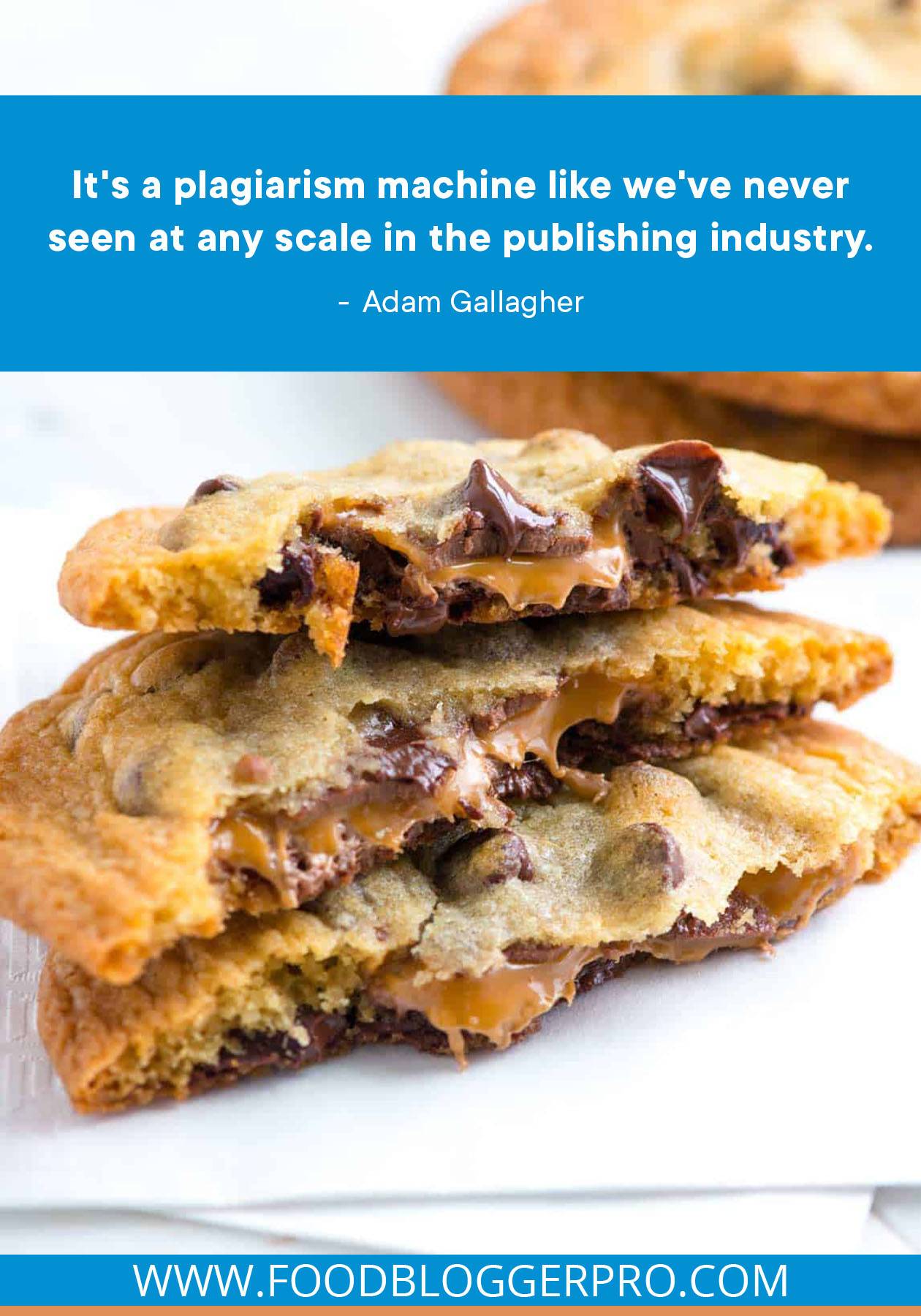
Adam Gallagher: So specifically AI overviews, we’re seeing it sometimes that has gotten better from a lot of our pushback and Raptive’s advocacy and anyone else that’s helped speak up. But now we’ll open up the Pandora’s box of AI mode, now the march of it kind of replacing AI overviews and Google trying to get you there, if you click show more on AI overviews, you get dumped into AI mode more and more, which is kind of their chatbot. Explain it if they don’t understand what that is, but it’s kind of their ChatGPT variant. Now once you go to … We’re seeing it less, thank goodness, in AI overviews, but now they’re dumping you into AI mode, which is, it’s a plagiarism machine that we’ve never seen at any scale in the publishing industry. So we’re seeing imagery, videos, Pinch of Yum’s names on Frankenstein recipes. You name it, it’s happening.
Adam Gallagher: We’re seeing verbatim, we’re seeing not verbatim. We’re seeing riddled with errors. We’re seeing citations missing completely. So I’ll say inspired taste recipe that is celebrated for hummus, whatever. It’ll use our image and then the recipe’s wrong or which poison, what’s
Bjork Ostrom: Worse.
Adam Gallagher: And we’ve talked to lawyers and it’s a copyright issue, definitely. Are we going to do anything about it necessarily? Not yet. But it is a problem, but mostly it’s the anti-competitive behavior that they’re kind of dumping you into their chatbot and the Frankenstein recipe, the branded is in full form. It’s like they’re coming up all the time.
Bjork Ostrom: They’re coming up being …
Adam Gallagher: In AI mode?
Bjork Ostrom: Oh yeah, yeah, yeah. That pathway is coming up all the time, AI mode. Is that what you’re saying? Okay. Yeah. So you
Adam Gallagher: Start your search in and you’ll say Inspired Taste Thomas Recipe.
Bjork Ostrom: Sometimes
Adam Gallagher: Very rare, you’ll see like an AI overview branded Frankenstein recipe. More so you’ll see some weird, not very useful for recipes of something of like, what is Hummus? Is that useful? I’m not sure. Are we getting less clicks or not? We can’t track, which is another problem. That’s another topic we’ll get to later.
Bjork Ostrom: Sure. We don’t
Adam Gallagher: Really track much in GSC or a Google search console.
Bjork Ostrom: Then
Adam Gallagher: If you hit show more as a user and you’re curious in the AI overview, you’re dumped into AI mode. And then the first prompt that’s populated is once again what you searched, inspired taste hummus or pinch of yum’s hummus or whatever. So then the default output of AI mode, which now you’re getting. So now it’s a full takeover of your phone, which we get mostly our traffic from, is a Frankenstein recipe that’s branded with inspired taste hummus, and then there’s mistakes and our imagery is used and our videos sometimes. Our YouTube video will be thrown
Bjork Ostrom: Adjacent to an incorrect recipe.
Adam Gallagher: So
Bjork Ostrom: It’s
Adam Gallagher: The whole store of if any publisher did that, which we do all the time, we would file a DMCA complaint.
Bjork Ostrom: Yeah, right. We’ve had that happen where somebody will, and I’m sure people who have been publishing for a while have had that where you’re like, wait a minute, that’s my image. And it’s actually using the recipe as well. Sometimes it’s people who don’t know what they’re doing and they’re like, “I love this recipe,” and they publish it to Blogspot or something. Oftentimes it’s people who know what they’re doing and they’re trying to, without doing any work, get traffic. So there’s this process called DMCA. It’s a process that a publisher, a digital publisher can follow if something has been copyrighted. Easiest use of it is a big block of text or an image where you can be like, “Hey, I originally published it here and it’s showing up over here. This is mine. You got to take this down and you send it and the host has to honor that.
Bjork Ostrom: ” But it’s like, okay, try doing that with Google on an AI mode search result. That’s kind of what you’re saying is you can’t do it in the way that you would with this normal process. And so that’s an interesting and I think important point to make, which is AI overviews, which shows up in traditional search result page. So for all of us, I think it’s really important to remember how multifaceted Google is. And 95% of us probably think of Google within the context of you go to Google and you search a thing and then you scroll through those search results. But what’s interesting is if you start to pay attention, you can see that depending on how you search, Google will even display the different options differently above. So if you search something like a best football catches, it’s going to show the video tab closer to the traditional search result than it would if you searched best football shoes, and then it’s going to show shopping closer.
Bjork Ostrom: And so it rearranges these tabs. Google’s always thinking about what is the most relevant view for people to see this search result. And what you’re saying that’s really important for us to remember is that there’s different kind of windows into the way that Google is presenting content, one of which is that traditional search result, an AI overview showing up in that, detrimental for sure. What you’re saying is maybe there’s less of that happening now in large part due to speaking out against it, pointing out how bad some of these results are, but now it’s happening within AI mode. And for anybody who hasn’t used it, it’s important to go and use it. It feels pretty similar like ChatGPT, Claude. It’s like Google’s version of that where you’re having a conversation with this chat interface. But what you’re saying is a lot of times it will peel off of a search result.
Bjork Ostrom: And I think that most often shows up in like a, looks like it’s like a dive deeper in AI mode. Is that what you’re talking about and what you’re seeing?
Adam Gallagher: Or in AI overviews, it’ll be the show more button.
Bjork Ostrom: Show more. Yep.
Adam Gallagher: Then if you click the show more, now I’m pretty sure it’s like rolled out to production where 100% of the time you click show more, it’s a full AI mode takeover and now you’re in AI modes and then at the bottom that you’re prompted to ask another query. Some people may not … It’s like Google’s way of trying to force people to use it. People may not know the next question you ask and now you’re going to be in AI mode. And the only way to get out is to hit like it’s in the top right, there’s an X. Then you’re back in the normal-
Bjork Ostrom: Yeah, it’s your point here. So I did, I’m kind of working on this in real time. I did a what is hummus, Google search, and then I clicked dive deeper in AI mode. It’s like, “Here’s what hummus is. ” And it’s referencing different sites and then it’s like, “Would you like a simple step-by-step recipe make at home?” And I was like, “Yes.” And then it gives it to you. Now that’s obviously a little bit different. It gets more, to use your word egregious, if it’s like a branded search result where then suddenly your brand is associated with that. And I think probably what happens as people get into this is it’s like, gosh, it’s kind of infuriating. Man, there’s this multi-trillion, it’s like a multi-trillion dollar company who is creating a product that they are earning money from that is detrimental to publishers, but it feels like you’re kind of stuck because it’s not like you’re going to say, “Hey, I don’t want Google to crawl my site anymore.” And you could block specifically an AI bot, but even that feels like you’re taking a little bit of a risk.
Bjork Ostrom: Don’t know exactly what that looks like, how that plays out. So what do you do? You’ve been active in speaking out against this and have had success with it. You’ve also been kind enough to Credit Raptive and other creators who have spoken out, but what do other creators do and what would your advice be as you start to notice instances of this coming up and how can you help to push back against some of this so as not to get in a place where five years down the line, we’re creating content that’s just all showing up in AI mode?
Adam Gallagher: That one is actually, oddly enough, a really easy question is like, right now what Google is doing is wrong. You can do any example for Pinch of Yum and insert recipe and see the Frankenstein recipe and anyone just needs to speak out about it and just realize that yes, Google is kind of like this monolithic thing. And we’ve talked to a lot of creators and they have this, they feel defeated almost like, “What do we do? ” I think Paul Bannister have had a lot of chats with him and he’s kind of called it the hostage dilemma. And yet Google is holding us hostage. There’s nothing we can do. We can block Google extended, but that’s very, very, very specific. It’s like their Vertex API. So not to get too geeky, but that’s like a very small use case of their Gemini app. It’s not search at all.
Bjork Ostrom: It’s like if you download Gemini the app, it would be … Yeah.
Adam Gallagher: Which it’s not a traffic driver for anyone. No one focuses on that. So we used to block it, then we didn’t block it just to see what would happen. We got cited like 300 times, we get no traffic from it. It’s neither here nor there. Google has not … There’s been a bit bad, quite a bit bad by not splitting out the AI bot from their normal search bot. So we are being held hostage. They are using our content. They’re quite literally going to court saying, “It’s for use. It’s mine.” They’re asking for, “Hey, it’s your use. It’s mine to use.” So really all we can do until all of Penske versus Google and all of these major cases, New York Times versus ChatGPT. Those are going to take years to play out. There’s going to be appeal upon appeal. So our industry just needs to say, “Hey, this isn’t okay.” And realize it’s not like Google is going to backlash and get you in trouble.
Adam Gallagher: We’ve been very, very vocal. I’ve had chats with quite a few Google executives. Like Elizabeth Tucker had great chat with her. I went to South by Southwest where she was speaking. I chatted with her. She wasn’t a big fan of how the AI was being used, but she’s not on the AI side. She’s on the organic side.
Emily Walker: Sure.
Adam Gallagher: But she’s a person, right? I don’t know who she’s going to talk to now. And she was only open to feedback. I’ve had many chats, still have chats to this day with Danny. Danny Sullivan, who’s no longer the search liaison, and he thanked me for the feedback and said, “I’m going to give all the feedback to who I need to. ” What happens out of it? I have no idea. But recently, two weeks ago, Robbie Stein, who is on the AI side, he is like the UX, I think. He’s like the SVP of … He’s in charge of AI product. So he is in charge of how AI mode the UX looks. And he just said, due to feedback, he thanked us for the feedback. Who knows if that’s actually how he honestly feels. Sure. And they said changes are coming, but there’s still default Frankenstein.
Adam Gallagher: So we’re not there yet by any means. So we need to keep the heat up and we need to pressure them to do something because if we wait for the courts, the damage is piling up now. So we need
Emily Walker: To
Adam Gallagher: Speak out about that. And we can’t do anything from our publisher standpoint. We can’t block anything. So the last thing there is we do block all other answer engines. We block ChatGPT and Perplexity because they don’t drive us traffic. We have all the data we worked to double and triple check our data. We get, I think ChatGPT drove 80 clicks over six months.
Bjork Ostrom: Sure.
Adam Gallagher: There’s no traffic. So we block them, there’s no benefits. So Google’s it.
Bjork Ostrom: You use Cloudflare for that?
Adam Gallagher: Yeah, we use Cloudflare, their CDN
Bjork Ostrom: To do the Block. Did you test the pay for access AI bot Cloudflare thing?
Adam Gallagher: Yeah, we haven’t. We were part of a pilot to do so, but we actually just decided to stop at blocking.
Bjork Ostrom: Yeah.
Adam Gallagher: Because I think it is important to, before we get to why we decided not to test it out is, so robots.text, not to get too geeky, but I’m sure you’ve talked on your podcast about that.
Bjork Ostrom: Yeah. It’s like a file that exists within your website that tells robots what to do, like bots that are crawling your site. Yeah.
Adam Gallagher: It’s a polite hint. There’s no laws to abide by. Companies can do whatever they want. And since AI is in the Wild West, many times it’s not … So Cloudflare, we’ve worked with high-end engineers and they said the accuracy of blocking with robots.text directives is like 30%. Most bots are just not caring at all. So you need to pay Cloudflare to proactively block to get up to the 95 plus percent accuracy of blocking like Perplexity and ChatGPT. So we use Enterprise Cloudflare to block with that extreme precision of blocking.
Bjork Ostrom: Yeah. So RobotsHotTXT, it’s a like, “Hey, please, hey, please don’t crawl my site.” To which a lot of bully bots would be like, “Or I will.” And then they just do it and it’s like they don’t tell you. But with the Cloudflare, what you’re saying is you can actually say, “Hey, block this This bot from actually coming onto a site, you can be more precise. It’s not like a recommendation. It’s like code that’s existing within your stack that’s saying, just don’t allow this bot to crawl.
Adam Gallagher: Exactly. Which it is a paid feature because it’s … So robots.text blocks based on user agent stuff, which AI bots, they morph all the time to look like a normal user. So that’s why they’re just circumnavigating it. So Cloudflare paid their enterprise grade system, which NerdPress, we worked with them. We have our own singular seat that Andrew helps do the technical. But we help them figure out how to get that 95 plus percent blocking to all of their clients. So if you’re with NerdPress, you can block anyone that you want.
Bjork Ostrom: You can opt in and say, “Hey, this is something that I want, ” because NerdPress and Andrew and their team there have the enterprise Cloudflare version. It’s part of what they’re doing.
Adam Gallagher: No extra cost. So that’s a good thing. So now you have to block because that’s what AI companies are asking you to do. They’re saying, well, they’re going to court to say all content that has ever existed and will ever exist is ours. So you have to block, Google quite frankly says this in their advice. You have to block us to have us come to the table. They actually say that many, many times in their press release. So obviously-
Bjork Ostrom: Come to the table, meaning have a conversation about-
Adam Gallagher: We may have an agreement. We can work together.
Bjork Ostrom: Yeah. And that’s what you’re talking about with some of these court cases. There’s this long process. New York Times is an example. Hey, you used all of this content on the New York Times to train these models. New York Times says, “We’re going to sue you for that. ” It’s not like that happens in three months. Oftentimes it’s not like that happens in three years, but then those court cases are often set the precedent for all of the other instances. And that’s why those first early ones are so important. But what you’re saying is you can’t wait until that settles because we might all be retired by then, not actually true, but the damage is going to be done in this world one, two, three years down the line because of how quickly things move and just the way that the industry is. So you had said a little bit like, “Hey, there’s not much that you can do.
Bjork Ostrom: We’re trapped in this. ” But at the same time, there’s actually stuff that you have done, which is have these conversations. And one of the places that you’re doing that is on X on Twitter. And it’s interesting to see people are accessible and seeing those messages and responses, is there something that you think that creatives could do to be a part of that conversation if they do see something come up to mention it? Would there be any advice that you’d have for people who want to not be over the top angry about it and go scream at everybody, but to enter into a conversation to let people know who probably want to be creating helpful, good products in the world, to let people know that this is happening. Because I think a lot of times they might be aware of it. A lot of times they might not be aware of it or might not be aware of exactly the impact that is happening on some of these small businesses.
Adam Gallagher: You have to remember, Google is huge. I know you know that, but don’t have that be deer in the headlight. So once again, like I already said, just remember there’s a command struck and there’s a lot of people in between and they talk amongst themselves. So they’re also on LinkedIn and yes, we still call it Twitter
Adam Gallagher: And basically it’s just screenshots and videos. So it’s just, Google, have you seen this? I mean, everyone needs to choose their own voice and there’s a lot of people out there that are just expletives and like, “How dare you do this, blah, blah, blah, blah, blah.” And I can’t repeat them. It’s a human emotion when there’s theft at this level happening. So you do you, but we’ve decided to take more of this like Google, we’ve had conversations, we’ve been here for a really long time and Pinch of Yum would be great at this and say, “We don’t like how you’re using our content. Here’s an example. Have you seen this? ” That sort of thing. And you can get a little bit feistier than that, just like ratchet it up a little. But it’s more just like polite shaming. And you have to realize that many, many times we’ve been in the Google complex and had conversations with engineers on a couple projects before and they have no idea.
Adam Gallagher: They’ve never seen it. That’s a big eye-opener when I tell people that. It’s like, well, it’s there, right? It’s at scale. It’s like billions of queries.
Bjork Ostrom: Yeah. It’s wild to think about it, but I just finished this podcast series. It was actually Kate All from SimplePen Media recommended it when we were chatting. It’s called The Last Invention. And it’s this, I don’t remember how many episodes it is, seven, eight. The first batch was maybe like six or seven. But one of the things that was such an interesting takeaway from it is this idea of how AI came to be. This is a very broad generalization, but there’s some people who were in the camp of like, we need to create a really structured process to have this tool that operates in a way that is very predictable. And then there’s another camp of people who are like, “We need to treat this as if it was like a baby and a baby that grows into a toddler, that grows into a kindergartner.” And we as humans can’t look at another human and be like, “This is exactly how it operates and this is why it does these steps and here’s how it plays out.
Bjork Ostrom: “ And the takeaway for me was in deciding to go the path of we want to create AI through the process of giving it an immense amount of compute and data and a general directive to then make sense of that and see how it evolves, what you get on the other side is something that you can’t control and that you don’t completely understand. And it’s a black box. And so I think that too is an important reminder for us as publishers that the output that is happening here isn’t necessarily pre-programmed to look a really specific exact way. And it doesn’t mean that they can’t shift or adjust or change it, but it does mean that there are a lot of unintended consequences that come out of early stage AI tools. And if you come across an instance like this and you point it out to people who are working on it, it’s not necessarily saying like, ”Hey, I saw you created this thing and this thing that you created is really bad.“ It’s saying, ”Hey, you created this AI product and just so you know, this is one of the outputs that it’s giving us.” And a lot of times, like you said, they might not even know that that’s happening.
Bjork Ostrom: I think in this case, it’s at the point where are informed enough due to being vocal about it, but what does that look like for you? It’s like screenshots, it’s videos, and then it’s tagging people on Twitter, on Instagram, maybe on LinkedIn would be a better place. And then how do you know who’s who? In these companies, I think of Google and I’m like, I don’t know, I could find Google search who the CEO is, but …
Adam Gallagher: Well, for us, so for X specifically or Twitter, is Robbie Stein, he’s active. He doesn’t respond to a lot of people, but I know he’s reading. You just know Google has to be cautious with what they say, so especially
Bjork Ostrom: On
Adam Gallagher: Platform like Twitter or LinkedIn or wherever.
Bjork Ostrom: Suddenly you’re publicly speaking on behalf of Google. So
Adam Gallagher: You have to assume … That’s why we go on the more polite side. We want them to not see us and be like, “Oh, inspired eye roll.” We want them to maybe pay attention a little bit. And so on Twitter, we would recommend Robbie Stein. He’s huge on that. And he’s the one that just announced for recipe specifically, called out recipe specifically in AI mode, the UX will see improvements, stay tuned. So he opened up. That’s massive. I think that’s huge because I think up until the launch of AI overviews and beyond, they haven’t specifically set a niche, like a search vertical is going to see improvements like that, that specifically yet. I think that is the first to do so. I could be wrong, but there’s been some small UX tweaks here, but for them to say that massive improvements will be coming, it’s huge.
Adam Gallagher: So he’s kind of opened it up. And Virgin Patel, that’s the other one. He’s on, I believe more on the organic side, but he does some AI stuff. He was someone who worked on AI or the lens, Google Lens.
Bjork Ostrom: Sure.
Adam Gallagher: He thanked us for our feedback personally on X.
Bjork Ostrom: Cool. So
Adam Gallagher: That was amazing. And then they’re also there on LinkedIn as well. And you’d be surprised how many people are in charge of Google, but I think those two, they’re vocal and they were actually brought on to help Danny Sullivan when he was search liaison because it’s pretty much him and John Mueller that would do public PR stuff. They were brought on to help him before Danny was whatever happened to him.
Bjork Ostrom: Yeah. So Danny Sullivan, John, what was John’s last name? John Mueller. These are people who search liaison. These are people who kind of speak on behalf of Google around the state of search, here’s what’s happening, here’s what’s going on, advice, best practices, things like that. And so they’re almost like the kind of evangelist on behalf of Google. So where does that leave you now? You’ve been doing this for a long time. We’ve been doing this for a long time. We’ve seen a lot of evolutions within the world of content creation, within the world of blogging, social media. There’s been a lot of things that you can look back to and point to say like, “Hey, this was a big change.” None of which I feel like are as big as what’s happening right now. So for you as a creator, when you think about the business that you’re building, what do you think of over the next year, the next two years, the next five years?
Bjork Ostrom: Are there any thoughts that you have around the future of content creation as it relates to search or even just in general, where are you at right now as you think about what your job is, what your business is looking forward?
Adam Gallagher: Emotions can be true at the same time, utter terror sometimes, and then also optimism because in us voicing our opinion, yeah, sure. When we first started, we were a bit nervous about what if we get backlash for, I don’t know what reason, I don’t know what we were thinking about what backlash, but we’ve only seen the general public 90% plus be on our side. And we’re also seeing this backlash against AI being forced upon us and trying to replace everyone. So recipes, artists, photographers, the backlash is real. So you’re actually, when you voice your opinion, sure there’ll maybe be 10%, I would say, that are just pro AI at all costs.
Bjork Ostrom: Sure.
Adam Gallagher: Fine, AI all the way. We must beat whoever, China, we might race to make AGI, but 90% plus I would say vast majority will support you. So basically what I’m trying to say is we’re hopeful that through advocacy, we need clicks. Clicks is the ballgame. If that doesn’t change, we are in serious trouble because there isn’t, as you pointed out in the Bloomberg article, there isn’t another replacement. There’s nothing. On ChatGPT, if you get cited on it, great, but you don’t get clicks and they’re not doing so well right now. They just pulled the plug on Soara, their video creation sloppy,
Adam Gallagher: But they never generated clicks to begin with. So we’re hopeful, but also terrified. But we do think the clicks because of the backlash and mostly that will get heard. And I think all companies are starting to see it and that like the dam starting to burst. I don’t want to say the bubble. I don’t want to talk about bubble. I’m so sick of that topic, but I think there is like a regulation that is starting to occur where I don’t think it’s a coincidence that Robbie Stein specifically said, “Thank you for the feedback we need to change.” I think they’re seeing the value that … Well, once again, it seems crazy that they’re seeing the value of Click. They’re seeing the value that creators need to exist for an ecosystem to exist. So there will be a future, but there will be quite a bit of damage
Bjork Ostrom: And a lot of change. I think that’s the other thing. It’s like there’s been changes on platforms like Instagram, the massive change going from video to images to short form video, Facebook. There’s been so many changes through the years, but I think none as impactful as the shifts that are happening within the world of search. And so yeah, I love to think about that idea of holding those two things at the same time. You can have a little bit of fear around what will happen, thinking of the downside, thinking of the risk, but also some optimism in saying, “Hey, the future could be really bright. There’s a lot of really amazing things that can come from this. ” And we could do another episode talking about a part, if you section out the negative impact of AI, there’s some really incredible things as creators that allow us to do less of the monotonous work.
Bjork Ostrom: I think a really good example is like organizing files. I’ve been asking people a few times on the podcast like, “How do you organize your video files? Or where do you put your photos?” And a lot of people will laugh assuming that they have a system for that. And that would be a great example of AI can come in and really it’s really good at taking a bunch of data and making sense of it. But then it’s not just a perfect, it’s awesome or a perfect, it’s terrible. It’s this kind of weird mix of it. And so how do you take the good and then address the bad? And I think you’ve done such a great job of that in voicing the opinions you have and advocating for fair use of content, advocating for creators. And I think it’s super helpful to talk about ways that you can do that so other creators can enjoy that conversation.
Bjork Ostrom: Is there a way, you’re continuing to talk about this on X, on Twitter, maybe on LinkedIn as well. For anybody who’s interested in joining the conversation or even following along with what you’re doing, what’s the best way to do that, Adam?
Adam Gallagher: So I would like to leave it with a … We try to be very clear what we’re asking Google to do, because you could rail at Google and say, “Fix everything.” But then Google has, once again, they’re a huge company, questionable intentions, but they have to tell an engineer like, “Oh, we need to fix that. Let me take a note,” and then someone has to fix it. So what we’re asking for is, so Robbie Stein specifically said that the … So right now it is still a complete mess. Images, the default response for recipe queries, branded and unbranded is default Franken.
Bjork Ostrom: In AI mode.
Adam Gallagher: If you search something like Ground Tacos as something more vague, that’s what Robbie rolled out. You’ll get more links and better … It’s once again, you can’t track anything, so you can’t see if there’s improvements of clicks. But if you just type in something vague like Ground Taco, not Ground Taco Recipe, you’ll get more links embedded in.
Bjork Ostrom: Sure.
Adam Gallagher: But you still have to click it and then you get an AI overview, then there’s links. So what we need is default experiences to be you, there’s links that go directly to Creator and the recipe intent queries branded and unbranded, the Frankenstein has got to go. And I immediately said, “Thank you, Ravi. Thank you, Rajen.” Which resent, he responded back saying, “Thank you for the feedback.” I was pretty scathing after to say, “Thank you very much, but the default Frankenstein still has to go. We’re still seeing it. ” And then I did some more video, like I did a video thread. So that’s a great place to start. Gives it a nice razor edge for recipe specific. The default Frankenstein situation’s got to go. And he did say there’s a lot more … This was the thing that I was blown away. In his announcement, he said, “We’ve heard the feedback.
Adam Gallagher: There’s a lot of work to do and stay tuned. The floor is ours.” So I think everyone should share screenshots to say the default Frankenstein situation’s got to be fixed, Robbie.
Bjork Ostrom: It’s so interesting to see as you’re talking about this, I did a ground taco recipe, that’s just what I searched in AI mode. After doing that, Pinch of Yum, I did a Pinch of Yum chocolate chip cookies, showed some links on Pinch of Yum. And then after I did a ground taco recipe and it’s like, “What’s going on here?” I’m reading through it and it’s like for classic ground taco, the goal is a savory saucy meat that clings to the shell. While Pinch of Yum doesn’t have a standalone ground beef taco post, their taco meat method is a community staple for its use of a quote unquote slurry to create that perfect texture. And then it goes down and then it says, “If you want to skip the packet, this ratio from love and lemons and pinch of yum works for beef, taco or chicken.” And then the referenced link is momsdinner.net.
Bjork Ostrom: It’s
Adam Gallagher: A mess.
Bjork Ostrom: So it’s like exactly what you’re talking about. It’s like, none of those creators want to be associated with the recipe that exists underneath that, and yet we are. And I think that’s a great … We can end on that as an example, but something for us to be aware of. It’s been super cool to see you and the work that you’re doing speaking out against this. And on inspired taste side, where can people follow along with what you’re up to? And you guys create such great content.
Adam Gallagher: Thank you so much. And thank you for the kind words. We’re happy to do it because we love what we do. We want the industry and ourselves to have a future and we’re optimistic, but I think more people need to join in the conversation. So if you want to see what we’re saying in our voice, if you’re not quite sure, not saying that ours is perfect by any means, we’re human, we’re not AI, that’s worse. That’s a bad example. Is on X, that’s our AI voice and LinkedIn is our AI voice. It’s actually my page, Adam Gallagher. It’s not inspired.
Bjork Ostrom: Sure.
Adam Gallagher: But as far as the recipes are concerned, we’re on all other platforms. That’s where you’d find us YouTube, Interest, and everything else. But if you want to follow along, maybe who should I be talking to? You’ll see who I talk to on X and LinkedIn.
Bjork Ostrom: Yeah, that’s great. And shout out to Joanne as well. High school sweethearts, Lindsay and I too. Love that. So you guys both have done such great work in advocating for the industry. Appreciate you coming on, sharing stories, and we’ll have to have some updates along the way as you guys continue to not only continue to create content, but also have these conversations around the web. So thanks for coming on, Adam.
Emily Walker: Hey there. This is Emily again. Thank you so much for listening to that episode of the podcast. We are already almost halfway through April, and this month really got away from me, but better late than never with our monthly membership update. If you didn’t already know, we have a wonderful Food Blogger Pro membership that you can join as a monthly, quarterly, or yearly member. And within the membership, we have hundreds of course lessons, monthly live Q&As, monthly coaching calls and site audits, a member forum, and deals and discounts all available to our members. It’s an incredible resource if you’re looking to start or grow your food content business. Usually at the start of each month, I like to pop on the podcast and let you know what you can expect in the membership. Since it’s already the middle of April, I’ll recap you on what we’ve already done and what you can look forward to in the month.
On Thursday, April 2nd, we released our April coaching call with Stephanie Deming from the blog, The Chaotic Table. In this coaching call, Bjork and Stephanie chat about transitioning from client work, standing out in the age of AI and defining your brand. Last Thursday, we released a course update to our blog post writing 101 course. We’ve updated some of the lessons and then also added a great lesson that walks you through step-by-step, start to finish, how to write a blog post, how to format it, what to include, really just everything you need to know to write a great blog post. Next up, this Thursday, April 16th, we’ll be doing our monthly live Q&A. This month, we are welcoming Jenna from the Pinch of Yum team to talk about marketing your content. She’ll answer all of your questions about promoting your recipes on social media, on email, everything you need to know to get your recipes out in the world.
It’s already been a great month and we’re really looking forward to the live Q&A this Thursday. If you’d like to join us in the membership, you can just head to foodbloggerpro.com/membership to learn more. Next week on the podcast, we are welcoming back Sally Ekis, who is a literary agent in the cookbook space. It’s a really wonderful interview, so we’ll see you back here next week for that. Make it a great week.