
Listen to this episode of The Food Blogger Pro Podcast using the player above or check it out on Apple Podcasts or Spotify.
This episode is sponsored by Clariti.
Welcome to episode 570 of The Food Blogger Pro Podcast! This week on the podcast, Bjork interviews Jenn Lueke from Jenn Eats Goood.
Last week on the podcast, Bjork chatted with Liz Wilcox. To go back and listen to that episode, click here.
How Jenn Lueke Grew to 1.7 Million Followers with Budget Meal Planning Content
Jenn Lueke started Jenn Eats Goood in 2018 as a college student — no strategy, no monetization plan, just a hobby Instagram account she loved running. For five years, growth was slow, but she remained consistent. Then in 2023, something clicked. She leaned into meal planning and budget grocery content, and everything changed. Within a year, she went from stalling in the thousands to crossing one million followers.
In this episode, Jenn and Bjork chat about all of it — what finally worked, how she prioritizes data in her content strategy, which platforms she’s focusing on right now, and why she now considers her Substack newsletter her number one priority.
Three episode takeaways:
- The importance of leaning into what is working — It took five years of trial and error, learning, experimenting, and testing before Jenn’s following on social media started to grow. Her meal planning content really resonated with her audience, so she capitalized on the momentum of the series to grow her community (rather than reinventing the wheel)!
- How Jenn built her team — Growth brings new challenges, and Jenn is candid about how hard it was to build a team in the beginning and what the division of labor looks like now that she’s figured it out.
- Why Jenn made Substack her number one priority — After just a couple of years, Substack is now the biggest revenue driver in Jenn’s business. She and Bjork talk about how she balances free and paid content, what drives growth on Substack, and why it is the most important part of her business right now.
Resources:
- Jenn Eats Goood
- Liz Moody
- Buy Back Your Time by Dan Martell
- Q&A: Using Substack as a Food Creator — for Food Blogger Pro members
- Don’t Think About Dinner
- Follow Jenn on Instagram, Facebook, TikTok, Substack, and YouTube
- Join the Food Blogger Pro Podcast Facebook Group
Thank you to our sponsors!
This episode is sponsored by Clariti.
Clariti is a content organization and optimization platform that helps you uncover SEO insights and monitor performance improvements by analyzing your WordPress and Google data in real-time — so you can audit your content, understand performance, and see real opportunities instead of guessing.
And it doesn’t stop at insights. Clariti helps you turn what you’re learning into actual projects and tasks — so you can go from analysis to action and actually get stuff done.
Go to clariti.com to learn more.
And, if you’re a Mediavine publisher, Clariti has a dedicated partnership just for you. Just go to clariti.com/mediavine to see what’s included.
Interested in working with us too? Learn more about our sponsorship opportunities and how to get started here.
If you have any comments, questions, or suggestions for interviews, be sure to email them to [email protected].
Transcript (click to expand):
Disclaimer: this transcript was generated using AI.
Bjork Ostrom: If you’ve ever opened Google Analytics or Google Search Console and then just looked at it for a little bit and closed the tab because it felt overwhelming, this is for you. And here’s the thing, it’s not just analytics or search console, it’s also WordPress. Maybe you’re trying to find a post quickly, understand how it’s performing. And after a while, you’re jumping from tab to tab, trying to piece together information about how your content is doing. It really is one of the hardest parts about growing a content business. It’s getting clarity. It’s not always necessarily effort, it’s just knowing what you should do next because your data is scattered, your priorities are getting fuzzy, and you’re staying busy, but you’re not confident that you’re working on the right things. That’s why we created Clariti. It’s C-L-A-R-I-T-I. Clariti is a content organization and optimization platform that pulls all that messy data into one clear place.
So you can audit your content, understand performance, and see real opportunities instead of just guessing. And it doesn’t stop at just insights. Clariti helps you turn what you’re learning into actual projects and tasks. So you can go from analysis to action and actually get stuff done. It’s not about quick wins or hacks. It’s about building a calmer, more sustainable system so you can grow with clarity and confidence. Go to C-L-A-R-I-T-I to learn more. And if you’re a Mediavine publisher, Clariti has a dedicated partnership just for you. Just go to clariti.com/mediavine to see what’s included.
Emily Walker: Hey there, this is Emily from the Food Blogger Pro Team, and you are listening to the Food Blogger Po Podcast. This week on the podcast, we are chatting with Jenn Lueke from the food blog, Jenn Eats Goood. Jenn started her blog in 2018 as a college student. And for five years, her growth was slow, but she remained consistent. Then in 2023, something clicked. She leaned into meal planning and budget grocery content and everything changed. Within a year, she went from stalling in the thousands of followers to crossing one million followers. In this episode, Jenn and Bjork chat about what finally worked, how Jenn prioritizes data in her content strategy, which platforms she’s focusing on right now, and why she now considers her Substack newsletter her number one priority. It’s a great episode with lots of practical tips, and we really hope you’ll enjoy it. Without further ado, I’ll let Bjork take it away.
Bjork Ostrom: Jenn, welcome to the podcast.
Jenn Lueke: Thank you so much for having me on. Excited to be here.
Bjork Ostrom: You’ve had a great journey as a creator. You started in 2018, is that right?
Jenn Lueke: Yeah.
Bjork Ostrom: And have grown your following to millions, hundreds of thousands on different platforms, millions on some platforms. And to you, it probably seems like a long time, probably seems like you’ve been doing this for a long time. But also to get to that point over an eight-year period is really impressive. So one of the things I always like to hear from creators is your mindset in getting started. When you started this, did you have the mindset of, “Hey, it’s 2018. I want to work on creating a media business.” Is that how you approached it when you first got started?
Jenn Lueke: Honestly, no, not at all. When I started in 2018, I was in college and Instagram, I think some people were starting to turn this into a job, especially in the food world. There were some really early on people that I started to look up to in those first couple of years, but the moment that I started my Instagram account, which was the first thing that I did before anything else, it was just kind of a fun hobby. And I always loved to share photos. I loved to share photos of food, and it was more of a diary than anything that I thought would turn into a business. But once I started, I started to be exposed to other people who were turning this into a business. And very quickly, I realized, oh, wow, this could be something. I kind of imagined it could be a side hustle.
Jenn Lueke: I could maybe make a couple hundred dollars a month doing this. And that was really appealing to me. I never imagined it would turn into my full-time career that I would have employees, any of that. But I really just started to lean in once I realized it could become a business. I really looked up to other people in the space that were doing it. And yeah, you’re right. It feels like it’s been a long time because it’s really been my whole professional career because once I graduated college, I was kind of doing this in the background all the way up until now, but it feels like it’s been a while, but it all happened very quickly in the end.
Bjork Ostrom: Yeah. So tell me about the moment that you did realize it kind of sounded like something that you enjoyed, which I think is so important that we start with the thing that we can do sustainably. And oftentimes that’s the thing that we have a natural draw towards. So what do you find yourself doing naturally? Some people, it might be design related things, some people might be development. For other people, it might be publishing content. If you find yourself naturally drawn towards publishing content, that’s a good indicator that this might be a good industry for you. At what point after that kind of initial phase of, “Hey, I like to do this, ” did it get to the point of, “Hey, maybe I should consider this as my career
Jenn Lueke: Post-college?” It took a long time. So I did have another career post-college. I was a finance major. I went into a traditional commercial finance job after I graduated for about three years, and I kind of figured that’s what I was going to do, but there was always this little piece of me that was like, maybe I could do this. So when I was working my finance job on the weekends after work, basically anytime I wasn’t working my corporate job or sleeping, I was taking photos. I was updating my website that I had made my senior year in college. Somebody for their final project in college helped me create my website as their project, which was so cool. The best way to do it. So the URL that I’ve used today. Yeah. So there was little things I was doing in the background. I slowly made little investments.
Jenn Lueke: I bought a camera, I started to learn how to take photos of food. When Reels came about in 2020 or late 2019, I very, very slowly started to learn how to do that, but that was a real learning curve. And over time, I just kind of taught myself the skills. And it was a really slow progress. Those three years after I graduated when I was working in commercial banking, it’s not like I was getting a big following during that time, but I was really motivated, like I mentioned, by these other people that were really killing it in the space. So I was watching them, I was trying to emulate what they were doing, but nothing was really working and it took a long time for that to grow. So I think at the time I left my corporate job, I had 5,000 followers on Instagram.
Jenn Lueke: I was not getting a lot of page views on the website, but I still was motivated to keep trying. And when I left that job, I went to go work for another content creator, Liz Moody. So I worked for her for about a year. And the reason I decided to make that switch is because I knew I was really interested in this creator economy industry. So I wanted to do something there while I couldn’t just work for myself because I wasn’t at that point. And then during that time when I was working for Liz, I continued to try to grow. I continued to create reels and try a million different things to get people to see my content. And then that year was kind of finally the time where people really liked it. And that was in 2023 when I started sharing my meal planning content.
Jenn Lueke: And at the time, meal planning videos were not very common. I don’t really remember seeing them at all in my feed, which is crazy now because I feel like it’s my entire feed just because of what I consume. But I had decided to make this type of video where you get the grocery list, you get all the recipes for the week and you can follow along, especially on a budget, it really resonated with people. I leaned in there and then ultimately was able to go off on my own, but it was a long journey.
Bjork Ostrom: Yeah. I think it’s super helpful for people to have that perspective because so often what we can see is the overnight success moment. But what we don’t see is, in your case, grinding for four or five years, really trying to figure out what works, iterating, seeing something work or maybe kind of work and then it doesn’t work, and then a long stretch of continuing to figure things out. Even the stage of working for somebody else, I think that’s one of the smartest things that you can do if you’re interested in creating content, for example, but you’re not at the point where you can do that on your own. I think one of the best things that you can do is find somebody who needs somebody on their team to create content, do that for them the best that you can. It’s a great way to learn to be in the business.
Bjork Ostrom: In your case, you’re going to learn a lot more doing that than you would’ve eight hours doing commercial banking. Not that commercial banking is bad, but if that’s not what you want to be doing, then if you can find something that aligns with that, what a huge win. So that 2018 to 2023 period was really learning, experimenting, continuing to test, to iterate, to see what works. And then after all of that, like this training period, you’re finally able to find something that works both for the type of content that you want to create and also something that resonates online and people are interested in consuming that content. And what a great feeling that is when you can lock that in and really start to apply all of the effort that you had before to something that is going to be a multiplier on the content that you’re creating.
Bjork Ostrom: It must have felt really amazing when you started to produce content that you could predict a little bit that it would do better. Not that we know for sure, but tell me about what that was like when you started to discover something that worked well and what growth looked like in that season compared to the season before.
Jenn Lueke: Yeah. Yeah. It was definitely very, I guess maybe not shocking, but in a way shocking because I had tried so many different things. I always have been very data driven, even when it was a thousand people seeing my videos. I’ve tried to notice what works and what doesn’t and kind of lean into the things that work, iterate, continue to do it, and really listen to my followers even when it was a smaller group of people. And that time where I was growing, I always say I’m very grateful that it took me a long time to grow my following because I did learn so much. Like you said, I got to see how to do it with lower stakes, which was really helpful because not that many people were seeing it. So I got to try out a lot of different things, but I also got to see what I’m good at, what I like to create, what makes sense for my brand.
Jenn Lueke: I got to create my brand around the content that performed the best. So when I was creating this content about shopping on a budget and just overall saving money at the grocery store, which was very timely in 2023 and continues to be now, that really became the direction that I took. And that was fully based on the data that I was seeing. And it just so happened that that’s something that I really enjoy to do. I have this background in finance, which is kind of a fun tie-in, but I like to talk about money and food because I don’t think enough people do, especially those of us that create recipes, it’s kind of the most important aspect of what your dinners for the week are going to be is what’s your budget? What are you working with for the week? So that was a really interesting thing that I got to see.
Jenn Lueke: And when this series that I created where I take a 50, 60, $70 grocery list and turn it into a week of meals, the first time that I did that series, it was January 2023, I did not think it was going to go viral by any means because I had tried so many different series and all different things, but I was excited about it. But when I posted that, it immediately went viral. And I had never had a viral video before. So I just immediately was like, I’m going to do it again. I started creating the next one just days into, because it’s like a six-day series. Just like one, two days into that series, I already started creating the next one and I started creating the next one, the next one because I knew that people, it was resonating and I was going to take that momentum and do as much as I could with it because I had been waiting for that moment for so long.
Jenn Lueke: And that’s exactly what I did. So in 2023, I consistently made those series, which was difficult because I was working full-time and there were a lot of work to put together and I was still learning how to do it. So I wasn’t as fast as I am now. I was iterating it. I was taking feedback from people in the comments, changing how I presented it. I did that all year in 2023, and that year I grew a million followers. So it was just a completely life-changing series that I had decided to do. It’s now the basis of my cookbook. It’s everything that I do. And it’s really the reason that I have so many people in my community. Usually when I meet people, they say, “Oh, you’re the Trader Joe’s girl, meal plan girl.” And I love that because I think tools-based videos or resources, all these different things that I do, I just love to be able to give people something very tangible and valuable that they can take, actually use and serve to them or their families.
Jenn Lueke: And I think that’s so cool when there’s so much content out there, so much media to consume. And I like that people are actually using it. People are making the recipes. It makes me so happy.
Bjork Ostrom: Yeah. There’s this idea in investing, you’re a finance person, so you maybe know this, but just this idea of let your winners ride. And I think that if you, as it relates to stocks, if you invest in these stocks and you have something that’s growing, people will use this phrase, let your winners continue to let them grow and expand. And I think sometimes what we can do, and what I’ve seen is people have a winner and then they think like, “Okay, what’s the next thing that I can do that isn’t like this? ” They try and create a new different thing, but it’s like, “Man, let your winner fry.” Okay, people resonated with this. Do it again and again and again and again because people proved that they wanted that. The internet proved that they wanted that. Why not continue to offer that until you see something that shows different that people don’t want it? What did that look like in the early days? You talked about being data driven. Can you talk about how you did that for somebody else who wants to get better at understanding the data as it relates to their content? What are some simple ways that people could start to get better at understanding data as it relates to their content?
Bjork Ostrom: And is there a specific platform you’re looking at or was it all platforms?
Jenn Lueke: Yeah, I love that question. I would say the biggest thing if people are listening and they’re overwhelmed by what do I look at for data? There’s so much. I always look at the very basic things, to be honest. And this is still what I do now. So in those early days, it was mainly my Instagram analytics and I’m talking things like how many views did a video get or how many likes or saves? And just kind of noticing even at the beginning, those were very small differences. It would be the difference between a video getting 5,000 views and 10,000 views. But I tried to take notice of what those things were because that’s kind of all I had at the time. And then now on a bigger level, I’m still doing that. Every week and then every month and every quarter, me and my team members were sorting by the videos, what got the most views, what got the most engagement and talking about why we think so.
Jenn Lueke: And it’s always kind of follows the same pattern of like, we know what kinds of videos do well. And kind of to speak to what you just mentioned, I do put in there sometimes something new that I want to try, something that I’m personally excited about or I like to share just to kind of see how people react. But I keep it grounded by the things that I know people like and they’re going to engage with and that they expect. So my meal plan videos for sure are in that category. I do meal prep videos where I show everything I prep for the week. People love those videos. I always know those are going to perform. And then maybe I’ll throw something in there that is a little different just to see how people react. So that’s kind of what we’re looking at. And then at the end of the month or even the end of the week, we’ll kind of look back, see how people reacted, what could we do differently?
Jenn Lueke: What are other people in this space doing? How can we continue to iterate and be fresh and new when there’s so much media out there? So those are a big chunk of the analytics. And then now that I’ve kind of expanded to other platforms as well, the blog, Substack, we’ll even look at TikTok, YouTube shorts, all of that, and we’ll pull all that data just like views, comments, likes, and why is this working? Every now and then it’s like, we don’t really know why, but let’s try it again. And it’s definitely not always just a rule that if something worked once, it’s going to work again or vice versa. But being able to look at that at least gives us some kind of guidance. And maybe it’s something as simple as the phrasing of the text that we threw on screen. But we always try to be intentional about what that stuff is to make sure I’m progressing and kind of iterating and having new stuff to share that people are interested in and will actually make.
Jenn Lueke: But sometimes it feels like it’s more of an art than a full science, so you have to balance it. But I do like looking at those analytics and just knowing, having the information and knowing over the past month, how many videos did we share? Which were the ones that got the most likes or saves and why do we think so and how should we approach the next month knowing all of that?
Bjork Ostrom: Yeah, there definitely is that cross-section, art and science.
Bjork Ostrom: Let’s say somebody leaned only into the science, only the data. You could end up in a really weird place where you’re creating this super polarizing content, gets a lot of views, gets a lot of engagement. And so it’s that cross section of, okay, as a creator, as an artist, what do I want my brand to be? What type of content do I … What’s my content box? What am I going to create content about and in? Then within that, okay, what does the data show me around that? What performs well? Okay, let’s experiment with this. This thing did well. What if we created a version of that and that’s where the art comes in? What if we created a version of that that kind of looked similar, but was different? And so then it’s like, maybe it’s a meal prep, but for a different grocery store or something like that.
Bjork Ostrom: The other thing I’d be curious to hear about is that you talked about your team a little bit. What does that look like to bring other people into it, knowing that you had a long stretch of not only working on your own, but working on your own in the margins, maybe lunch, evenings, weekends. There’s a huge hustle factor that goes into those early years. You kind of own everything, you touch every piece of content that goes out. What does it look like to bring a team in over the last few years and what have you learned about that process?
Jenn Lueke: Yeah, I think many of us in this industry feel this way. It’s very hard to give up and delegate things to people. When I first decided to get help, it was at a point where I was like, I absolutely know that I need help, but I was still so hesitant to do it because we do build these businesses on our own. We’re so used to touching every single thing 100% and giving that up is really scary. Even editing videos, all of us, I think, start with editing our own videos. And that was something I would spend hours and hours and hours on, especially these longer videos that I make that have sometimes two, three hours worth of footage that I cut down to 60 seconds. And that was taking up a lot of time. So that was one of the first things that I dabbled with outsourcing, but it was still really hard.
Jenn Lueke: I talked to other creators, I feel like every week about this and how they are nervous about giving up video editing. And I try to encourage people to outsource as much as possible, even though it can be a lot of work at the beginning to just kind of nail down the style with somebody else, but it is really worth it. And then that was kind of the first thing I got help with. And then the major thing that I got help with a year in, I want to say, was I hired my first full-time employee. And that, again, was really scary to give things up, but I had started my Substack maybe five, six months ahead of that. And I knew I needed help there because I was creating a lot of content for Substack and it was just very hard to keep up with.
Jenn Lueke: And then I also had gotten my cookbook deal and I had to start writing this book and I really needed help because I couldn’t figure out any time that I could put into writing the book that I had to turn in a year later. So I hired my first full-time employee, and it was the best decision ever, even though it was scary to give stuff up, delegate, let go of some things. I was able to figure out over time how to make sure that I still touched everything, but I had people kind of helping on the early end, and then I would view everything before it went out. We would have long strategy discussions about things. And then I hired my second full-time employee back in December of this past year, so she’s been with me for a few months now. And again, so happy that I did that and just having more support with just posting a video on social media.
Jenn Lueke: Some people don’t realize how much work goes into that. Going on every platform, caption tags, close captioning, just getting a post up is such an effort and can take a couple hours out of the day. So having help with those various things, and I have a lot of independent contractors that help me with various things too, has been the only way I’m able to keep up with the amount of content that I share. We send three newsletters a week. I have new posts going up on the blog constantly. I have new videos going out, and it really does take many people. And I’m always very open about the fact that there’s a lot of people that help me because sometimes it can look like we’re all just doing this on our own, but at least everybody I know there’s a team supporting and it is a team effort for sure.
Bjork Ostrom: Yeah. It’s one of the things about a personal brand versus a brand is if you look at some startup clothing company, you don’t assume it’s one person, but when you have a personal brand where the brand is your person, I think it’s harder to imagine for most people because the person is the content. So it kind of feels like, wait, you’re doing all of this. But in reality, so often, most of the time, majority of the time for an established business, there’s people who are helping behind the scenes. Talk a little bit about what each one of those roles for those team members, those employees that you have, what are those people doing?
Jenn Lueke: Yeah, the answer sometimes is depends on what’s going on. And I have a great team who is always kind of up to work on anything, so I’m very lucky in that sense. But week to week, the most common things are my two full-time team members, they help me a lot with getting our newsletters out every week. So once a week we have a long call where we talk about what are the newsletters for the upcoming week? What do we want to talk about? What do we want my voice to be? Because I think one of the biggest things that people fear in these personal brands when you start hiring people is you don’t want to lose your voice for the reasons that you just said. So I was worried about that, and that’s something that’s actually been really fun to work on with the team.
Jenn Lueke: And even just managing team members has been such a joy of getting to work for myself that I never even really thought about when I considered going off on my own. So that’s been amazing to see them grow, grow with them and really have people part of this brand that I’ve been building. So the newsletters, the topics, that’s a big thing that they help me with every week and then actually making them happen. I have a lot of ideas and I’ll kind of randomly throw things out all week. And they’re really great about being like, “You said you wanted to do this. Where does it fit in? Here’s my idea.” And that is so huge because there are just so many ideas in my head about recipes and resources and things like that all the time. So they’ll make the templates and outlines for each of the newsletters start to fill things in and we’ll kind of talk throughout the week.
Jenn Lueke: And then I do final edits and all of them add my intros and recipe notes and all of that. I do all of my own recipe testing. So that’s the one thing that I have decided to not give up is I come up with the recipes, I test them, I do all of development, but everything else they support with. So they support with getting posts up on the blog, on WordPress, the graphics that we share to advertise what we’re doing on stories on the newsletter, anything like that, affiliate linking, brand partnerships, pretty much everything that goes into this. And then with my cookbook, a whole variety of things with the cookbook, giveaways we were doing, pre-order promotion, just the general marketing strategy for the book. Back when I was writing the book, my first hire, she helped me just put together the recipes I had written up, get them into the Word doc, follow the style guide for my publisher, make sure I was on time with everything, track in our Excel sheet, what recipes had been tested, what stage they were at, just kind of getting the ball down the road as we did that process.
Jenn Lueke: And then when the book came out, a lot of coming to the events with me, helping me organize the book tour, helping me do all this promotion of the book while I was traveling, just like everything. And then I have a video editor who helps with putting all the videos together, posting them, and then even more people, photographers, someone who helped me put together the cookbook, just many, many people who wear many hats.
Bjork Ostrom: Yeah, it’s such an important piece. And I think one of the things that you referenced is important to point out, which is this idea that you’re not just completely giving that up, but it’s outsourcing the majority of the work. Dan Martell creates a lot of business content. One of the things he talks about, it’s this idea of 10, 80, 10, where it’s like you shape 10% of the idea and then good delegation then is working with somebody to do 80% of the execution and then you review that last 10% before it goes live. And I think that really applies in personal brand work where you don’t want to completely pass that off because it’s you, it’s your voice, it’s a video of you. So you do want to have that final review of it, but it’s just if you want to produce content at scale across multiple platforms, it’s just not realistic for you to do all of it.
Bjork Ostrom: So you need to figure out, okay, what’s the best way to continue to have your pulse on what’s happening, but to not completely let go of all of it. And it feels like you’ve figured that out well. Talk to me about the different social platforms. So Instagram’s where you started, it’s your biggest following, is that right, is on Instagram?
Jenn Lueke: Yes.
Bjork Ostrom: How do you view the other platforms related to Instagram? And then we’re going to talk about your approach for promoting Substack versus the blog, cookbook, how you use those platforms to advertise. But let’s start by talking about the platforms themselves. So talk to me about what your most important platform is and maybe a little bit of what’s working on those platforms, maybe the top three things that are working well right now.
Jenn Lueke: Yeah, it’s always changing, so it’s always hard to answer. It’s a great question because at the beginning, especially during that time when I first started having those viral posts and I was growing really quickly, I was really prioritizing Instagram at the time because it was working well. I was growing followers and I was just kind of putting all of my time into Instagram. So I was sharing the recipes in the captions. I was like literally, you didn’t have to leave my Instagram page to get everything that you wanted, which was great because it was helping me grow followers. It was getting people to repeatedly watch the videos and just kind of putting out as much as possible during that time for people who were coming to the page for the first time. The only issue with that was even though I was getting a lot of followers, I wasn’t really monetizing my business at all at that point.
Jenn Lueke: This is still when I was working full-time. I wasn’t as worried about turning it into a business in that moment because I was just trying to take advantage of the fact that people were coming. So I think there are seasons of when I’ve had to prioritize different things, but after that first year when I grew the following and I started to- This
Bjork Ostrom: Was 2023 that you’re when you’re … Yep.
Jenn Lueke: Yeah, that was 2023. At the end of 2023 is when I decided to go work for myself full-time. So at that time, I started to be like, all right, I need to figure out how to monetize this because I had a website, but I wasn’t really using it very much. I was using it more back in those five years. But then when I started to grow on Instagram, like I said, I just kind of put everything in there and I had taken a backseat on the blog. So I had that, but wasn’t monetizing. I didn’t have ads on my website or anything like that. So it was truly just there as a resource. And then I was doing some brand deals on Instagram and that was really the only way I was making income, which was fine at the time, but I knew I wanted to do less of that and just focus more on sharing my recipes.
Jenn Lueke: So late into 2023 when I decided I wanted to start working on a book proposal, I was thinking more about how is this turning into a business? And I started to think about taking the blog a bit more seriously. So I got it revamped from the website that my friend had helped me build in college. I got it redesigned. I started to learn a bit more about recipe pages, SEO, all of that, as much as I could because I’m definitely not the person that’s the biggest expert on SEO and Google and all of that as much as I try to, but I started to pick my toes in a little bit more. I hired a photographer so I could have better faux Photos, and I just started taking that more seriously. I added ads to the website and all of that.
Jenn Lueke: At that same time, when I was doing this kind of rebrand, it was also while I was working on my book proposal and when I started my Substack. So this was kind of my brand growth time. And I started my Substack in January 2024. So about pretty much exactly a year after I had started that grocery series that grew my following. And I wasn’t really sure what would happen with Substack. Not a lot of people or food people, I guess, were on at the time. I didn’t really know anybody personally that was on Substack, but I knew I wanted to start a newsletter because I was working on this cookbook proposal and I wanted to tell people about the cookbook when I finally could. So that was the motivation. It was really just an email list and I decided to do it on Substack because it was free.
Jenn Lueke: You didn’t have to pay to send out your emails every week. And I was like, “Okay, cool. I’ll do it. ” And there was strategy and though behind it. I had the paid subscription tier, but I really didn’t think anybody was going to want it. I just kind of added it on to see if people would be interested and people were, which was amazing. And Substack has become pretty much the biggest part of my business now, which is amazing, but I didn’t really set
Bjork Ostrom: Out that- From a revenue perspective, that’s the most valuable part of your business.
Jenn Lueke: Yeah, exactly. So it was kind of a surprise because it was this, at least for me in the circles that I had, it was kind of an uncharted territory, but I was excited about it. I love to write and I just kind of went all in. And I did really commit to Substack, especially after I launched it and people did subscribe. And that first month, I was like, “Oh, okay, this is real. I got to really lock in, make it amazing for people because I take it really seriously if people are going to be paying me for my content.” And since day one, I always have, I’ve never missed a newsletter. I do what I say I’m going to do every single month. I continue to add to it and I take it really seriously. So in a lot of ways, I would say at this point, Substack is my number one priority.
Jenn Lueke: And it really is because of that financial component. If people are going to be paying me each month, I am going to make sure they are getting the most value possible. And it is my number one priority every single month. And then all of the other platforms, all of my other content kind of surrounds what’s coming on Substack. So my content calendar is dominated by the newsletters that I send out. I do three every week, and then everything surrounding that, the videos or carousels or blog posts going up, and I can talk about how that all plays into it, all surround the newsletters for the week. And even things like brand partnerships, they have to slot into a topic on the newsletter because it all is really important to me that it connects. And I always tell people that my Substack is kind of the hub of my business.
Jenn Lueke: And you can go to my blog for individual recipes, and that’s always going to be there because I’ve been doing it for a long time. I have over 400 recipes on the blog. But if you want the tools, if you want the guides, if you want just to not think about it, then go to my Substack and I’ll provide everything for you. But I also do a lot of free content on Substack for that reason because it is such a key piece of my brand. Two out of three newsletters every week are 100% free. So it’s not like I’m putting out this content that is inaccessible to a lot of my followers because most of my followers are not Substack subscribers, paid subscribers. So they still get free recipes every Sunday and Wednesday. They get our subscriber chat, comments, everything about that community, and they get things right to their inbox, which they really like.
Jenn Lueke: So that’s number one. I would say Instagram is probably number two, just because that is where I have the biggest community. But I use Instagram a lot to promote my Substack and what’s going on throughout the week. And then I have blog posts going up and those are the things that are the free recipes, but I back link them from Substack. So they’re going to people’s emails, so it all kind of connects. And then to answer your question about what’s working best, it’s always something a little bit different, but I always go back to that content that I spoke about, my meal planning content, my meal prep plan content, and then it’s always kind of making little changes depending on what’s working. But sometimes something that works one month doesn’t work the next month. But I do see that for me, my longer videos do a bit better.
Jenn Lueke: They get me more followers versus a short video, even if the short videos get more views, the longer videos where people really get to know me, generate more followers and that’s something-
Bjork Ostrom: On Instagram?
Jenn Lueke: Yeah.
Bjork Ostrom: Yeah.
Jenn Lueke: So I value that a lot.
Bjork Ostrom: What’s an example of a long video versus a short video?
Jenn Lueke: Anything
Bjork Ostrom: Over a
Jenn Lueke: Minute I would say is a long video. And then short videos, I’m talking seven seconds, 13 seconds, something really short that can get you more views because people can watch it a lot of times.
Bjork Ostrom: Yep, it loops. So talk to me, we did an interview with the community person from Substack. This was a while ago. We can link to it in the show notes if anybody wants to check it out. But do you have a rough guess as to, hey, if I can get a hundred people to sign up for the free version of Substack, three of those will become a paid subscriber. Is there any kind of percentage that you use when doing that calculation in your head in terms of getting new signups?
Jenn Lueke: I wish, to be honest, that there is a bit better data on Substack for things like that. I hope that they will in the future because I know they’re still relatively early. The analytics and insights are very limited on Substack for what you can see. So I don’t really know the answer to that, but what I do know is when people do turn from free subscribers to paid subscribers, they can send notes to me. And almost always those notes are, I’ve been a free subscriber for a while and I’ve really enjoyed the recipes. I’ve made a lot of them, they’ve worked, my family likes them, so I’ve decided to upgrade. And that makes me super happy because they’re seeing the value in it, and that’s what I’m trying to do with the free subscription. But at the end of the day, I always say to my team, “We’re trying to grow free subscribers.” And I truly feel that way because I just want people to feel part of the community.
Jenn Lueke: And if they decide to upgrade to paid, that’s amazing. But also there’s so much that they can get from free. I know that the best way to get a paid subscriber is to get a free subscriber because they’re going to see that value of the content and then hopefully upgrade. But either way, they’re being part of my community. They’re clicking links to go to the blog, which is super helpful. They’re buying my cookbook, they’re discussing with other members of the community, they’re making the recipes, they’re sharing at school pickup or with their neighbors about my recipes. And that at the end of the day is everything. And just being somebody that people trust to share recipes for them and their families.
Bjork Ostrom: Yeah, that’s great. So how do you view, let’s say Instagram is platform number one, we’ll have the Substack and the blog kind of be separate. We’re just talking about social platforms. Instagram, number one, TikTok number two would you say in terms of priority? If you were to rank the top three, what would they be?
Jenn Lueke: Yeah, I guess so. I think TikTok and YouTube kind of switch off depending on the month. I had dabbled with making long form videos on YouTube. So last year I would say YouTube was number two because I was making long form videos. Right now I’m not making long form and I’m just doing YouTube shorts because it’s a lot and something kind of had to give. I’d love to go back to it at some point. But YouTube shorts, we still kind of look at that data and people tend to engage more on YouTube shorts versus TikTok. So that’s why I say it may be number two over TikTok. TikTok, I just feel like, I don’t know, the engagement is so unpredictable and I just don’t think my community is there as much because I don’t have those people in the comments having a back and forth.
Jenn Lueke: We’re not talking in DMs, which is such an important part of my business. I feel like I love hearing what people are wanting and what their feedback is and all of that. So it’s not something that I prioritize just because of that lack of community
Bjork Ostrom: Feeling. Sure. So Instagram and then YouTube, TikTok would be kind of the two, and two and three kind of switches back and forth.
Jenn Lueke: Yeah. Yeah,
Bjork Ostrom: It depends.
Bjork Ostrom: Then when you’re creating that social content, short form video primarily, how do you view the marketing of that content? Because we talk a lot about this idea of usually what we’re doing is we’re creating social content and we’re creating that social content to market something. It’s either if you are strictly a social creator, it’s either, “Hey, follow me. ” That would be the marketing piece, or maybe you have a brand partnership and then you’re marketing that brand, or maybe you have your own product, which is more rare. If you have a website, a lot of people will be saying, “Hey, go check out my website. I’m going to direct you to my website.” Or in your case, you have your Substack. And my guess is that from what you’ve said, a lot of the thought that you have around marketing as it relates to your content is how do we get people top of funnel?
Bjork Ostrom: So that would be the social followers to, how do we get as many people to see this piece of content as possible? And then from that, how do we get as many of those people to become free subscribers on Substack? Does that accurately reflect your mindset as it relates to social content or how would you change that if I was a little bit off with it?
Jenn Lueke: Yeah, no, I think that is how I think about it. A few people told me early on that having an email list was extremely valuable. So that’s always back of my head what I’m marketing at the end of the day. And it happens to obviously be my Substack as well. So like you said, the free subscribers is hugely important. I try to mindfully market the newsletter because it is, as I mentioned, it’s complicated marketing something that’s paid to a degree, even though there is the free content that I really prioritize because this is a type of content that for a long time people have expected to be a hundred percent free always. So I understand that and I do try to be mindful of how I market it. So depending on the post, sometimes I am directing people to the blog. Sometimes I’m directing people to the free Substack post.
Jenn Lueke: And then once a week I’m directing people to the paid Substack post. So there’s kind of this all different, and then every now and then I’ll just put everything in the caption just to give people variety. And again, look at the analytics and see what’s working. But I do try to be mindful of it. And I do know that there are people who are upset when something’s paid, and I’d be lying if I said that didn’t affect me, and I try to have a variety. But yes, I do think that funnel goes just having people in the community, having people on the email list at large, and then having them take from there what’s helpful, whether that’s the Substack subscription, whether that’s getting the cookbook, or whether that’s just being someone that’s really engaged in the community on Substack free or not.
Bjork Ostrom: Yeah. How do you differentiate between the free part of Substack and then the paid? It sounds like maybe the paid is more tool oriented, like the meal plan and grocery list, things like that.
Jenn Lueke: Exactly. Yeah. It’s always kind of been like that from the beginning where once a week the paid subscribers, they get a grocery list, they get either a meal plan, like a dinner plan for the week, like the format of my original budget grocery series, or they get a meal prep plan that covers the whole month. So I pretty much cover every meal of the day for the entire month if people are subscribers, plus more on top of that. So we do a prep day plan that you can print out and kind of just follow along so that you have all your prep done and it just makes your life easier. The grocery list, everything’s in PDF, there’s no ads, you can print it out. Some people really value that. And then the free content is like, this is a recipe that I’m sharing for free.
Jenn Lueke: So I’ll take one recipe from the meal plan and share that for free on Sunday. So people can get a little bit of a sneak peek of what’s in the full plan. They don’t have to pay for it or they can just make that one recipe and never ever be part of the plan because some people don’t even want that. And then on Wednesdays, my newsletters are usually some kind of roundup. So like a recipe roundup, tips, things like that. But anything that’s really tools-based, like a guide to stocking your freezer for the entire month or something like that would be on the paid subscription.
Bjork Ostrom: Is it safe to say that recipes as a standalone are always free on the blog, on Substack, potentially in social, and then tools and resources are generally paid, maybe not always, but meal plans and things like that would be part of the Substack paid?
Jenn Lueke: For the most part, yes, I do one to two subscriber only recipes every month. So if I do eight new recipes for the month, six to seven are free and then one to two are paid. Over time, those subscriber only recipes have built up in the archive. So I’ll use those subscriber only recipes in meal plans, so then it starts to be more paywalled, but depending on the week, and I’m very upfront about that. If you read my Instagram captions where I’m promoting my meal prep plan, you’ll see, I say you can get all the tools or if you just want individual recipes, three out of four of these are on the website, you can search them. So
Jenn Lueke: I let people know that, but yeah, people do. This was one of the things that shocked me when I started the Substack, even though I guess I shouldn’t have been shocked because I knew that this was the thing that helped me grow followers is like those tools, those things that reduce your decision fatigue, the mental drain on you weekly, those are the things that people are willing to pay for because there are millions of recipes out there. There’s no shortage of recipes, but it’s almost too much and people just want to be told what to do. And I get it because same.
Bjork Ostrom: Yeah. Yeah. They talk about this idea in the world of marketing and product really specifically, like what is a vitamin and what is a painkiller? And I think that in a lot of ways recipes are vitamins. They’re nice to have, they’re good, they’re proactive and that’s what a vitamin would be. It’s like I take a multivitamin, but I don’t feel any different day to day and I don’t have this ache that solves things in the same way that Advil would, which would be more of like a painkiller. And I think as much as possible in the world of product that you can get closer to painkillers and you can have something where there’s a pain that somebody has and that pain is, they don’t have time to figure out what to make. And if you can kill that pain for them, if you can reduce that pain for them, people are more willing to pay for something that is a painkiller as opposed to a vitamin.
Bjork Ostrom: And I think your examples of that are great examples in the real world where you’ve created something that saves people time, but not only does it save them time, it’s these recipes that they really enjoy from you because they trust you, you’ve created content, you show up consistently both on social and on Substack, which is really cool to see. So let’s say somebody is starting out today, what advice would you give them if they’re interested in building a creator business? You’ve done that, you’ve figured out, you’ve worked hard for a long block of time, you’ve through that hard work uncovered an opportunity and then have grown that into a really successful business. For somebody else out there listening, trying to figure out how to do that for themselves, what advice would you give them?
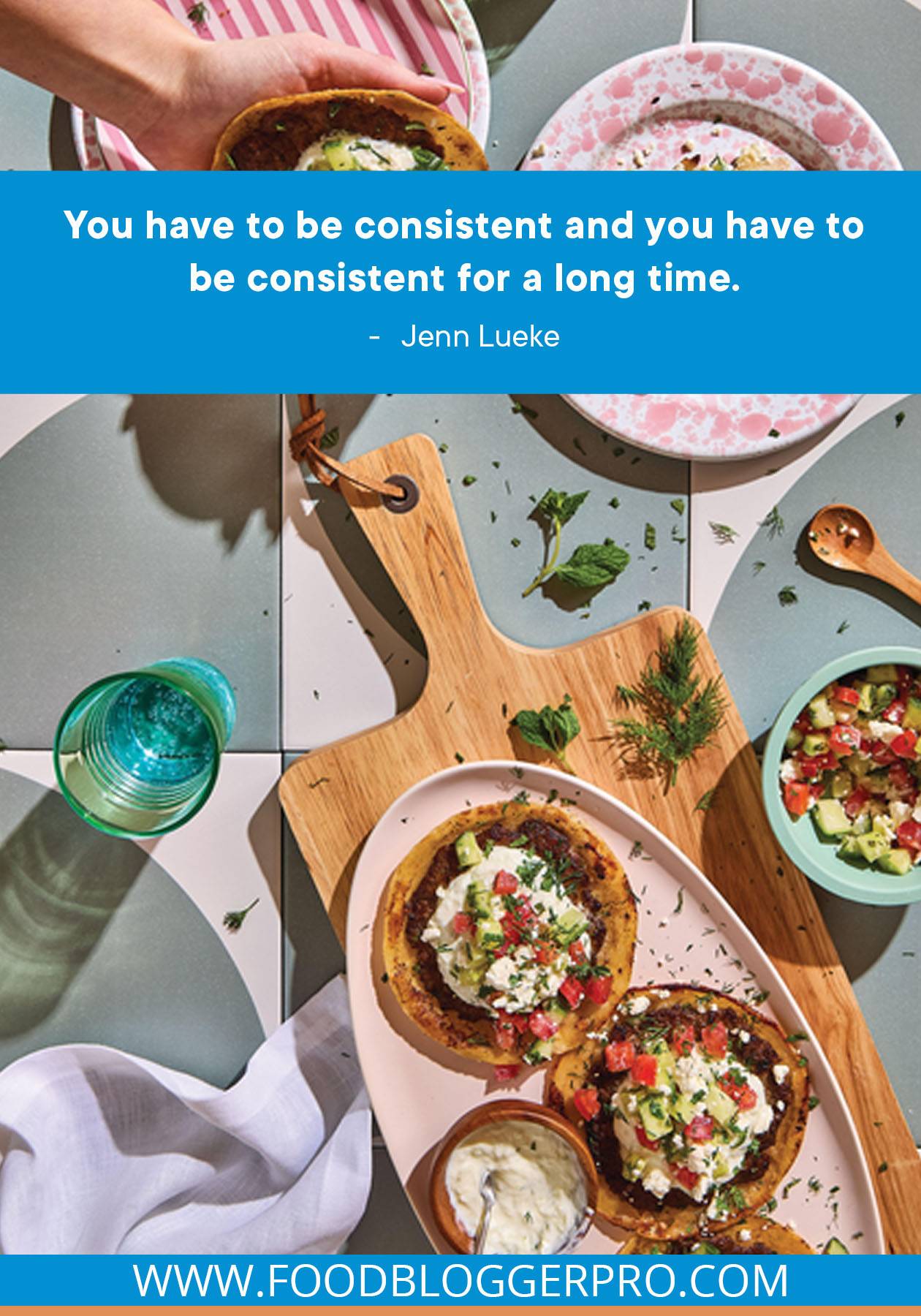
Jenn Lueke: Oh, so much. But my number one advice would be you have to be consistent and you have to be consistent for a long time, even if it’s not working, but I’ll caveat that with saying you can’t just keep doing the same thing that’s not working and never iterating. So you have to continue to show up, take that data like we talked about at the beginning, make new content or whatever it is that you’re doing, just with little tweaks and continue to see what’s happening. But the most important thing is showing up if you can every day and take it very seriously from the beginning. Even those early days, like a year in when I had started my Instagram account, anybody that is in my personal life, because those are really the people that were following me at the time, they will tell you I treated this like a business from that point because I knew that if I wanted it to be a business, I had to act like it was.
Jenn Lueke: So even the way that I would show up on Instagram stories or share a post, like I was talking to thousands of people and I definitely wasn’t. So being serious about it, looking at the data and being consistent, showing up. And then once you do figure that out, once you do get some kind of following, whether it’s a large following or even just a couple thousand people, don’t feel like, “Okay, now I don’t need to do all of those things.” I’ve only leaned more into being consistent, showing up every day, iterating, always making things better, more valuable for people more and more as my following has grown because it feels like the stakes are higher. I have more people who are actually following along, making the recipes, following the meal plans, whatever it is. And I want them to be happy and I want them to trust me.
Jenn Lueke: And that is, I think, the key in continuing to get people and having people stick around.
Bjork Ostrom: Yeah, that’s great. Last question. What’s the story with 3Os and good?
Jenn Lueke: There’s not much of a story other than when I started, my handle was just Good Eats and Good Eats with two O’s was taken. So I was Goood Eats with three O’s. And then when I decided to change my handles to Jen Eats Good, I think it was in 2020, Jen Eats Good with two O’s was also taken and I had done the three O, so I kept it as three. But let me tell you, it’s a pain because I always have to tell people, “Make sure you’re using three O’s because they’ll be like, your website doesn’t work,” or something like that.
Bjork Ostrom: Yeah. But it’s also, I feel like something that is memorable about it. There’s a little bit of a hook with it. And so I think maybe for the same reason that it’s a pain because you have to explain it, there’s a benefit to it because of the kind of novelty with it. So I’m afraid-
Jenn Lueke: Yeah, I’m attached to it now. So I’ve tried to write it in my book, I have
Bjork Ostrom: Goood
Jenn Lueke: To know with three Os, so
Bjork Ostrom: It’s part of it now. Yeah, exactly. I love it. Jenn, thanks so much for coming on. With your book, if people want to check that out, we’ll do a link as well, kind of a quick snippet of that. The book is out, can buy it anywhere. Anything else that you’d add for that with the
Jenn Lueke: Book? Yeah, I’d just say if you are somebody that likes those kinds of tools, that’s what the book leans into. There’s 12 weeks of meal plans, grocery lists that you follow, recipes right in there. It’s called Don’t Think About Dinner, but I also have breakfast, lunch every meal of the day.
Bjork Ostrom: Cool. Jenn, thanks so much for coming on.
Jenn Lueke: Thank you so much for having me.
Emily Walker: Hey there, this is Emily again. Thank you so much for listening to that episode of the Food Blogger Pro Podcast. And thanks so much to Jenn for joining us. We hope you’ll tune in again next week for our interview with Sharlene Murrell from the food blog Good Enough Momming. She’ll be chatting with Bjork all about her strategies on Pinterest. That’s it for now. Hope you have a wonderful week and we’ll see you back here next week.