
Listen to this episode of The Food Blogger Pro Podcast using the player above or check it out on Apple Podcasts or Spotify.
This episode is sponsored by Yoast and Clariti.
Welcome to episode 587 of The Food Blogger Pro Podcast! This week on the podcast, Bjork interviews Andrew Wilder and Miranda Wicker from NerdPress.
Last week on the podcast, Bjork chatted with Timothy Pakron. To go back and listen to that episode, click here.
Building Smarter Systems as a Creator with Andrew Wilder and Miranda Wicker
Bjork is chatting with Andrew and Miranda for a conversation on AI, content creation, and what it means to stay human in an increasingly automated world. They dig into a question that every creator is facing right now: are you reacting to the AI shift, or are you using it to rethink how you work?
They’ll walk through real examples of AI integrations, memory, skills, scheduled tasks, and MCP connections, including NerdPress’s very own guided agent connector, built with guardrails and approval steps for safer site management. If you’ve been wondering how to use AI to work smarter without losing what makes your content yours, this episode is a great place to start!
Three episode takeaways:
- Rethink instead of reacting: Andrew and Miranda discuss how creator businesses have weathered the changes to search over the last few years. Their key takeaway: it’s time to rethink how you work, not just brace for what’s next.
- Use AI as a tool, not a ghostwriter: AI shines at research and repetitive work, but if you allow it to write for you, be prepared for writing that’s just average. Let AI support your process, but allow your own passion and expertise to shine through in your own writing!
- Implement guardrails to make AI safer to use: Memory, skills, scheduled tasks, and MCP connections — Andrew and Miranda share how they’re putting these to work, including NerdPress’s guided agent connector, which includes approval steps for safer site management. AI can help you do more, but with just enough oversight to keep it from going rogue.
Resources:
- NerdPress
- Slack
- Claude
- ChatGPT
- Granola
- Littlebird
- Episode 584 of The Food Blogger Pro podcast: A Step-by-Step Guide to Using Claude as a Food Blogger with Shruthi Baskaran-Makanju
- OpenClaw
- Caffeine and Cabernet
- Clariti
- Raptive
- Join the Food Blogger Pro Podcast Facebook Group
Thank you to our sponsors!
This episode is sponsored by Yoast and Clariti. Learn more about our sponsors at foodbloggerpro.com/sponsors.
Thanks to Yoast for sponsoring this episode!
If you’re a food blogger, you’ve probably spent years mastering traditional SEO — optimizing for Google, tracking rankings, and monitoring your traffic. But here’s the big question: how does your brand show up inside AI answers? Are you being cited in ChatGPT, Perplexity, or Gemini… or completely left out?
That’s where Yoast comes in. Included with Yoast SEO AI+, Yoast SEO Brand Insights scans how your brand appears across AI platforms like Perplexity, Gemini, and ChatGPT. You can:
- See when (and if) you’re mentioned in AI-generated answers
- Track sentiment around your brand
- Compare your visibility to competitors
It’s a whole new layer of search visibility — beyond traditional rankings. Use code foodblogger10% at checkout for 10% off Yoast SEO Premium, Yoast WooCommerce, and Yoast SEO AI+.
Clariti is a content organization and optimization platform that helps you uncover SEO insights and monitor performance improvements by analyzing your WordPress and Google data in real-time — so you can audit your content, understand performance, and see real opportunities instead of guessing.
And it doesn’t stop at insights. Clariti helps you turn what you’re learning into actual projects and tasks — so you can go from analysis to action and actually get stuff done.
Go to clariti.com to learn more.
And, if you’re a Mediavine publisher, Clariti has a dedicated partnership just for you. Just go to clariti.com/mediavine to see what’s included.
Interested in working with us too? Learn more about our sponsorship opportunities and how to get started here.
If you have any comments, questions, or suggestions for interviews, be sure to email them to [email protected].
Transcript (click to expand):
Disclaimer: This transcript was generated using AI.
Bjork Ostrom: If you’ve been blogging for a while, you’ve probably become very accustomed to spending a lot of time on traditional SEO, optimizing posts, updating old content, and tracking to see if that helps you show up in Google search results. And tools like the Yoast SEO premium plugin have helped make that process a lot easier for WordPress creators. But now there’s a new place people are searching, AI tools like ChatGPT, Gemini, and Perplexity. And a lot of creators have no idea how their sites are showing up in those answers. That’s where Yoast SEO AI+ comes in. If you upgrade to Yoast SEO AI+, you can see if your brand is actually being mentioned in AI generated responses, whether AI is speaking positively about your content and how often your site appears compared to other sites. And it now scans across ChatGPT Perplexity and Gemini. If you want to discover how your site is appearing in AI responses, head to Yoast and use the code foodblogger10%.
That’s F-O-O-D-B-L-O-G-G-E-R-1-0-% at checkout for 10% off Yoast SEO Premium, Yoast WooCommerce, or Yoast SEO AI Plus.
Bjork Ostrom: Andrew and Miranda, welcome to the podcast. yeah, this is fun. It’s always fun to have two guests. It’s a little bit of a round table. We’re going to be talking about all things AI and content. I would say the two things that people want to talk about most on this podcast or want us to talk about most as of late is AI. And then all of us that listen to this have content businesses. And that’s what we’re going to be talking about today.
Andrew Wilder: Hello.
Miranda Wicker: Hi, thanks for having us.
Bjork Ostrom: Before we do that, Andrew, you’ve been on the podcast multiple times, like probably top three guests that we’ve ever had in terms of appearances on the podcast. but for those who haven’t connected with you, do you wanna share a little bit of your story and the background of NerdPress and kind of what your day to day looks like right now?
Andrew Wilder: Sure. so I got my start in in this realm, as this career, this version of my career in 2010 when I started a food blog. And I had already I had done website stuff in the in the past, so I knew what I was doing technically. And when other food bloggers found out I knew what I was doing, they asked me for help. And long story short, I started doing work on food blogs and I started support subscriptions. And fast forward 16 years later,
Bjork Ostrom: Amazing.
Andrew Wilder: NerdPress we’ve grown into NerdPress. We are a WordPress maintenance and support company. we’re 20 people all in the US supporting hundreds of publisher sites. most of them are food bloggers. So of course it feels like coming home every time I talk to you. and you know, I’m also a food blogger pro expert, and so I’ll pop into the forums every so often. and yeah, we’ve been just supporting food bloggers and content creators for a decade and a half now.
Bjork Ostrom: Yeah.
Andrew Wilder: And I think the the most exciting thing for me is I picked this path. Like in 2010, I was wearing five different hats and I picked like supporting websites and tech as like the one thing I I wanted to focus on because it was always going to be changing. And therefore I’d always be learning and interested. because by then I felt like I had said everything I needed to say about healthy eating. but tech is always evolving, right? And and I think
Bjork Ostrom: Sure. Yeah. Yeah. And it’s never been more quickly evolving than today. Yeah.
Andrew Wilder: Yeah. And now it’s kind of like now I’m feeling like be careful what you wish for. But yeah, great. I mean, you know, twenty twenty six is definitely I feel like we are in the middle of the S curve of a main you know, huge technology change. Like and may maybe it’s not the middle of the curve, but it feels like we’re in the steepest part of that curve right now where everything is just like shifting. And I I don’t know, my my spidey sense is this is gonna be the year where we look back and go, Okay, that was the year everything changed.
Miranda Wicker: That’s true.
Bjork Ostrom: Sure, yeah. You got it. Never changing. Here we are.
Bjork Ostrom: Yeah. It’s amazing the pace. Yeah. You and I have both been doing this for a really long time. It’s it’s fun to look back, you know, I can remember having conversations when you’d say you’re a team of twenty, having a conversation around your first hire. And we’re talking about like, okay, what does it look like to hire? And it’s amazing that you fast forward now, you have a team of twenty. A huge reason why is because you all do such a wonderful job supporting creators with one of the things.
Andrew Wilder: Whether or not that’s good or bad is different.
Andrew Wilder: Yeah.
Bjork Ostrom: That the vast majority of creators, I would say ninety-five percent of the people that we talk to don’t want to do, which is like the technical stuff related to running a website. And you guys not only do that, you do it well, and have done it for a long time. Miranda, you are one of those twenty employees that has joined the Nerd Press team. You have a background as a creator yourself. started publishing content
Miranda Wicker: Yeah.
Bjork Ostrom: on a blog before Andrew and I did, which doesn’t happen a lot that we have these conversations that, you know, somebody started publishing online pre twenty ten. It sounds like you started in two thousand eight. Tell us a little bit about your story.
Andrew Wilder: Yeah.
Miranda Wicker: If we go all the way back to live journal, then it’s been a very long time. So we we don’t have to bring that those days up. But I was a teacher and taught high school English. I love books and and and all of that stuff. So I loved what I did and then I had kids, and then I became a mom with a blog. I needed a place to write about parenting and postpartum depression and anxiety specifically, which I was dealing with after my son was born.
Bjork Ostrom: Yeah. Yeah.
Miranda Wicker: And so I really found like a like a really strong sense of community. And from that blog, I left the classroom, started freelance writing, building communities for brands, and kind of pivoted into social media marketing and content marketing with a background in the strength of communities for growing a brand, growing a business, and and growing one another. Like how do we collaboratively do this? I’m a big believer that the internet is not like it’s not finite.
Andrew Wilder: Didn’t read it, you look at the okay.
Miranda Wicker: Keeping Andrew on task. That’s that, you know, I keep Andrew on task as much as I can with the marketing and communication stuff. but I am just I really love working with creators. I really, I really enjoy specifically as a woman, I love how many women have been able to find a career and that that people didn’t you know they’ve been able to support their families in ways that nobody thought possible.
Bjork Ostrom: Great to have one of those team members. Yeah. Yeah. Yeah.
Andrew Wilder: Yeah.
Miranda Wicker: Nobody saw this coming and then and then women have been able I mean, I think I think women really created the influencer and creator economy. and and I’m proud to be a part of that. So I love seeing where it’s gone and I can’t wait to see where it goes next.
Bjork Ostrom: Yeah, you both have such a deep pool of experience and a lot of knowledge to draw on, not only because of your personal involvement as creators, each of you have this origin story, but now also you have hundreds, thousands of touch points to other creators. And so you have a really good beat on not only what the arc of the industry has looked like, but also what the present pulse of the creator is.
Andrew Wilder: Cautious optimism. I feel like the I feel like people aren’t operating out of panic anymore. And maybe that’s me. I’m not as panicky as I was even six months ago about what’s gonna happen with AI, right? but I think you know, two, two and a half years ago, I was really worried, genuinely worried, that websites would not exist, blogs would not exist. They were all gonna be replaced by some sort of
Miranda Wicker: I don’t even know if that was two years ago. Like I
Andrew Wilder: the helpful content up with update was really separate from AI. So like it’s been turbulent and challenging. because we kind of reached peak food content during the pandemic, when everybody started a blog and stayed home and cooked, right? and so that’s not been easy. It’s been very hard. And a lot of people have given up and shut down or sold their sites and left. but blogging in general and food blogging in general,
Miranda Wicker: 17 and 14 and they hate well, I mean, it depends on what we’re talking about. My son despises it. He absolutely hates it. My daughter understands that like sometimes there might be a use case for this if I am stuck on a math problem and I can’t get, you know, like there, she has moments, but mostly, especially for creation purposes, she hates it.
Andrew Wilder: And it’s it’s soulless, right? and you can tell, especially written content. and I think the reason I’m optimistic is that the general public is recognizing that and craving that human connection. And, you know, we’ve been saying for years, like be authentic online, right? you know, be uniquely you and have your unique perspective. Like we’ve talked about that, I’m sure, in our many, many conversations and like on the SEO for bloggers episodes, we’ve talked about it a lot.
Bjork Ostrom: Yeah.
Andrew Wilder: And I think that’s you know now more than ever so valuable and appreciated. And and and so that’s really like the people who’ve been doing that well and authentically and showing up as them, that that is really more valuable than it ever has been.
Bjork Ostrom: Yeah. In in one of the things I think a lot about within the context of marketing, a lot of what we are doing as creators is marketing. I know Miranda, you have kind of a marketing hat that you wear within the context of your role as well. one of the things that we talk about is this idea of novelty and novelty as it relates to marketing. And if you’ve seen something ten thousand times, if something isn’t novel, if something is wrote, like
Miranda Wicker: Yeah. So one of the things that I think we have to keep in mind, like when you’re talking about AI will just continue to get better, one of the things that sticks out to me is AI is only ever going to be an average. It’s math. It’s really always just a math problem and it can only ever be average. So if creators keep pushing the envelope and AI keeps getting better, I think that’s because creators keep pushing the AI. Like the creators keep pushing the envelope. They keep getting better.
Bjork Ostrom: That is a pattern, like that would be a structure that AI would use. dash is maybe the like example that you always see coming up.
Andrew Wilder: Yeah.
Miranda Wicker: That pushes a real writer to really hone their voice, to to say, okay, if I know that AI has trained off of decades of writing and this is what it’s come out with as the average, and I feel attacked because that’s how I was writing, it’s taken then then that’s a tip for you as the writer, as the creator, to say, How do I level up my voice? How do I make myself stand out against that? Because really that’s kind of a gut check moment.
Bjork Ostrom: Mm-hmm.
Miranda Wicker: If you sound like AI or AI sounds like you, it’s a chicken egg and you you have to get better. You have to improve. so I think just from the content creation perspective, from the writing perspective, that’s one way that we can can think of AI. the other thing is visuals, when you know the first time you see a a really an AI flyer for something at your kids’ school, PTA, whatever.
Bjork Ostrom: Mm hmm. Mm-hmm.
Miranda Wicker: You think, my gosh, look, the PTA, this graphic looks so great. And then you see another school’s PTA, and the graphic looks exactly the same. And I went to my pediatrician’s office, and the flyer hanging in the pediatrician’s office yesterday looked exactly the same as the one the PTA is putting out, which is the same one as the football boosters putting out. So you really do start to see that regression to the mean. And I think that’s where visual artists get an opportunity to excel too. Like, how do we level up our creation? Because again, these AI tools are showing us.
Bjork Ostrom: Yeah.
Bjork Ostrom: Yeah, it’s it’s such a great point because I think that one of the things that we have to do as a creator is stand out. We hear about this all the time. How do you stand out as a creator? And there’s a lot of different ways to do it. But the best way is to be excellent. And how can you be excellent? There’s a lot of different ways you can be excellent. You can be excellent written communication, you can be excellent in systems, you can be excellent in photography and video, in strong hooks. but excellent, I think
Bjork Ostrom: That’s exactly what AI agents are about to give you. And most people have no answer. And I think for a lot of us as content creators, the first answer that we come up with is I’m going to have it write all my emails and write my post. But that should probably be one of the last things that you should do. So what should we be doing if we have these 10,000 brilliant employees at our disposal? What does it look like to use them?
Miranda Wicker: That should be the last thing.
Bjork Ostrom: in the most strategic way possible, like within the context of a tool versus as a content creator.
Miranda Wicker: Do you want me to take that or do you Andrew to take it?
Andrew Wilder: So why we might both have answers. my answer to that is to to use it for the things that humans aren’t good at. and especially if you’re a human that’s not good at something. Now you may be really awful at writing emails, but hopefully not the case if you’re a content creator. that’s where I’m finding it like it ha it has abilities that we do not have.
Bjork Ostrom: Yeah. Why don’t why don’t you start, Andrew, and then Miranda, if you have additional information you could add in.
Andrew Wilder: Data ingestion, analyzing things, researching things, finding that email and connecting the dots between certain things that like it’s fascinating because it’s like the smartest thing with the shortest possible memory. And and you kind of have to constantly steer it, right? But I’m using it to like like I wanted to know, I wanted to, I wanted to go back and look at like what are some of our accomplishments over the last six months at NerdPress?
Bjork Ostrom: It’s research, it’s information gathering, and then it’s compiling that.
Andrew Wilder: but you know it there are some jobs where I don’t think it’s gonna take jobs away, but I think it’s gonna change how those jobs are done. and you know, for programmers, that’s already happened. but I I think that’s where I’m like, how cool I can do this now. I have a superpower that I didn’t have before. And that like has made me level up. It’s made a lot of us at NerdPress level up and the whole company has leveled up. Whereas when I try at it, when I have it try write an email for me.
Bjork Ostrom: Like the information is the inform yeah, yeah, yeah, yeah. The information is good that it has in it, but in terms of like what it feels like, that that’s not good.
Miranda Wicker: Which is hard. That’s really hard.
Andrew Wilder: Yeah.
Andrew Wilder: Yeah, even when I have it like create a a writing skill and prompt. I mean, it’s it’s weird. Like I so I I spent some time having it create a Andrew writing style, right? And I write a lot. I send emails, I write in Slack, I do blog posts, I do one-on-one, you know, like I communicate and my style is slightly different on each one, right? and it actually did an amazing treatise on what my writing style is. Like I read it and I was like, Yeah, I do that. I don’t do that. I do you know, it it was an incredible analysis. But then when it goes to write.
Bjork Ostrom: The interesting thing, you know, yeah, I think of it outside of the context of content creators. I think for people who are poor writers, it can be a really wonderful tool because suddenly you can articulate what you want to communicate and it can bring it from subpar, it can bring it from really poor writing to average, which is like a huge level up. And I think of some people in my world who I can tell like, you know, this isn’t necessarily working relationship.
Miranda Wicker: Context is huge. And when you I find that when I don’t give Claude we use Claude at NerdPress, we use it and then I also have a personal Claude. So and they have two different contexts, right? Because my personal Claude doesn’t really do my work stuff and my work stuff doesn’t do my personal stuff. And so the context I’m giving it in both places is different. but when I don’t give the tool the right context for what I’m asking it to do, the result is terrible.
Bjork Ostrom: Mm-hmm.
Andrew Wilder: But I’m gonna say though, that’s testament to you too. You’ve gotten very good at writing the news, like and curating it and using your brain. you know, and figuring out what is relevant to all of our clients and all of that. So it’s credit to you, not Claude.
Miranda Wicker: Right.
Miranda Wicker: Mm-hmm.
Bjork Ostrom: Mm-hmm.
Miranda Wicker: And what do I not have time to do? If I’m also doing all of these other things, I don’t have time to read 10 websites a day to find the latest news articles that I can use to pass along to our audience. So that’s two ways I think to use it. And then the other way is is to use it to find your blind spots. and that’s where I think it comes in really handy for creators, especially as we start talking about kind of agentic AI and blogs, where it’s we’re not using it for content creation, but we’re using it.
Bjork Ostrom: Mm-hmm.
Miranda Wicker: to help us figure out what we don’t know. What what do we what did we miss 10 years ago that now we need to fix? So.
Bjork Ostrom: Yeah. It’s it’s one of the the beliefs that I’ve come to develop over the last I would say two months is I generally feel like Claude Fable Five Max ChatGPT Soul Ultra So these are both the thinking levels like the model level and then the thinking level are going to be better than me.
Bjork Ostrom: To help Cloud give you better answers and Andrew, we can start with you.
Bjork Ostrom: Building a creator business isn’t getting any easier. Between AI constant platform changes and the pressure to keep growing, it can feel like you’re running just to keep up. That’s why we’re excited to partner with Raptive. Raptive works with thousands of the webs leading independent creators, including us, to help them earn more, grow smarter, and build sustainable businesses for the long term. They combine industry-leading advertising with personalized guidance, data-driven insights, and a team that’s constantly helping creators adapt to changes in search AI in the broader digital landscape. They’re also leading the charge to protect creator content and advocate for a future where independent creators can continue to thrive. And now it’s easier than ever to join. If your site gets at least 25,000 monthly pag views, you can apply to become part of the Raptive creator community and get support that’s designed to grow with your business.
To learn more or apply, visit raptive.com/fbp. Thanks again to Raptive for sponsoring this episode.
Andrew Wilder: I’m I’m kind of grinning and so is Miranda because I think we’re we’ve had the same time frame with you on that. And I think a lot of people have, where it’s like, I you know, I wrote down on an index card before we started talking, context is everything. without it, it’s just average. But once it has that thing, it starts connecting pieces that I didn’t even realize it could. And like every single day it’s like, wait, check with Colin about this thing because he said this over there in Slack. And so in terms of how I’m using it, like I’m
Bjork Ostrom: Yeah, here’s my OA. Yeah.
Andrew Wilder: I don’t know, about two months ago, I saw an ad. I was influenced. I saw an ad on Instagram for granola.ai. And the catchphrase was, you’ve probably heard of it, the AI app for people in back-to-back Zoom meetings. And I’m like, I feel seen. You get me. That is exactly what you needed to say. I am in back to I will be in Zoom meetings for six hours a day. And so I have I installed Granola, and it’s basically spyware, right? I’ve literally
Bjork Ostrom: And you’re like, that’s me. Mm-hmm.
Bjork Ostrom: Mm-hmm.
Andrew Wilder: Willingly installed spyware on my computer to listen to conversations. now it doesn’t always do it. Like it goes, you know, when I’m on Zoom or something, it says, Hey, would you like me to take and and so then it starts listening when I click OK. So it’s not always spying, but I’ve literally like have it doing that. and meaningless. Well
Bjork Ostrom: Mm-hmm.
Bjork Ostrom: So that’s and one example is meeting notes. And then the to draw the connection here, within Claude, you connect Claude to Granola. So now Claude has context around every meeting that you’ve opted in to record within Granola. So that’s one concrete example of context. Yeah.
Andrew Wilder: Yes.
Andrew Wilder: It and that’s that’s the special toss. Absolutely. Like it’s not, here’s a bunch of notes of here’s your your to-do item. Here’s it’s not here’s your action items at the end of the call that I have to copy and paste and create tasks with. I don’t even look at it most of the time. but what it does is in my morning briefing tomorrow, it’s like, hey, don’t forget you told Miranda you’d do this, right? And it pulls it from the transcript just automatically because of that MCP connection.
Bjork Ostrom: All day.
Bjork Ostrom: Mm-hmm.
Andrew Wilder: And some it’s it’s weird because somehow I’m like, well, I might let Littlebird do it, but I wouldn’t let Microsoft do it. It’s it’s so it’s so unlike Granola. It’s like, it’s lovely. Bottom line is, I’m giving some cloud provider really intimate, direct access to anything I say. And then that is staying in a database, and then I’m giving Claude access to all of it.
Bjork Ostrom: Mm. What’s the name? Little Bird, it’s so unassuming. Yeah.
Andrew Wilder: And the question is, is it worth it? And I’m like, well, we’re leveling up. So yeah, I guess. yeah, it’s simultaneously amazing and terrifying.
Bjork Ostrom: Mm.
Miranda Wicker: It yes, it’s it’s both.
Bjork Ostrom: And I yeah. So, that’s one: Granola, MCP connection into Granola. And I think it’s helpful for people to understand who haven’t done this. You go in; there’s a connection option within, you know, Cloud or ChatGPT. Many of these applications will then have the ability to say, like, hey, I want to make a connection; you sign in, and then it gives it — you have to grant it access, and then it has access. And then you can it reference it within your conversations with Cloud. So granola, you mentioned Slack. You mentioned
Andrew Wilder: Yeah.
Andrew Wilder: Yep. Mm-hmm.
Bjork Ostrom: Gmail. Are there other ones that connections that you’ve made, Andrew? And then I want to hear from you, Andrew, or Miranda.
Andrew Wilder: Well, internally we’ve connected all of our tools. And that’s that’s actually been the biggest game changer. So like Slack is really an internal comms tool, right? That’s how we message. We don’t use email much at NordPress, it’s almost all Slack.
Bjork Ostrom: Yeah.
Miranda Wicker: Well, and that’s that I think is the beautiful thing of what we’ve done is that, you know, when you’re talking about a fully remote team, twenty working across the country, across time zones, you know, somebody comes in first thing in the morning and they experience this thing and they’re handling tickets in our in our client software, like they’re responding. Somebody else comes in later and they get a similar ticket, they get a similar question from another client. Those two things aren’t talking.
Bjork Ostrom: Mm-hmm.
Bjork Ostrom: Yeah. I think maybe one of the key takeaways in all of this that I’ve started to notice is that I think a lot of times people talked about using AI and have said like, hey, it’s gonna be great because it’s gonna be able to replace this work that you used to do. You used to do this and now it can do that for you. You know, it’s like, for me, I would go in and review our business accounts and make sure that we have like three months of expenses in those. That was a routine I had. Okay, now AI does that. Like it it’s able to go and see like
Miranda Wicker: Mm.
Bjork Ostrom: you know, you have one, you’re one person, maybe you have some part-time team members, and you want to maybe do some of the things that you were previously doing, but also you want to do more without having to work an extra 30 hours a week. Given the tools that we have, which are Claude, ChatGPT, and then some of these connections — these MCPs, we call them — which are essentially like a pipe that connects one data source to another.
Miranda Wicker: Well, do we wanna talk about the tool that we built? Because I think that would be I think if we talk about the tool that we built, Andrew, and then I’ll talk about how I’ve used it. Cause we’re talking about the pipes and the connections right now. So this might be a good time to to segue into that.
Bjork Ostrom: You can do yeah, I think that would be a great example.
Andrew Wilder: Sure.
Andrew Wilder: Yeah. So I think, you know, the whole thing we’re realizing is like you’ve got to connect all these things for it to work. So it has the context, and it has the capability to do things. but we’ve also noticed that like AI is a people pleaser, right? It’s programmed to like try to keep helping. It’s like, what else can I do? here’s an idea. Maybe I can fix this, right? would you like me to do this now? I can take care of that. And I think some of that is they’re trying to get us hooked, frankly. but also because people don’t know how to use it. So it’s kind of self-teaching us.
Bjork Ostrom: Sure. Yeah.
Andrew Wilder: but it’s very eager to help. And so it’s very easy to go off on a tangent because you can be like, yeah, and like there’s no end to it. it’s you know, you end up at midnight, you’re like, I need to go to bed, but you’re like, I’m not done. There’s no
Bjork Ostrom: Yeah, I think it’s one of it’s it’s one of the like quantifiable downsides that I’ve noticed is like the which you could have an entire episode on that. The unending amount of work that that you can start to do and how just how work changes. It’s I’ve been thinking a ton about like
Andrew Wilder: Yeah.
Andrew Wilder: Ha ha.
Miranda Wicker: Yeah.
Andrew Wilder: Mm-hmm.
Miranda Wicker: That is why I don’t pay by usage for my personal Claude account.
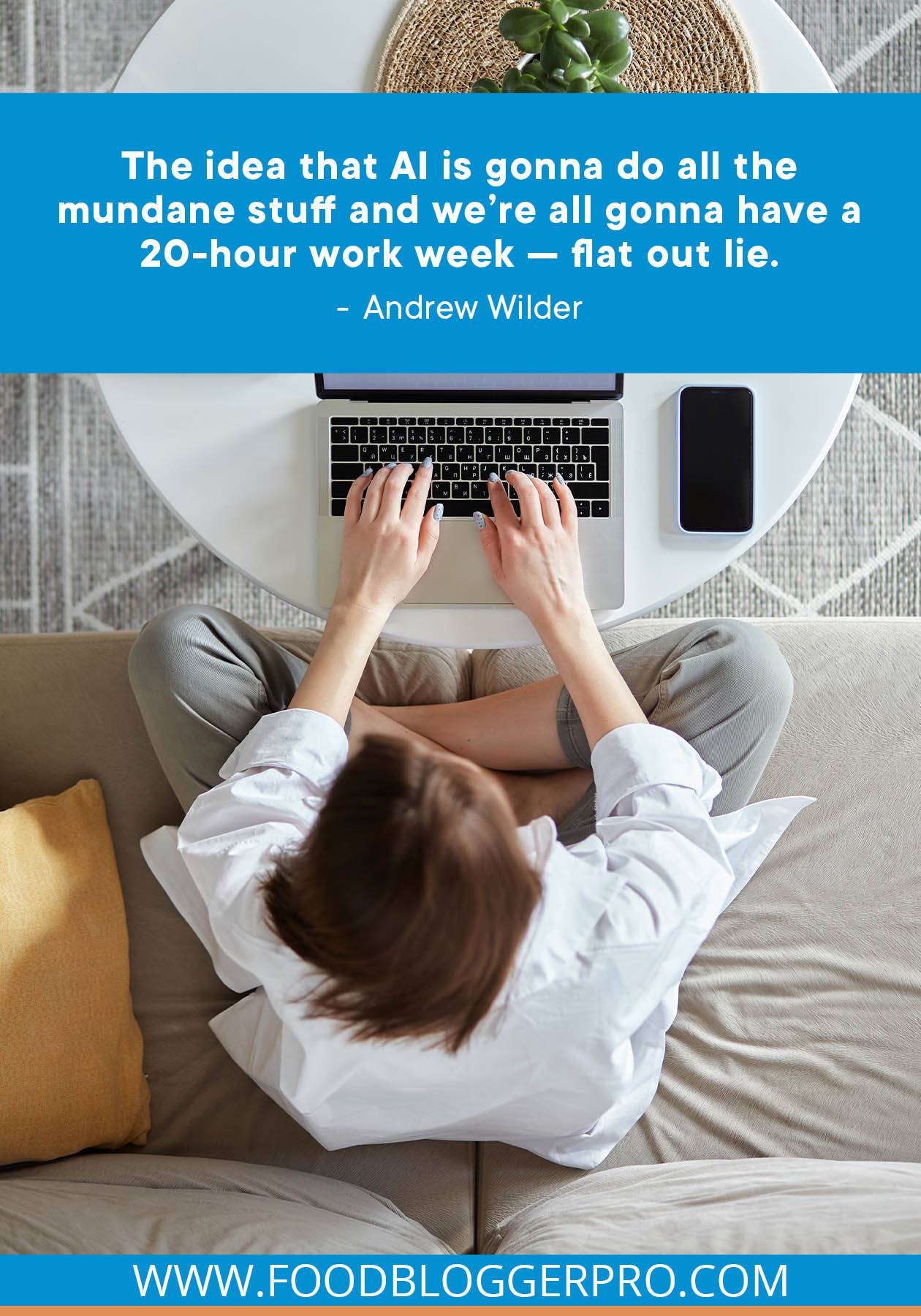
Andrew Wilder: Right. I I I burned a lot of tokens this weekend. so so I think you know, the idea that AI is gonna do all the mundane stuff and we’re all gonna have a 20-hour work week, flat out lie. No technology improvement has ever done that. What’s happened is everybody’s had to produce more, their output has to go up. Competition has never been stronger, right? I’ve said I I was at the national WordPress conference, WordCamp, last week, and I said to several people, I’m like,
Bjork Ostrom: Yeah, yeah.
Bjork Ostrom: Yeah.
Andrew Wilder: Man, if I was the only one who had AI, I would love it. And and everyone like immediately laughed and understood what I meant, which is like, but we all have it. So we all have to scramble to use it better and faster in output to stay competitive. So that’s that’s the balancing act. And you’re gonna drive yourself crazy if you don’t get outside and touch grass every once in a while. So you have to take good care of yourself and just know to unplug and be like, you know what? It’s this will be infinite and we are finite beings. But
Bjork Ostrom: Mm-hmm.
Andrew Wilder: and so I don’t think it’s a good idea for people to make a direct MCP connection to their WordPress site, not on a production site that is your business. It’s just too risky. because it’s gonna be like, hey, I updated three other posts for you. wait, I deleted this post because I didn’t think it was necessary anymore. And it just it’s well intentioned, it what or I guess, but it can kind of go rogue. And so
Bjork Ostrom: And to be clear, what you’re talking about is if you use ChatGPT or Claude and you say, I want to connect to my WordPress website via ChatGPT or Claude, and then work on my website within Claude or ChatGPT. That’s what we’re talking about here is like usually we’re used to going in and doing the actual work. We change the post, we update the titles, we swap out the images, we update the recipe. We’re in there doing it.
Andrew Wilder: Mm-hmm.
Andrew Wilder: Yeah, yeah.
Bjork Ostrom: One of the changes in this agentic world is that now we are actually starting to task agents with doing that work. But in this context, you’re saying number one, it takes a lot of work, as things currently are with WordPress, to connect your Claud or ChatGPT account to your WordPress account. So there’s a lot of work involved. And then number two, one of the issues is that there aren’t guardrails
Andrew Wilder: Yep, that’s exactly right. And you know, there are ways to say like don’t update a post without asking, but still it’s like, well, what’s the update gonna be? And so what we what we’ve created is we’re calling it the NerdPress Guided Agent Connector. We went with a very boring name, a very descriptive name. we didn’t really want we didn’t want to answer. Yeah, it’s like naming things as hard. We didn’t want to come up with a cute name. We wanted to be descriptive because and in each of those each of those words is there for a good reason.
Bjork Ostrom: Got it.
Bjork Ostrom: Mm-hmm. Yep. Relay. Relay and guided connector. Yeah.
Miranda Wicker: Naming things is hard, okay? Naming things is hard.
Andrew Wilder: But it is literally to help people connect their AI tool, Cloud or ChatGPT, to their website so they can be pr more productive. But it’s easier and we’re trying to make it safer. So we’ve added audit logging so you can see what’s been done and undo functionality. So if it does something you don’t want, you can hit the undo button, you know, where it’s possible to do that. but I think the special sauce that I’m most excited about is the guardrails and the guidance. So we’ve added extra guardrails where you could have to, we can say, no, no, no, you can’t do that. Like we add the
Bjork Ostrom: Do you have an example of what that would be?
Andrew Wilder: Dutifully follow our instructions, send the link in the back in the chat to whoever’s using it and say, hey, NerdPress wants to wants to be extra sure you really want to delete this thing. Click this link and say okay, and then come back and tell me you’ve done it. And until the user has has proactively done that, it it won’t literally will not be able to do delete the content. And then once once you know whoever’s using it says that’s okay, then we’re good. We don’t want to introduce too much friction, right? That sounds like a pain in the butt every time. And so we’re only doing that for really important things.
Bjork Ostrom: Mm-hmm.
Andrew Wilder: because scaling a team is really hard if you don’t have documentation. So we have all these documents of like when somebody asks a question about Yoast, what are the best practices? Like, what should my featured image sizes be? All of this stuff that like we’ve been talking about for a decade on this podcast, that is like here’s the NerdPress way to do something, here’s guidance. So it’s it’s very specific to our clients rather than just the general website word internet at large. And so if you upload a featured image, it’s gonna know, I should size this to 1200 pixels.
Bjork Ostrom: Mm-hmm.
Bjork Ostrom: Mm-hmm. Yeah. It’s I almost if you if we’re talking about this analogy of a pipe, the pipe is the connector, I almost imagine maybe a better way to say it is like it is a tunnel and agents are people, and you can have a tunnel that is like open access, and it’s just a database to Claude. And the agent can go back and forth as they please. What you’re describing is almost like key fob access. And so
Andrew Wilder: Yeah.
Bjork Ostrom: It doesn’t happen a lot, but that was an instance where I was like, there was a pipe, it had access to do it, and it did a thing that I didn’t want it to do. It was probably a bad prompt, but then also there wasn’t a guardrail in place for it to check back with me.
Andrew Wilder: Andrew Wilder
Bjork Ostrom: Mm-hmm.
Miranda Wicker: Mm-hmm.
Bjork Ostrom: Yeah. That’s great.
Miranda Wicker: So the context thing is really interesting. And if I can, just a minute, really quickly, one of the things I’ve been using the Agent Connector to do is clean up a lot of the technical debt, because we’re talking about a website now, 20 years old. Andrew mentioned 500 blog posts, and I was like, 2000? And like, you know, this is blog spot days, so that’s before categories and tags were even a thing. I know Shruti mentioned that she used
Bjork Ostrom: Sure.
Andrew Wilder: Wow.
Miranda Wicker: Her agent to do taxonomy, which is and I I immediately texted Andrew and I was like, Shruti used to just do the exact same thing that I just used one to do. So, because I was like cleaning up categories. But in the in the lack of context, so one of the things that cleaning up my site, I have a lot of thin content because in the early days it was, you know, your blog post might just be like a quick little diary entry. but maybe that diary entry also came along with a baby picture of my son. And
Bjork Ostrom: Mm-hmm.
Miranda Wicker: When I started this project, Claude wanted to delete over half of my website because it was like, this is all thin content and didn’t understand like the name of the blog is Caffeine and Cabernet. That doesn’t necessarily lend itself to automatically thinking that this baby photo from 16 years ago, 17 years ago is relevant. So it was like we it just we need to delete 900 posts. And I was like, those are actually, this is like a baby book.
Bjork Ostrom: Yeah, I almost feel like with AI, there’s three layers. There’s the layer of like the broader internet, the open web, everything that AI has trained on, which is pretty comprehensive. But then there’s an additional layer below that that’s harder to access, which is like industry knowledge. That would be an example of like the NerdPress documentation. That’s not something that Claude can crawl, and it’s probably not something that’s super well documented on the web.
Andrew Wilder: Yep.
Bjork Ostrom: Different layers that somebody can step into if they are starting to get into AI. maybe better ways to say it levels. Like, so if somebody’s level one, they’re probably just starting out. They are using Cloud and ChatGPT to answer questions almost like you would Google. What would you say are the other levels that would exist beyond that? And where do you think that we are trying to go as creators? So
Andrew Wilder: I don’t know. I don’t know if this is a whole level, but my first thought is understanding memory. so as you use these tools, they automatically have memory that they write. and so under like I think the next level is starting to understand how the tool works, maybe. And so memory is one of the key things that makes this actually really cool, is it’ll remember that.
Bjork Ostrom: Read it. Yep.
Andrew Wilder: is maybe a way to start understanding it and then and then maybe on top of that is like standing instructions. I don’t know, Matt. So you
Bjork Ostrom: Standing instructions meaning
Miranda Wicker: Well the one that I have is that I don’t want Claude to be a sycophant. I don’t want it to just always agree with me. I and so in my instructions, in both my Nerdpress Claude and my personal Claude is like you can push back. If if if I’m brainstorming an idea, if I’m working through something and it’s a bad idea, you can tell me it’s a bad idea. So that so that some of the instructions are
Bjork Ostrom: It’s almost like shaping the tool. So starting to say, here’s how I want you to act, here’s what I want you to do. This would be the next level, shaping it, not just assuming there’s a default, but like here’s how I want you to partner with me in this context. I think that’s great. I would almost say like a level three would be starting to develop. You talked about this, Miranda, like a scheduled task or a skill. Can you talk about what those are? And i you know, we could go deep on them, but at a high level.
Andrew Wilder: Yes.
Bjork Ostrom: How could somebody create their first skill or create their first schedule task?
Miranda Wicker: Well, I am the least technical person to be answering this question, but I what I’ll say is and they think that makes it like relevant for me to answer it, right? Because if you’re not a technical person, I literally just go into Claude and I I use cowork when I’m doing skills. So I open up a project in cowork. So we’ll talk about my daily to-do. and I just start writing. I need you to help me write a prompt that I can turn into a skill that will
Bjork Ostrom: Mm-hmm. Yeah. I I just did this today. So I was nerding out, NerdPress appropriate. and I had it watch my screen. And so it was actually what I was working on is like I wanna have a process for insuring usually this is again a little bit nerdy, but like usually we have an investment allocation split for our investments. Okay, we want to do seventy percent, you know, total US stock market, thirty percent foreign, you know, total foreign stock market, Vanguard funds. Usually, we would allocate that on a yearly basis; we would rebalance. I want to do it every time that I’m doing an investment. I want to do an analysis to see how it’s drifted and then make an investment based on the drift, so it’s more real-time. So I just had it follow me in Vanguard to see how I go about doing that with the skill, initially looking at the investment allocation. And so I would almost say like you can do skills, you can do scheduled tasks. It feels like that next and maybe last level that we could talk about would be starting to do those MCP connections. I feel like for any creator, the NerdPress guided agent is a great example. There’s a ton, you know; Kit has one for email. All of these integrations into these platforms that we’re using. Clariti, we launched one for Clariti so people can interact with their analytics data. Raptive has API data. So we can make these connections. and then I’d be interested if either either of you, this is within the last month for me, have done computer use. Have you turned on computer use and like watched it navigate a website or your computer at all?
Miranda Wicker: I have seen it navigate a website.
Andrew Wilder: I’ve used Cloud for Chrome, which is, you know, basically you can let it open a tab and navigate in that tab. I have not let it do anything else on my computer because of security and app. Also, like, the funny thing is, like, I’m actually really bad at delegating. My team will laugh because it’s true. and so it’s like the whole like imagine tomorrow you have 10,000 employees. What are you gonna tell them to do? I’m like,
Bjork Ostrom: Yeah.
Miranda Wicker: Terror, fear.
Andrew Wilder: Crap, I don’t know. I like I’m I and so like just because I’m so used to being like, do it rather, you know, I’ve gotten better at delegating as I’ve built a team. I’ve had to. yeah. But there’s still a lot of stuff that I’m like, you know, and and so it’s this like
Bjork Ostrom: Yeah, go home and take a day off.
Bjork Ostrom: Yeah. Yeah. Well you obviously have. You have twenty people on your team. Yeah.
Andrew Wilder: But I’m gonna trust Miranda, a smart human, more than to to do something autonomously than I am gonna trust Claude to do something autonomously, especially when it comes to l controlling my computer, which has access to a lot of things.
Bjork Ostrom: Yeah, yeah, yeah. Yeah. I’ve started, I mean, the majority of the way that I’m using it is within a browser. but it’s kind of one of those things, and I think maybe this speaks to the levels piece. I think what I’ve found, especially as these models get smarter and smarter, is like you start with like, okay, I’m gonna make this connection into you know, into my email. You kind of experiment it with a little bit. You you kind of let the rope out a little bit and you continually do that. Yeah. Yeah, that I think that’s a really key piece. Read only, meaning it can only read, it can’t like write on your behalf. And that’s exactly how it started for me with you know, all of these little pieces is like, okay, let’s experiment with this. What does it feel like to to do this? Okay, what if I turned computer use on or like Chrome access and it was able to like go in and
Andrew Wilder: And starting read only. Right.
Bjork Ostrom: Audit DNS settings for my email. actually like I have some issues with my DNS settings. What does it look like if I just watch it and see what it does? Okay, actually it updated those. That to me is part of it is I feel like it’s a little bit of my job, which is testing the upper boundaries of some of these tools. but another part is the the question that I’ve come away with is like like at what point do I stop trusting it?
Andrew Wilder: Yeah.
Bjork Ostrom: And there’s definitely is that point. but I think that’s a little bit of what these levels are, is like an encouragement to people to kind of level up a little bit, try something new. But it’s really important to remember that having those guardrails is important, which I think why what you’ve built with the guided agent at NerdPress is so great. We could talk for another two hours here. Yeah, Miranda, you can share that. Share share that. Yeah.
Miranda Wicker: I think those those levels really quickly though, those you’ve kind of indicated what is so difficult about the AI conversation for creators because so many of us have been sole providers, have been single operators for so long that the idea that this AI can suddenly do so many things for us, the the temptation is definitely there.
Bjork Ostrom: Yes.
Miranda Wicker: to say, you know, how can I scale this up? Not just in having it write my content, but in doing all of the things that I don’t want to do, but still maintaining that humanity and being really cognizant of what you’re letting it to do, I think is is crucial.
Bjork Ostrom: Yeah. Yeah. It is, I think, one of the, as a last thought, I think one of the bigger considerations for us is how do we maintain our sanity when suddenly we have 10,000 employees that can do incredible work and are super smart. And and I I’m not saying like then the only thing you do is like work with AI agents. It’s like all of us within the context of companies and knowledge workers, how do we maintain our Sanity when we technically have this massive pool of knowledge that we can resource and that we can put to work. And I think the biggest shift for me is in the categories where I previously was an independent contributor, meaning I was doing the work, where now I am tasking the thing to do the work. And I’m not talking about like creating content. I think we’ve talked through that idea of like we want to be novel and unique and human as a competitive advantage. I’m talking about like One of the things I’ve been thinking doing a lot is like auditing. I’m just like it’s audit everything. Audit my Facebook account, audit my investments, audit my, like, Delta Amex card to see where I’m missing opportunities. Suddenly I realize it could audit everything. Like, and when do I stop? You know, that’s the hard part for me is like it feels like it’s endless and it could go on and on. but I think the key takeaway in it is. What we need to be doing is thinking strategically around how we can be using these as tools to help us with our day-to-day, that those layers of knowledge and and making sure that we involve ourselves in that, and then maintaining our humanity as a creator. And I think those, when I hear you guys reflect on that, it’s like so obvious that you are deep in the creator world because you understand the nuances of the needs of this community. For people who would want to use this tool or work with you within the context of NerdPress, can you talk a little bit about what that looks like? We know, you know, countless people who are NerdPress members and have used your services and just feel so grateful that a tool like or a service like NerdPress exists. talk a little bit about what that looks like if people are interested. Maybe is there like a
Bjork Ostrom: People should start looking at it at this level, as a creator. Wha what does that look like?
Andrew Wilder: So as we speak right now, as we record this, we are beta testing it with some clients and internally. I’m guessing by the time this airs, I’m hoping by the time this airs, we’ll actually have launched it. so at this point, we are going to be making it available for all of our clients on our support plans. so for no extra charge. We’re just going to basically give this to all of our clients. and that’s where we’re stopping at at the moment. we may open it up to others, depending.
Bjork Ostrom: Awesome.
Andrew Wilder: On how that goes. you know, I love the idea of one of our clients uses Clariti and they get recommended they’re working in Claude, they get recommendations from from Claude and Clariti recommendations in their Claude, and then they use our connector to safely make those changes and they’re able to manage that whole project, right? It it helps from recommendation to implementation. And they and Claude can be smart in the in in Ethereum. So we we really want to empower power our clients and help them be more successful. So basically on on any of our WordPress support plans, it’ll be available soon.
Bjork Ostrom: Yes.
Bjork Ostrom: That’s awesome. Yeah. Miranda, Andrew, thanks so much for coming on. Really appreciate it.
Miranda Wicker: Thanks for having us.
Andrew Wilder: Thank you.