
Listen to this episode of The Food Blogger Pro Podcast using the player above or check it out on Apple Podcasts or Spotify.
This episode is sponsored by GRO.
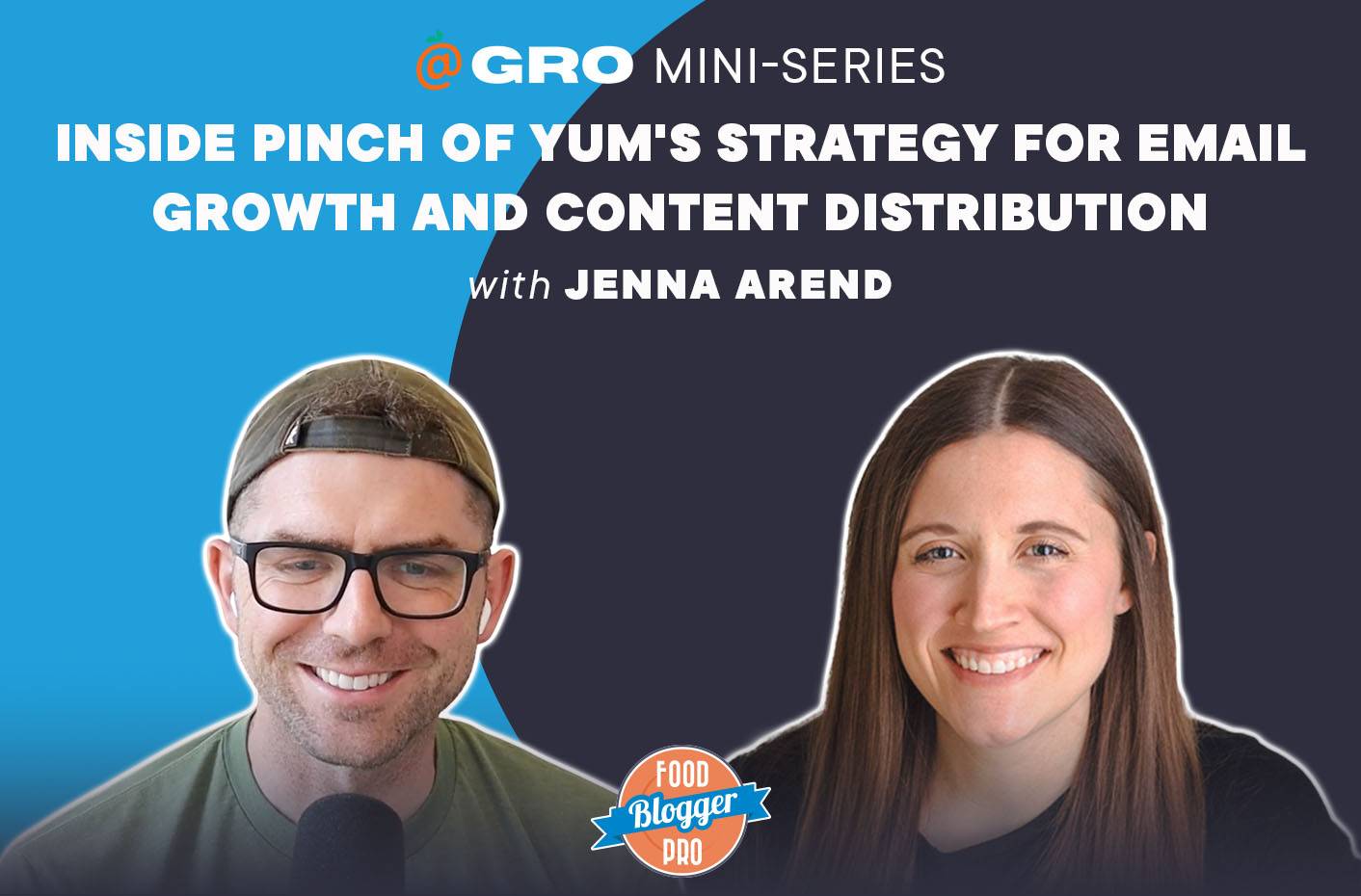
Welcome to episode 575 of The Food Blogger Pro Podcast! This week on the podcast, Bjork interviews Jenna Arend.
Last week on the podcast, Bjork chatted with Ben Jabbawy. To go back and listen to that episode, click here.
Inside Pinch of Yum’s Strategy for Email Growth and Content Distribution with Jenna Arend
This week, Bjork sits down with Jenna Arend, General Manager of Pinch of Yum, as part of our ongoing GRO mini-series. In this episode, she shares how Pinch of Yum is navigating the biggest shifts in the digital landscape right now, from the decline of third-party cookies to the rise of AI, and why those changes have pushed the team to double down on email and Facebook as their most reliable channels.
Jenna also gets into the strategy behind keeping a long-running food blog relevant and thriving — from improving older content to creating targeted resources like meal plans and freezer meals. She shares how GRO has helped streamline the process of converting social media followers into loyal email subscribers, and why building that direct line of communication with your audience matters more than ever. If you’ve been thinking about how to future-proof your content strategy, this one is worth a listen!

Three episode takeaways:
- Adapt your strategy as the digital landscape shifts: With changes like the decline of third-party cookies and the rise of AI, relying solely on search traffic is risky. Pinch of Yum has leaned into email and Facebook as more stable, direct channels — and it’s paying off.
- Don’t overlook your existing content: Improving older posts can be just as valuable as creating new ones, especially for a long-running blog looking to maintain relevance and traffic in an ever-changing algorithm environment.
- How Pinch of Yum uses GRO to turn followers into subscribers: A clear call to action paired with genuinely helpful resources — like meal plans or freezer meal guides — gives your audience a real reason to join your email list, and tools like GRO can make that conversion process even smoother.
Resources:
- Pinch of Yum
- GRO
- Pinch of Yum’s Traffic Trends (2024 vs. 2026)
- Episode 547 of The Food Blogger Pro podcast: Inside Crowded Kitchen’s Strategy for Growing to 2.4 Million Followers on Facebook
- Pinch of Yum – Freezer Meals
- Get Pinch of Yum’s Trader Joe’s Meal Plan for free here!
- See the Trader Joe’s DM automation in action here!
- Episode 563 of The Food Blogger Pro podcast: Using AI to Eliminate Busywork and Unlock Creative Time with Jason Glaspey
- OpenClaw
- Live Q&A with Jenna: Marketing Your Content
- Follow Pinch of Yum on Instagram and Facebook
- Join the Food Blogger Pro Podcast Facebook Group
Thank you to our sponsors!
This episode is sponsored by GRO. Learn more about our sponsors at foodbloggerpro.com/sponsors.

Built specifically for food creators, GRO is the ‘comment for recipe’ platform designed to help you effortlessly grow your email list, drive more traffic to your site, and earn more affiliate sales.
Learn how top food creators see 75% click-through rates and 5% opt-in rates during upcoming office hours at GRO. You can register for the event at gro.co and use promo code PODCAST to get your first month totally free.
Interested in working with us too? Learn more about our sponsorship opportunities and how to get started here.
If you have any comments, questions, or suggestions for interviews, be sure to email them to [email protected].
Transcript (click to expand):
Disclaimer: This transcript was generated using AI.
Bjork Ostrom: If you’re a food creator, chances are you’ve come across comment for DM tools and using that functionality within Instagram can result in some huge wins, but the tools are really complicated and they’re oftentimes built for marketers like people who are in the tool day in and day out, not built for food bloggers or recipe creators specifically. That’s where GRO, spelled G-R-O, comes in. It’s built from the ground up for food creators. So if you’re looking to grow your email list, get more traffic to your site or maybe earn more affiliate sales all without spending a ton of extra time or having to learn a complicated tool, then GRO is for you. And what’s really cool is they’re seeing some pretty impressive numbers like 75% click-through rates, which is kind of mind-blowing, and 5% opt-in rates from people who are engaging with content that is sent through the GRO platform. And they’re actually doing an office hour session soon. So if you want to see behind the scenes of how creators are using it, you can sign up at GRO.co, that’s G-R-O. co, and a little bonus for you as a podcast listener. If you use the promo code podcast, you’ll get your first month completely free. Again, that’s GRO.co, promocode podcast.
Ann Morrissey: Welcome back to another episode of the Food Blogger Pro podcast. I’m Ann from the Food Blogger Pro team. This week, Bjork sits down with Jenna Arend, General Manager of Pinch of Yum, for the last episode of our GRO miniseries. In this episode, she shares how Pinch of Yum is navigating the biggest shifts in the digital landscape right now from the decline of third party cookies to the rise of AI and why those changes have pushed the team to double down on email and Facebook as their most reliable channels. Jenna also gets into the strategy behind keeping a long running food blog relevant and thriving from improving older content to creating targeted resources like meal plans and freezer meals. She also shares how GRO has helped streamline the process of converting social media followers into loyal email subscribers and why building that direct line of communication with your audience matters now more than ever. If you’ve been thinking about how to future proof your content strategy, this one is worth a listen. And now without further ado, I’ll let Bjork take it away.
Bjork Ostrom: Jenna, welcome back to the podcast. If you might be one of the top guests on the podcast through the years because you’ve been involved with Pinch of Yum for 10 plus years. I remember back to when we were doing some hiring for, I think it was like an office manager role.
Bjork Ostrom: The vision that I have was we had this office in North Loop, North Fish, Minneapolis, right on the river, super cool building, super cool space, but it was kind of cold. Do you remember this? It felt like it was … Yeah. I think the day that you came in to interview, we had this little office that was glass office and came in. The vision that I have is it was kind of a cold day, but came in to do this office manager role and have really grown into overseeing a lot of the different components of most of the different components of Pinch of Yum on a day-to-day basis in a general manager position. We’re going to be talking about Pinch of Yum today and what’s been happening with it. Obviously, Lindsay produces a lot of the content, so people see Lindsay and the content that she’s producing, but you’re also scheduling that a lot of the email work you’re doing, which we’re going to be talking a lot about today, helping to put together some of the posts for the Roundup content on the blog.
Bjork Ostrom: Anything else that you’d add? There’s a thousand things that we could talk about, but to help fill out that picture of what your role as general manager looks like at Pinch of Yum.
Jenna Arend: Yeah, it’s shifted and changed over time as our strategy changes, obviously, but that’s a good deal of what I’m usually working on the day-to-day is Lindsay’s creating the content and then I’m working on how do we get that where people can see it and access it and enjoy it in an accessible way. So that involves email, that involves making our recipes discoverable on search and also just helping with just the day-to-day of getting new content out and improving our old content.
Bjork Ostrom: Yeah. One of the things that you have that’s really unique that a lot of people don’t have is 10 years of experience in the world of publishing content online with a specific brand. So similar to some people listening to the podcast, you’ve seen a lot of things change and shift and evolve, different platforms that have worked, then they don’t work and then they work again. And some of those are decisions we’re making as a team. “Hey, we want to invest in this platform. We don’t.” Others are just the macro trends for what we see working and then what doesn’t work. So from your standpoint, what’s the assessment of where things are at right now for Pinch of Yum in terms of the platforms that you see working well, that we’re focusing on we have a small lean team and so we’re not showing up everywhere.
Bjork Ostrom: We try and show up in little ways across all the different platforms, but really place a stronger emphasis on some platforms. So from your side, day-to-day, what are you seeing and what’s working well from a platform perspective?
Jenna Arend: Yeah. Like you said, one of those things that has shifted and changed a lot just as algorithms change and things that we’re seeing success with and that seems to be achieving our goals, but also meeting readers where they are. And right now our main areas of focus, the first one will always be the blog, which seems obvious, but that’s something that’s shifted and changed over time so much for us as far as … And when I say that, I mean publishing on the blog and getting traffic from the blog because
Bjork Ostrom: Obviously
Jenna Arend: That’s our first source of revenue and that’s changed so much where I think too I wasn’t maybe involved as much right at the beginning of my tenure with Pinch of Yum, but think about going through COVID and how that was such a big shift and change for us for traffic on the blog. Think about when the third party cookie was going to be introduced and that
Bjork Ostrom: Shifted
Jenna Arend: Strategy a little bit. And now with AI, which is what we’re still obvious all publishers are kind of figuring out as newer updates come from that too. So it shifted a lot, but it still remains our number one focus. So whether that’s improving older content and optimizing it, which we’ve talked about a lot on, I feel like we’ve probably had a podcast episode about that in courses too. So that’s where we put a lot of our energy is updating older posts and then obviously publishing new content and making site updates that just perform better for search and make us more … I’m thinking about the EEAT guidelines, position us more of an expert to Google and for
Bjork Ostrom: Search.
Jenna Arend: So that’s always our number one area of emphasis of what we’re doing. But what we’ve had a lot of success with more recently that I feel like has shifted into our main areas of focus right now would be email, which I know we’re going to talk a little bit more about today too, but yeah, email, when I mentioned that third party cookie, I originally stemmed from that of
Bjork Ostrom: One- Yeah, kind of kickstarted it.
Jenna Arend: Yeah. Yep. And now it’s our fourth source of traffic, which is higher even than Pinterest. So it’s funny to see the changes where Pinterest had always been our number two, number three source of traffic and it shifted into that’s overtaken now by email and Facebook, which is where I would say our other area of growth and emphasis is right now is on Facebook, which is our third source of traffic right now.
Bjork Ostrom: So traffic sources would be search and then direct and then Facebook and then email and then Pinterest?
Jenna Arend: And then Pinterest, yep.
Bjork Ostrom: Yeah. It’s interesting there’s those, I don’t know if you’ve ever seen those data nerd Instagram videos where it’s like population over time and it shows the graph going in and out or like operating systems over time and it shows like, oh, there’s Windows and then Apple comes and it’s the shift as the years progress. It’d be interesting to see kind of a traffic version of that. And I think what you’d probably see, at least in Pinch of Yums is Facebook was really low and then it kind of rises up over this last year as we’ve placed more of an emphasis on it. But the reason that we placed more of an emphasis on it is because we are getting more traction there and we kind of figured out through some recommendations and working with some people. Some of the podcast interviews I did that we learned from Lexi from Crowded Kitchen talking about Facebook and Facebook strategy and posting frequency.
Bjork Ostrom: Talk a little bit about email. You talked about third-party cookies for those who aren’t familiar.
Bjork Ostrom: The idea with that was there’s this kind of, I think of when in Minnesota when you go to a cabin, I know you have a cabin and you look out over the lake and you see a storm and you’re like, “Oh, the storm’s coming.” That felt like third party cookies was like, it wasn’t here yet, but the storm was coming and every day you’d wake up and you’re like, “It’s still there. I can still see it, but it’s not here yet.” And it kind of was that for what felt like a year. But for those who aren’t familiar with third party cookies, this idea that a cookie, this thing that you can track, it allows you to track somebody online and it allowed you to do targeted ads. And so you would earn more from those ads the more that you knew about somebody and the more that you could target them.
Bjork Ostrom: If that goes away, you can’t be as targeted so then advertisers won’t pay as much. So everybody was kind of panicking and saying our ad RPMs are going to drop because we’re not going to be able to target as much. That continually got pushed off and pushed off and pushed off and never really was implemented in the way that people thought it would be. But as that was happening, the rise of email came up because they’re like, “Hey, now we can get first party data and get information about people and advertisers would pay even more as long as somebody clicks on a link and an email goes to the website.” So can you talk about from a strategy perspective for Pinch of Yum, as that was happening, as we saw this storm on the horizon and we’re like, “We need to ready the boats prepare our strategy, what changes we made to email that now benefit us today as kind of this owned source of traffic?” What changes occurred during that time?
Jenna Arend: Yeah, we mostly just tried to create new incentives for somebody to sign up for our email list. Our incentive that we had had for just standard so long was the way we’d get new email addresses was just the bar at the top and maybe something on the homepage and our incentive was like an e-cookbook and that had been successful to get people on the list for getting our new recipes, but we just kind of got creative with new ways to get people on our email list. So I remember we used to do, we used to call them niche opt-ins and it would be like on all of the recipes in the quick and easy category, there would be a pop-up that popped up that was like, “Get my five easy weeknight recipes sent to your inbox.” So we were doing that and just integrating more opt-ins into the site in the recipe card and doing some inline forms as well.
Jenna Arend: I just remember us doing a lot of testing to se how to get more people on our email list.
Bjork Ostrom: On the site specifically?
Jenna Arend: Yes, on the site
Bjork Ostrom: Specifically.
Jenna Arend: And that was really our primary kind of way of doing it. We released maybe a few new products. We did the freezer meals that was extremely successful and still is. Instead of just giving somebody click this link to download the PDF, we were now always saying, “Sign up for this form. It’ll be sent to your email.” And so creating some more valuable products like that, like freezer meals or meal plans was really successful too. It gave us something as well to market a lot more strongly on social more than just like, “Hey, send up our email list.” It was a specific campaign around getting a PDF of freezer meals or a PDF of meal plans. So we made some changes like that. And then I think the other piece too is just in the last, I would say two to three years, we really just made the content that we’re sending via email a lot more targeted and valuable.
Jenna Arend: Whether that’s one thing I didn’t mention is we revamped our welcome sequence too, which I feel like it’s talked about a lot of, which is when somebody signs up for a forum on your site, they get maybe two to three emails that’s introducing who Lindsay is, sending our top recipes, things like that. So we just kind of really dialed in on making just our overall experience for readers via email a lot more helpful and interesting and useful and effective, which has kind of led into now what our weekly email cadence is today. And we have other strategies of growth now, which we’ll talk about a little bit, what we’re doing on Instagram. But that was kind of where we started was just kind of testing out different ways to entice people to get on our email list. And then the other piece of making sure that then what we’re sending after that is actually useful and effective.
Jenna Arend: And over time as we’ve tested, we’ve really found what that kind of niche is of what people seem to respond to and makes them want to stay on the list too.
Bjork Ostrom: Yeah. It’s one of the things that is great about how people create content on the internet, which is you have this kind of tight feedback loop, you’re able to create something, it’s a digital thing, you’re able to send it out, you’re able to see how people respond. The other piece that I think exists in a unique way online is like you’re able to in real time gather information from people. I know one of the things that you and Lindsay both do is create a piece of content like Lindsay will maybe do a poll on an Instagram story to see, hey, what’s most helpful? And even just being in comments and reading DMs that people are responding with and saying, “Hey, this was super helpful. This made a difference,” whatever it is, you start to develop this kind of instinct around what’s going to resonate with an audience.
Bjork Ostrom: And the thing that you said that I think is really important is this idea of really targeted, targeted and helpful. So it’s specific and helpful. And for all of us as content creators, I think one of the things, this applies for what I’m doing with the podcast, like how can we get as targeted as possible and how can we make that as helpful as possible? So an example that I would think about is like AI, okay, people are interested in AI, but what is it like for AI for creators or more specifically, what is it like for AI for food creators? Okay, that’s targeted as a topic. Now we know that we have a targeted topic. Then what does it look like for that to be really helpful? So how do you create something that is actually going to make a difference for people who are interested in AI for food creators?
Bjork Ostrom: I think of a few people who reached out after I did the interview with Jason, who I know you know Jason Glaspey, you’ve talked to him before and he came and talked about OpenClaw, this tool that he’s using, great episode that everybody should go back and listen to. And we had a few people reach out and they’re like, “I started to do this and it was life changing, like how I’m using this tool.” And it’s like, “Oh, that’s a great example of targeted and helpful.” And the third piece that I think is really important within this is once you have something that you feel like is really targeted and is really helpful, then our job is to market it. And one of the things that I love about GRO, sponsor for this series, one of the reasons it’s a sponsor, one of the reasons that we’re advisors and investors is because of how great of a fit it is for creators like ourselves.
Bjork Ostrom: Started as food specific, now it’s broader. So there’s a lot of different platforms using it, but it’s kind of foundation is still with food creators. But one of the things that I really liked about it was it allowed solo creators, lean teams to use a platform like Instagram efficiently to market the things that they are creating that are targeted and helpful. And for a lot of us, we have thousands, tens of thousands, hundreds of thousands or millions of people who are following us on these platforms. And traditionally what we’ve done is we’ve tried to drum up interest in going to a piece of content and consuming that content on our website, but in using a tool like this, you’re able to market a little bit differently. And I think that’s what’s really exciting when you can have those three things, really good marketing, you can have a really targeted piece of content or a product, even if it’s a free product and something that’s actually going to be helpful for people, you wrap all of that together and you have this really great opportunity to capture value in some way.
Bjork Ostrom: The way that we decided to do that was primarily through email. Can you talk about a few of what that looks like functionally to trangulate with those three things, helpful, targeted, and then how do you actually get people to sign up for an email and then we can talk about after the fact what it looks like to continue to connect with those people and direct them in the way that you are most interested in directing them.
Jenna Arend: Yeah. So I make sure I understand your question.
Bjork Ostrom: Sure.
Jenna Arend: Kind of looking at the before you send the content of how you find those people where those things all meet, is that what you’re saying?
Bjork Ostrom: Yeah. Well, and maybe even what you could talk about specifically is we could use an example for Pinch of Yum. We create a product. The product would be like a PDF, it’d maybe be a free meal plan, freezer meals. And then I think the piece that would be most interesting to talk about is the actual marketing of that. So what does that look like if somebody who’s listening has figured out the helpful piece, they’ve figured out the targeted piece, they’ve come up with something that they think is going to be helpful, what does it look like to market that well? And maybe ideas that you could share around where and how using GRO as a platform. There’s other similar tools that can do stuff like that. So it can be kind of the theory of it, or you can talk specifically around what it looks like within GRO to use that.
Bjork Ostrom: But the marketing piece around how to actually get that in front of people and help people to take an action, I think of the examples of creating a reel and the real talking through some highlights of recipes that we have and then allowing people to sign up and get that email delivered to them and then they’re on the email list. That is an example.
Jenna Arend: Yeah, for sure. Yeah. One way that I feel like we as a team like looking at it and me personally is if you’ve found what that specific targeted piece of this is, and for us it’s easy dinners, weeknight dinners, looking at it almost in a way of what’s our reader’s problem and how can we solve it? Because I feel like that’s kind of what leads our marketing on all these different platforms is what’s the problem that they’re having and what can we provide that will solve that? And that kind of drives everything that we’re doing. It maybe sounds really simplistic, but I feel like looking at it as a problem to solve instead of just like, “Oh, here’s what people like. ”
Bjork Ostrom: They
Jenna Arend: Actually have this problem. A lot of our audiences, maybe people with kids and families or maybe a single professional who just doesn’t have a lot of time to cook in their week and somebody who wants easy dinners, but they feel more elevated than just boxed mac and cheese and chicken nuggets, which
Bjork Ostrom: There’s
Jenna Arend: Nothing wrong with that, but just a little-
Bjork Ostrom: Been there. Yeah. We also have that.
Jenna Arend: Yeah, I love it. But yeah, I feel like looking at that’s the problem to be solved and then how can we provide a solution to that? And for us, for Pinch of Yum specifically, it’s been, I mean, email is such a large part of it because the thing about email that’s been really fun is it’s somebody who actually took the step to ask to receive your content and people can click follow on Instagram or it shows up on their Discover tab, but somebody on email, I feel like we have this kind of next level relationship then. And so we have just hyper-focused on that as the target of what we’re sending via email. And so I can walk through even our email cadence too, but it’s sending round-ups multiple times a week that are like, even though it feels repetitive, it’s just specifically targeting that problem and just continuing to give solutions for it and in a very personal way too where they’re written by Lindsay, they’re from Lindsay. So there’s that. And then also we have been able to spin off, I guess products you could call them, or I guess I would say resources is the better term for it. So freezer meals would be one of them, not to be repetitive, but yeah, freezer meals and then the paid meal plans that we’ve done. But then we’ve also been on Instagram right now really just focusing on free meal planning content, not necessarily like, here’s a PDF of a meal plan and a grocery list that goes with it, but Lindsay will do, here’s what I cooked this week and you can comment and you’ll get all these recipes in your DMs in your inbox.
Jenna Arend: And so finding just new ways to give … The awesome thing about it is that it’s coming from Lindsay’s real life as a mom of two.
Bjork Ostrom: It’s like also a problem that we’re trying to solve.
Jenna Arend: Exactly. Become this nice, which I would imagine is similar for you with your podcast example of AI. We are also trying to solve the AI problem.
Bjork Ostrom: We’re in the middle of it, which makes it easier to create content around it.
Jenna Arend: For sure.
Bjork Ostrom: And the difference is in one scenario you might be trying to solve it and then you solve it and then it’s solved. In both of our scenarios for Food Blogger Pro and Pinch of Yum, we’re trying to solve it, we solve it, and then we create something out of it, a podcast, a download, a course, a Q&A because there are other people we know who are out there trying to solve that same problem. Can you talk about … So in the example of creating a list of different recipes, what does that look like functionally? If you talk about funnel, the top piece of content is the free content and then the next step down would be you described this idea of a DM that’s sent. Can you describe what that looks like? And then also the two benefits of that I would imagine would be potential email signups or traffic.
Bjork Ostrom: So people see the content, they comment and then what … Yeah, just talk through that flow, what that looks like.
Jenna Arend: Yep, yep. So I think if we start with the problem to solve is people are busy and they want weeknight dinners and we’re going to use Instagram to solve that problem. We create a piece of content that is a reel maybe. We’ve done a few different content types for this. So maybe it’s a reel of different recipes or Lindsay in the kitchen with your two kids around running around or it’s an image carousel, which again, following what’s working right now, that’s what’s working on Instagram right now are image carousels. So it’s creating, here are my top five easy weeknight recipes that my kids love right now, or here are the recipes I made this week and my ratings for them, taking it from her own personal life and creating a piece of content about it. The awesome thing about carousels being effective right now is they’re a lot less work splicing videos together or filming.
Jenna Arend: It’s kind of just bringing the images you already have together and really focusing on … We tend to re-share a lot of whatever our top content is and sometimes it might feel repetitive, but it’s also just getting … We want to give what’s working best for people get it into their hands instead of something that maybe is not as highly rated or something like that. So
Jenna Arend: We’re picking recipes that are tried and true and from there the CTA is usually comment save or comment recipe. And right now we’re using Grocers List or GRO and if they comment, there’s a few different ways that they get the content. We’re still testing out all these different ways, but traditionally it’s sent them to a link to a form and then they sign up like, “ I want this Trader Joe’s meal plan. ”And they sign up and they receive it in their email inbox or it’s a link to a roundup. I was just looking at what’s our most successful ones had been and one was it was a promotion of, I think it was summer recipes and then it just sent them to a roundup page. It just sent them a link. And then lastly, which this is a new tool, is you can actually do set it up sending an email or get it sent.
Jenna Arend: I’m not using the right language for this, but they comment on their recipe, the DM gets sent and says,“ What’s your email? ”So instead of sending them to a form, it’s just saying,“ What’s your email? ”The give them the email, okay, it’s in your email inbox. So
Bjork Ostrom: Waiting- And that’s also then connected to, in our case, Kit,
Bjork Ostrom: Which signs them up the before and after, not super clunky, but pretty clunky because we’d hear from people occasionally where you’re like, “ Hey, DM and I’ll send you this meal plan as an example, PDF. ”So then people DM or they comment and then they get a DM and the DM is like, “ Here’s a link to sign up for the PDF. ”So then you click on it and it opens a page, which is like a kit landing page and it’s like put in your name and email, you put it in and then there’s a confirmation page. We sent you that and it’s like, okay.
Bjork Ostrom: But yeah, that’s what had to happen in order to get an email address, which the exchange is like, we’re creating content for free. The way that we’re able to do this as a business is like we need to continue to be able to market to somebody. So that’s what we’ve decided the exchange is going to be. The bummer was this friction, which now doesn’t exist. You’re able to just send a DM back with your email address, which then gets them on the list and then they get sent that PDF. So there’s less friction, great for the user, better for you as the publisher because people aren’t going to become disgruntled or fall off along the way. And so kind of two benefits. One would be the traffic. You just click on the link and you go to the site. That’s great, really frictionless, but you’re maybe getting some short-term value by getting more traffic, but you don’t have the long-term value of getting people on the email list.
Bjork Ostrom: That’s really the primary way that we are using GRO right now. The main value add would be traffic where people get a card and they can click on it and then email and you get some kind of sprinkled in email signups Just from people who get one of the cards sent to them and it’s like, “Hey, you could also sign up for email and you’ll get some of those.” And then occasionally we’ll do bigger campaigns where it’s like, we have this resource, here’s this cool thing. We create an Instagram reel, people can sign up for that and become a part of it. So there’s that as well. And then what happens after is that you have these email addresses and then the job for you as a creator is to talk to those people. It’s to tell them about the stuff that’s working well. So talk a little bit about the things that you would recommend for people based on what we’ve learned.
Bjork Ostrom: Once you do have people on your list, what are some of the things that people could be aware of, some of the things that people could be doing? And then maybe some of the tips and tricks. You can talk about it within the context of broadly speaking, we use Kit, but what would be some best practices for people once they do have somebody signing up for an email list after that?
Jenna Arend: Yeah. The first thing is I mentioned the welcome sequence is something that a lot of creators do and we do as well. And again, it’s just basically when somebody signs up for your list, it’s kind of an introduction to yourself and to your brand and top recipes and things like that. So that’s something that everybody gets, whether they sign up from the website or sign up from GRO on Instagram DMs, they’re all getting an introduction to Pinch of Yum. We used to have a very long welcome sequence series. It was maybe six emails and it was really good, but it was really long and we were just kind of fine. I think it was Lindsay who first brought up that was like, “Do we have to have it be so long? Could it just be one email?” And so now I think our welcome sequence is one or two emails.
Jenna Arend: And the goal with that was just to when you have somebody coming from the blog, maybe they’re more invested in who Pinch of Yum is and who Lindsay is and that the long string of content for a welcome sequence works for them. But when you have more people now coming from social like Instagram, they might not want all that content or all that information. And so we shortened it up and so it’s just one, I think it’s maybe two emails now, maybe three. And so I think that’s a good first intro of letting people know what to expect too. So we let them know, “Hey, I’m Lindsay, this is who I am. This is what I want to do for you. These are the problems I want to solve.” And you can expect two to three recipe emails from me per week,
Jenna Arend: Then they know. And so that’s kind of the first step for us is just giving them what to expect, which is important. And then after that, we really just honed in on what kind of content we’re sending and how often. And so for us, that is a Roundup every Sunday because again, our focus is on people who need weeknight dinner ideas or to solve the problem of weeknight dinner. And so on Sunday mornings, we’re always sending a roundup of maybe eight to 10 recipes with a high focus on easy weeknight. We really drill into that, but that’s what everyone’s doing on Sunday, especially if you’re somebody with a family or somebody who’s busy. And so that’s one of the things to expect. Then the other is whenever there’s a new recipe, you get it sent via email on the day or day after it publishes.
Jenna Arend: And so it’s really like we’ve tried to really focus in on just sending good recipes that align with the reason that they signed up, which is typically from Instagram now. It’s usually somebody who wants a meal plan or freezer meals or it’s a single recipe that they wanted saved to their inbox that is mostly easy weeknight.
Jenna Arend: So yeah, I think our focus is fulfilling the promise we made of this is why you signed up and so here’s the content you are going to receive is primarily focused on that.
Bjork Ostrom: And what I love about it is it doesn’t have to be super complicated. It’s a lot of work. The actual process of coming up with something that’s helpful, kind of have the targeted piece, especially if people have been creating content for 10 years, you probably are at the point where you kind of know who your audience is and your target is, but you’re probably continually trying to think about what’s a helpful thing I could create. But then to actually create the marketing content around it, for us it’s primarily Instagram for other people that could show up in other places, but that’s a lot of work. But the system, the process is relatively simple. You create a valuable piece of content, you have a call to action. I think that’s one thing that a lot of people miss, which is crazy, but the call to action is like, what is the next step that people see after they see that piece of content?
Bjork Ostrom: And for us as food creators, we have this opportunity to have people sign up for an email or to go to the blog. Some of us have products that we could sell, whether it be food product or a cookbook. I think of friends that we know who are just content creators and generally what they’re trying to do is just get as many eyeballs as possible. There’s not a real strong call to action unless they’re maybe doing branded content, but from a business perspective, we’re really lucky that we have this not only are we trying to figure out how to get as many people to see it as possible, but then we can have this call to action where we have email lists and websites that we can send people to.
Bjork Ostrom: And then it’s that rinse and repeat of like, okay, you get people signing up for the email and you know in our case 50 to 60% of people, is that accurate will open an email. And so if you get a thousand people who sign up, that’s an additional 500 clicks and you know that every thousand clicks could be 50, 60, 70 dollars depending on the day and the season and the platform and how many ads you have running. And to some degree it allows you to play the numbers game a litle bit and say, okay, I can see some predictability with this as I continue to grow this as a valuable group of people that I can talk to in a way that’s more predictable than like a Instagram algorithm or even like search algorithms which are becoming more unpredictable. And so I kind of view it as like we have these platforms that are fluctuating.
Bjork Ostrom: It might go really well, you might get a lot of views, you might not get a lot of views, but along the way, how can you be as strategic as possible to build the things that are reliable, like an email list that are predictable, where you know you can have this open rate, you know you can have this click rate and you can kind of rinse and repeat that. And so generally you have up and to the right with email, even if platforms fluctuate and something works and then it doesn’t work. But figuring out how do you capture a bit of that if you have something that goes viral and a million people see it, what’s your call to action that’s getting people to take action there? So can you talk a little bit about as you see it, one of the things I’ll often ask creators when they come on is like, what would you view the most valuable platform to be or like rank order the most important kind of broadcast areas that you have for your content to get in front of people.
Bjork Ostrom: It wouldn’t even have to be like where are you earning the most revenue from, but from where you’re sitting, what would you view as the most valuable for Pinch of Yum day-to-day in terms of different platforms or places that we can reach people?
Jenna Arend: Yeah, it’s very repetitive, but I would say email. I mean, it’s like the third party cookie thing was kind of a panic moment and then it kind of died off, but I’m really glad we had that panic moment because it made us rethink the importance of email. And so as you were even just describing, it’s more like storm safe from algorithms like there’s not much influencing it unless we suddenly pivoted to sending content that they did not agree to if we switched to clothing, lifestyle kind of dance videos of me. It’s harder to influence it and touch it. We are fully in control of it for the most part and I think that that is something that feels really good because especially as we have looked at our search traffic over time and I don’t think at this point traffic from email would ever overtake organic search traffic. And so yeah, like you said, it’s not necessarily the most profitable, but it is a place that we have more control. And so I think that is really important. And I think related to that, especially with using GRO, with Instagram, it used to just not be any important source of traffic for us because we could only get people to the site from stories.
Bjork Ostrom: It’s kind of ambiguous awareness.That was kind of the purpose. We were like, we don’t have a product, we’re maybe not doing a ton of sponsored content. The question was like, and Lindsay would often say, “We have this great platform, but I wonder what’s the primary purpose of it?
Jenna Arend: ” Right, exactly. So I think it’s made it a lot more important. And then with just Facebook making this comeback over the last year, social is still important and we do use GRO on Facebook too, but I think with some of the … We’ve had some of our Instagram posts, especially the Trader Joe’s meal plans and the freezer meals go viral with a large percentage of people seeing that being non-followers. So they’re finding it in their Discover tab or just in their feed for suggested content. And now it is more valuable because it turns into emails. I feel like it’s also we have a very strong open rate for our emails and click rate. And so that also feels like it’s a good indication that after people get on our list, what we’re sending is fitting what they want to see because they’re opening it consistently. And so it feels like it kind of all comes together where it funnels into our social is really, like I said, Facebook is our third source of traffic and so it’s very important for direct clicks from
Bjork Ostrom: Facebook
Jenna Arend: Obviously, but-
Bjork Ostrom: Which is easier on Facebook because they allow linking. Yeah.
Jenna Arend: Yeah. But yeah, before now there just wasn’t a way to convert that to an email subscriber. And so it’s been fun to have a tool to do that and it’s just then made social, Facebook, and Instagram more valuable for
Bjork Ostrom: Us. Yeah. It’s a litle bit more clear. I think one of the things that
Bjork Ostrom: Will be more true generally every day moving forward is that for people who have the business of creating content on the internet, social will become more and more important. And it’s not even really social media anymore. I think it’s just this hangover term from 10 years ago when it truly was social where you’d find your friends on Facebook that you went to college with, where now it’s an algorithmic content play and somebody who has a thousand fans I would say has almost equal likelihood of somebody who has a hundred thousand fans of producing a piece of content that gets 500,000 views as long as that piece of content is all of the things that it needs to be in order to be engaging and interesting and fascinating to a group of people. And if the algorithm sees that, then it will surface it to hundreds of thousands of people.
Bjork Ostrom: And so in that way, I feel like it’s a great time to be a content creator because you can start tomorrow and potentially reach hundreds of thousands of people. It’s not as much of a slow start as it was 10 years ago, you have to have those skills and those abilities and kind of that intuition, which that would be the slow part is developing that. But I think social more and more every day is becoming more significant, more important. Then the question is like, okay, as you start to get better at that, what’s the transaction that’s happening? And you’re starting to see people who only build on social and they’re transacting on social and they might have products that they’re selling, they might have a shop, they might be like a course, but it’s all linked from within their social accounts. Then the question is for us as content creators who are used to monetizing by people going to a blog, going to a website, what is the play for us?
Bjork Ostrom: And I think what you’ve just described is a great implementation of that, which is, okay, we need to in some way transact on the platform. So on Instagram, how are we going to get people to interact natively, DMs, comments? It’s all happening natively, but then eventually have the conversation around, here’s the link, here’s the email where you can sign up and move people over to the place where we are transacting. And that was a lot harder to do before it feels like that gap was wider than it is now. And tools that allow you to do that, the one that we’re talking about today is GRO, have shrunk that gap so it’s easier to get people to click, to sign up, to engage in a way that you can eventually bring them over. So if somebody was starting today, we can talk specifically to GRO.
Bjork Ostrom: What was the one thing that was easiest to get started with? If somebody does want to try it out, if they want to get into the platform, if they want to try a thing, what’s the first thing that you think that they could try? Or even what’s the first thing that we did when we first tried it out? That would be a good entry point for somebody as we round out the interview.
Jenna Arend: I think the most standard, and this is our day-to-day usage of it, is to set up your … You can set up default words on any post that you publish. If you include a URL in the caption, for us, the default words are save or recipe, I think. And so they can just always on any post, if they type save, it’ll send them the recipe that you’re promoting. So I think on single recipe usage is the place that I would start and that’s where we started too. So just kind of set it up the defaults that we have. Some people might want to set up comment pasta for this pasta or something like that, but the easiest standard way to do it and for us that worked well was to set up just default words and only use those. And so
Jenna Arend: That’s how we started was then the CTA and the caption would be comment save to get this recipe in your inbox. And that’s kind of the standard way that we used it for a long time. So that’s where I would start is just kind of seeing how that goes. And again, the fun thing about it is that you can, on the DM card that they get, it says the link to the recipe, which is why they commented, but then it also says, email me this link or whatever language you want to put in. And even just from that day-to-day start with just doing it on individual recipes, I wish I had the chart in kit, but it’s like our numbers are flat and then it just kind of slowly starts going up. And then when we hit the next level, it just kind of-
Bjork Ostrom: Because you have now hundreds of pieces of content that people are seeing and so it’s incremental, but it’s maybe compounding in that every one piece of content you produce that has that allows that graph to go up a litle bit higher.
Jenna Arend: Yeah, for sure. And I think it’s also a preference of where people want to consume their recipe content. Some people want to cook from Instagram and save all that in Instagram and those people aren’t clicking the email me, this recipe button, but other people live more out of their inbox, which means maybe even an elder millennial thing too
Bjork Ostrom: Often
Jenna Arend: From Instagram. And I’m solidly millennial. So it’s just differences too in how people consume it. And so that’s just the day-to-day of how we’ve used it. And then from there we started doing new things with it. So two examples that I’ll share, one is I’ve talked a lot about these specific resources that we have sent. So freezer meals, which is a PDF of freezer meals. It’s like a whole prep PDF of everything you need in it. And then we started doing these one-pager Trader Joe’s meal plans. That’s like five Trader Joe’s dinners for under $100. And we started using those as specific opt-ins. So whether it’s, like I said, a reel of Lindsay cooking the recipes in her kitchen or holding up the freezer bag or something like that. And it’s click to get this resource. And those are the ones that if I sort by what’s been most DM’d or saved, it’s right at the top is freezer meals and then Trader Joe’s meal plan and then viral easy dinners.
Jenna Arend: And so again, that kind of speaks to our target here. And so that was kind of our next step was trying out, what if we offer something bigger than just an individual recipe on the site?
Jenna Arend: And that was kind of the key for us to unlocking where you see the line and convert kit go really high up is that was people were like, yes, I want that and this is a really easy way for me to get it rather than before it would’ve been like click the link in my bio to go to a link in profile or Linktree and then-
Bjork Ostrom: Yeah, so much friction.
Jenna Arend: And then you get to a form and then it’s just much more easily accessible. So that’s kind of the next step up we did. And now one usage that we’re having success with is doing these recipe carousels. So Lindsay will share, here’s my meal plan for the week, or here are the meals I cooked my family this week and what I rated them. And if you comment save, I’ll send you all these recipe cards. And I really love just how it looks in the DM. It’s like say it’s five recipes you shared in the carousel, you get a DM that’s a scrollable five recipe cards and you can save all of them to your email or you can just click each individual one. So it kind of takes like, “Oh, I like the recipes in this carousel,” and you get all of the links directly to your DM inbox.
Jenna Arend: So we’ve kind of taken little steps up, but it’s been fun to see how each of them have been really successful for us.
Bjork Ostrom: Yeah, I think it’s such a great example of this idea of how do you find little ways along the way to introduce something that isn’t a huge lift. It takes maybe a litle bit of learning, takes a litle bit of work in the beginning, but then you can kind of fold it in as this little multiplier, value multiplier on the content that you’re creating and we’re going to be creating that content anyways. We’re going to be publishing. It’s what we do. So then how do we think of something that’s going to make that more valuable for the business? We slot that in as a system and as a process. So then you have more people seeing it or the same amount of people seeing it maybe, but then you have more people who are clicking on the link or signing up for the emails. Once they’re on the emails, you get more people who get that in their inbox and potentially click on it and all of that stuff, just one little thing on its own probably doesn’t make a big difference, but when you’re producing 25 pieces of content a year or 50 pieces of content a year and then each one of those has that little multiplier along the way and then you find five, 10, 20 different things that you can have as little multipliers, it really adds up and makes a difference.
Bjork Ostrom: Yeah.
Jenna Arend: One thing I’ll just note that when I was looking at just some of the analytics within GRO is even, we did the freezer meals maybe last summer, last fall and it was super successful and then we just shared it again last month or two months ago and it got almost the exact same conversion rate and response and we didn’t change anything. It was a good reminder for us of how we have this existing piece of time. Before if we share it again and captured new users and was also successful again. And so I think sometimes in our heads it’s like, it’s too repetitive or we already shared it. And I think I talked about this in one of the Q&As we just did, but I think a lot less people are paying attention than we think it’s some people didn’t see it before and now they see it again.
Bjork Ostrom: Or they did see it before and then they see it again and then they … Yeah, right. I think of commercials and it’s like, man, sometimes they see a commercial. I watch a football game or if you watch the NBA … I know you’re a Timberwolves fan, you watch the Timberwolves and it’s like you’ll see the same commercial 30 times if you’re watching it live. It’s probably not the worst thing in the world if somebody who’s scrolling Instagram sees your 12-second video twice in a year. It’s such a good reminder for those of us who have a bank of content, which most of us do, to think about how can you do a light lift on pulling that content up and potentially scheduling it again. So it’s a great takeaway. We could talk for another hour about this stuff. We’ll have to have Yan again soon.
Bjork Ostrom: Jenna, we’re super grateful for you and all that you do for Pinch of Yam. You do such a great job and I know so many people probably not listening to this podcast. Those who listened got a lot of value from the day-to-day, but literally millions of people have their lives impacted by the quiet, significant work that you’re doing behind the scenes for Pinch of Yum and all the day-to-day stuff there. So super grateful for you. Thanks for coming on, talking a little bit about what it looks like day-to-day as you do that important work and we’ll have to have you on again soon. Thanks for coming on.
Jenna Arend: Thanks. Thanks. Appreciate it.
Ann Morrissey: Hey there, Ann again from the Food Bagger Pro team. Thanks so much for listening to that episode of the Food Blogger Pro podcast and for tuning into our GRO mini-series. If you enjoyed the episode, we would greatly appreciate it if you could share it with your community and leave a rating or review wherever you listen to podcasts. Join us next week for our next episode as Bjork interviews Rebecca Blackwell about how she built her six-figure digital business from her RV. We’ll see you back here soon and in the meantime, we hope you have a wonderful week.