
Listen to this episode of The Food Blogger Pro Podcast using the player above or check it out on Apple Podcasts or Spotify.

This episode is sponsored by Clariti.
Welcome to episode 578 of The Food Blogger Pro Podcast! This week on the podcast, Bjork interviews Josh Gale.
Last week on the podcast, Bjork chatted with Emily Baksa. To go back and listen to that episode, click here.
How Josh Gale Grew His Audience to 1.2M+ in Under a Year by Leading with Storytelling
In this episode, Bjork interviews Josh Gale, a content creator who has rapidly grown his online presence in the food industry through his blog, The Chef Out West. Josh shares his journey from being a private chef and participating in food competitions to becoming a successful content creator within just a year. He discusses the initial challenges he faced, such as learning to film and edit, and how he overcame the fear of starting something new.
Josh emphasizes the importance of storytelling in content creation, explaining how his personal experiences and passion for food have helped him connect with his audience. He also highlights the role of social media platforms like Instagram and Facebook in his growth, sharing insights on how different types of content perform across platforms.
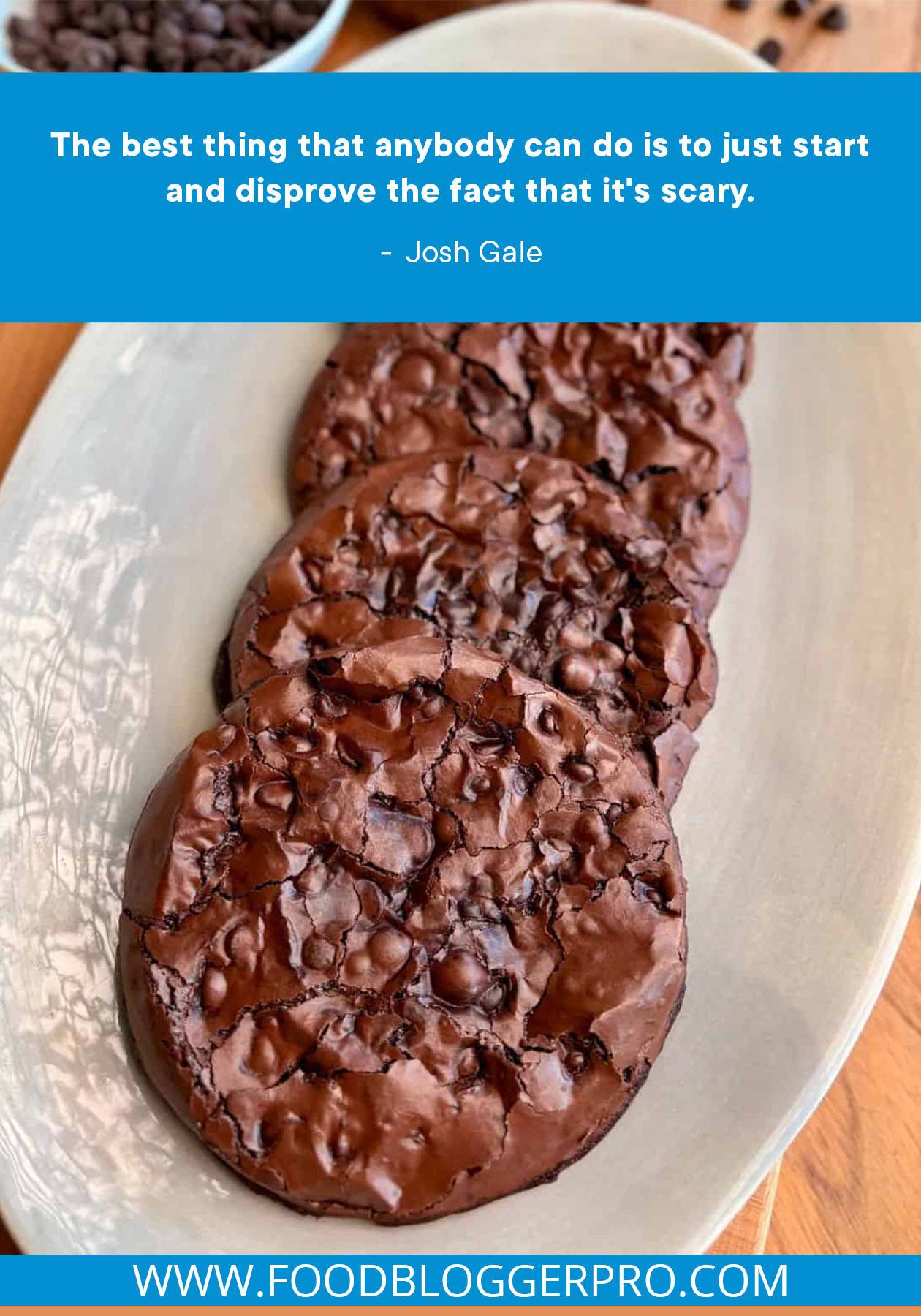
Three episode takeaways:
- Just start, even if it’s not perfect: Josh waited until he felt ready, but the real growth came from simply hitting record. Imperfect early content is part of the process, not a reason to delay.
- Storytelling is the differentiator: What’s driven Josh’s rapid growth isn’t just great food, it’s the way he frames it. Audiences connect with the why behind a dish as much as the dish itself.
- Know which platform does what: Josh treats Instagram as his traffic engine and his blog as his revenue hub. Understanding each platform’s role, rather than chasing all of them equally, has been key to building a sustainable business.
Resources:
- The Chef Out West
- Toronto Sun — Josh Gale Talks Cheesecake Flop on MasterChef Canada
- Season 33: Episode 5 of Beat Bobby Flay: Another “Flay” in the Office
- Episode 527 of The Food Blogger Pro podcast: How Storytelling Helps Creators Stand Out Online with Brita Britnell
- Check out Josh’s potato waffle recipe on TikTok!
- Episode 125 of The Food Blogger Pro podcast: Monetizing as an Entrepreneurial Chef with Shawn Wenner and Chris Hill
- Episode 561 of The Food Blogger Pro podcast: How Food Dolls Turned Facebook Into Their Top Traffic Source
- Meta Business Suite
- GRO (formerly Grocer’s List
- Episode 547 of The Food Blogger Pro Podcast: Inside Crowded Kitchen’s Strategy for Growing to 2.4 Million Followers on Facebook
- Episode 2 of Food Empires by Grocers List: He Quit Cooking for The Rock to Go All In On Instagram
- Tastemaker Conference
- Mediavine
- Raptive
- Substack
- Follow Josh on Instagram and Other platform – facebook, youtube, tiktok, whatever seems most important for them
- Join the Food Blogger Pro Podcast Facebook Group
Thank you to our sponsors!
This episode is sponsored by Clariti.
Clariti is a content organization and optimization platform that helps you uncover SEO insights and monitor performance improvements by analyzing your WordPress and Google data in real-time — so you can audit your content, understand performance, and see real opportunities instead of guessing.
And it doesn’t stop at insights. Clariti helps you turn what you’re learning into actual projects and tasks — so you can go from analysis to action and actually get stuff done.
Go to clariti.com to learn more.
And, if you’re a Mediavine publisher, Clariti has a dedicated partnership just for you. Just go to clariti.com/mediavine to see what’s included.
Interested in working with us too? Learn more about our sponsorship opportunities and how to get started here.
If you have any comments, questions, or suggestions for interviews, be sure to email them to [email protected].
Transcript (click to expand):
Disclaimer: This transcript was generated using AI.
Bjork Ostrom: If you’ve ever opened Google Analytics or Google Search Console and then just looked at it for a little bit and closed the tab because it felt overwhelming, this is for you. And here’s the thing: it’s not just analytics or Search Console; it’s also WordPress. Maybe you’re trying to find a post quickly, understand how it’s performing. And after a while you’re jumping from tab to tab, trying to piece together information about how your content is doing. It really is one of the hardest parts about growing a content business. It’s getting clarity. It’s not always necessarily effort, it’s just knowing what you should do next because your data is scattered, your priorities are getting fuzzy and you’re staying busy but you’re not confident that you’re working on the right things. That’s why we created Clariti. It’s C-L-A-R-I-T-I. Clariti is a content organization and optimization platform that pulls all that messy data into on clear place so you can audit your content, understand performance and see real opportunities instead of just guessing. And it doesn’t stop at just insights. Clariti helps you turn what you’re learning into actual projects and tasks. So you can go from analysis to action and actually get stuff done. It’s not about quick wins or hacks. It’s about building a calmer, more sustainable system so you can grow with clarity and confidence. Go to C-L-A-R-I-T-I to learn more. And if you’re a Mediavine publisher, Clariti has a dedicated partnership just for you. Just go to clariti.com/mediavine to see what’s included.
Ann Morrissey: Welcome back to another episode of the Food Blogger Pro Podcast. I’m Ann from Food Blogger Pro Team and in this episode, Bjork interviews Josh Gale, a content creator who has rapidly grown his online presence in the food industry through his blog, The Chef Out West. Josh shares his online journey from being a private chef and participating in food competitions to becoming a successful content creator within just a year. He discusses the initial challenges he faced, such as learning to film and edit and how he overcame the fear of starting something new. You’ll hear him talk about the importance of storytelling and content creation explaining how his personal experiences and passion for food have helped him connect with his audience. He also highlights the role of social media platforms like Instagram and Facebook and his growth, sharing insights on how different types of content perform across platforms. And now without further ado, I’ll let Bjork take it away.
Bjork Ostrom: Josh, welcome to the podcast.
Josh Gale: Hi Bjork, thanks for having me.
Bjork Ostrom: Yeah, we’re going to be talking about your journey as a content creator, which sometimes we’ll have these conversations with people and their journeys long, especially in internet years. It’s 10, 15 years. Your journey in food, you have a long story there, but your journey as a content creator isn’t that long. You’re relatively new to the game. And one of the things that is so exciting about your story is you’ve been able to grow and you’ve been able to grow quickly and I think so many people are interested in how do you start a business and even in our little conversation that we’ve had before pressing record, you’ve referred to this as an intentional move that you’ve had around creating a content business. So how do you create a content business and then how do you grow quickly to the point where you’re able to make it a substantial business where it has revenue coming in and you’ve been able to do that within a year. So it’s to the point now where it’s hundreds of thousands, maybe you’ve almost hit the million mark if you add all of them up. So millions of people are following you in your journey and that has happened within a year. Take us back to the moment where you decided, “Hey, I’m going to go in on this as a business, as a content business, because it was a big pivot for you and you can maybe talk a little bit about what you were doing before.”
Josh Gale: Yeah, absolutely. I’ll be honest, this was something that was in the back of my mind for quite a few years. Some of my friends that know me best for years and years while I was private chefing and running restaurants were just like, “Man, your love of food is just so infectious. You’re so in your element when you’re cooking. It’d be so cool to share that through content.”
Bjork Ostrom: Because people who knew you could see it. Yeah, exactly. You love talking about food, you love making food.
Josh Gale: Exactly.
Bjork Ostrom: It constantly comes up. If people have food questions, they go to you, that type of stuff.
Josh Gale: Yeah. And I mean, I’ve loved doing food television. I’ve competed on a lot of food network food competitions and I love being in front of the camera. But to be honest, the idea of starting a content business myself was terrifying. The idea of putting myself out there and trying something new. It was
Bjork Ostrom: Intimidating.
Josh Gale: I felt like I didn’t really know how to film and edit and light and do all of these things. So it took me, I think, up until 13 months ago to decide to pull the trigger. And at the start of last year, I just kind of had this moment where I could kind of see the path clearly. I was following some creators at the time that really I think inspired me and maybe gave me some of the confidence to be like, “You know what? I’ve got a message, I’ve got an angle, I’ve got a love for food. I want to give this a shot.” And one day my partner, Mackenzie and I were literally like, “Let’s just grab a phone, grab a tripod and film something.”
Bjork Ostrom: That’s what it takes so often is that moment. It’s less of here’s the perfect plan, here’s the business plan. Some businesses you need that. But in this world, I think it’s more of how do you press record today? How do you edit something tonight and how do you publish it after it’s done? And then that starts the process of like, okay, we broke through that. Great. Hey, some people actually watched it. Wouldn’t that be cool if instead of a thousand people, it was 3,000 people and you’re able to start to play the game. We’re going to talk about how you’re quickly able to accelerate that from getting thousands to millions. Before we do though, so you referenced this competing on these shows, Chopped Firemasters, MasterChef, Beat Bobby Flay. Did I get those? Yep. And so obviously there’s something there. Producers are interviewing you. They’re like, “Yes, I think you would be a good fit for this. ” Tell me a little bit about that process because you said, “Hey, it was really intimidating to think about doing this content business.” I think for a lot of people it’d be really intimidating to think about going on a TV show where there’s cameras everywhere and then you’re going to be broadcasting millions of people. What was that like and what do you think it was about you that resulted in these producers being like, “Yes, we want to bring you on to the show?” Because obviously there’s something there that exists within the content that you’re creating now as well.
Josh Gale: Yeah. I mean, I think for me it boils down to the fact that I just love food. I live and breathe it. It is in my bones. My happy place is when I’m cooking food and whether it’s on my own or for my partner, for my friends, for a restaurant full of people or center stage on a TV show with all the lights and cameras on me, it’s always kind of brought my energy out and it brings me out and I find that I’m always very kind of like myself and fun and sort of relaxed. I’m not going to deny the fact that yes, I’m a little terrified when I’m doing it on TV, but I think the big difference doing it on TV is like I still get to just focus on doing the thing that I love, cooking food, sharing it with people, having a good time. For me, that was always exciting. I think the big difference when I thought about redirecting that to creating my own content was rather than just rock up on a day and be like, “Cool, what are we cooking? Everyone else take care of the technical side. Everyone else can film and do the lighting, et cetera, et cetera.” The way that I saw it, I was like, “Man, not only do I need to come up with cool recipes, but I need to figure out how to film myself, how to light myself, how to edit.” And that started to become this story in my head where I was like, “I don’t know how to do any of these things.” So all of a sudden the cooking doesn’t even really matter that much. Yes, I know how to cook, but I don’t know how to do all these other aspects of this business. So for that reason, this is going to be really hard. Maybe I won’t be very good at it. And it really shifted from I love going on food TV to I’m terrified of doing this on my own. And that was the big obstacle at the beginning that I had to overcome.
Bjork Ostrom: Yeah. I think a lot in terms of what are similar industries that you could compare this to and one that I like to use is music. And I think of people who are really incredible musicians and do those people want to build a following online? If they do, the obvious massive asset that they have is their skill as whatever it is, classical guitarist or a singer or a songwriter. And then now that you have this raw material to work with, the multiplier becomes some of the technical stuff like shooting, editing, lighting. But I think sometimes we get trapped in thinking that those things that are the multipliers are the raw material. Oh, you got to get really good at shooting, editing, the tactic, but those are all just multipliers. And I think one of the things that’s important to point out in your story is you had the raw material of an undeniably deep passion and expertise in food, which verified social proof by going through the process of applying to be on these shows and then being like, “Yeah, you would be a great fit for it. ” And then coming into it and saying, “Okay, how can I learn a new thing? That new thing being social platforms and creating content, but it’s not easy to do it, but it’s a lot easier if you have the raw material. In this case, it’s a deep expertise of food and food content and then using the multipliers on top of that. So you had so much coming into it. Talk a little bit about your previous experience. You worked in restaurants, you private chef, what did that do to set you up to be able to pivot then into content? Yeah,
Josh Gale: I think that’s a good question. I think a lot of what I’m focused on right now is storytelling and trying to bring more of myself into my content. And again, we’re kind of a year into this journey and it’s really only right now where I’m really trying to onboard a lot more of that. I think at the start of this because I wanted to basically validate that yes, I could be successful in this space, I want to get views. And I saw the quickest way to do that was to create some really aesthetic, really cool, pretty food that at the end of the day wasn’t necessarily interlaced with my story, who I am, what I’ve done, where I’ve come from, that sort of thing. And so now a year into it, I find myself trying to really figure out that piece, how do I start to tell my story more and more? A great example is when I was on MasterChef about 15 years ago, I think in 11th or 12th, and I found myself in a cheesecake showdown and at the time I’d never baked a cheesecake before.
Bjork Ostrom: Side note, first time that’s ever been said on the podcast. Cheesecake Showdown. Yeah.
Josh Gale: Cheesecake Showdown. I mean, this is so funny because this has become pretty iconic for me. But yeah, I’m in this cheesecake showdown. I bake a pretty shitty cheesecake. I get kicked off the show for it. I vow I’ll never bake cheesecake again. I even get talked into doing this ridiculous anti-cheesecake photo shoot where I’m smashing or stabbing cheesecakes with knives. It was so ridiculous. Yeah. I can’t believe I got talked into it, but I did. If anyone’s listening, it is –
Bjork Ostrom: Signing change.org petitions to remove cheesecakes from restaurants.
Josh Gale: Yeah. And one of the first videos and video series that went viral for me was high protein cheesecakes. And so now that’s a real backbone of my content. Those have always really performed well for me to the point that I think some people know me as the high protein cheesecake guy. So now when I’m sharing that content, I’m trying to interlace that with a story of how crazy is it that I got kicked off this TV show for making a terrible cheesecake, swearing I’d never make cheesecake again to sharing this pistachio cheesecake with you if you want the recipe, it’s in the caption. So I think that’s kind of an example of something that we’re really trying to just work into our content and our business is that backstory. And I’ve got all sorts of cool stories from working in restaurants and being on food TV. And I think the more I can share that with my audience, just the more people can kind of relate.
Bjork Ostrom: Yeah. I had a conversation, this was a couple years ago now with a creator named Brita Britnell, and she talked about Facebook and growing on Facebook. And one of the most important things that she pointed out was story. And I think especially in a world where AI content is going to becoming, it’s increasingly easier for people to create a piece of content with a one-shot single prompt, create a beautiful video of mac and cheese recipe being made.That will be within a year, two years, three years, that will be able to be created and published. But what it won’t be able to do is tell a story like, I mean, it could technically, but it can’t tell a true story about a person that you can connect with. And so I think not only does story work well generally, we want to hear stories. We’re captivated by stories, but I think it’s especially helpful to differentiate. I think about it even within the context of the Winter Olympics. I really didn’t know any of the Olympians going into it. Red Girard, he was a snowboarder and Tieghan Gerard, who does Half Baked Harvest. It’s like her brother, he won a gold medal. So I was like, okay, I know red. But other than that, I don’t really know any Olympians. And by the end I’m like, I want all of these people to win and I’m tearing up when they finish because of the story. And I think that for us as creators, we can look to other areas like that for inspiration to say like, okay, how’s story being used and how can we use story? What would you say would be the key components of growth for you? Because within a year to go from just starting out to, I’m pulling up your Facebook and this won’t come out for a couple months, but over 650,000 followers on Facebook, over 350,000 followers on Instagram, over 80,000 followers on TikTok, people who have been publishing content for years and years and years are, I think Pinch of Yum’s Facebook account is 900,000. And we’ve been publishing content to that platform for, I don’t know, 14 years. What was it for you that allowed you to grow that quickly and was story a piece of it? Were there other, this maybe gets into the multiplier effect, what were the other kind of tools, tricks, component, parts of a video that you think of as you’re compiling something to post to these platforms that allow you to get more reach, to get more exposure? There’s the follower count, but then there’s also, you shared this, how many monthly views are you getting? That’s probably a more impactful number and 50 million on Instagram, 45 million on Facebook, 25,000 on your email list, the revenue that comes from Facebook, five to 10,000. So what’s your advice for people who want to grow on these platforms?
Josh Gale: I think it’s a great question and it’s interesting because I listen to your podcast a ton and I hear a lot of creators and I think we all have some slightly different ideas as to what works. And so that speaks to me that there’s no one formula for this. There’s no formula for success when it comes to content and social media. So I think for me and for our business, it was about what works for us. We started to build our audience slowly about a year ago and then it was all about figuring out why has that first group of people followed us? What are they wanting from us and how can we give them more of that and just do that better? And so early on –
Bjork Ostrom: Do you see that in the data?
Josh Gale: Yeah.
Bjork Ostrom: Is that what you’re looking
Josh Gale: At? Especially if I go back over the last year, I’ve produced and shared a lot of content on all platforms. And if I go and look back, the trends are so obvious it’s crazy, especially
Bjork Ostrom: Platforms. Do you have an example?
Josh Gale: Yeah. So I’ll give you an example. So when I look at all of my highest performing content, the crazy thing is it is very different platform to platform. So if I look at all of my highest performing content on Instagram, it’s basically been the same three dishes in different flavors, iterations, versions. Yeah, for sure. So end of last year, I did this potato waffle and it was slightly dressed up like a little breakfast potato waffle with some sliced avocado, egg, chili crisp. It went bananas and did 40 million views. So it’s just like, okay, there’s something here with the potato waffle, let’s do five versions of this. Every single one did between 10 and 40 million views and that was great for us. It was huge, but clearly I was like, “Okay, now for this month, I’m the potato waffle guy and this will be the thing.” And eventually that –
Bjork Ostrom: High protein cheesecake guy, potato waffle guy. Yeah.
Josh Gale: I mean, the memory and the attention span of the audience is only limited to a certain amount of time. So it’s not like you can release a thing and then just live off the success of that for months and months and months. Everything kind of shifts, people move on to new things. So I think it’s
Bjork Ostrom: About figuring out – You might interest that might work in winter of 2026, but come spring people are talking about different things, they’re seeing different things, they’re interested in different things, a fab that was existed dyes. Yeah.
Josh Gale: And they’ve seen enough potato waffles. My reel for the potato waffle opens the same way every time. There’s a little waffle maker. I drop a little potato in the middle and I think for the first month for tons of people, that was super captivating. I was like, “What’s going to happen next?” But eventually you hit a point of some amount of saturation. People are like, “Hey, I’ve seen this. I want something else.” And so you move on from it. But when I look at Instagram over the last year, there’s three basically recipes. So there was this potato waffle. I’ve also gotten pretty known for these rice paper spirals filling a couple sheets of rice paper with some cool fillings, like a New York style bacon, egg and cheese. And they’re very fun. They’re very visual. Admittedly, they’re freaking delicious.
Bjork Ostrom: Which also helps.
Josh Gale: Yeah, which helps. I shared one six months ago. It performed really well. So it was just like, great, every version I can think of, let’s do eight of these, every single one went viral. And then again, the cheesecakes. So there’s been basically three really obvious recipe styles that are performed on Instagram. And when I noticed they were working, it’s like, okay, let’s just pull this lever, iterate a little bit. But if we find something… The one thing I’ll say, Bjork, is that it can be really hard to find something that’s going to work. As creators, we all create so many different things, so many different recipes. We try so many things and there’s only so many that work. And I think for us, success has been about identifying that thing right out the gate and then just iterating. And so rather than moving on to something new, it’s like, how can I respin this? How can I keep using this? How can I get the most out of my content? And you talk about this a ton on the podcast is we can only create so much. So how do we get the most amount of leverage out of the content that we’re creating? And to us, that’s the formula that
Bjork Ostrom: Works. Yeah, just keep drilling. I think a lot of times for whatever reason, the human condition, the brain feels like we need to move on. I think there’s also something very real about we have complete awareness of every single piece of content that we make and every single piece of content that we publish. And if we publish nine different potato waffle recipes, it feels like, man, is my audience going to get kind of frustrated with me that I’m publishing all of this content? And it’s like they might have no clue at all that you’ve actually published multiple, or they would, but it’s not like they care because then they watch it for a little bit and it’s interesting. And as soon as it’s not interesting, then you just move on to the next thing. And I think so often we feel like we need to move on sooner than we do. And my bet would be that as content creators, when I talk about this idea of just keep drilling, the vast majority of creators don’t drill, they hit oil and then they don’t completely… I don’t know the oil industry at all, but they don’t run the… And maybe this is bad to do in the oil industry, but they don’t run the oil dry. They move the drill before they’ve fully tapped, maybe it’s a sap tree. They hit sap and then they move it the next time before the tree’s fully been tapped. But what you’re saying I think is so important as a reminder for content creators first to look at the data to say, “Hey, what’s actually working?” To develop some opinions on that, but you don’t have to be a data scientist. It’s not like you have to do this extreme analysis. You can look and say, “Hey, this thing did well. Can I create, in your words, an iteration off of that? That might also do well. And if it does, what if I create another iteration off of that and see if that does well?” And for all of us, a super actionable thing that we can do is to pull up our library of content and to look at the piece of content that performed the best over the last year and to think, “Can I do an iteration off of that that might also then perform well?” And if it does, then you can see, okay, there’s a trend here. And that’s where we start to develop this opinion as a creator where my guess is now versus a year ago, you have a better sense when you’re creating something where you’re like, “Hey, this might pop off. I know that this might do well. I just kind of have this intuition and you develop that intuition through reps, reps of looking at the data, creating the content, and then looking at it and monitoring it. One of the things you said that’s different from platform is that the content that performs well is different platform to platform. Can you talk at a high level how the differences that you have seen with the platforms in terms of what type of content performs well or even how you think about and approach different platforms?
Josh Gale: Yeah, I mean, I can, but the reality is, and I think and hope that this resonates with any other creators listening, is that the work involved in the process of creating content is a large one. And so I can only create and produce so much. And so interestingly, last night, actually, I was listening to your podcast with the Food Dolls and they were talking about creating different… Yeah, it was a great episode and they’re phenomenal talking about creating different content or different styles for different platforms, which was really interesting to me. But I think the reality of what we’re doing is that there’s only so many hours in the day and only so much time that I can create content. And so it hasn’t been about creating different content for different platforms.
Bjork Ostrom: Yeah. It’s not like you’re creating a different reel for Instagram versus Facebook versus TikTok. Yeah.
Josh Gale: Yeah. So our creative funnel doesn’t work that way. It’s not what does this platform want, create something for it. Our funnel starts with a content and if anything, and I did hear the FoodDoll speak about this a little bit, it’s maybe how do we edit something slightly different for a different platform? An example there would be Facebook versus Instagram. The demographics on Facebook and Instagram are obviously quite different. Facebook’s typically tending a little bit older. And so I think the attention span is a little bit longer and you don’t need as much of that snappy, dopamine, quick cuts, videos can only be 20 seconds or people are completely onto the next thing. So there is an opportunity to maybe create a slightly longer version of the same piece of content, which allows you to tell maybe a little bit more story. Maybe you can actually tell a story, whereas on Instagram, that piece of content, you’re just going to overlay with some really catchy, trendy music. On Facebook, you might tell a story of the dish and why you’re sharing it, that kind of thing. So that would be the only real difference in the content is basically how it’s presented. But at the end of the day, it’s always kind of like content first, not what do I create to get big numbers on Facebook And not post it to Instagram. That
Bjork Ostrom: Never happens. How does that look for you in terms of managing your… We’re trying to figure this out right now, managing your media library. So you have your year in. Do you have any tips for organizing your content? And then also I think so many people can relate to this. This is selfishly a question that I’m… And I think the answer for us is probably it’s going to be some version of AI helping us to… For sure. It’s like 14 years of content. Yeah. What have you found with that? And then also related to that, for posting to different platforms, is it like, hey, you finish a thing and then as soon as this is done, you just know I’m going to post this on other platforms. Are you keeping track of it with any dual or anything or is it pretty organic?
Josh Gale: So to answer that question, I would say the entire thing is organic. In terms of how we store and manage our media, it’s alphabetical. It’s alphabetical and it’s based on timestamp. So if I want to be… And the one thing that I’ll say, again, coming back to this point of just trying to get… It takes so much time and work to create content, I want to get as much out of it as I can. So one thing we’ve been doing is constantly going back three to four to five months and being like, okay, what did we post? What content did we create three, four, five months ago? How do we reuse that now? Is it good enough to just repost just as we did four months ago? Do we tell a slightly different story? Do we have some content that we loved at the time that didn’t perform for whatever reason that we want to try and respin, re-edit, that kind of thing. But at the end of the day, that’s kind of what that process looks like and the organization behind it, I almost want to say or the lack thereof, and it’s nothing
Bjork Ostrom: Crazy. It’s you and it sounds like your partner McKenzie involved to some degree making these decisions around the media library lives in your head because it’s just you. It’s not like you’re having to partner with somebody else to figure out what goes where and communicate that. And I think sometimes people can overstructure things and the majority of the work becomes the organization, which I think that there’s also a flaw there if you spend too much time creating the perfect system as opposed to just publishing. But one of the things that is interesting to me is you talked about repurposing older content. I think it’s super important. We see more people doing that. Do you have a kind of goal in your head around how much you’re trying to post to each platform?
Josh Gale: Yeah, a very clear goal. So essentially on Instagram, right now for the last few months on Instagram, it’s five times a week, Monday to Friday. In the summer we typically tick that down a little bit just for personal life reasons – Sanity. Well, Sanity and McKenzie and I do a ton of travel, adventuring, fishing, camping, all these kinds of things.
Bjork Ostrom: Love it.
Josh Gale: So we’re like, yeah, let’s not commit to cranking out all of this content in a time where we’re not home as much, we’re really busy, we want to be out playing essentially. So we usually tick down to four. When it gets really busy, we’ll go down to three a week on Instagram. Facebook is a very different beast and I know this is getting talked about a lot again on your pod. I heard the Food Dolls say the same thing. Facebook, you can just throw as much content as you want on it and it’s totally random kind of what works. There’s no punishment for posting four different things in a day the same way that other platforms might hinder the reach on things. So on Facebook, it’s pretty easy to post once a week or sorry, once a day, seven days a week, just because we can reuse content a lot more than we can on something like Instagram. It really seems like on Instagram these days, you can only reuse content once ever Every few months even, that number seems to be getting bigger and bigger too.
Bjork Ostrom: But you’re seeing the window, if you reposted something a month after there might be something going on where the reach of that is compressed versus if you waited six months or four months.
Josh Gale: Yeah, I think Instagram has way tighter filters and recognition software on duplicate posting or content that already exists on the platform. So even last year you could share something like you said. If it went viral a month ago, you could reshare it three, four weeks later. It could perform similarly. That Windows just getting larger and larger on Instagram. Facebook is completely different. Honestly, I can’t make any sense of their algorithm, which is why it’s kind of like Wild West, throw it at the wall, see what sticks, churn content. Facebook’s also monetized. We make money for views. There’s a lot more incentive to just keep churning. I want to say churning, pumping out content in order to hit certain views, hit bonuses, make sure that we’re maxing our monetization there. So it’s a very different beast. And then when it comes to YouTube and TikTok, those are essentially lined up with our Instagram. Everything that goes on our Instagram pretty much goes out same day on TikTok and YouTube.
Bjork Ostrom: Do you have an order that you think of the priority of the different platforms, highest to lowest? And then I want to talk about blogging and how that fits in.
Josh Gale: Yeah. I mean, so that’s a perfect segue actually, because for us it’s always Instagram. Everything is Instagram first for us. Our content was always created for Instagram. Facebook was just a net. And to be honest and to backtrack a tiny bit, I didn’t even know what was happening on my Facebook until six months ago. I was just aware that if you post it on Instagram, it gets automatically crossposted to Facebook. So
Bjork Ostrom: You were like, “Whoa, it’s like having a bank account that you didn’t know existed or something.”
Josh Gale: Yeah. Bjork, until six months ago, I hadn’t been on Facebook in a decade. I literally hadn’t looked at it. I didn’t know what was going on.
Bjork Ostrom: You just selected the crosspost option.
Josh Gale: And then I downloaded Meta Business Suite to track, I think, Instagram a little better. And then one day I noticed I was just getting –
Bjork Ostrom: Monetization option.
Josh Gale: Well, no, I was getting absurd amount of messages from Facebook and I was like, “What the hell’s going on here?” And I go and look and we’ve got 150,000 followers. I was like, “Where did this start? Where did
Bjork Ostrom: All
Josh Gale: These people come from it? “ And then a month later, it’s like 250,000. And so that was when we’re like, ”Okay, pay attention to Facebook. Yes, turn on the monetization.” That whole thing changed. But at the end of the day, everything for us is Instagram first. And one of the big reasons and drivers for that is that we push way more people to our website via Instagram. We use an Auto DM automation tool. Let’s say a post does a million views on Instagram and on Facebook, we will get two to three times more people heading to our website from that same Instagram post than we will for Facebook.
Bjork Ostrom: Can you say that again? And is it Grocer’s List?
Josh Gale: Yeah. So we use Grocers List for our DM automation. Let’s say if I post a reel this morning, let’s say it gets the exact same reach on Instagram and on Facebook, it’s the same recipe and we push 6,000 people from Instagram to our website using that automation tool. The ratio that I typically see on Facebook is about a third. It’s very rare that we’ll ever get the same amount of people for the same reach on a video.
Bjork Ostrom: Via DM. On Facebook? The DM feature. How about the link? I’m going to be
Josh Gale: Perfectly honest. This I think has to do with the demographic. What I find with my audience is most people can’t figure out how to use the –
Bjork Ostrom: Internet.
Josh Gale: Well, yeah. They can’t find the caption.
Bjork Ostrom: Sure. They
Josh Gale: Can’t find the caption on the post to get to the auto DM in the first place. And then a lot of people –
Bjork Ostrom: But do you include – I can’t
Josh Gale: Believe I have to type recipe to get,
Bjork Ostrom: This is
Josh Gale: Crazy.
Bjork Ostrom: On Facebook, they’re saying that. On
Josh Gale: Facebook.
Bjork Ostrom: Yeah. Yeah. Are you including the link within a comment on Facebook or not?
Josh Gale: No. So we’re not doing that automation piece. I know that exists with grocers list. I’m wary of just putting links in captions or in comments. Honestly, I started out using ManyChat when we first did this. ManyChat takes a number of minutes, five, 10, 15 minutes to build an automation. Grocer’s list takes me 20 seconds. I have no problem doing that a few times a week to set up my automation rather than putting the link into the caption to do it fully automatically.
Bjork Ostrom: And you’re saying the traffic that you get via grocers list when comparing Instagram to Facebook, all things being equal in terms of exposure to that piece of content is three to one. Three to Instagram, one to Facebook, obviously super rough numbers. Interesting. It’s just
Josh Gale: Interesting. Again, listening to the Food Dolls last night, they’re driving way more traffic from their Facebook. So this is why I say I think all of us creators live in a slightly different experience when it comes to our audience, what works. There is no set formula for us. This is our reality. And if I go back and look at this for the last six months, it’s absolutely consistent, but Instagram by a mile is our number one driver.
Bjork Ostrom: Yeah, that’s great. One thing you could experiment with that I think would probably get you some track, I know you said you were wary of this including as in the first comment, the link, we’ve noticed a ton of traffic from people clicking on that link specifically. Interesting. And on Facebook,
Josh Gale: Is it a clickable link?
Bjork Ostrom: Yeah, in the comment.
Josh Gale: Yeah. Okay.
Bjork Ostrom: I’m trying to remember. I don’t remember what episode it was, but we did an interview with Lexi from Crowded Kitchen and she talked about this where you can, within the Meta Business Suite, you can schedule if you schedule a piece of content, you can also schedule the first comment. Yeah, scheduled content. And if you schedule the first comment to include a link, naturally that will then… I don’t think you’re pinning it, but I think it naturally shows up at the top. And so for those people who are having problems on Facebook with the DM functionality, what you get is they look at the comments and then they see right away where you can click – Well, I will testing that tomorrow
Josh Gale: Morning.
Bjork Ostrom: Something to experiment with. Yeah, I’m going to test it. If it works, you can buy me a drink when we hang out.
Josh Gale: That would make an insane… I mean, our Facebook has been so hot lately, so that would just make a crazy difference, which
Bjork Ostrom: Would be great. And I think that’s the piece that’s so great about Facebook is that you have not only the content monetization from Facebook itself, they just recently changed the program where it used to be divided up. So it’d have a category where you’d make money from Reels and then you have another category, it’s all jumbled together. Now it’s just this big bucket and the bucket is the content monetization bucket. And so you talked about that and as we were talking about the podcast, you’re able to make thousands of dollars just by posting content to Facebook. Then if you are also able to get traffic to your site from that post, it’s like two benefits for your business because that traffic will then monetize via ads and you get the ads from Facebook. And so Facebook for a long time, this was maybe three, four, five plus years ago, kind of became a backburner type platform for a lot of people. And now in our world, it’s really become an important platform. So my guess would be as you think about it, Instagram’s number one in terms of how you think about priority. Facebook is number two and then maybe TikTok, YouTube would be kind of clumped together in the bottom.
Josh Gale: They’re definitely not a… I mean, we monetized on YouTube a month ago and it will… I mean, interestingly, the RPM is showing up just a tiny bit higher than Facebook. We’re able to get way more reach on Facebook so far, but if YouTube can kind of perform similarly and then earn similarly, that would definitely change the game and become a lot more interesting. And I do think we want to try and experiment with some longer form content both on Facebook and on YouTube. So I think that might open up the door for us on YouTube as not a primary platform, but just something we put a little more focus and attention into. But it’ll depend on how that journey with long form goes. We’ll see.
Bjork Ostrom: Yeah. Super inspiring to hear about what you’ve done, what you’ve built. The other thing I’m interested to hear about is now thinking of value capture. So you have this attention as creators, as we get this attention, we have the decision, what do we want to do with it? For some people, they want to spread a message. For some people, they want to point people to a nonprofit. For other people, it’s a business and they want to create income from it. So we all have this option. Once we have attention, what do we want to do with it? I know for a while you had focused on creating a Substack and have recently pivoted towards focusing on your blog. Talk a little bit about that because I know a lot of people have thought about the opposite. “Hey, I’ve been focusing on my blog, but I’m going to shift and pivot to Substack.” What has that decision process been like for you?
Josh Gale: I mean, it’s definitely been one of those decisions where I’m like, “Man, why didn’t we do this sooner?”
Bjork Ostrom: Focus on a site and building your site.
Josh Gale: Yeah, focus on the website. I mean, if I’m being honest, I didn’t realize that there was as much revenue as there was in this space. When I look at a lot of blogs that exist, they remind me or they still look like the food blogs from 15 years ago which felt antiquated. And in my mind, without knowing anything about the space, I kind of assumed they were on their way out and people were using different services and apps and et cetera to get their recipes. Thankfully, I am and I was wrong. And so at the time, if we go back a few months, our plan was to, we’re getting all these views, we’re getting all these eyeballs, let’s try and capture this within a membership ecosystem, use Substack for that and basically offer 80% of our recipes for free and for people that want our premium, my favorite recipes, pay six bucks a month, et cetera, for our membership. And so we were slowly building that. It was working, but it was slow. And thankfully, I listened to your podcast a lot and I started listening to Ben Jabbawy from Grocer’s List, and I heard you guys talking about the website world. I connected to Ben and did an episode of his podcast on Food Empires on Grocers List and we talked about the website world and all of a sudden my mind was blown overnight. I couldn’t believe the metrics and the earning potential, especially given the fact that we’re driving 200,000 people a month were on Substack. So I met Ben this January at the Tastemakers Conference. We chatted more about it. He introduced us to the teams at Mediavine and Raptive, the ad networks and literally overnight we were like, okay, we’re going all in on a website and this is Mackenzie’s world, the split on our business as I do all things kind of like creation, I create, film, edit and share the content. And Mackenzie literally does everything else. She builds our websites, runs everything and anything technical because I have very few –
Bjork Ostrom: No desire to do that?
Josh Gale: No desire, no skills. It’s intimidating and she’s an absolute wizard. So she’s built an incredible The Chef Out West website. We met with Mediavine. They loved us and they were like, “We already know you guys. We trust Ben. We love what you’re doing. We’re going to get ads going on the website immediately.” So we had the website up for a month. Their ads went live just about four weeks ago and I think in the first month alone we’ll make more than we did in months on Substack. By month two, we’ll probably double our entire Substack. We did Substack for, I think, about six months, but the earning potential with the website is just so much greater. And I think the really big positive when it comes to how we interact with and communicate with our audience is the messaging is, “Hey, we don’t want to paywall anything. We don’t want to gate anything from you.”
Bjork Ostrom: ” Everything is… Yeah.
Josh Gale: Yeah, everything’s free. Everything’s freeware. We’ve got this amazing recipe, catalog, hundreds of recipes, adding more every single day, everything’s free on our website. Check it out here. And so it just feels like such a win-win. And then I think the biggest thing, again, and I think a lot of this I learned from listening to you, listening to Ben is we own that. That’s not on a third party platform that we have no ownership, no control over. We own the website, we own our audience, we own our email list. We get to be in front of our consumer as much or as little as we want. The messaging’s entirely ours. So we feel a lot more empowered that way. And I think there’s just so much more that we can do with it. And like I say, I wish we did this sooner, but I’m
Bjork Ostrom: Glad – Everybody does. It’s like –
Josh Gale: Yeah.
Bjork Ostrom: Yeah. I’m glad – If we only all would’ve started before we actually started. I think the thing that is exciting for me in your story is that there’s a sentiment that I think exists on the web for good reason where people are like, “Is this done? Will it be able to exist moving forward?” There’s a ton of questions around AI. There’s a ton of questions around the future of search. And I think one of the things, it’s so specific, but one of the things I’m most bullish on is the future for content creators who are social forward. And I think it’s going to become increasingly harder. Let’s say you were to build a site and you just went all in on building that site and that was your focus. You wanted to show up in search results and you wanted to rank well. It always has been hard, but it will become increasingly harder every day to only be that. But I think the opportunity has never been more rich for those who are creating compelling content that are showing up in that content as a person in front of the camera and publishing consistently to then also have, like you’ve talked about, a site that you are pairing that with that allows you to transact in some way, whether that be ads or product or whatever it might be. There’s so much opportunity for that moving forward. It’s competitive. You have to be good. It’s like for you, it’s not like you’re going to show up having never cooked anything. You have, I don’t know how long, 10, 15 years of professional experience doing this work to then encapsulate that in a career as a content creator. But the opportunity is there. And I think it’s super fun to hear your story because it matches what I think is and has been a shift within the industry continually over the last 10, 15 years, but really never more obvious than today that social is critical for creating this content. And specifically, if you get really niche within it, it’s like short form video as the main mechanism within the context of social. So as we wrap up, I could talk to you for another hour about this. I have to bring our girls to dance today, so that’s my hard cutoff, which is also incredible. But what would your advice be for somebody who is where you were, where they’re intimidated to press record, to create a thing, to press publish on that? What would your advice be to a person like that?
Josh Gale: My advice is simple. It’s really simple. It’s three words. I have a whole bunch of friends that are really keen on starting and doing content right now and my advice is just film the content, pick up the camera, remove that first obstacle, which is, “I don’t know what I’m doing. This is going to be hard. This is scary.” Disprove that. Grab a phone, film something, quickly edit it, share it. I think the best thing about the beginnings of the journey of content is that the reality is unless you’re absolutely perfect, almost no one’s going to see it anyway. And that is a good thing because there’s no way out the gate,
Bjork Ostrom: You’re
Josh Gale: Just going to be incredible. So the best thing is that for the first weeks, for the first few months, you get to test, you get to iterate, you get to get better and only a very, very small amount of people are going to see it. And three months down the road when you’ve started to figure it out and you’re creating great content, those same people are going to love the fact that they have got to see your journey thus far. Plus there’s going to be another however many thousand people on board to watch you and be with you for that next part of your journey. So I think the best thing that anybody can do is to just start and disprove the fact that it’s scary, you’re going to fail, it’s going to be really hard. You don’t want to know what you’re doing. This is month 12. I had no clue what I was doing a year ago. I had no clue how to film, how to light, how to edit, how to do any of the things other than cook. And so I think if you have anything worth sharing, a hobby, an activity, something that you love, pick up a camera, film yourself doing it, throw it in a cap cut, edit it for 10 minutes, share it and just wake up the next day and just keep doing it and keep doing it and keep doing it until this is your path and this is your kind of work. And Bjork, the last thing I’ll say, I think the thing that I’ll end on is that I’m so happy and grateful that we’re at where we are today.This feels like the most fulfilling, I don’t want to say career, this doesn’t feel like a career. This is the most fulfilling life that I’ve had thus far and I’ve done a lot. Awesome. Yeah. I’ve done a lot in it so far and getting to wake up every day and cook and share what I love about food with just an ever growing audience feels like the most insane opportunity gift. I’m just so happy that 12 months ago Mackenzie was like, “Let’s just film something. Let’s film this tuna salad, put it on Instagram.”
Bjork Ostrom: What a moment.
Josh Gale: A hundred people are going to watch it. It changed our lives.
Bjork Ostrom: That is so cool. And I think that more than anything is what we are after. When we have these, it’s so much easier to speak in metrics, followers, views, dollars, but I think that’s only a conduit to get us to content. I think what so often we are after is I want to feel content. I want to feel good about the work that I’m doing. I want to feel aligned. And just because you have those things doesn’t mean you will get that. And so I think it’s an important reminder that for all of us, what is it that we are really wanting out of this and then how do we use this as a tool to get us there? That’s different for everybody and it’s going to look different for everybody. So I’m really glad that you said that because that’s really what it’s all about is like finding work. It’s like our moments make up our days and our days make up our weeks and our weeks make up a month and that’s what makes up our life. And if we can fill those moments with things that we enjoy doing and people that we enjoy being with, man, what a win. So Josh, thanks for coming on. We’ll have to have you on again to get an update. Really appreciate all your insight and for coming on the podcast to share it.
Josh Gale: Cool. Thanks, Bjork. That was so much fun. Can’t wait to listen.
Emily Walker: Hey there. This is Emily from the Food Blogger Pro team. Thank you so much for listening to that episode of the podcast. Since we are kicking off a brand new month, I wanted to pop on and let you know what you can expect in the Food Blogger Pro membership this month. If you are not yet a Food Blogger Pro member, we would love to have you. You can head to foodbloggerpro.com/membership to learn more about what we offer. We have a huge course library, monthly live Q&As, monthly Coaching Call, a member forum, lots of tools and amazing resources if you’re starting, wanting to grow or ready to monetize your site. If you are already a Food Blogger Pro member, we’re going to have a great month in the membership. We kicked off the brand new month last Thursday, July 2nd with a new site audit with Violet from the Write At Home blog. You can watch the video replay in the live section of the site or listen to the podcast episode on that same page. Next up on Thursday, July 9th, we’ll be releasing a course update to our republishing content course. In this course, we discuss why it’s important to republish your content, how to identify content to republish, and then go through a republishing checklist of everything you need to cover when updating old content. Last up on Thursday, July 23rd, I will be hosting a Live Q&A with Jessica Wine from the Whisk and Wine blog. We’ll be discussing how you can put AI to work on the operations of your food blog, not the writing or the recipe development. Jessica has used various AI tools to make her content creation process much more efficient and scalable and is excited to share everything she has learned with you. Again, that will be on Thursday, July 23rd at 1:00 PM Eastern, 12:00 PM Central and 10:00 AM Pacific. We are really looking forward to this month of content and hope you’ll join us and we’ll be back next week with a brand new podcast episode with Casey Markee talking all about the changing rules of SEO in 2026. In the meantime, I hope you have a wonderful week and we’ll see you then.