
Listen to this episode of The Food Blogger Pro Podcast using the player above or check it out on Apple Podcasts or Spotify.
This episode is sponsored by Yoast and Raptive.
Welcome to episode 550 of The Food Blogger Pro Podcast! This week on the podcast, we are sharing a replay of our December Live Q&A from within the Food Blogger Pro membership — our annual Ask Bjork Anything session.
Last week on the podcast, Bjork chatted with Rachel Cunliffe. To go back and listen to that episode, click here.
Ask Bjork Anything: Our Holiday Q&A Special
Every month within the Food Blogger Pro membership we host a Live Q&A for our members to attend. For most of these Q&As we welcome Food Blogger Pro Experts — people like Casey Markee, Andrew Wilder, and Allea Grummert — to answer questions based around their expertise. But every December we like to host an ‘Ask Bjork Anything’ to answer a wide range of questions from members!
We wanted to share an edited version of the Q&A with our podcast listeners over our holiday break so that you could get a taste of what the Q&As are like in the membership and learn from all of the great questions our members asked! Happy Holidays!
Here’s a quick overview of the questions answered during the episode:
- Can you please refer a good SEO audit person for a small and newish blogger?
- What are best practices for URL slug? should you have the word recipe in them or does it not matter?
- I’m currently at 800k–900k page views/month in the high holiday season (usually 650k–800k throughout the year)- what do you recommend to push the site traffic to over 1 million page views/month as the baseline in even lower traffic seasons?
- After a hiatus from posting on my blog I’m wondering what are one or two things I should do that are the most important moving into 2026 for growth.
- Do you have any tips for Facebook? I see really little engagement on my posts and I’m wondering if it’s worth it or not.
- Any suggestions for getting more comfortable on camera? I’m trying to film more videos/Reels and it’s so hard!
- What is Pinch of Yum focusing on for 2026? Are you changing any strategies because of AI search?
- For someone starting this year, what would you prioritize? Social media? SEO? Newsletters?
- When should I start thinking about monetization? Is it still worth diving into onsite ads?
- What are some best practices for growing my email list?
- Is it still worth it to post on Pinterest with the rise of AI slop?
- Lately I’ve had a lot of spam ad comments on blog posts. I have to delete them and it’s getting to be time consuming. I have the control to approve or delete the comments so they are not showing up on the blog thank goodness. How do you prevent these?! Is this a common problem? I’m starting to notice the same issue with newsletter signups.
- I’m curious how Pinch of Yum plans their content far enough ahead to thoroughly test recipes before publishing. How far in advance do they plan their editorial calendar, and how much time do they usually spend testing each recipe?
- If I want to run a food blog that focuses less on recipes and more on how to cook or how to use recipes in practical ways, how should I attract an audience, and how can I still use recipes to promote my work?
- How niche does one need to go these days? For example, I am in the toddler nutrition space, obviously very challenging to compete with the sites like Yummy Toddler Food… do I need to go even further niche? I am a dietitian so I try and bring in that lens around supportive feeding and nutrition in the recipes/meals I create… but curious if I need to go further niched down
- If I want to shift my recipe blog into more of a “business hub” and focus on digital products rather than relying mainly on recipes and ad revenue, how would you approach that transition? I recently started a YouTube channel (thanks to your advice!), but I haven’t monetized either my blog or YouTube yet. What would be the most strategic steps to move forward?
Resources:
- ChatGPT Vs. Gemini Vs. Claude: What Are The Differences?
- Inside Crowded Kitchen’s Strategy for Growing to 2.4 Million Followers on Facebook
- Crowded Kitchen
- Budget Bytes
- Yummy Toddler Food
- Condiment Claire
- Grocers List
- Manychat
- Pinch of Yum’s Trader Joe’s Meal Plan Reel
- Akismet
- Quiet Light
- Memberful
- Circle
- Membership.io
- Stan Store
- Thinkific
- Join the Food Blogger Pro Podcast Facebook Group
Thank you to our sponsors!
This episode is sponsored by Yoast and Raptive.
Thanks to Yoast for sponsoring this episode!
Yoast just launched two updates that make it easier to understand how people discover and experience your brand online. Yoast AI Brand Insights, included with Yoast SEO AI+, now scans how your brand appears in both Perplexity and ChatGPT. That means food bloggers can see when they’re mentioned in AI-generated answers, track sentiment, and compare visibility to competitors.
Yoast has also added Site Kit by Google insights directly to the Yoast Dashboard for all Yoast SEO Premium users. You’ll get a quick view of your organic traffic, impressions, clicks, and bounce rates from Google Analytics and Search Console. Connect once, then use these insights—along with Yoast’s guidance—to spot opportunities and prioritize your SEO work.
Use code foodblogger10% at checkout for 10% off Yoast SEO Premium, Yoast WooCommerce, and Yoast SEO AI+ products.
Thanks to Raptive for sponsoring this episode!
Running a creator business is a constant balancing act between making great content, keeping up with platforms, and earning enough to keep doing what you love. That’s where Raptive comes in. They’re the team behind thousands of the internet’s top creators, and they help you tackle it all: growing your traffic, boosting your revenue, and protecting your content in an AI-driven world. Raptive offers tailored growth strategies covering SEO, email, and audience development.
Ready to level up? If your site gets at least 25,000 monthly pageviews, you can now apply to join their creator community by visiting raptive.com.
Interested in working with us too? Learn more about our sponsorship opportunities and how to get started here.
If you have any comments, questions, or suggestions for interviews, be sure to email them to [email protected].
Transcript (click to expand):
Disclaimer: This transcript was generated using AI.
Bjork Ostrom: If you’ve been listening to the podcast for a while, I’m always talking about how creators can better understand where traffic comes from and how people experience their brand. We’ve been talking about that a lot lately. Brand and the team at Yoast, which is the SEO plugin, many of us, I would say most of us already use, actually just rolled out two updates that make those things so much easier. First, Yoast SEO Premium. So that’s one plugin. The Yoast SEO premium plugin. It now brings site kit by Google Analytics right inside of Yoast. So for those who aren’t familiar, site Kit is Google’s official WordPress plugin for analytics and search console. And this integration makes your data, this is a wonderful word, simple. There’s no extra logins and no bouncing between dashboards. It’s just clean, actionable numbers, easily accessible right within Yoast. So that’s the Yoast SEO premium plugin, wonderful plugin.
It’s one that we use on all of our sites, but second and also really important is this concept of brand and specifically brand as it relates to ai. So a new feature with the Yoast SEO AI plus plugin. So this is a different plugin, is the Yoast AI brand insights. So this scans how your brand shows up in ChatGPT and Perplexity. You can see where you’re mentioned in AI generated answers. You can track sentiment and also compare your site’s visibility with other publishers to better understand how AI interprets your brand. Wonderful updates and wonderful features in a set of plugins that are really powerful and are needed for us as publishers to both understand our traffic and our analytics and our numbers, but also understand some of these brand considerations on how our site is showing up in AI. So you can upgrade or download and get 10% off using FoodBloggerPro10%. So that is one zero and the percent sign, and that’s to get 10% off of Yoast SEO Premium, WooCommerce SEO, and Yoast SEO AI plus products.
Emily Walker: Hey there, this is Emily from the Food Blogger Pro team and you are listening to the Food Blogger Pro podcast. We hope you are listening to this episode with a cup of hot cocoa and a nice Christmas cookie or just enjoying some time off and maybe even some wintry weather. This week on the podcast, we are sharing a replay of our December Live Q&A from within the Food Blogger Pro membership. This is our annual Ask Bjork anything session for most of our live Q&As. We welcome food blogger pro experts, people like Casey Markee, Andrew Wilder, and Allie Grummert to answer questions based around their expertise. But every December, we like to host and ask Bjork anything to answer a wide range of questions from the Food Blogger Pro members. We wanted to share a slightly edited version of the q and a with our podcast listeners over our holiday breaks so that you can get a taste of what the Q&As within the membership are like, and learn from all of the great questions and answers that were covered in this Q&A. So however you’re celebrating the holidays this year, we hope you have a wonderful holiday season. Thank you so much for listening to the podcast and without further ado, I’ll let Bjork take it away.
Bjork Ostrom: Fun to have people trickling in here excited about doing this live q and a. These really are some of my favorite events that we do where we have folks who listen in, who ask questions, and we work through those questions together. So first question is coming in from Melissa and she says, can you please refer a good SEO audit person for a small and newish blogger? So kind of quick background. So when you do an SEO audit, it’s somebody who comes in, they look at your site, they look at things that could be fixed, things that could be corrected. A lot of times an audit is going to be correcting technical issues, meaning search structured data, meaning maybe layout considerations of your site. Maybe there might be optimizations around the speed of your site. I would say if you are in the early stages, I think the most important thing to have is the actual raw material for somebody to come in and audit your site, who comes in and audits your site to be able to look at it and say, here are the specific changes that you can make that will have a material impact on your site.
Point being, if you are a smaller newish blogger, I don’t think that an audit is going to be the best use of your money or time. I think the best use of your money or time is going to be figuring out how to build up that bank of content that you’ve created, and that might be 200, 300, 400 different posts that you’ve created and have created social content around that you’ve figured out a marketing rhythm around. Those are going to be the things that are going to have an impact, and that’s going to be the raw material that somebody can come in and then actually audit your site. Because if you’re within the first six months, if you’re within the first year, you’re still getting enough content there for somebody to even be able to look at an audit. So I would say it’s probably worth holding off until you have a substantial amount of content, maybe 200 posts, something like that, to invest the time and the money that would go into an SEO audit.
Emily said this, and I actually think this is great little tip here. She’s saying this in the chat area, talking about using chat, GPT, Gemini and Claude as a tool to give you SEO recommendations. We’ve actually done this for Pinch of Yum. We set it up where we created a custom GPT and we tasked that custom GPT with being an expert in SEO. And what we do is we take the code from a post and we load it into the custom GBT and we ask it to give us feedback on the post. And we’re not rewriting with chat GBT, we’re not creating our content with chat GBT, but we are using it to review to give feedback. Another custom GPT that we’ve created is a recipe review custom GPT. So again, we’re not using it to create the recipe, we’re not using it to come up with the recipe idea, but once the recipe has been created, we’re asking it to look through and as an example, one of the things that we’ve tasked it with is to make sure that everything that’s mentioned in the ingredients isn’t mentioned in the instructions.
Because sometimes what can happen is you can forget to mention when you add the salt as an example. So those are some really creative ways that you can use chat GPT. And then Emily has this great link from Search Engine Journal as well, which is one that you can use. So great question for Melissa or from Melissa and great suggestion from Emily around a custom GPT or around using chat GP PT to be a search SEO tool. What are best practices for URL slugs? Should you have the word recipe in them or does it not matter? I would say it doesn’t matter. So an example with this would be like pinch of yum.com/chocolate-chips, dash chocolate chip cookies recipe, which is not how we have them structured. I don’t think you need to have that structured in that way. I don’t think it’s going to make any impact on the actual search results. So great question.
Brittany has a question here. It says, I’m currently at 800 to 900,000 page views a month in the high holiday season, which is amazing, and then 650 to 800,000 throughout the year. What do you recommend to push the site traffic to over 1 million page views a month as the baseline in even lower traffic seasons? So let’s say in lower traffic seasons, you’re at 70 or 700,000, so that’s like maybe 40% increase in traffic. And what would the recommendation be? I think if I, you and I were to sit down and to brainstorm, okay, what can we do to increase traffic? Some of the things that I would look at, and my guess is you’ve maybe versions of this, Brittany, I would look at the posts that are almost within reach of being substantially impactful from a search perspective. Meaning maybe when you search them, you have to scroll a little bit to see ’em, or maybe they’re on page two when you search for a certain keyword.
So they’re showing up in search engines, they’re showing up in Google, but it’s not at the point where it’s making a substantial impact. And then looking at that piece of content and seeing if there’s ways that you can make it better, if you can make it easier to understand, if you can structure it any differently. So you’re updating the piece of content, but I think the most important piece with that isn’t just you’re updating the content and then crossing your fingers and hoping that it does well, the most important piece then is that you are then marketing that piece of content. So we talk about this idea that there’s content marketers and then there is marketing content. And so content marketers have a product they’re selling, right? So it’s somebody who has, they work for a shoe company and they’re creating content that they hope a lot of people see that encourages them to buy the shoe.
In our world, we are marketing our content, so we are creating content and we hope that what it does is it encourages people to go and either watch that content or in this case, go to a blog post and actually consume that content because that kind of is the product for us. The product is usually the recipe itself from which we create an income in monetizing that through ads or affiliate. So if I were in your shoes, I would look at those pieces of content that are right on the edge. Maybe it’s the bottom of page one, top of page two. See if there’s ways that you can improve that content by making it easier to make, maybe including step-by-step instruction or photos. Maybe it’s adding a video to it. And then from there, thinking about all of the channels you have that you can market that content.
So let’s talk through what those would be. An easy one is email. So you’d be sending out an email, you’d be encouraging people to check it out by creating a little blurb talking about why it’s so awesome. You would be posting about it on social. So creating a short form video, maybe you’re creating it on Instagram stories, and it doesn’t have to be just once, right? It can be multiple times. Maybe you make it one week and then you make it another week the week after and say, Hey, this is such a great recipe. We’re having it again, our family loves it. Here’s where you can find it. So you really are thinking about not only how do I update that piece of content, how do I make it better, but then how do I become an expert at marketing that piece of content on the respective channels that I have a channel being?
Again, email, YouTube, TikTok, Instagram, all of the different platforms where you can promote a piece of content. Think about how you can do that. And what will naturally happen is if people see that there will be a handful of those people who will try and find that content and they might go to Google and search. So not only do you have the content that’s performing better because it’s improved, you’ve actually improved the structured content on the post itself. You’ve made it easier to make, but also then you have an influx of people who are trying to find that content, looking for it, potentially clicking it, and that can help in the search results as well. And you’re doing it with content that already has some traction, that already has some traction because it’s showing up in a search result. So that would be my recommendation.
Another one would be thinking about how you can kind of repurpose all of the content that you have. And I’m guessing you have quite a bit if you’re getting almost a million page views a month in holiday season, but I would be thinking about how you can package that up and remix it in ways that allow you to have a new piece of content that doesn’t necessarily mean you have a new recipe. So an example that you see a lot of people doing right now is roundups of certain seasonal content. So that’s a great way to not only get traffic to your other posts and have more links on your site, internal links, but also to potentially rank for something that you wouldn’t rank for if you were just trying to rank for a recipe name. So those would be the recommendations I’ve had. I’d have off the top of my head. Brittany, it’s a great question.
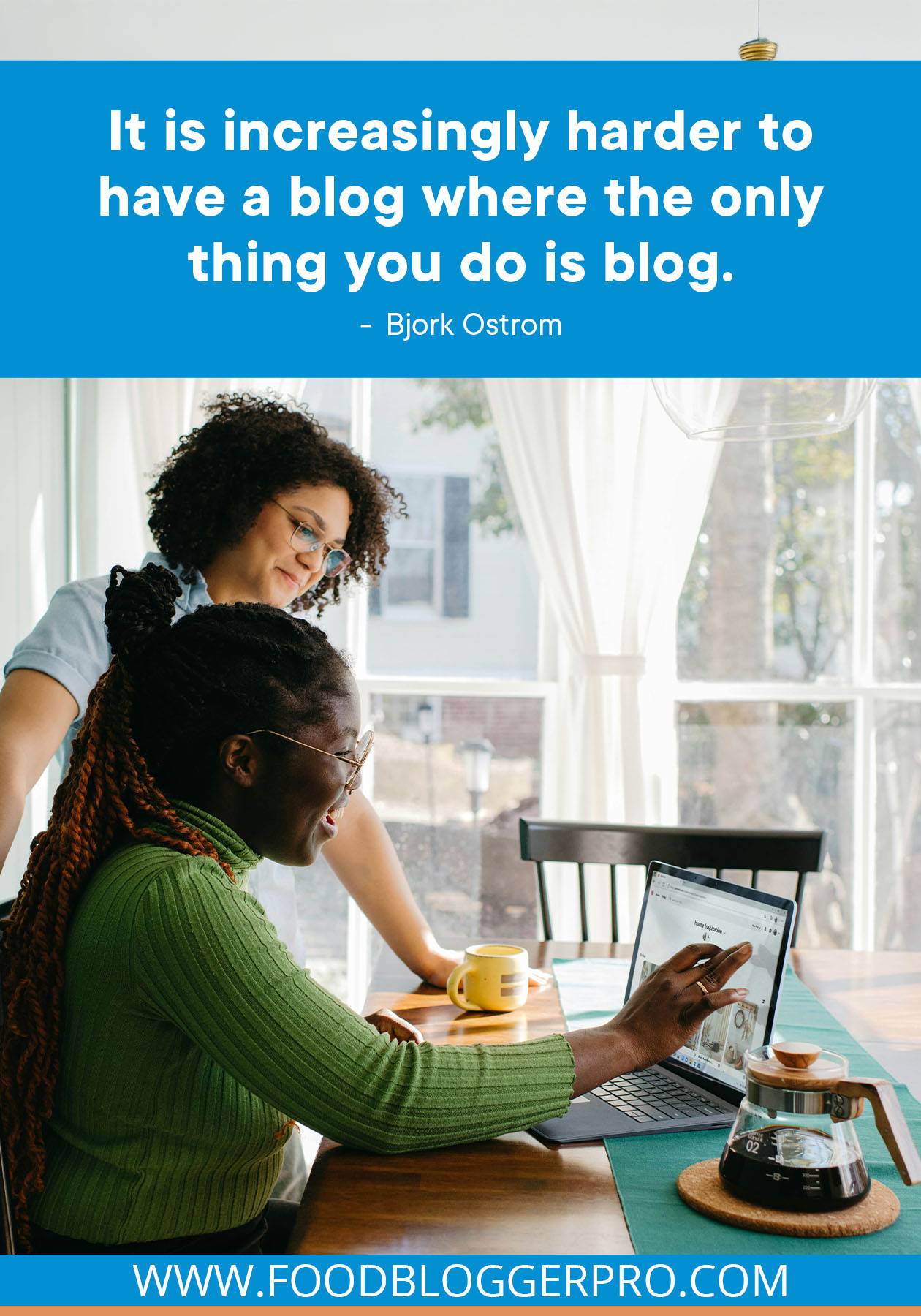
Elaine says, after hiatus from posting on my blog, I’m wondering what are one or two things I should do that are most important moving forward into 2026 for growth? So my guess is, Elaine, that you had a season where you’re posting more frequently, you’re familiar with WordPress, you have an understanding of the lay of the land, and now you’re just getting to the point where you’re saying, Hey, I’m going to come back. I’m going to start to do this a little bit more frequently. I think one of the things that will be true that was true in 2025 that will continue to be true in 2026 is that it is increasingly harder to have a blog where the only thing you do is blog. Meaning if you are posting to a website, if you’re posting to a blog, and that’s going to be the main mechanism for monetization, you’re using ads, you’re using affiliate income on your site to just post and then hope that it shows up in search results is going to result in a difficult or frustrating business.
You really have to think of how are you going to help people discover your content off of the website? And the easiest way to do that is social media. And so it goes back to that idea that we were talking about before where we need to be marketing our content, not just publishing our content, it’s going out in emails, it’s going out in YouTube, it’s going out in Instagram, it’s going out in TikTok. How are we distributing the idea and convincing people that the recipe that we have created is the best recipe for them to make? The best way to do that is where people are spending the majority of their time when they’re on their phone, which is on social platforms, people still very much so search, but in order to show up high on search, a prerequisite of that is that there has to be some traction or visibility on other platforms.
I think that’s true today in a way that it wasn’t true 6, 7, 8, 9, 10 years ago. And so I would say the most important thing to do moving into 2026, is to think about how you are going to be a marketer of your content. What’s the platform that you feel best fit for to show up and to consistently talk to people about the content that you are creating in order for them to be able to better find that content, to be convinced of that content and to be excited about that content. So that’s what I would say would be the consideration that you’d want to have as you move into 2026 is just thinking about how can you be a marketer and get really good at marketing your content. So it’s a little bit of table stakes. It has to be a really incredible recipe. All of those boxes have to be checked in terms of the structured data on your site and the flow of your site and what actual the post looks like.
But then you also have to be thinking about how you can actually market that piece of content. Here’s a question around Facebook. We’ve actually been working on Facebook a lot. Emily’s actually been helping start ramping up some things with the pinch review on Facebook. Jenna on our team has been working a lot on Facebook, so this is our world in a lot of ways lately. And the question is, do you have any tips for Facebook? I really see little engagement on my post. I’m wondering if it’s worth it or not. So we actually did a great interview recently on Facebook on the podcast, which I think Emily should be able to find and drop in as a resource. I would encourage you to check that out.
I think the main takeaway that I have with Facebook right now is that one of the best ways to perform well on Facebook is to increase your posting frequency, so to post. Often that’s not because it’s some algorithm trick, but it’s mostly just because those are all entrant into a lottery and the lottery is the viral Facebook algorithm and the more often you post, the more often you get a lottery ticket, the more lottery tickets you have, the higher likelihood that you’re able to win the lottery. And there is no, as far as we can tell or understand detrimental impact to your page by posting frequently on Facebook. The other thing that I think is really true is that short form video, as is the case on all of these platforms, is generally performing pretty well. You can also have just regular recipes that do well.
What we are experimenting with most right now is having a short little phrase at the top of the post, so like one sentence and then including the link to the recipe if you are going to include it in the comment as opposed to including that link in the description. Because I think there are some beliefs that Facebook will deprioritize a piece of content that has the link included within the description of the actual piece of content. So we’re including it in the link. And then the other piece is that you can repeat. So if you have something that performed well, let’s say six weeks ago, eight weeks ago, three months ago, you can then post that same piece of content to see if it performs well again, and oftentimes it will. And as far as we know, there is no negative impact on your page if you’re reposting a piece of content that previously performed.
Well, Emily said this as well. This is a great one and this was also something I was thinking about that I didn’t get to. Emily talked about posting natively within the meta business suite, so as opposed to using a scheduling tool, posting natively within the meta business suite. And then this was the thing I was thinking of or one of the things I was thinking of, you can also schedule the comment, so if you are including the comment, including in the comment a link to the recipe, then you can include that as a scheduled comment if you’re posting natively within the Meta Business suite. So a few considerations. That episode is a great episode to listen to in the comments and we talk about just kind of all these strategies around how Crowded Kitchen, specifically Lexie from Crowded Kitchen has grown their Facebook to multiple millions, which is amazing, so be sure to check that out.
Kristen says, still pretty new to food blogging about a year, and it focused on my site Instagram and some Pinterest, which I used to love, but there’s so much AI content now that I’m unsure if it’s worth it anymore. We’ve heard that a lot. We actually are going to do a podcast interview with Kate from Simple Pin Media to kind of hear how that’s been going, not been on Facebook so far, and I’m trying not to spread myself too thin, but I would say it’s so hard to know. It’s such an individual decision to know what spreading yourself too thin looks like. I would say if you have an extra hour or two, you could probably do that, but I do think that there’s a lot of wisdom in focusing on a specific platform, getting to know that platform well, getting really good at that platform as opposed to trying to be everywhere all the time.
But it’s really such a personal decision around how much bandwidth you have, how much time that you have, and usually what we’d say is it’s best to focus on one platform. Get good at that, understand your systems, understand your process before spreading yourself to other platforms. Any suggestions for getting more comfortable on camera? I’m trying to film more videos and reels and it’s so hard. I would just say this is super relatable. You’re not alone. I think a lot of people have this feel this. I would say it’s kind of like the dip your toe in the water methodology when you’re getting in the pool or a hot tub or I don’t know, cold lunch.
What does it look like to do it incrementally? So that could be one strategy where little by little, maybe the first thing is you do and the goal with it isn’t to go viral. The goal isn’t to get a bunch of views. The goal initially is to get comfortable, and so the best way to get comfortable in my opinion is through repeat exposure. The easiest way to get repeat exposure is to start with something that feels approachable today and then incrementally add onto it. So in your case, this is what it could look like. You could start today by doing a video that is just your hands with music and text overlay for the recipe. Again, it’s not going to go viral, it’s not going to be perfect, but you’re getting a feel for creating something and pressing publish, stepping back and seeing that the world continues to move on.
From there, you can maybe do the exact same thing, but then you do a voiceover so you can practice, you’re talking, you experience yourself talking over a thing, you press publish, you step back. You see that the world still moves forward after you do that. From there, you could maybe do a short little intro where you’re on camera and you say, Hey, showing up. Here’s this recipe, here’s why I like it, excited about it. And then you go through and you do the hands making video, and then maybe your last one is like you try and have it be on camera the entire time. The key here I think is repeat exposure. I felt this with the podcast I talk about in the first few months of doing the podcasts, really nervous. I could feel it, my heart rate would be going fast before I’d be doing an episode, and then it’s like, man, through repeat exposure, it becomes the way the human brain works is it just becomes less and less intimidating. You get used to it. And so I think the key is to figure out, to kind of coach yourself on how you can have that repeat exposure and get to a point where you feel good about it.
I think that would also be a good question in the forums, like if you feel out for posting in the forums to see if anybody has any responses, because my guess is that a lot of people have experienced a similar thing and they could talk about the process that they’ve gone through. Joy says, what is Pinch of Yum’s focus for 2026? Are you changing any strategies because of AI search? Yeah, I would say we haven’t changed anything significantly from a strategy perspective. I would say the one thing that’s been a slow but consistent evolution for us through the years is an increased reliance on social media as opposed to just posting on the blog and hoping that people show up because it shows up in search. I’ve said it a few times on this call, but this idea of really marketing our content, there is not a need for another recipe post to be published.
Maybe there are some exceptions for people talking about their experiences with a medical condition or a dietary consideration, but collectively on the internet, probably the majority of the recipes that people are making within their home have in some way been published or documented online. And so if your interest is in being a recipe creator, your approach has to be not what’s a new and unique recipe that needs to exist within the world on a website. The approach has to be why would somebody want this from me? What is my unique story? What is my differentiator? How am I going to be helpful in a way that somebody else might not be helpful? So it’s less about the recipe and it’s more about you. I think that’s the key. Some examples that I can think of that are unique approaches, Beth who started a site called Budget Bites will publish recipes that we all know, but her approach is around budget.
What does this look like from a cost perspective? Another example would be yummy toddler food. It’s like, Hey, how are you going to approach eating and cooking as a family when you have kids who might have dietary preferences, ingredient preferences, and so you’re developing an expertise around a certain genre, around a certain subject, around a certain idea, around a certain maybe belief, and then you’re publishing those recipes in that category. Binge VM is kind of moving towards this, but it’s probably a little bit of an anti example because it is a little bit of a general site and a lot of the sites that you see that are maybe 10 to 15 years old might be in that category. But I think for sites that are one to five years old that are looking to build a following game traction, there’s a higher need. It’s not impossible, but I think there’s a higher need to have a certain category, genre niche that you are adhering to.
And one of the reasons why is because I think going back to that idea of marketing content, in order to get traction on a social site, you often need that. In the sites that I see or the brands that I see personal brands or otherwise growing the quickest on social media are oftentimes brands that have a really specific niche. So it’s the super easy one right now to use is high protein, but it could also be people who have super indulgent food and so it’s super over the top desserts or it’s desserts from around the world, and so you’re traveling and documenting, but you have a niche and you have a focus, and I think that’s going to be one of the important things for people to increasingly think about as this world of AI search builds up. The thing that is important to remember with AI search is it’s easiest for AI search to solve the transactional questions.
How long do you boil in egg? Even things like what are the ingredients in a chocolate chip cookie recipe? It’s not going to be as good at budget bites as an example. If you are somebody who wants to be strategic and think around budget as it relates to food, that gets kind of messy. It’s not transactional in the same way as asking a question around how long does it take to hard boil an egg? And so that’s where you become more of a resource, where you become trusted, where people go to you because you answer a certain question. Yummy toddler food is another example. It’s a trusted source for people who have toddlers and want to figure out how to feed them well.
So AI, 10 years ago, there were a lot of people who could five years ago create content around keywords that they found and could answer questions and people would have a question. They would ask a version of that in Google search. From that, they would go to their post and they would get traffic, and they would earn money from that. That’s going to be the thing that is increasingly harder over time, but what’s going to be exist through time, no matter the state of AI and search and whatever is our desire, our curiosity and desire to connect with other humans, to learn about what people are doing. We are intrigued with each other, and to the degree that we can make that a part of how we are creating through story, through insights, through advice, through personal experiences, and then bring food and recipe along with it, I think that will be beneficial for us moving forward. Because AI search is going to be solving a lot of the problems that we have that are transactional and just answers that can be queries that can be solved with an answer in a text block as opposed to a resource or a place that you’d go or somebody you’d want to follow along with or learn what their opinion is on a thing. It’s a great question and it’s definitely something to be aware of.
Before we continue, let’s take a moment to hear from our sponsors.
Running your business can feel like a constant balancing act between making great content, keeping up with platforms, and actually earning enough to keep doing what you love. That’s where Raptive comes in. They’re the team behind thousands of the Internet’s top creators, including Pinch of Yum, and they help creators grow their traffic, boost their revenue, and protect their content. In an AI driven world, Raptive creates tailored growth strategies, helping with SEO email and audience development. They’re serious about supporting real human made content, and now it’s easier than ever to join. If your site gets at least 25,000 monthly page views, you can apply to become part of Raptive’s Creator community and get the kind of support that scales as your business grows to learn more or apply. Visit Raptive.com. Thanks again to Raptive for sponsoring this episode.
For someone starting this year, what would you prioritize social media SEO newsletters? So it depends. I think a lot of this comes back to this idea that we are all, if we are interested in this business, we are all innately creators. We are creating a thing, and our hope is that the thing that we create gains attention. What we do with that attention is our decision as the owners of that attention. Some of us just love the idea of creating things that get attention and to transact off of that, we don’t need to do it For others, it might be, Hey, I want to try and get people to my website, and when I get that attention, I’m going to monetize via ads. For others, they might be selling products, but the two things that we really need to decide as content creators is what medium are we going to be creating in?
It’s probably three things. What medium are we going to be creating in video, audio, text? So what medium in person like event could be another one? What medium are we creating in what platform will we be publishing on? So there’s all these platforms, Instagram, substack, YouTube, TikTok, Facebook website, medium platform, and then monetization. How are we going to be creating if our goal is to create an income, which for a lot of us is, but for some of us, it’s spreading a message, but if it’s to create an income, how are we going to be monetizing? And I think one of the most important things to consider is what is your best, most natural state of creation? Did a podcast interview maybe two weeks ago. I’m having a conversation and it’s like for kcl, and this podcast is going to be coming out later. Her deepest desire as a content creator was writing.
She loved writing, and so Substack was her platform. Monetization is built into Substack. You just need to decide what’s going to be gated and what’s not. And then the discovery process for her was through social media, so it was through Instagram and it was through TikTok primarily. And so her funnel looks like she creates video content where she talks about her substack, where people naturally find that sign up for it, and then it’s monetized through people paying for the premium substack. The mediums that she has decided to create in are video and writing. The platforms are TikTok, Instagram and Substack, and the monetization is a premium subscription on Substack. And so the one that I would prioritize when you ask the prioritization question, it depends on you as the creator. An example in my world and our family, in our family as content creators, it looks very different.
Lindsay and I are both content creators, but the way that we respectively create content is very different. I do a podcast and then the monetization is a membership program, which is education, which is what’s happening right now and sponsorships. So the business that I spend a lot of time in, it’s not monetized via ads. Well sponsorships, but not traditional display ads. Lindsay, she likes writing and she likes video, and so she’s thinking primarily within the context of short form video as she brainstorms the things and thinks about things. It’s short form video and it’s writing. The platforms are Instagram primarily the website and email, and then the monetization is ads affiliate and then sponsorships. And so it really depends on where you’re naturally drawn to. You could create a really great business just doing a podcast. You could create a great business just doing a newsletter on substack, and you could also create a great business just doing short form video on social media.
So much of it depends not on what should you do, but on where are you drawn to? Where do you find yourself most naturally inclined to create? Because we know people who are like, oh, I think I should be creating short form video, but I actually really don’t like video and I don’t like creating short form video is like, well, okay, that’s going to be like you’re building for yourself potentially a really miserable job because in order to do this, you have to do it. You have to show up consistently over time for a long period of time. So what is the way that you can do that in a sustainable way? That’s what I think would be the most important thing to think about. Not necessarily which platform should you do in terms of looking at the ones that you recommended, social media, SEO newsletters, some advantages and disadvantages with social media.
One of the advantages is short form video has the ability to get in front of a lot of people. Even if you don’t have a lot of followers, that’s not something that’s as easy to do on platforms like Substack or with SEO, where you usually have to build that snowball up a little bit more. So the ability for discoverability using short form video or a post that has some component of virality, it doesn’t always have to be short form video, but usually is one of the distinct advantages of social media as a way to jumpstart your attention building when you’re creating a content business. So it’s a little bit of a non-answer because so much of it is dependent on your personality where you’re naturally drawn to, but I do think that you shouldn’t be creating on MySpace, right? You should be creating on platforms where there is a tension, there is momentum, there’s a growing user base, and so you want to be strategic in that way.
You don’t want to be creating in a dying, you don. You don’t want to be building your magazine writing career, but I don’t think that’s what this is about. I think all of those that you mentioned have the potential to be beneficial. I would say SEO would be more of like a tier two focus because if you’re only focusing on SEO, you’re not going to have the ability to do kind of some of the main discoverability that would come from social media and maybe newsletters like a substack where you get discovered and then people would search for you after that. What we’re seeing is the importance of being known on certain platforms and that lifting your ability to be discovered on some of the search platforms. This question says, when should I start thinking about monetization? Is it still worth diving into onsite ads? There’s two ways that I would approach this.
One is if you are motivated by seeing that you can create money from a website earlier, the better. So an example would be if you are somebody who, if you make a dollar in a day and you wake up the next day and you’re like, whoa, this thing that I built earned $1 and 12 cents, that’s amazing, and it actually, I didn’t work on it at all yesterday, or maybe it earned $4 and you’re like, this now covers my daily McDonald’s coffee and then some, I could get two McDonald’s coffees with how much I make from my website. If that’s motivating for you, that’s fuel in your entrepreneurial fire, I think it makes sense to start earlier. I would say if not, then you probably want to wait until you can get to a point where what the earnings are, wait until a point where the earnings are an amount that are motivating.
And I would say, I don’t know, if I had to guess that would be 50,000 page views, a hundred thousand page views where you can roughly use $50 RPM if you wanted to kind of play it safe within the context of a media vine or a rap. And then you can play the numbers game and say, okay, if I’m able to earn $50 from every thousand people that come to my site, then you know that you could earn in a month thousands of dollars. That’s where it suddenly becomes, I think, pretty motivating where it becomes the equivalent of what a salary would be.
And there’s lots of ways that you could get there. You could use a tool like Grocers List, so it doesn’t have to be SEO traffic and you can send traffic from your social account where people DM to get a link to your content Grocers list is we’re advisors for the company and also investors in the company. They’re an advertiser on the podcast. ManyChat is another example of a similar product which we’re not connected with. You could get it through. Maybe you build a YouTube following and you encourage people to search for your content on Google through that or include a link. So there’s a lot of ways that you can get to tens of thousands or even hundreds of thousands of page views with your content. And once you get to that point, you’re able to pay the mortgage, pay, rent, save, put money away for your kids’ college. That’s where it gets kind of exciting. But I do think that if you don’t have ads on your site in the early stage that you’ll have a better experience. It’ll be quicker to load. There won’t be as much to deal with. And so if it’s not necessarily a huge motivator to you, then it’s probably better to wait until it gets to a point where, hey, if I have a hundred thousand page views, I could be earning multiple thousands of dollars. This is where it becomes substantial for me.
What are some of the best practices for growing my email list? I think some of the best practices are just figuring out valuable things that you could give people and then giving them the opportunity to sign up for your email to get those things. What is the most beneficial thing that we can create that is also the least costly offer? Something where you have a unique expertise or maybe you’ve done some work to make somebody else’s life easier. So Lindsay has done this with a Trader Joe’s meal plan, so like a hundred dollars a week of meals at Trader Joe’s for a hundred dollars or less. That was a lot of work, had to shop Trader Joe’s had to keep track of the receipts, had to create the PDF, had to create the shopping list, had to create the recipes, or the recipes maybe were created and had to make sure that they were at Trader Joe’s.
It’s a lot of work, but it makes somebody’s life easier and people sign up for it and they’re interested in it because you’ve done the work. And so I think the best practice for growing email is figuring out if the cost that somebody, if incurring is giving you their information, what is the benefit that they’re getting? They’re not giving you money, but they’re giving a currency and that is their contact info with the promise that you are going to give them something that’s valuable. So I would think about that for your audience, for your niche, for your focus and for your expertise. What can you package up and offer to people that is really valuable. Mary says, lately, I’ve had a lot of spam ad comments on blog posts. I have to delete them and it’s to be time consuming. I have the control to approve or delete the comments so they’re not showing on my blog, thank goodness.
How do you prevent these? This is a common problem. I’m starting to notice the same issue with newsletter signups. So with newsletter signups, you can do a double opt-in where people get the email and then they have to click to confirm that they want to join the email list that would cut down on that. You can also do something where it automatically removes people if they haven’t opened an email after a certain period of time. You can set what the time is, so like four weeks, two months, whatever. If people haven’t opened an email, they’ll automatically be removed from your list. So you could look at doing that. And then there’s different plugins that you can install. Kismet is a part of the Jet Pack solution. Their tagline is Spam shall not Pass. So if you haven’t installed that yet, it’s from Automatic, which is the WordPress parent company.
So that should help with that. So those are the two that I would look into. And last question says, I think of recipes, but they’re not what people are searching for on Google, but they are what I know my students and followers would love. Should my strategy starting out mainly just be SEO recipes or creating and sharing my own? Okay. Yeah. So I would say that creating, there’s two ways that people can discover recipes primarily. One would be search and the other would be social. More and more people are building really strong businesses, not by getting a bunch of search traffic, but by getting a bunch of attention on social. And then for people from there, finding their way to the recipe. If you’re creating on social, it doesn’t matter if people are searching for it or not, if it has the ability to be discovered on social, and if that’s the case, then it’s kind of doesn’t matter how much search term people are using because people will figure it out either through a link that you provide through a DM that you’re sending them in an automation or through going to Google and searching, baking for business, and then the recipe name.
So on social, it doesn’t really matter as much, and I think if that’s what you know that you want to create, it’s what your students want, I would go in that direction versus trying to appease some search tool.
Allie says, how niche does one need to go these days? For example, I’m in the toddler nutrition space. Awesome. We were just talking about that. Obviously very challenging computer sites like Yemy, toddler food, do I need to go even further niche? I’m a dietician, so I try and bring in that lens around supporting feeding and nutrition and the recipes. Meals are great. My quick thought with it is you don’t need to go any more niche. I think your expertise as a nutrition and your focus on toddler food is niche enough. If you show up on social and you’re like, Hey, I’m a certified nutritionist and my goal is to help families get delicious and nutritious food that their toddler will actually eat, that’s compelling and that’s compelling enough. And I think that then what you are doing is thinking around what are the problems that people have in your world?
How can you uniquely solve those? How are you creating content around that? I think that’s perfectly niche and really compelling. As a parent. It’s compelling for me. I’m curious how pinch Vion plans their content far enough ahead to thoroughly test recipes before publishing. How far in advance do they usually plan their editorial calendar or how much time do they usually spend testing each recipe? I would say generally speaking at this stage, pinch of Yum is inspirational. Inspiration led meaning that Lindsay will have a recipe, she’ll be excited about it, and she’ll be cooking it for three weeks. She’ll test it, she’ll iterate it. I’ll have some of it. I’ll be like, I’m not an expert, but be like, Hey, as resident, normal guy, here are my thoughts on it.
She’ll revise, I don’t know how many times, four or five, six different times, and then we’ll eventually get to the point where she feels comfortable publishing it. But other than if we have branded work that we’re doing partnerships, there’s not this huge lead time for content that ends up on the blog. It’s usually this is the thing that Lindsay’s interested in. She’s excited about this recipe. She’s working on this recipe, she’s talking about this recipe, documents the recipe, publishes the recipe, markets the recipe via social and then goes into the process and does it again. So that’s different than a lot of other people that I know. There was a site that was listed for sale on Quiet Light Brokerage, which is a brokerage for, we actually interviewed the founder, Mark Long time ago on the podcast, be interesting podcast to listen to, but they sell all different types of online businesses and one of which was a food site, and they were scheduled out this food site.
I am saying this because I read the brief on it, and it was like they were scheduled out 18 months in advance. That’s how much content they had to create, and that’s somebody who’s had a great system and had a team and had people working ahead and had this huge lead time on when the recipes were published. So just a different business and it was a super successful business. But just like different founder, different priorities, different systems, different skills. So either can work, we’re just personally not super far planned out with recipes or Lindsay, isn’t I, if I want to run a food blog that focuses less on recipes and more on how to cook or how to use recipes in practical ways, how should I attract an audience and how can I still use recipes to ProE my work? So I think the one thing to be aware of with this, the How to Cook category, depending on what it is, is I think potentially vulnerable to AI overviews as an answer. So an example would be if you search Sharpen a knife, right now, this may look different for everybody, but if I search Sharpen a knife, I get the AI answers overview for that, and it tells me how to sharpen a knife. There’s a link to YouTube videos for me, but it mostly gets me what I need. If it’s content like that in the category of how to cook that content can be vulnerable to AI overviews.
I don’t know how to cook is obviously very broad. And so I don’t know if there’s other specific thoughts that you have around with that or even strategies around how you would do it. But if that were my approach, I think what I would do is I would think about what is my strong belief or opinion around cooking and letting that be the mechanism that is my niche and my focus, and this is not what it’s going to be for you, but this is just some examples. You need to figure out what it is for you. It could be you have the belief and opinion that anybody can cook. You don’t need to be an expert, you don’t need to be experienced. Anybody starting tomorrow can cook as long as X, Y, Z. Or your opinion might be that actually the opposite. In order to actually cook well, you have to be trained well, you have to have experience, you have to have education around how to cook.
Or your belief might be that every meal should be able to be made from start to finish in 30 minutes. I dunno. But I think it’s niching down a little bit from how to cook and saying like, here’s my opinion, here’s my belief, here’s what I think around what it means when I say how to cook. And letting that be the thing that attracts people to what you are doing, because I think that is going to be more compelling than the actual information. If it’s the information and only the information, then the sharpen a knife example, that’s going to become more and more common. People are going to get their answers from a chat interface, from an AI overview if it’s transactional knowledge-based information. But if it’s like a belief system, if it’s a kind of community that you are building of people who have or in a similar place and trying to go from not being able to cook or cooking when you’re older, I don’t know what it is, that’s going to be a little bit easier to build an audience and a brand around.
And then I think in the recipe side of things, as much as you bring recipes, recipes will just naturally work its way into all of those. So those are some thoughts that I would have off the top of my head without knowing additional information. If I want to shift my recipe blog into more of a business hub and focus on digital products rather than relying mainly on recipes and ad revenue, how would you approach that transition? Recently started a YouTube channel, thanks to your advice, but I haven’t monetized either my blog or YouTube yet. What would be the best strategic steps to move forward without knowing more information? I would say that an opportunity for people who are looking to make this transition would be to, instead of thinking of one-off products, Hey, I’m going to sell this thing for $29, or I’m going to sell this ebook for 50 bucks.
I would think of it as a community and what is the type of community that you are trying to build and who are the people that you are trying to attract and how are you going to help those people? And within that, what is the structure that you’re going to create that will help those people experience that transition from where you say that you’re going to help them go to where they are? Lots of different options for what a community would look like. We’ve had podcast sponsors member, there’s also Circle, which is a solution that does this. Yeah, stand store membership, io, Thinkific, some other ones from Amanda there. All of these could be options that you could look at, but I, that’s what I would look towards isn’t like one-off project product isn’t a digital product, but it would be thinking about who’s the community, who are the people that would want to join a community that you would be creating?
That would be the focus that I would look at if you’re creating content and hoping to send people to a product, because I think it’s just more sustainable and predictable and not as chunky. So that would be my thoughts. Hey, these are always super fun. Some of the most interesting recorded conversations that we have are on these live Q and as. Super helpful to hear from people, fun to have people attending live and to anybody who watches after the fact. Hope it’s helpful. As always, just post on the community forums if you ever need anything. Thanks to Emily for passing along the links and thanks to the folks for tuning in live and we’ll see you next time. Look at this starting at 12 ending at one. Perfect timing. So thanks everybody. We’ll see you on the other side. Bye.
Emily Walker: Hey there, this is Emily. Thank you so much for listening to that episode of the Food Blogger Pro podcast. We’ll be back next week with another sneak peek inside the Food Blogger Pro membership. We’ll be sharing a coaching call with the family behind the food blog Cafe Sucre Farine. Again, thank you so much for listening. If you enjoyed this episode, please leave a rating or review. It makes a huge difference. Hope you have a great week and holiday season.