
Welcome to episode 45 of the Food Blogger Pro podcast! This week, Bjork interviews Tony Rulli from Intentional Spark about advertising on Facebook.
Last week, Bjork interviewed Justine Grey about getting started with affiliate marketing. If you’re looking to monetize a low-traffic blog (or cash in on a high-traffic one), listen to that episode here.
Reaching the Right People with Facebook Ads
In today’s day and age, the internet can be really noisy. There are ads all over the place for products you may or may not be interested in; companies and all sorts of companies are asking you to buy their products, and more and more things to look at every day.
So what makes you pay attention to the few things that catch your eye? A lot of the time, what makes you pay attention is relevancy – the thing that caught your eye has something to do with you and solves a problem you already have.
So, if you’re selling a product, promoting your company, or just wanting to get the word out, the best way to get people to pay attention is to target the right people in the first place.
While this sounds complicated, Facebook actually makes it pretty easy! Listen in to today’s podcast with Tony Rulli to learn how to leverage Facebook’s powerful remarketing tools to help you create an income from your blog.
In this episode, Tony shares:
- His first foray into selling products online
- Why Facebook ads have huge potential for food bloggers
- The difference between boosting posts and running an advertisement
- How Facebook retargeting works and who should be using it
- How you can use Facebook retargeting to make money even when you don’t have a product to sell
- What a sales funnel is in laymen’s terms
- How to attract the right people as potential customers
- His top 3 action items for getting started with Facebook marketing
Listen to the Food Blogger Pro Podcast below or check it out on iTunes or Google Play Music:
Resources:
- IntentionalSpark.com
- IntentionalSpark.com/foodbloggerpro
- foodbloggerpro.com/45
- Jim Gaffigan – Disney
- How to install a Facebook Pixel on your website
- 041: Ninja Email Marketing for Bloggers with Barry Moore from The Active Marketer
- Buzzsumo
If you have any comments, questions, or suggestions for interviews, be sure to email them to [email protected].
Be sure to review us on iTunes!
If you’d like to jump to the comments section, click here.
Transcript:
Bjork Ostrom: Welcome to episode number 45 of the Food Blogger Pro Podcast.
Welcome to episode number 45 of the Food Blogger Pro Podcast. My name is Bjork Ostrom and I am coming to you with a conversation with one of my very good friends actually, Tony Rulli from intentionalspark.com and one of the things that Tony and I are going to talk about and really dive deep into is this idea of Facebook advertising, and all of the different things that you can do with Facebook. One of my hopes with this podcast is to have conversations around different ways to build the business online that maybe people on our space normally don’t think about.
I think a lot of times when we talk about a food blog or really any type of content driven blog. We think a lot about sponsored content where we work with brands. We think a lot about advertising but we don’t think a lot about these other ways that we can build a brand or build a business for instance creating our own thing, our own product and then advertising that on Facebook. Usually, when we have conversations around building a blog, we go to content route as oppose to the paid advertising route.
The reality is there’s all these options at play, and so I want to make sure to have conversations that open up that potential so you can think about that, “Hey, would that work for what I’m doing?” If not, we talk about these kinds of things says like, back packet kind of stuff, so really insightful information. Maybe it doesn’t apply to you right away so you put it in your back pocket and when the time does makes sense for you to apply this, you can come back, maybe listen to this podcast episode again or implement some of the things that you learned.
One of the things that Tony offered that I think is so awesome is a one hour free consultation for anybody that leaves a comment on this blog post or on this show notes for this. You can get to those by going to foodbloggerpro.com/45. Here are the rules for entry. Number one, it either has to be a question or number two, it has to be something that you learned or that you were able to take away after listening to this podcast, so a follow up question that you have or something that you learned or take away.
What we’ll do after is we’ll go through and look and pick one of those and then Tony will do a free one hour consultation with you and talk through some of the different strategies that you can apply through blog. I’ve actually done that within before and it’s super, super helpful. Let’s go ahead and jump in to this interview with Tony Rulli from Intentional Spark. Tony, welcome to the podcast.
Tony Rulli: Hey, everybody. It’s good to be here.
Bjork Ostrom: Yeah, excited to have you. I wouldn’t say that we necessarily go way back but we go back. You’ve helped us with some Facebook stuff and we’ve also just every once in a while check in on calls. We did that maybe a week or two ago. Right after we wrapped up the call I was like, “Gal, why I have not ask Tony to come on the podcast yet?” So thanks for coming on Tony, I appreciate it.
Tony Rulli: Yeah, I like that. We go back, not way back, but back.
Bjork Ostrom: Yeah, right. Yeah, you don’t hear that often. Tony and I go back. It’s not quite far as way back but we go back.
Tony Rulli: Well, where was the Food Blogger Pro podcast?
Bjork Ostrom: Yeah, sure, that would be in the beginning, so you’ve listen too, so you kind of like that.
Tony Rulli: Okay. I like that part. I like that part.
Bjork Ostrom: Yeah, that’s one of those things where you do it in the first couple times and then it becomes a things, so it’s like, “Okay, I guess we’re going to be doing this every single time.”
Tony Rulli: Yeah, you have to do it.
Bjork Ostrom: Yeah, it’s committed to it. One of the things I’m most interested in hearing Tony is how people got started and a little context around this question. I think most of the people that listen to this podcast. You could put them in the food blog category … Were you flipping coins? Are you flipping coins in this podcast? I heard a coin.
Tony Rulli: I had a coin. I’m a fidgeter, so I apologize for any noise you might hear.
Bjork Ostrom: No, that’s good. Maybe it would be subliminal messaging as you talk about how to grow your business that suddenly in the background you can have coins falling, right? It’s like a casino-
Tony Rulli: That’s my brand.
Bjork Ostrom: It’s not at all, which is I’m excited to have you on today because you do good job with this stuff and you’re also very personable person which is a good combination. I’m interested here, how you got into this. The reason again, kind of the context around this is I think people that listen to this are interested not only in building a thing in the foods base. Maybe it’s a food blog or food related business. A lot of people that listen might not even be in the food business.
They just want to hear these conversations, but I think everybody universally has this idea of making a shift into doing their own thing, right? To not work for “Demand” or a big company but to be able to really do their own thing, and you’ve made that transition but I’m interested to hear a little bit about your story and how that happened.
Tony Rulli: Yeah, so that’s a cool thing. Once you get over into the lane of doing your own thing, you meet so many more people who’ve done their own thing. It’s amazing how many pass there are to get into that lane.
Bjork Ostrom: Yes, for sure, and this is part of what I think is so important, is exposing those, so people are like, “Oh, this is a thing.” “This is a possibility.”
Tony Rulli: Yeah, and I think the biggest take away for me for talking to other people and even in my own story which I’ve talk in a second, is just the biggest thing is that first step and just take on the leap, and realizing there’s so many things you can do that aren’t permanent that just get you on the path, and once you’re expose to other ways to make money besides corporate America or whatever you’re currently doing, the more possible it seems.
For me, so five years at the college, I was in commercial banking, working for Wells Fargo. I was getting loans out to the middle market companies from $20million in revenue to a billion dollars in revenue. I was working for the man and I kind of what’s the man. I was alone manager and I was younger than most of my peers in the space. For me, I looked around when I was 27, so it was four years ago now. I realized there were my peers that I wanted to be and there was no one above me in the corporation that I wanted to be like there’s no one who. I was like that’s what I want to be in 25 years and I was like, “Oh, my God.” “I’m going to be that guy in 25 years.”
Bjork Ostrom: Yes, for sure, you kind of project out the path.
Tony Rulli: Yeah, and I was like, I’m not going to be happier the longer I stay, so that got me thinking. It just so happen my wife was a business management consultant, traveling every week for first, four, five straight years really so I tutor on the weekends. She got burned out. We got lucky and both have the thought around the same time and both agreed that we’re going to quit our job and travel. Just by saying that, we’re still to either way from doing it, but we started planning and the more we plan and literally it came.
We started actually blogging and that’s how we got into the online world. We started a travel blog, just a kind of a start just to record our experiences, to share on friends and family, but because we had the business background, we couldn’t just leave it alone.
Bjork Ostrom: Sure.
Tony Rulli: We slowly start and write for SCO and write content that we thought interesting and helpful because why not. By the time we were fully you know, we are talking to other people on the space. We saw other people living from their travel blogs, and really there’s possible. By the time we left out for our trip, we actually were able to get sponsored itinerary, so we get the Grand Hyatt would put us up for three nights. We get tours in local countries, for Morocco Tour companies just based on our blog, and just say, you know, we’re right about you. We’ll give you an honest review.
That got us into the world, and from there, we learned digital marketing. That started the organic digital marketing side for us where we’ve really learned how to promote ourselves and how do people were making a living doing it.
Bjork Ostrom: Yeah, for sure, because in way, you were doing it on your own.
Tony Rulli: Yeah, completely. We had no plans really when we got back, we just knew we didn’t want to … so we traveled for a year and then we met people who went to travel blogging conference and just got fully emerged in that culture.
Bjork Ostrom: Yup.
Tony Rulli: When we came back, we did want to really like to corporate America, my started digital marketing company. I actually got sidetracks for a bit. I started this subscriptions Spice Box, so every corner, I should felt…
Bjork Ostrom: Which is filling for Food Blogger Pro podcast, so that’s good.
Tony Rulli: Yes, it is. There is a year there where I knew all the food blogs because I probably emailed anybody who had a food blog that I could find. I was emailing, asking if they wanted to promote us or having to work together.
Bjork Ostrom: I want to go back. There’s a couple of interest and pieces I want to pullout from that story and the first one is the transition. You said, we made a decision and it took two years, and then eventually, you did it. First of all, what was that like to make the decision and then what did you have to put in place in order to get that ball rolling to two years later, say, now, we’re going to go and we’re going to travel fulltime, because there’s a lot of stuff that happens in between working corporate jobs, traditional day to day and then traveling full time year around. What happened to them between that time?
Tony Rulli: Yeah, that’s a good point because I think for some people, they hear that and they deride in, while other people get intimidated by what it would actually take. I think for anybody but for us in particular, it was just starting to learn about what it really was. We started following travel blog and just seeing what that lifestyle look like. Where would they going, you know. We started interacting with them on Twitter and got to know some of these people. That got us aware of what was possible. We didn’t fully commit the first, so like when we said, let’s do this, it was like, “Should we do this?”
That sounds kind of fun. Maybe it was kind of 10%, but just that kind of 10% acknowledgement that this could be something? It opened us to start investigating. We started like spending the last thing like if we were going to travel, we should spend a little less now, so let’s just do that. Let’s live as if we were going to travel. About a year out, we downsize our apartment from a two bed to a one bed. We’re living in Miami at that time. We did that. We’re like, okay, let’s do this. Let’s really save some money.
Also at that point, my wife had get her job notice because they actually gave 10 months somebody call the people for job.
Bjork Ostrom: Yeah.
Tony Rulli: In order to get that she’d apply year early, so we were like, if we’re going to do it, this is the time. At that point, the countdown started, about 10.
Bjork Ostrom: Sure.
Tony Rulli: About a year or 10 months out.
Bjork Ostrom: Okay. If you look back at that experience for people that … and I think this could apply to people that not only want to like to go and travel but also want to start doing their own thing whether it’d be a food blog or business or whatever it’d be. What would you have done different during that time period if you were to go back and do it again? Or would you have done it pretty similar?
Tony Rulli: Differently interesting. I think, differently, I’d be probably could’ve left earlier. My friends that are still in corporate America, we seem pretty reckless because we quit our job and travel and now, we’re working for ourselves and they don’t really understand but we’re pretty cautious people and risk averse, so we try and mitigate risk as much as possible. I used to be a banker, so I can’t totally [crosstalk 00:11:33].
Bjork Ostrom: Yeah, like somebody that gives loans, so that’s what you do all day, right? It’s like you figure out the risks associated with that transaction.
Tony Rulli: Yeah, all I do … mitigate risk. By the time we’ve left, we didn’t just save enough money to travel for a year. We also save enough money so that really came back, we could live for a year in case we couldn’t make in it, like we’d check every box twice. There’s really no preparation you can do as far as the actual travel part. I think I might have started earlier. I might have gone more on the business side I guess just knowing where I am now. It would have been nice to start earlier. We really took that year just to totally travel and travel blog and just kind of relax.
Bjork Ostrom: Yeah, for sure. Cool. Again, I ask because I think it’s interesting to really hear that are and interest in making that transition whether it’d be the starting of the business or to travel or to go in a different type of business. I think what you say about risk is so interesting because I think that’s actually true for a lot of entrepreneurs. It’s not necessarily people that are really inclined to take on huge risk. It’s people that risk averse in a lot of ways and I would put myself in that category where you are really intentional to build up reserves or to whatever have insurance in place, like all of these different things that are so boring and matter of fact and people wouldn’t think of those necessarily as entrepreneurial things but I think a lot of times, that’s the case for entrepreneur, so it’s interesting to hear you talk about that because I think it’s true.
Eventually, you get back and you say, “Hey, we’re not going to get in the corporate America.” You’re not going to back into a corporate jobs. You have a little bit of exposure to this digital marketing world. Did you know at that point that you were going to go in a certain direction or was it kind of like, “Hey, let’s take a few steps forward here with this.” What are those steps forward look like?
Tony Rulli: Not for me. I think my wife probably knew before me because she right away went into it because she was already doing our social media for our travel bog.
Bjork Ostrom: Sure.
Tony Rulli: And was already kind of coaching other people on this side just for fun. I think she also knew that that was probably my destiny. I didn’t know it though.
Bjork Ostrom: Why do you think that is?
Tony Rulli: She knows I love coaching because I try and coach her, and that’s what I think go well. She knew that I would be … She’s like, “You’re great coach.” She said for me.
Bjork Ostrom: Yeah, okay.
Tony Rulli: She knows I love to learn. I was always learning tactics and strategies and I love telling to other people I’m coaching, so she saw that as my destiny. It took me about a year of really knocking my head against the wall with the subscriptions Spice Box to make the switch.
Bjork Ostrom: I want to take into that a little bit if you’re okay talking about it. Can you talk to me about what that was and what worked with it and what didn’t work with it? What eventually led you to move away from that?
Tony Rulli: The Spice Box?
Bjork Ostrom: Yeah.
Tony Rulli: It was called SpicePanda because I want to look it catchy name and my logo…
Bjork Ostrom: It is. Yeah, I like it.
Tony Rulli: My logo was a panda wearing a chief’s hat and having a salt and pepper shaker.
Bjork Ostrom: Okay.
Tony Rulli: It kind of came about because we wanted to do something from our travels and we basically own a travel to eat and so we just eat in every country like I think 40% or 50% of our cost of our trip are just food. That’s all we did.
Bjork Ostrom: Yeah. Have you ever heard that pulling to this in the show notes, for anybody that wants to watch but if you ever seen that Jim Gaffigan commentary where he talks about how vacation is essentially just eating somewhere you’ve never been?
Tony Rulli: No, I’m not but it’s entirely true.
Bjork Ostrom: Yeah. It’s so true. It’s really funny rolling to it. I want attempt to like redo somebody’s find tuned comedic thing but…
Tony Rulli: Oh, I love you for that.
Bjork Ostrom: But now, we’ll pass. I know my limits.
Tony Rulli: Nice.
Bjork Ostrom: So anyways, so you’re traveling to this place as you’re eating and experiencing new food, that’s a really great part of it.
Tony Rulli: Right, and new flavors. We came back, we’re like, it wouldn’t be fun of you because we’re like always experience new flavors. We like cooking and we cook a lot on the roads too, so we got a lot of there being beast, and so the idea was, well, let’s go find these artisanal spice makers, create theme boxes and then we’ll provide recipes on the boxes using the spices. The first iteration with the first box was a spring box and it was Tie spices. There’s always Tie spices that you could not find in a grocery store like dried lemongrass, Kaffir lime leaves, pretty much anything that wasn’t at the grocery store, and we put them in a box and we had all these recipes like Green Curry and everything else that we loved in the box.
We sent that out and people seemed to like it. We didn’t have a ton of customers but it’s my first time actually selling a real product and to have fully just want my family or friends so it’s really cool.
Bjork Ostrom: It’s so fascinating like that firs time that somebody buy something that you’ve created and you’re like, I don’t think I’d know who this person is and it’s such a great feeling.
Tony Rulli: Yeah, and some of them were like my biggest fans. They would send me emails and thank you notes, and then when I finally cancel it, they were so sad. It was really cool. I kept trying to figure out different boxes. We had one box that was a salt box but all the salts were super local and flavored like one of the mixture is from an Oregon ate place here that takes it right out of the bay by hand. It’s a really cool shop place, and they’ll had a story … and the whole thing like I really wanted to make a design well, so I had this beautiful carves inside that were made special every time.
We put out four boxes to every corner. The reason we ended up shutting it down was there was so much work. I realize in order to scale, we have to scale fast and higher, and the breakeven point was so far away because I was packing all these boxes with myself.
Bjork Ostrom: Yeah.
Tony Rulli: It wasn’t feasible between that and then trying to do the online marketing piece and I could’ve realize that was not where my interest lay, but it was through this restaurant to figure out how to get more customers that I started to get in the Facebook adds.
Bjork Ostrom: Okay.
Tony Rulli: I was trying to figure out actually how to sell this myself.
Bjork Ostrom: I was just going to say, which is eventually we’re on the go to conversation but I’m so glad that I asked about some of that beginning stuff because I think it’s just so interesting to hear. One of the things that we’re trying to bring up often on the podcast is this idea of your past applying to what you want to do in the future even if it doesn’t seem like you would be a direct correlation, and for you, there’s all these elements that build up to eventually where you are right now.
Tony Rulli: Yup.
Bjork Ostrom: It’s not like you were always somebody who really understooded … you can use that if you want too. That’d be the buzzword, “Understooded”.
Tony Rulli: Understooded.
Bjork Ostrom: Yeah, it’s not like you were somebody who started up sort of the college studying Facebook advertising but slowly as your story would build, you’d try something it’s like, okay, this kind of works. I like this. I’m interested in this. Where does the next phase take me? And how all of those things connect eventually to where you are right now? I would say from the outside, it feels like kind of a switch pad for you in terms of working on something you’re really good at, and it’s going well for you.
There’s a story to that, right? There’s a long tail process of eventually getting to where you are and I want to encourage people that are trying to find that whatever it is and to know that sometimes, the answer is to stick with what you’re doing and to try it longer and to try and build it, and sometimes, it’s to pull the pieces out of that that you enjoy and that you’re interested in and then, segment that out and evolve whatever that is which I’m guessing it’s what you’re getting to when you talk about the Facebook add piece.
Tony Rulli: Yeah, and actually I’m a hundred percent agree with you on this because one of my big things that I always tell people is really you don’t know what’s going to work on that, so you got to try a bunch of stuff and then you just got to listen to what’s working and try to do that a little more. For me, I’d tried this for year. It wasn’t working but I kept trying it and I’d try different things and then when I tried the Facebook ad things, I actually had no success with my own Facebook ads which tends to be the case and it seems like where it’s always easier to help other people sometimes.
You can see their problem easier and you can see the solution. In your own thing, it’s something that you can do really hard. I tried the Facebook ads and it didn’t work great but just by talking to other people about it, people were asking me for help, so I started up for free help and all of the sudden, I had too many offers for free help so I had to start charging. And then, all of the sudden I was like, okay, well, I can’t do Spice Box and Facebook ads support but no one really … everyone seemed to want Facebook ad help, so let me do one of this.
The other thing I learned too and this is something I read, Mark Cuban said this. He wrote this on a blog of course like years ago but you really only have to know 10% more than the person you’re working with to be the expert, and so just really try to keep that in mind because if I knew 10% more, I could still add a ton of value to anybody I work with. That helped me not be afraid to dive in at Facebook ad support even though I’m just starting out to-
Bjork Ostrom: Yeah, we talk about it in terms of like being the ultimate expert and we say, you don’t need to be the ultimate expert. You just need to be more expert than the person that you’re helping and in some ways, it’s going to be more of an advantage. It’s going to be a competitive advantage potentially if you are let’s say only 20% beyond somebody versus 200% because like if I’m trying to learn, let’s say I’m trying to learn how to code PHP.
Tony Rulli: Right.
Bjork Ostrom: If somebody is let’s say half of where I am 50% better, they’re probably going to be able to speak to me a little bit more clearly than somebody who is 5,000% because they’re going to be in this other stratus fear that I’m not even going to be able to understand, so I think it’s such an important point for people especially those people are thinking about stuff like this, like coaching or consulting. Obviously, you need to know it. You need to understand it and you need to be good at it but you don’t have to be like the number one ultimate resource for it. I think that’s such an important point.
Tony Rulli: Right, and if you’re going to consulting or coaching, people are hiring you because you know more than them like they can’t do it and if you can’t do it, that’s great. You might not be the biggest expert but they couldn’t do it themselves at all, so you are adding a ton of value, and you can charge appropriately, right? If you’re just a little bit better, you can charge a little bit and get more experience and then grow there. I think the biggest takeaway is you got to just start doing stuff.
Bjork Ostrom: Yup, for sure. I think it’s again, it all goes back to this idea of story and building up in somebody’s path which I think is so valuable. I want to talk a little bit about the specifics of Facebook advertising now. My hope with this and, we occasionally have podcast and views like this were normally you’d think Food Blogger Pro podcast, how does Facebook advertising apply to food blogging? One of the things that I hope this podcast will do is help people understand the different ways that they can do their thing, and one of them is like we’ve talked about with you in your story is you can go into a certain niche and you can serve that niche and do a really good job with it. For you, that’s been Facebook along with a lot of other things which we’ll talk about.
If you want to stay for people that are listening, if they want to stay in this food niche, it doesn’t necessarily have to be, you write a bog post, you build your social media following and you get tons of traffic and then you have advertising and sponsor content, like that’s I think the most common path of people would take, but the thing with content marketing and you know this from doing your blog Tony, like it takes a really, really long time. If you talk to people in the internet space, they’ll talk about how hard it is to build a content based business if you’re just doing enough for the advertising and sponsor content because it’s a really competitive industry.
The good news is, that there’s all these different paths and all these different approaches that you can take. I think that is idea of paid advertising is one of those components. From a really high level, can you talk about how paid advertising works and some of the different ways that bloggers or content creators or solopreneurs will call them? How they’re using sponsor or how they’re using paid advertising to build their business?
Tony Rulli: Yeah, definitely and I think to your point too, blogging is so popular now, right? It’s so much noise out there. People built up so much SCO. You can still breakthrough but I think what’s interesting is instead of watching what everyone else is doing in your niche like what other food bloggers are doing, look outside like what are other popular blogger doing that aren’t necessary to blogger. Where is the next place that you could kind of launch off road to make yourself stand out because that’s what get s traffic and see success when you can stand out. It’s hard to stand out when you’re just doing the same thing.
Bjork Ostrom: Right.
Tony Rulli: With Facebook ads like two bloggers are doing Facebook ads but it’s probably not the number one strategy right now. There is a way to win on Facebook and maybe get ahead of some other people that are focused just on the content creation side.
Bjork Ostrom: When you say Facebook Ads, let’s talk what that is. What is a Facebook Ad? Let’s say you’re familiar with Facebook. You have a Facebook account and maybe everyone want to see a post that says sponsored under it or something like that. At a high level, what is Facebook Advertising?
Tony Rulli: What most people probably are used to with Facebook Ads if they have their Facebook page, just seeing the boost post button on their post, and when you see that and you hit it, you can do actually lots of things there but the normal thing is just everyone know that Facebook organic reach has gone down to like 5%.
Bjork Ostrom: Can you explain what that means and why that is?
Tony Rulli: Sure, so Facebook Organic Reach is the average number of people that will see any given post you put on your Facebook page. If you have a hundred people who’d like your page, you put a post to probably only five will see it. Now, maybe more will see it if you get a lot of traction but that’s kind of the average about 5%. The reason Facebook does up aside is just to really hate on small business owners, that’s what everyone always says but the real reason is to protect the audience on Facebook because what ended up happening is on Facebook first, you start the business pages, everyone just like every page, and so, people’s newsfeed is really getting filled up with only businesses and then to their friends or anything else.
Facebook slowly has been reducing the organic reach of your Facebook business page because they don’t want the audiences to get overwhelmed because if they leave Facebook, it doesn’t help anybody.
Bjork Ostrom: Do you think part of that as well is … this is speculation land here but I like to speculate. It’s the combination of improving the user experience on Facebook so you’re seeing stuff from your friend as opposed to Abercrombie & Fitch but also as Facebook ramped up, paid advertising that they intentionally ramped down, exposure for businesses or do you think it was purely the user experience side?
Tony Rulli: No, definitely they’re interrelated. I think they waited … it kind of go inside with the advertising because people were seeing such reason, but I think ultimately, if Facebook hasn’t done it, it would’ve ruin Facebook.
Bjork Ostrom: Right.
Tony Rulli: There’s a saying, I can’t remember who said it but basically, marketers ruin everything eventually.
Bjork Ostrom: Yes.
Tony Rulli: Whatever social media platform there is, marketers including myself like if it’s free promotion, we’re going to do as much as we possibly can.
Bjork Ostrom: Yeah, Gary Vaynerchuk talks about that lot.
Tony Rulli: Yes. I think that’s right.
Bjork Ostrom: Yeah, and the example he gives his email and he talks about 20 years ago, I could send an email or I don’t know, this wasn’t 20 years, 15 years ago or whatever. I’ll send an email and I’ll have a 90% open rate, and he’s like, “That would still be the case if it wasn’t for marketers and marketers have ruin everything.” It’s all about getting to a place where there’s still the ability to make the impact and then it’s like, if there’s an impact that can be made, marketers will ruin it.
Tony Rulli: Yeah.
Bjork Ostrom: Yeah, which is interesting and true.
Tony Rulli: It’s so true and like you’re seeing it with Instagram now too because for the last year and a half, Instagram has been an incredible free resource for brands because you’re getting a hundred percent show rate of all your post to anybody who followed you, and brads are now become so prominent in Instagram that you’re starting to see Instagram take steps to manage people’s feeds so that’s not just brands.
Bjork Ostrom: Right.
Tony Rulli: They’re also Facebook or to Instagram and there are business and they want to make money, so they also see the opportunity of you know, if it’s harder to freely reach people, you’ll pay for it but it’s probably worth it too and that’s what you see with Facebook Ads, so that’s like Facebook rapid trail.
Bjork Ostrom: Anyways, yeah, we diverted with rapid trail, okay.
Tony Rulli: Facebook Ads, in general, it’s a way to reach your own audience. You could boost a post and have everyone in your audience see it. That’s kind of one basic ad and that’s the one most people are familiar with.
Bjork Ostrom: Would you recommend to people do that?
Tony Rulli: Yes, so all of the strategy pieces that I’ll recommend on Facebook are having plan and place first.
Bjork Ostrom: Okay.
Tony Rulli: I think a lot of people come in saying, “I’ve heard you can do really well with $10 a day on Facebook Ads.” And then, I ask, “We’ll do while doing what?” And they don’t know. They doesn’t know if you can do well, and they’re like, I want more like, say I just want my page to be bigger, but that doesn’t really help them make more money or have the bigger audience. I think the first key is really understanding what your goals are, and then working out the best way to do it.
Bjork Ostrom: Siege is making appearance. We’re talking about that before.
Tony Rulli: She agrees.
Bjork Ostrom: She agrees. We’ll leave that in. Usually, we’ll cut it out if she barks.
Tony Rulli: I was waiting.
Bjork Ostrom: You were waiting. You specifically said before this. You said that if Sage has some input on the podcast that means that she’s engaged.
Tony Rulli: I want [crosstalk 00:30:14].
Bjork Ostrom: She’s engaged.
Tony Rulli: She’s upset about the Facebook organic reach problem.
Bjork Ostrom: Yeah, she knows that it impacts us and when something impacts family, it impacts you.
Tony Rulli: Exactly.
Bjork Ostrom: Okay, sorry to interrupt what you’re saying.
Tony Rulli: That’s what people are used to and there as time in place that promote your own content and just for content purposes.
Bjork Ostrom: Yeah.
Tony Rulli: I don’t actually recommend people start there unless they’ve really have a plan in place.
Bjork Ostrom: Okay.
Tony Rulli: The other kind of ad, and this is the ad that really are kind of what most of people are doing on Facebook. It used to be called dark post around publish post but it’s basically Facebook post that don’t go on your own personal page. They just show up on other people’s newsfeed.
Bjork Ostrom: Okay.
Tony Rulli: With those, that way it doesn’t literally your business page and that’s really a pure ad.
Bjork Ostrom: Yeah. To distinguish the two, we have the potential to do something. That is a boosted post which means you post it to your Facebook page and then you press the little button and you say boost this essentially meaning that your Facebook post is then seen by more people. It would maybe be comparable if you’re posting on your personal page in terms of what you might be able to see and you can pay varying amount of money to have more people see it or less people see it, and that’s going on your page.
Or there is this other type where it’s more of like an ad but it maybe when people are scrolling through Facebook, it has the potential to look like a Facebook post but that’s not actually going out on your page. It’s just showing up in people’s feed and encouraging people to click on it or to sign up for something. Those are kind of the very two basic different types of post that you could do or paid content you can do on Facebook.
Tony Rulli: Correct. It’s about the way Facebook presents it because when you actually make them, if you wanted two, you can make both in a very similar way.
Bjork Ostrom: Sure.
Tony Rulli: It’s the way of Facebook present it to people. I think one of the reasons we wanted to talk about is because I think one same people can really do in the very first thing with Facebook Ads is if you have as a blog and you have traffic is to set up Facebook retarding.
Bjork Ostrom: Okay.
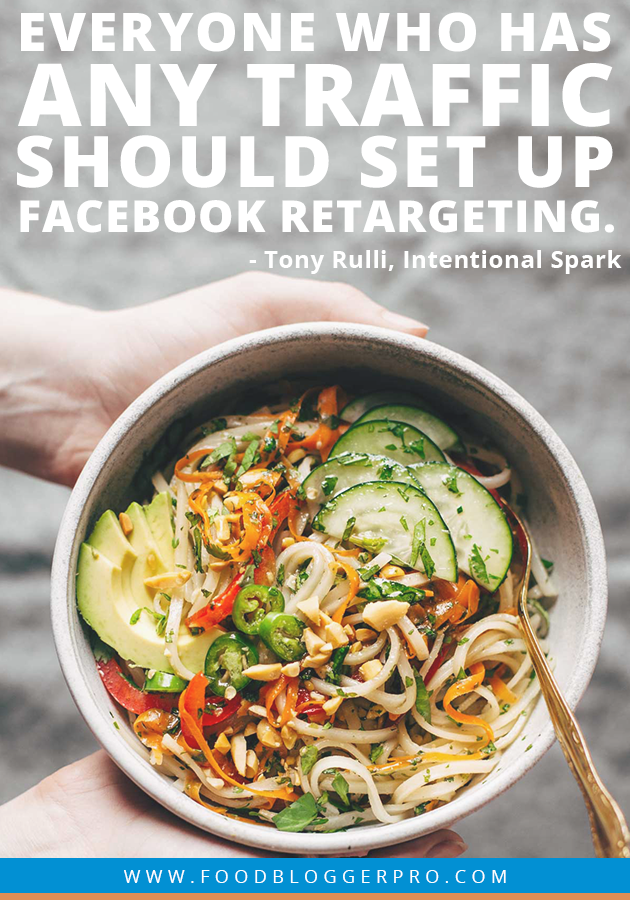
Tony Rulli: I think maybe talking about that in a very high level way and what that actually is. It’s probably like the best thing people could do. I think everyone who has traffic should be at least setting Facebook retargeting.
Bjork Ostrom: Can you talk about what that is then? High level and then how people can do that let’s say if they’re just getting started, how much should they spend? How should they set that up? What are the different things that you do consider?
Tony Rulli: Retargeting, we’re talking about paid advertising, it’s when you’re advertising to people that have already touched your content in some way. When I’m talking about retargeting here, I’m talking about people that have visited your site, and then you can actually send them an ad on Facebook, so they could visit your homepage, your entire website or maybe specific blog post. Maybe they visited a page about an apple pie you made, right? And then, you sell your book of pies there on Facebook with an ad.
They didn’t see in there the site about that you sold a book for pies but they saw the apple pie content. And then on Facebook, you can actually say, everybody who visits this specific page show them an ads selling my book about pies, and so that’s what retargeting lets you do, it’s kind of have that level of detail.
Bjork Ostrom: Yeah, and the idea being that it’s retargeting because they’ve already had a touchpoint with something that you’ve created in the past and then they go into this different echo system and then suddenly, you’re scrolling through Facebook and you see something that has the similar brand and content around something you just visited but maybe with the prompt to take an action where before, you maybe didn’t notice it.
Tony Rulli: Exactly.
Bjork Ostrom: Got it.
Tony Rulli: It tends to be a very high converting cheaper way to do adverting just because people already know you. They’ve already raised their hands and said they like your content.
Bjork Ostrom: Got it, yeah. This is interesting because I just pulled up Facebook here and I’m being intentional not to scroll through and get distracted while on the podcast. One of the challenges you have to deal with, with this job is this idea that you work within Facebook which is the ultimate distraction. I’m looking here. I’m scrolling through and I see somebody that is marketing something called Ad-hoc and it says, “Marketing managers, welcome to your digital advertising assistant.”
This isn’t something I’ve necessarily gone to before but maybe I meet a certain profile, like maybe there’s something about my Facebook page that says like entrepreneur that are … and maybe it’s a sort of interest that I have and they’re targeting to me, but up in the top rate or on the right hand column is I’m scrolling through. There’s kind of this, and this is on the desktop version. There’s this little sticky area and it goes with me, but one of the things that it’s advertising is a product called SamCart which is I was talking to a friend in the other day and he said he’s using this as their checkout system.
It’s very obvious that I went to this page and now, I I’ve come back here and they’re showing me a little ad kind of like a reminder because I didn’t’ purchase it, so they’re like saying, you know, it says, hey, this is the perfect checkout page, learn more about it. It’s a class in the 10 simple checkout page tweaks, so it’s like, oh. If I say that, I know the brand. I’m familiar with it, and I click on that and go through. The one below it is say, “What this man did with the simple PVC pipe will amaze you.” Which I don’t what that’s from, volunteerfew.com…
Tony Rulli: They know you well, they know you well.
Bjork Ostrom: Yeah, apparently. Yeah, do you mind pausing the podcast for me? I want to read this article. Yeah, so that’s kind of an idea of where these ads are showing up but the example being this SamCart one where I’ve gone to that page and then came back. With that, how do you know if it’s worth it? What is the metric for somebody to say, I’m going to put this on my page but what happens if they end up spending a hundred dollars on something? How do they track that? What is the variable that they look at in terms of if it’s worth it or not?
Tony Rulli: Sure. We’ll back track for one second, in order to set this up, it’s really a simple placement. Facebook gives you a little bit of code you have to put on your site, and that’s all you have to do. You just put it, right where you’d put your Google analytics code.
Bjork Ostrom: Okay.
Tony Rulli: That will track pixels and people visiting your site. That’s all you have to do to site up. I would just say everybody put that on their site. Whether you use Facebook today or not, as soon as it’s in there, you can actually go back up to 180 days to find people who visited your website.
Bjork Ostrom: There’s not a charge or anything with that?
Tony Rulli: Nope, yeah, you just to setup your ad account which is free and then you just place the pixel and you can forget about it.
Bjork Ostrom: Got it. The idea with that is it’s like Google analytics where it’s tracking that information.
Tony Rulli: Exactly, it’s tracking visitors, so if you didn’t want to start advertising, you’d have a history. You could start in a month saying anybody who visited in the last 30 days and it would know.
Bjork Ostrom: Just to make sure I’m fully understanding this. The idea is that, Facebook has this pixel that’s collecting the information and then it puts that information back into Facebook and then, so is there a cookie that is connecting that behavior, so they say, this cookie on Facebook matches that cookie on the website, therefore, we know it’s this person with this profile that has been to your website?
Tony Rulli: Exactly, yup.
Bjork Ostrom: Got it, which is pretty amazing.
Tony Rulli: Yeah, and it’s amazing too like if people are just curious just even … get your Facebook ad to kind of spend any money, just look around of the at information. There’s something in the ad manager called audience insights which will let you just look up random audiences, by interest, by demographic. It is amazing the amount of information Facebook has on people.
Bjork Ostrom: Yeah.
Tony Rulli: It’s great for marketers. It’s also just amazing to someone who uses Facebook just to see how much we share.
Bjork Ostrom: Right. It’s that classic example of if you’re not paying for something, you are the product.
Tony Rulli: Yes, exactly.
Bjork Ostrom: For Facebook, it’s like, oh this is great. We can connect with people and share stuff and we don’t have to pay or it, same with the Gmail or Google like it’s awesome, well, it’s because we are the product, they’re selling us.
Tony Rulli: Right. Yeah, and as businesses, as blog owners, if you’re you know, as food bloggers, it actually is incredible because you can get very specific on your audiences, and maybe we could talk about some different … you know, how specific.
Bjork Ostrom: Yeah.
Tony Rulli: I think you were asking about pixels?
Bjork Ostrom: Yeah, so to go back into kind of continue building out that story, I remember Fed, it was specifically about pixels but we’re talking about some of these beginning level things that people can do and also some of the advertising options that people have. You talked about retargeting being one of the main things. One of the questions that I had was, how do you know if it’s worthwhile? One of the things I did a long time ago was I tried Google AdSense, it was unrelated website and it’s like, well that was a click $100 that I spend and it’s like, well that went buy and I don’t really have anything to show for it, so how do you know if it’s working? Do you have to have a product? Would it ever make sense just to send somebody back for a page visit? What is that like?
Tony Rulli: Yeah, so I think this part is key. It’s kind of looking at your entire, what I call your sales funnel. What a visitor looks like. What an email subscriber looks like, and if you can, how much each of those is worth? If you know how much your site makes per month, you could say, well, we get this many unique visitors a month, so that’s every visitors worth 10 cents, 5 cents.
Bjork Ostrom: Yup.
Tony Rulli: Every email is worth a dollar 20 a month. If you could work out those numbers, then you can say, okay, well, I’d gladly pay 9 cents a click to get a visitor if visitors worth 10 cents on average, and so you want to breakout what that’s worth. If you have a product, it’s usually easier because it’s hard to track all the way through on your affiliate sales or your advertising, where the conversation came from.
Bjork Ostrom: Yeah, and like you said, you can break those numbers out, like let’s say, you do just advertising and sponsor content. You could control these numbers and get, like hey, I’m average for every time somebody visits a page. Here’s how much I earned, but that doesn’t necessarily mean that every single person that comes earns that exact amount, right? So some visitors might be more like … I hate using this term because it’s associate value but like. Some visitors might be more valuable to you than other visitors.
Tony Rulli: Right.
Bjork Ostrom: But when you have a product, you can track that a little bit more closely, is that what I hear you saying?
Tony Rulli: Exactly. Traffic coming from a guess post or link from a popular blog has a lot of trust associated with it. Sometimes, that can be more valuable visit than someone coming from Cold traffic on Facebook who doesn’t know you at all, and so you do need to know if you can what that actual number is. What are Facebook visitor’s worth. It’s hard to do that if you’re just sending people to an affiliate page and they click on the link and they’re gone. There’s ways around it and you can setup there from tracking maybe and hack it together but ideally, if you have a product or at the recent email, an email signup, I would say that’s for minimum, it’s get people to sign up to an email.
Bjork Ostrom: Got it, so not necessarily a page view unless it would be a really unique situation. You’re not going to want to be like paying for traffic essentially but the things you would pay for is potentially a click to a product page or maybe you have an eCommerce site or somebody is signing up for an email list if you have a real intentional use for that email. We recently did interview with Barry from theactivemarketer.com.
Barry talked about this idea of like really intentionally setting up these email sequences, so you know when somebody comes in, it’s not like they just sit in your email list but you really intentionally have a conversation with them and check in and say, hey, are there things that can be doing or making mention of a product that you maybe have. What I hear you saying is at the very least, make sure somebody is going to email list that then brings them through this intentional process, so you’re not just essentially throwing money out there and having people go to random pages.
Tony Rulli: Right, yeah, and have a plan. Have a strategy like why are you … let’s say ultimate goal of paying money on Facebook, so in that way, you can measure. I spend a hundred dollars on Facebook and this resulted in 50 emails and that turned into for sales, and then you can actually figure out. You could do something like if you’re doing affiliate sales, you could send people to an email funnel that maybe educates them on … I’m just going to post something out of I had here, but maybe like the five best suits to make with the Vitamix and at the end of your five email campaign or recipes, you send them to your affiliate page, it’s like all Vitamix and other blenders, right?
Bjork Ostrom: Yup, for sure.
Tony Rulli: And you could still find out a way to measure that, but that’s what you want to do, it’s kind of make it measurable so you’re not just spending money and not knowing what the result is.
Bjork Ostrom: Yeah, I think that’s great. It goes back to this idea that it doesn’t have to be just traffic, right? So it doesn’t have to be work for three years, four years, to the point where you’re getting enough traffic to get sponsor content and to make money from advertising. If you’re intentional about it, you could do something like create some type of product and setup these systems maybe it’s email marketing, Facebook is definitely a part of that, that essentially run in the background and allow you to more quickly get to the point where you’re building a business around this.
An example that we have and you actually set this up Tony is the retargeting for Tasty Food Photography. I feel like that’s maybe a really good example and you don’t’ have to use real numbers for this but can you explain how that works for Tasty Food Photography with these eBook and how we retarget to people that don’t purchase?
Tony Rulli: Yeah, so there are couple of different ways that we try and try with this. People are visiting a few different pages related to Tasty Food Photography. One was the sales page, and so people who visited the sales page would then get and ad on Facebook either saying, hey, we saw you checked it out like could you, you know, that likes getting away or maybe just promoting it again, right? And we said this to that, they’d only get the ad for five days.
We would earn them out, but a lot of time, so then either A, you get the sale when they first visit the page or you actually get a sale from people, you know, they saw the page. They liked it. They’re getting email. They’re in their Facebook newsfeed. They forget something. They never end up buying. Then they see it again, they’re like, oh, yeah, that’s right. I wanted to get it. When you do retargeting, I usually any type of Facebook ad campaign. I try a name for a minimum of two times ROY, so how much you pay versus how much you earn, and I think we were getting that.
Bjork Ostrom: Yup, and I was just in there the other day and I think it was an average per conversion, so every time that somebody purchase Tasty Food Photography after seeing an ad, isn’t that what it’s based on after seeing it?
Tony Rulli: Or clicking. You can see either.
Bjork Ostrom: Seeing or click, okay.
Tony Rulli: Yeah, so you can see either.
Bjork Ostrom: Yup, so every time that somebody purchase Tasty Food Photography after seeing an ad I think it was, it was an average spend of $7, so the end let’s say, $29 eBook, so it’s like, well, that makes sense. Why not have that turned on and just running consistently in the background because it works and it helps to bring in people that have decided not to buy and then later on say, “Oh you know what I actually didn’t want to purchase that.” I feel like that’s a good example of how retargeting can work when you get it setup.
Tony Rulli: Exactly, and you’ve already done so much worth to get people, to that sales paid organically, right? Anybody that leaves then is just gone, so you gladly paid the $7 to catch rooms just to add more in.
Bjork Ostrom: Yeah.
Tony Rulli: The other thing we did too, and I can’t remember if this worth for Tasty Food Photography or not. It works sometimes but not on other case here. Not everybody is reaching that sales page but you might have content on your sites that’s very similar, you know, maybe you wrote about the five best way to setup your lighting on the blog and that’s a popular blog post. You can actually advertise the people that visited that blog post but that haven’t gone to the sales page yet.
Those are people that never even had a chance to look at the offer and you’re putting it back in front of them.
Bjork Ostrom: Yup and then you can track that and say, okay, is this actually working? Tracking that by the Facebook pixels, is that right?
Tony Rulli: Exactly. Once you put that Facebook pixel on your site, it’ll also that you track conversion. It will tell you if you set it up, so you just tell Facebook what the conversion page is, so usually it’s a thank you for buying page.
Bjork Ostrom: Yup.
Tony Rulli: Facebook then will actually attribute each ad with the sale because it knows that people click on this ad and then they visited this page that means they bought, so Facebook will also track at that level.
Bjork Ostrom: Yeah, cool. I feel like if nothing is else it opens up the possibility for people that especially if they have something that they’re selling on their website that this is something they could be doing, and at the very least, if they have an email list or maybe they’re an affiliate person product that they can start to at least look into this and say, would it makes sense for me to have something like this setup? And again, all coming back to this idea that there are so many different avenues that you can take as you’re looking to build your business online. It’s not just strictly about that organic traffic. It doesn’t have to be strictly about that.
One of the other things that I’m interested to talk to you about Tony because I know that you experience with this is this idea of funnels. It’s such an internet marketing term but I also think it’s an important concept. Can you talk about what a funnel is and maybe how Facebook advertising ties into that? And how you see smart marketers using funnels?
Tony Rulli: Definitely. Just to wrap the conversation around retargeting and the pixel.
Bjork Ostrom: Yeah.
Tony Rulli: I don’t want people to get intimidated because you know, when talking about pixels and code, I think a lot of bloggers are like, Oh God, forget it, like I’ll just wait, but there’s a lot of instructions online, very clear instructions. You could pay someone on cyber to put the pixel into. It’s a very simple process. Retargeting isn’t scary because you already know your audience, so it’s the one form of advertising where you already attracted them once based on your organic content, so you know exactly the messaging that they are open to.
It’s probably the easiest way for you. You don’t have to come up with new messaging because what you already doing is working. It’s the most authentic and easiest way for someone who’s never written an ad in their life to write an ad.
Bjork Ostrom: Yeah, because essentially, you’re using similar content to what you’ve had because it worked.
Tony Rulli: Right. They liked you already, so whatever you did, work. Just be yourself, putting that out there and you’ll see some good results early.
Bjork Ostrom: That’s great.
Tony Rulli: For the funnel, everything with marketing, we make complicated words and systems but all the funnels is this, how people move through your sites, your email list. It’s how you direct people. I think a lot of people when they start out have no real direction. They set up an email, maybe have an autoresponder but they haven’t sold about well, you know, when people do this, then what am I going to send that.
Bjork Ostrom: Yeah. I feel like a real life example. I was trying to think of what are real life examples. This might be a terrible example, but every time that I walk into the Apple store, I feel like there is this Apple store funnel where I come in and there’s this guy with an iPad and he greets me and says, how are you doing? What can I help you with? And I say, I’m having this issue with my computer. And he says, okay, yeah. I’m going to connect you with this person here. And he shoots me off into this person and they schedule an appointment for me and they say, okay, you can wait here for five minutes and then somebody at the Genius Bar will be ready for you.
And then I go there, and then they work on the problem. And then, once I’m done with that, I leave and then I get an email asking for me to review it like it seems like a real world, world example of a funnel. Would you say or is that, is that off?
Tony Rulli: No, that’s definitely a funnel but you’re much more modern than I’m Bjork. I go old school with my example.
Bjork Ostrom: Okay.
Tony Rulli: So like the grocery store is a very old school sales funnel.
Bjork Ostrom: Nice yeah.
Tony Rulli: Because where’s the milk? The milks is always in back. Why is it in back? Because they intentionally want you to walk to the entire grocery store and see everything else that’s available. You get the milk. You go to check out. What’s that checkout? It’s all the info side and they’re making it easy for you to buy the little things. They’ve intentionally, you know, the store, if you just look that, that looks very kind of things all over the place. There’s aisle, but there’s a strategy there and they’re directing you through it to give you as many chance to be possible to buy.
Bjork Ostrom: Yeah.
Tony Rulli: That’s something many people are familiar with.
Bjork Ostrom: What is the … translate that into the digital world then. What does that look like?
Tony Rulli: The digital world, say you have a Facebook ad and you’re offering five, three recipes and you’re promoting it on Facebook and they have to sign up by email to get it in everyday then you send them an email that’s for recipe. That already is a very basic funnel. You’re going to send them five recipes because they signed up on Facebook. Facebook ad would be the beginning of the funnel and then your five recipes are the rest of it.
Bjork Ostrom: Okay, got it. All leading to something?
Tony Rulli: Yes, it could You mean, you could’ve a funnel that shows that. It’s just content or it’s just education.
Bjork Ostrom: Yup.
Tony Rulli: But a sales funnel then, you’d set it up, so it’s five recipes on something and then, maybe at the end, you’d send an email or two and this would be the sales part where you offer a course, a technique or something related to that type of cooking or that recipe. That’s a very simple sales funnel. From beginning to end where you’re intentionally putting people all the way through it from free content, free emails to the actual sales offer.
Bjork Ostrom: Got it, and that I think would people would maybe understand that’s if they see this type of content on their site but explain why so often you see stuff like free webinar or maybe it’s download for free product and if I’m understanding this right that comes from people putting together this ad based on your profile. Maybe they see that you’re interested in blogging or this certain things and they say, we’re going to try advertising to these people but the first thing they’re advertising isn’t a product. It’s some type of free content, and that’s kind of the initial filter in the funnel to see if these are potential good leads.
Tony Rulli: Yes.
Bjork Ostrom: What are the different ways that people can have that initial offer in their funnel for Facebook ads? We talked about webinars. Are there other ways that you see people doing this often?
Tony Rulli: Yes, so content. Free content related to whatever you’re eventually going to sell. It doesn’t have to be right away, right? You could have five emails of free content in between maybe you’re gearing for a launch a couple of months from now, but whatever your free content is should be somewhat related so that you’re attracting the right potential buyer, and this could be a free webinar, a free eBook, a free cheat sheet like a free PDF download, eCourses, it could be really simple. It could be a seven course emails here on how to Sous Vide or something like that.
Basically, anything that gives value to people upfront, and basically they’re paying with their email then, right?
Bjork Ostrom: Yup.
Tony Rulli: They’re buying with their email. They give you their email and exchange. They get access to this free content.
Bjork Ostrom: Yup, and that allows you to non-only start this conversation with people but also to know that this is something they’re interested in so you’re not necessarily just blasting out this random content that hits everybody but it’s very focused on whatever certain topic that you’re focused on. I feel like potentially a good kind of as a last real life example. It would be interesting to talk through we have an upcoming open for food blogger photo, so we have this really big launch that we have coming up.
We do two public enrollments every year, but one of the things that we’re thinking about doing is getting people into the funnel that we know would be interested in food blogging. Would you be up for doing like a real life case study and talking through what it would look like for us?
Tony Rulli: Yeah, let’s run through it.
Bjork Ostrom: Okay, where would we start?
Tony Rulli: At first, we’d say have you done this before where you’ve sent like Cold traffic into your sales funnel like you know…
Bjork Ostrom: I don’t think we have with Food Blogger Pro. We’ve done some retargeting stuff when it was open enrollment but since we’ve closed on, we’ve turned that off, so this would be the first time for us.
Tony Rulli: What I would say at first, if you want to setup tracking … what email do you use? I don’t remember.
Bjork Ostrom: Active campaign.
Tony Rulli: Active campaign, so I’m sure there’s a way on active campaign, but you want to set it up so that you could track Facebook ads.
Bjork Ostrom: Got it.
Tony Rulli: This is helpful for everybody but you want to know because the Facebook ad will probably be a little less valuable to you if someone come in organically just because they’re coming from one piece of contact. They don’t know you very well.
Bjork Ostrom: Yup.
Tony Rulli: So you might over the course of your emails and people call it a nurture sequence where you’re wanting people up to you and with your emails and content, they might become just like a regular leave but you’d want to see if the people that … even if they’re opting in for emails at a very cheap rate, they actually end up buying during launch, because you could spend $500, get 500 emails but only have one person from that list buy.
Bjork Ostrom: Right.
Tony Rulli: You’re kind of want to track and measure that piece.
Bjork Ostrom: So in some ways, if we do it this go around, it would be the experiment where we say, hey, what work and what didn’t work? Because it wouldn’t be something we’d always have on. We would just do it for this big enrollment period.
Tony Rulli: Right, so yeah, for the first time, I would do it as a test, set aside a certain amount of money and say, let’s see what emails cost. Let’s see how many people buy. Does it make sense? And if it did, then you could just have it on all the time going forward.
Bjork Ostrom: Yeah.
Tony Rulli: Food Blogger Pro is a course that you just be part of the make money for the blogging, right? So then the opting content would want to be around that team, maybe even … so a couple of ways to think about the content you’re going to give away for free are it could be something very similar or it could be something that people would think about before they got to Food Blogger Pro.
Bjork Ostrom: Sure.
Tony Rulli: Maybe you tell me like do you have content you’re already creating or thinking about?
Bjork Ostrom: Yeah, I think what we would end up doing is some type of … our hope is to do it for this go round but it would be some type of summit, so like this idea of having a free virtual summit or virtual conference around the certain subject and we don’t know what that subject would be but it’s something having to do with blogging or food blogging.
Tony Rulli: This would be the free opt-in?
Bjork Ostrom: Yup.
Tony Rulli: Okay. So this would be a little bit more of like a one times, is that right? Because you couldn’t set it and forget it like later, it’s like a free PDF?
Bjork Ostrom: Yup.
Tony Rulli: Yeah, so let’s get work well. Maybe around food blogging, and then so they’d signup for the summit, and then by signing up, you know there are students who are blogging, so that’s perfect. What you’d want to do is think about what types of interest your audience has. Obviously, they love food. They’re into blogging. Within Facebook audience insights, you can go look up how many people identify as bloggers and then you could actually reduce that to see if you could find the food bloggers.
Something we didn’t talk about with retargeting, what is actually really interesting is not only can we retarget side traffic. You can retarget your email list so you could upload your email list.
Bjork Ostrom: Sure, yeah, if they use that within Facebook, then you can target to those people.
Tony Rulli: Exactly, so if you upload your email list on Facebook, you usually get about half of your email list to show up and you can actually advertise to them.
Bjork Ostrom: Sure.
Tony Rulli: The other thing you can do when you do that whether it’s website traffic or email list is you can actually create a lookalike audience in Facebook. What this does with Facebook will actually look at all the people you give them and say, these people tend to have these things in common. They over index on these interest meaning, there are 300 times more likely to like these types of pages and then it’ll go out and it’ll find a minimum of a million people that are similar to your email list.
Bjork Ostrom: Interesting, and then you can take that audience and say…
Tony Rulli: And you could advertise to it, or yeah, or you could split that audience then again, by interest. Facebook gives you an audience of 1.5million people like look like your email list and then you could say only show me people that are interested in blogging. And then, maybe you have 100,000 people that’s very specific.
Bjork Ostrom: We could essentially upload Food Blogger Pro email list and say, create a look alike audience meaning people look like people that have signed up for Food Blogger Pro, and then we have this look alike audience so we can say, show them information about this or show them an ad for this free digital conference that we have coming up as opposed to showing random content to people on Facebook, we know that this is targeted to people that could potentially have a lot of overlap with the audience that we know are part of Food Blogger Pro.
Tony Rulli: Exactly. The other thing too is Facebook algorithm learns overtime if you keep it running, so you have this audience of million people like look like your email list and as Facebook starts to get people signing up, it’s like oh, a lot of this type of person is signing up. A lot of people who like these types of interest are signing up, and then will start showing your ads more to those people.
Bjork Ostrom: Interesting.
Tony Rulli: It will learn over even it’s a huge audience, it will learn overtime who’s actually converting because you can tell Facebook what your conversion goal is. if you told on Facebook that I want email signups, it’ll say, okay, I’ll optimize your adds for email signup, so I’ll show it to more people that look like I’ll sign up for your email list.
Bjork Ostrom: Wow, so the idea being that we start with this free giveaway and we create some type of ad or promotion for it. We show that on Facebook, but who we’re showing it to, there’s multiple different ways we could target those people. We could show it to a lookalike audience, people that are similar to people that have signed up for Food Blogger Pro. We could also show it to people that have designated blogging as an interest or we could show it to both, people that look like the audience and have also designated blogging as an interest, and that would be probably the most highly targeted.
So then we have this opt-in, and they become part of our email list. They go through this process and then, I would guess that it depends on what we’re going to do for our funnel, right? Do we want to have a lot of emails before? Do we want to have it be a short funnel? That probably is it depends.
Tony Rulli: Right. I think that guaranteed and you want to give them a lot of value upfront when they sign up with the ad, like you know, a free summit, lots of free content, all of the sudden, they now know you as the resource that when you do launch, you know, if you go to your launch process, there’s lots of different ways. You could do a launch, yeah short or long. You could incorporate webinars. You’re going to want testimonials definitely. You always want testimonial but especially to an audience like from a Facebook ad that doesn’t know you, that’s really valuable.
Bjork Ostrom: Yup.
Tony Rulli: This is what people realized like this is the big sales funnel, right? This is the entire thing. So you’ve already … because you guys have a product. You already have a launch sequence because you sold it before and so now, you’re just piecing it all together from free signup all the way through the free emails to the sales emails, to the ultimate purchase.
Bjork Ostrom: Yeah, which is good for you to break it down like that because I think like you said, sometimes people hear the word funnel and they’re like, I don’t know how to do a funnel. I don’t know what funnel is but when you look at a close, it’s …
Tony Rulli: It’s all pieces.
Bjork Ostrom: Yeah.
Tony Rulli: You don’t have to do them all at once, right? Like if you just wanted to test out something simple, you could just have on a Facebook ad to a free cheat sheet and then you send people maybe three valuable emails around that topic and then you could offer a $9 eBook, and you could just see how that works, and that’s a very straight forward, simple email funnel and sales funnel.
Bjork Ostrom: Got it. Tony, so much stuff. It’s all so interesting and fascinating. My hope like I’ve said a few times is that what this does is it helps people to move closer or to reveal all of these different potential avenues that you can go through that it doesn’t have to be just strictly putting out as much content as you can and hoping to build traffic. I’ll say this as kind of a last thought. What would your three high level action items be for people that are just getting started if they haven’t done any of this before and it can be a stuff that you’ve already said.
Tony Rulli: Okay. If we’re just talking Facebook ad, I would say get the Facebook pixel on your site. Setup your ad manager through your Facebook account, get your Facebook pixel, place it on your site just so if you ever in the future wanted to advertise, doing retargeting, you’d be all setup.
Bjork Ostrom: Yup.
Tony Rulli: Number two is, you’re doing all this work on organic promotion, so you’re probably already doing organic Facebook post. You’re doing your own blog post, SCO. You’re getting organic traffic, leverage that. There’s lot of tools like on your Facebook business page, it’ll tell you what your most popular Facebook post are. Those app is the best place to start with your ad. If you have a Facebook post linking to a blog article of yours that’s getting a ton of love more than other blog post, more than another Facebook post, that might be a really good ads. Maybe you could create a cheat sheet that’s very similar to that blog post and then just use that Facebook post like whatever you set on that text and have that be your first ad. That’s a really good way too.
My other tip would be along the lines of leveraging what already works. I don’t know if you hear other people talk about BuzzSumo, people like to mention BuzzSumo.
Bjork Ostrom: No, we haven’t before.
Tony Rulli: Okay, you know, BuzzSumo all right?
Bjork Ostrom: Yeah. I haven’t used it but I’m familiar with it.
Tony Rulli: BuzzSumo can be a really good way to figure out what’s working. You can type your own URL and … Go to BuzzSumo, type your own URL and it’ll tell you what your most shared content that’s on your website and you can filter it by Facebook post, Twitter, Pinterest, but you can also type in other people stuff, and you can even search for keywords. It’s an interesting way to get ideas for content, so like of yourself, you can go type in food blogging and see what the most shared Facebook post are on food blogging and maybe, you look at the number one shared Facebook post to that keyword and you’re like, I could write a cheat sheet for that topic.
Bjork Ostrom: Yeah.
Tony Rulli: And you know that shares really well, so it has good traction. BuzzSumo can be a great way to … Also it’s a great way just to find organic content you want to write on your own site because these are all topics that are highly shareable.
Bjork Ostrom: Yeah, that’s great. I just actually pulled it up here and yeah, for sure, it’s like oh men, it’s so interesting right after that.
Tony Rulli: Yeah, and he gives you like five or 10 free but you can keep that every day and go back and type and more and see different things.
Bjork Ostrom: Cool.
Tony Rulli: Yeah, that’s a good one just to find your organic content or to find something interesting that might be a good Facebook ad.
Bjork Ostrom: Yup, for sure. Cool. Hey, those are great. I think people will really appreciate those quick action items throughout things up. Last thing, where can people connect with you Tony if they’re interested in following along with what you’re doing and interested in … We had talked about doing a contest as well which I have mention at the beginning and the end.
Tony Rulli: Yes. If people want to have and interested in just Facebook ad or sales funnels, or this digital marketing and how they can really use it for their blog, I think you said maybe the best thing to do would be have people share their number one take away or the number one lesson they learn from the podcast, or even to ask question, number one question, right? If you still have a big question around, something we’ve talked about, wanting you say it in the comments of the blog post related to this podcast then we’ll answer and then, rather we’ll pick you there our favorite question or the best take away. I’ll offer an hour long consulting call on Facebook ads and digital marketing.
Bjork Ostrom: That’s awesome, and it would be really, really insightful for people. I think it would be a good thing because I’ve done that with you before and it’s been a huge help. The two things would be either something that you took away or another question that you had and we’ll be able to jump in there and answer those when the podcast comes out and we’ll pick one of those and somebody … you’ll do coaching call with them which I think will be great.
Tony Rulli: Yeah, and it’s all like fun.
Bjork Ostrom: Cool.
Tony Rulli: People can reach me on my website, intentionalspark.com. if you go to intentionalspark.com/foodbloggerpro, people can get a bunch of Facebook ads that I’ve already copied and so they can kind of just get ideas for different Facebook ads and what they look like.
Bjork Ostrom: Awesome, and that’s intentionalspark.com/foodbloggerpro.
Tony Rulli: Exactly.
Bjork Ostrom: Great.
Tony Rulli: That’s a great way to start doing your own Facebook ad, just to see other people are doing, and there’s a bunch of food ones in there, so you can see what Blue Apron does or any of those companies and see how they position themselves for food, food audiences.
Bjork Ostrom: Awesome, that’s great. Can you do a quick just synopsis of what it is that you do? we kind of talk about it in general terms but what is it that your day to day looks like and people that you work with and how do you help them?
Tony Rulli: Sure, so Intentional Spark. I work with my wife. It’s a digital marketing agency, so she does organic social media NPR and I handle the paid marketing side and sales funnel. We do full implementation services, so you know, we’ll run your Facebook ads. We’ll run your social media accounts but we also offer hourly coaching and you can buy blocks of time like one hour or three hour, six hours.
Bjork Ostrom: Awesome.
Tony Rulli: We dive in and really work on here marketing plan.
Bjork Ostrom: Cool, that’s great. I would really recommend people check that out. Tony, thanks so much for coming on the podcast, really helpful, really insightful, and I know people get a lot out of it, so thanks for coming on.
Tony Rulli: Yeah, this is great, say bye to Siege for me.
Bjork Ostrom: Yeah. She’s sleeping in the corner here but when she wakes up, I’ll let her know.
Tony Rulli: All right, awesome. Thanks for having me on.
Bjork Ostrom: Thanks Tony, yup and bye.
That’s wrapped for episode number 45. One more reminder to leave a comment if you want to enter and to get that one hour free consultation from Tony by going to foodbloggerpro.com/45 and leave a follow up question or you can leave the takeaway that you have or the thing that you learned from listening to this podcast. If you do end up going over there, if you are not yet on the waiting list for Food Blogger Pro before when we open enrollment, you can go ahead and join that list.
You can do that in the sidebar of the blog post or you can just go to foodbloggerpro.com and hop on that waiting list, so you can be notified when we do indeed open doors to Food Blogger Pro for new members. Right now, we’re closed but in a little bit, coming down the line here so make sure to hop on that waiting list to get notified when we go ahead and do that. All right, that’s a wrap for this week’s episode. Thanks so much for tuning in and we will see you same time, same place next week.
How did we do?
If you rate this transcript 3 or below, this agent will not work on your future orders
Thanks for this episode! I now officially have my FB pixel installed and can’t wait to load in my e-mail list. Next step after that is to evaluate my most successful FB posts. Only question is, what’s Tony’s travel blog site? Thanks for sharing all the smart stuff!!
Way to take action, Joanie! You’re on the right track.
It seems like every time I share my travel blog the comment gets deleted, but you can find it if you google landingstanding 🙂
It’s become more of a food blog focusing on Portland since we moved here last here… but we just got back from Colombia so I need to at least add an update for that!
Another great episode from Food Blogger Pro. My biggest take away was understanding how retargeting works, you took a topic that has always confused and overwhelmed me and broke it down into understandable bits. I have only ever run facebook ads when I open enrollment for a specific program, but I typically use them very sparingly and haven’t seen a great return on investment. Thanks for all the great info!
Glad to hear you have tried Facebook ads, Abra. They definitely can take some testing, but using retargeting ads for sales offers can be highly effective. For cold traffic, I would recommend ads promoting free content or an opt-in offer.
If you try retargeting with your next open enrollment, I would love to hear how it goes!
hugely enjoyed this podcast – was wary at first because i’m a big fan of organic reach and have been having a lot of success that way, but didn’t realize the breadth of what is available with facebook ads. have my first ebook coming out this month and think this will be very helpful! definitely going to set up the pixel! thanks again 😀
Definitely set that up, April! If you have had great organic reach, you can really magnify it with FB ads. Just take what was working organically and promote it to your target audience.
Would love to hear how your ebook promotion goes!
I so enjoyed this podcast. It’s so ironic that I just did a boost to my Facebook page two days ago. I was once told by other blogger not to pay for page boost, but with Facebook reach being what it is I decided that if other businesses can pay to put their brand in front of their target customer, then why can’t I. My biggest take away is I’m going to set up Facebook cookies on my site now before I need, so when I do have the need, it will already have tracking data. And I am no longer going to feel bad about paying for ads or boost, espically since it is relatively inexpensive right now and who knows how long it’ll be at that price. Thanks for the awesome podcast filled with valuable information.
Hi Celeste – Great insights!
When you have the pixel placed and the cookies collecting data, you’ll be in great shape. That way if you boost a post that directs back to your own content, you can advertise something directly to those people.
Boosting a post is neither good nor bad – you just need to have a strategy in place first. If promoting your band to your target audience can create a solid return for you, then go for it!
Loved this podcast. Even Sage chimed in. 😉 And I’d love to have tony help me with fb. I rebranded last year (after 5 years of blogging) and started a whole new FB page. It’s been HARD. Or rather, overwhelming. I feel so behind now. But I think the first step to do is get that pixel! So thank you for all the insight.
You got it, Lindsay! Get that pixel placed. That way you can leverage all of that hard organic traffic work when you’re ready to try ads.
Biggest thing you can do is just start – and figure it out as you go. That’s what we all do anyways! Sounds like you’re on the right track 🙂
Oh my goodness! Facebook pixels! So informative. Had heard of them before but had no idea how powerful or easy to implement they are. Thank you so much. Can totally see the potential in this approach for a new initiative we’re trying. Would so appreciate being selected for a coaching call to work through some of the ideas we have!
I also have to say that I’m so impressed by the content you share with the Food Blooger Pro podcast – I always walk away with something new which is exciting in a time where most of the information out there feels regurgitated. Thank you.
Glad you enjoyed the podcast, Jane!
Completely agree about the FBP podcast. They always make super actionable content – glad I got to be a part of one 🙂
Love this, as per usual! I’m just wondering if you can have two different pixels or use the same pixel for two different websites? I have set up the pixel on one of the websites (my main blogging site) but a friend and I have started to run women’s wellness retreats and as it is health and wellness related it still is in sync with my main blog. Do I use the same pixel to retarget to people that have been looking at the retreat site?
Thanks guys!
Hi Nicole!
You only get one pixel per ad account, but you can use the pixel on as many sites as you want. Facebook is actually smart enough to recognize the different domains, so if you place it on multiple sites, a dropdown will actually appear when creating a site-based audience asking you to select the domain you want.
If you wanted to retarget separately you can by selecting an audience based on the domain, or you could create an audience in an ad campaign combining both! Your choice.
Thanks so much Tony! I emailed IS a few days ago but I haven’t heard back. Was just enquiring about some one on one consultations with you? 🙂
Strange! I can’t find it. Thanks for letting me know. You can try me at [email protected] and on twitter at @unrulli if the email still doesn’t work 🙂
As always, I learn so much from this podcast. It’s one of only two that I am sure to listen to on the day they’re released.
I had two biggest takeaways: The first was to jump on that darn pixel train! The second was more subtle, but it was perhaps more impactful and that was the reminder that we can all choose to do whatever we want with the small slice of talent and time we’ve been given. I found Tony’s story of how he started his business post-traveling really inspiring. I can relate to the feeling of “yuck” he had in his corporate life and I really admire the fact that he not only had the vision to think something else was possible, but also the fortitude to make it happen.
Now, I also had a question: Tony, am I correct in understanding that all the strategies you listed are basically unrelated to how big of a FB page you already have? So, essentially, a very small blogger can buy some success on FB just like a very large one could, thereby providing a level playing field for everyone. (Or at least, everyone with some cash ;))
Thanks again for expanding my understanding of what’s possible, both on FB and in life!
Love your takeaways, Jess!
Get on that pixel train 🙂 Even if you have no intention of advertising right now… you might in the future and having all of those older visits tracked is key.
And you are 100% correct – the size of your FB page following does not matter at all with ads. In fact, if there is a big blogger that Facebook rates as an “interest”, you can actually target people who are like them with your own ads.
Small world–I went to high school with Tony! I had no idea a FB pixel was easy and free to install. So much great info in this episode!
Becky!!! I’ll always remember the Bean Song 🙂
Love your site. I’ve never gone full paleo… but I’ve dabbled. But are you kidding me with that Thai Basil Noodles with Beef recipe? That looks insane…
Hope you are doing well!
First time, long time 🙂 I’ve always wanted to be a radio show caller!
Great takeaway, Lisa! Boosting a post can be effective if you have a specific goal in mind for it. For example, if you had a cookbook all about healthy snacks and had an article about a recipe that was popular. You can promote that post to your audience with a boosted post and then using the FB pixel, retarget everyone who visits that recipe with an offer to buy the cookbook.
Thanks for listening!
I installed FB pixel now. I cannot wait to use it. Thanks for sharing.
-gustavo woltmann