
Listen to this episode of The Food Blogger Pro Podcast using the player above or check it out on Apple Podcasts or Spotify.
This episode is sponsored by Raptive.
Welcome to episode 594 of The Food Blogger Pro Podcast! This week on the podcast, Bjork interviews Emily Christensen from Country Roads Sourdough.
Last week on the podcast, Bjork chatted with Dahn Boquist. To go back and listen to that episode, click here.
The Real Timeline Behind Creator Growth with Emily Christensen
Emily Christensen joins Bjork this week to share how she grew Country Roads Sourdough from local sourdough classes into a thriving online business. It started small, with a simple logo and posts in local Facebook groups. From there, Emily steadily built her social media following, learned which content hooks connect with her audience, and found ways to turn one popular recipe into several posts. She also explains how her blog, cookbook, affiliate links, and social platforms each play a pivotal role in her business.
You’ll also hear Emily get candid about what contributed to her growth: plenty of time and persistence, the work of balancing a business with raising a family, and the decision to hire help and set boundaries. If you’re working to turn your audience into income and want a business that supports your life rather than taking it over, you’ll come away from this episode with practical ideas to put to work right away!
Three episode takeaways:
- Start with what you have: Emily didn’t wait for a polished brand to get going. A simple logo and posts in local Facebook groups were enough to get Country Road Sourdough off the ground!
- Get more from the content that works: Spotting strong hooks and turning popular recipes into multiple posts helped Emily grow her audience without reinventing the wheel every time.
- Build a business that fits your life: Growth didn’t happen overnight; it took time and persistence. Hiring help and setting clear boundaries made it possible for Emily to keep growing while raising her family.
Resources:
- Country Roads Sourdough
- Same Day Sourdough Bread
- Check our Emily’s cookbooks here!
- Raptive
- Shop My
- Amazon Affiliates Program
- GRO
- URLgenius
- Follow Emily on Instagram and Facebook
- Join the Food Blogger Pro Podcast Facebook Group
Thank you to our sponsors!
This episode is sponsored by Raptive. Learn more about our sponsors at foodbloggerpro.com/sponsors.

Thanks to Raptive for sponsoring this episode!
Building a creator business isn’t getting any easier. Between AI, constant platform changes, and the pressure to keep growing, it can feel like you’re running just to keep up.
That’s why we’re excited to partner with Raptive. Raptive works with thousands of the web’s leading independent creators—including us—to help them earn more, grow smarter, and build sustainable businesses for the long term.
They combine industry-leading advertising with personalized guidance, data-driven insights, and a team that’s constantly helping creators adapt to changes in search, AI, and the broader digital landscape. They’re also leading the charge to protect creator content and advocate for a future where independent creators can continue to thrive.
And now it’s easier than ever to join. If your site gets at least 25,000 monthly pageviews, you can apply to become part of the Raptive creator community and get support that’s designed to grow with your business.
To learn more or apply, visit raptive.com/fbp.
Interested in working with us too? Learn more about our sponsorship opportunities and how to get started here.
If you have any comments, questions, or suggestions for interviews, be sure to email them to [email protected].
Transcript (click to expand):
Disclaimer: This transcript was generated using AI.
Bjork Ostrom: Emily, welcome to the podcast.
Emily Christensen: Hi. Thank you so much for having me. I’m excited to be here.
Bjork Ostrom: Yeah, you have experienced what a lot of people are trying to do, which is start something, grow something, and get it to the point where it is equal to or, in a lot of ways, greater than what you would get with a full-time job. You’ve done that kind of out of necessity because you’ve been moving a lot. It sounds like your husband is kind of pursuing his medical career, which has required a lot of moves along the way.
Emily Christensen: Yeah. Yes.
Bjork Ostrom: Tell me a little bit about the stage of life that you’re in, the multiple moves that you’ve had, and how, out of that, you came up with the idea to start sourdough classes.
Emily Christensen: Yeah, I graduated with a degree in marketing. So this was slightly in my wheelhouse. And so after I left my corporate job, we were moving for my husband’s schooling. He was starting medical school at the time. And, you know, when you’re in medical school, you have zero dollars in your bank account. So we were just living off loans, and I had just had my second son. I was doing part-time marketing work, but it ended after my second son was born. A couple of months later, like three months later, I was like, you know what, I really need something. I need to make some money, I need to do something. But we were moving around a lot, and we were in West Virginia at the time, which is why Country Road Sourdough is the name of my brand. So I decided, you know what, I’m just gonna throw a logo together on Canva and I’m gonna call it Country Road Sourdough, and I’m just going to teach local sourdough classes. I had already been doing it just for lots of different friends, and I had been making sourdough for about two years at that point. And so I was like, there seemed to be a really big interest around sourdough. And so I just decided, you know what, I’m just gonna try it out. Gonna try to make some money for us and give myself something aside from motherhood that I could just kind of latch onto. And so I decided to do it and I remember feeling like I was going to throw up. Like this was the worst decision ever. I can’t believe— Yeah, I was so nervous that no one was going to come. I was going to embarrass myself. It was in April of 2022 that I started doing the classes, and I had had my son just a few months prior to that, in December. And—
Bjork Ostrom: Because you’re so nervous. Yeah. When was this? Classes.
Emily Christensen: So I put it out there and I remember just thinking, I’m an idiot for doing this. Nobody’s gonna sign up. And then I had done two classes, and they both sold out within one to two days. These were in person.
Bjork Ostrom: Yeah, and these were in person classes. And if you were in a place that was— you had been moving around a lot, so it’s not necessarily a bunch of family and friends. How did people discover the classes?
Emily Christensen: So I put together a flyer on Canva and then I just started putting it on mom groups on Facebook, community groups, like any local groups I could find. Facebook is where I started sharing it. And then that just started to take off via word of mouth. I didn’t have a website at the time, like it was very basic. There was no social media, nothing. I just started putting it out there. Yeah, because, I mean, we moved during COVID—
Bjork Ostrom: Local—
Emily Christensen: —in 2020 to West Virginia. So it’s not like I had made a ton of connections at that time. So really, it was just through Facebook groups that I started.
Bjork Ostrom: Yeah. Well, I think the interesting thing is like it was through social media, but it’s through a different avenue of social media, which is pre-existing groups and getting involved in those groups. And I think it’s such a smart way of thinking about all the different places that you could take advantage of. We’re an online business. It doesn’t have to be growing a social following, although we are going to talk about, you know, hundreds of thousands of followers that you were able to grow in a really short period of time, relatively.
Emily Christensen: Yes. Mm-hmm.
Bjork Ostrom: But it’s like, okay, there are these pre-existing groups. How do you create something that might be of interest for these groups? They’re local. You know that it’s gonna be people who might be interested in it. You know that there’s an interest in sourdough. Can you talk about how you actually transacted? Like was there a landing page? Did people Venmo you money? What did that look like?
Emily Christensen: Yeah, it was so basic. Actually, for the majority of the time that I did classes, it was like, “Venmo me here and just send me a message to this email address that you want to do the class.” And I think I actually did a Google sign-up. So I think I had created a Google landing page where they could put in their information, and then—
Bjork Ostrom: Yeah, Google has the ability to create an easy form. So they fill that out and then that goes into a spreadsheet.
Emily Christensen: Exactly. So I had like the spreadsheet and then they would either Venmo me ahead of time or bring cash to the class.
Bjork Ostrom: Yeah, love it. I think what’s so inspiring about that is sometimes we can get caught up in the creation stage of a thing. You’ve gotta get the perfect logo, gotta get a landing page. How do you optimize conversion? Whatever it might be. We occasionally talk about this idea of ready, fire, aim instead of ready, aim, fire, where you do the thing, you get it out there, you iterate, and it sounds like that’s what you did. How many classes did you do before you started to think about social media and kind of building your own brand around content?
Emily Christensen: So I started posting— I looked this up. I started posting on Instagram September 28th of 2022. And I had started teaching classes in April of that year. So a few months had gone by. I had done several classes at that point. I can’t exactly remember, probably eight to ten, including like some private classes, because once people found out, they were like, I want to host a private class, you know, in my house with my friends. And so I started doing private classes as well. And then in September, I had done a little bit of Instagram with my previous position in marketing. And so I was like, you know what? I’m gonna just start posting on Instagram. And I wouldn’t say it was pretty at first. And something I did want to mention is that I started posting in September, September 28th, and then I looked it up. My first like super viral post, like I’m talking like 750,000 views on it, that one I didn’t have until May 25th of 2023. So it took some consistent time of posting to like really gain traction. And that post is where I gained a ton of followers. And then from there I had a few more viral posts, and from that point I was able to skyrocket my growth. But it took a while for me to really like nail down what I was talking about, what information I was sharing, how I was videoing, the lighting, everything. But I think the important thing, like kind of what you’re talking about, is just doing it, even if you’re not good at it at first. Like the majority of people that start out on Instagram are not experts in video editing or putting together the video, and you don’t even know what lighting to get or what phone mounts to get. And honestly—
Bjork Ostrom: Mm-hmm.
Emily Christensen: I have over half a million— well, between all of the platforms, over a million followers. A lot of the time I’m literally just propping up my phone against the wall. Like it doesn’t have to be so serious. And I think sometimes we get so stressed out that we don’t even know where to start, so we don’t start. But the key to learning and to like growing is just doing it and learning as you go.
Bjork Ostrom: Mm-hmm. Yeah. At the time of recording, you have 678,000 followers on Instagram, and you think about, you know, when you started, September 2022, to now—a short amount of time to grow such a significant following. What were the things, in that early stage when you were figuring it out, that you iterated toward? Eventually, you found an unlock that allowed you to grow in a really significant way. What were the things that were most helpful—the unlocks along the way? What were the things that you learned that were most beneficial for that growth?
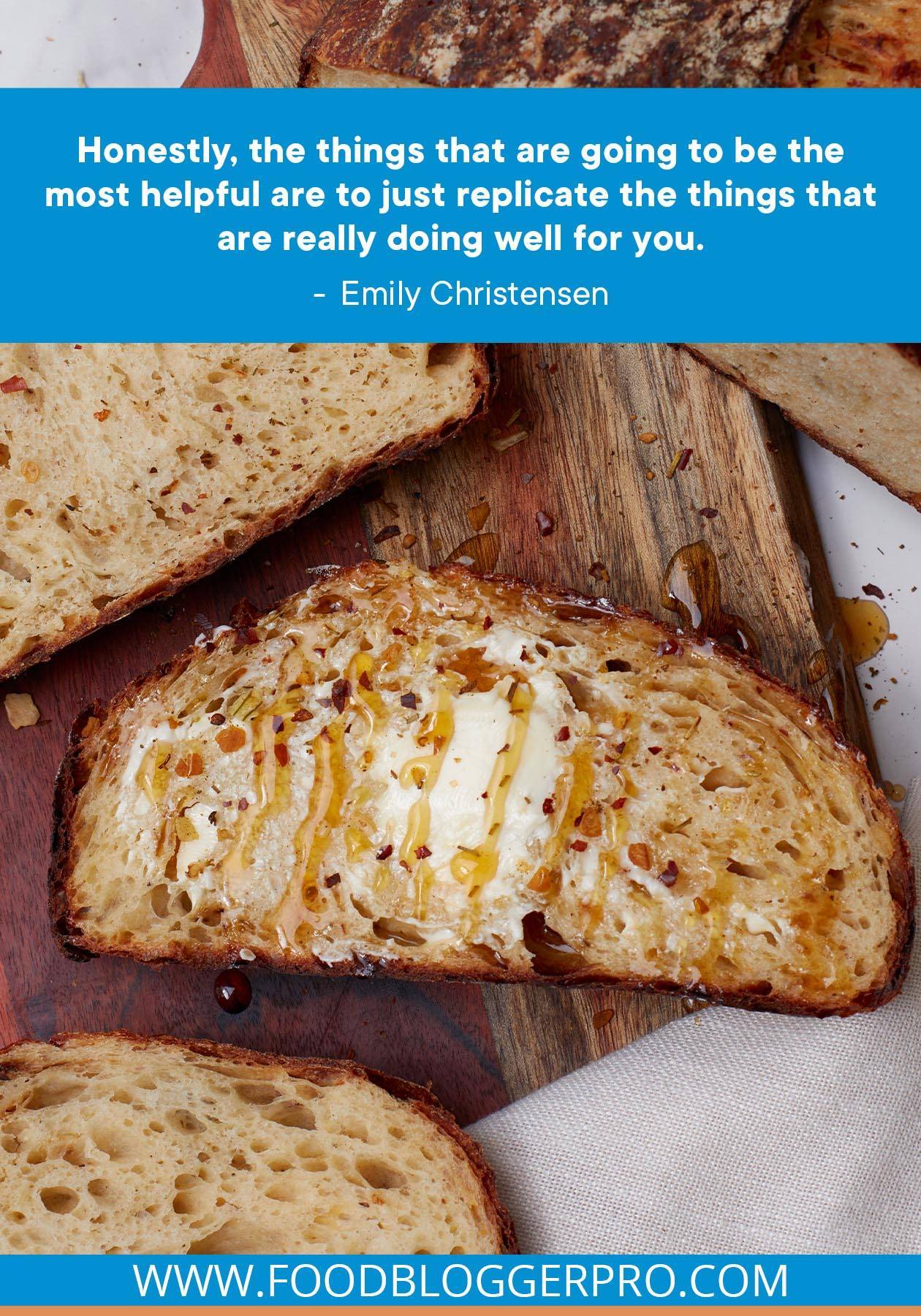
Emily Christensen: I think some of the biggest things were just learning and a lot of it just came from watching lots of other people and learning from what everybody else was doing on Instagram. Instead of just scrolling, I scrolled with actual intent: if I saw something go viral, it’s like, okay, why did that go viral? Was it the visual hook that they’re using at the beginning? Is it the words that they’re using at the beginning? And what is going viral? So I like to keep a lot of folders in my Instagram. I have different folders. So I’ll have like visual hooks and I’ll save anything that like really catches my eye and is doing well on Instagram. I will save to that folder. Or if there are specific words that are used, I’m like, I like that phrasing. I’m gonna save this to a folder. So I have lots of different folders that I save specific things to and then I can go back and look through those. So when I am deciding on a post, I can be like, okay, I really liked how they brought the dough in this scene. So like how can I kind of replicate that with my type of recipe or like what little things can I do to make my videos more successful? So I really tried to be very mindful of how I was scrolling instead of just the mindless scrolling on Instagram and then really listening to the feedback that I was getting. So if something, you know, not necessarily went viral, but if it did well on Instagram and when I first started, that might have been like 10,000 views. So if something got like 10,000 views, it’s like, okay, what about what was I talking about there or what was I showing in that video? And like how can I replicate that again? And then once they started getting really big, like some of the really big hooks, it’s like, okay, what did I do specifically here and how can I replicate that again and again? Because I think so often we want to keep reinventing the wheel. But honestly, the things that are going to be the most helpful, I feel like, are to just replicate the things that are really doing well for you and keep doing those. I mean, it doesn’t mean to keep posting the same reel over and over again, but ask what specifically about that did well and how you can replicate that again with a different recipe. Or how can you change up the recipe that did really well? How can you change that up a little bit to kind of reshare that information again? And I feel like that’s really successful.
Bjork Ostrom: Yeah. Mm. That’s great. I— Yeah, go ahead, finish. Sorry, you feel like that’s what?
Emily Christensen: I feel like that is the key to success is just like figuring out those patterns and then continuing to replicate them. I mean, over time your audience might change. So like something that you did several times, you know, all of a sudden might not work anymore. And so you kinda have to pivot from there. But if it is still working, keep doing it. There’s no reason to completely change if something’s working.
Bjork Ostrom: Yeah. There are some really important things from that I think are good to point out. This idea of studying, not scrolling. Like when you are using the platform, you are studying the content, you aren’t just mindlessly scrolling and saving based on category. Okay, this has a good hook, this has a good deliverable, whatever it might be, and really having a studying mindset, which is hard to do because it’s easy to get sucked into just scrolling on a platform. You really have to declare it. I feel like I’m gonna go in, I’m gonna study. The second piece is this idea we talk about, you know, if you strike oil, in this case, you have a viral piece of content. Sometimes what can happen is people are like, Hey, that was really great. I’m going to go and drill somewhere else. And it’s like, no, you’ve discovered oil, like stay there. You know, obviously oil’s a little bit controversial, but like for the sake of the analogy, continue to, you know, get oil—
Emily Christensen: Yeah.
Bjork Ostrom: —from striking oil until you can’t anymore, and then find somewhere else to drill. So I think, to your point, we sometimes move on too quickly from something that’s working. And like you said, you don’t just post the same thing over and over, but you iterate on it and you kind of stay in that world until it feels like, maybe this has lost some momentum, and then switch and pivot to something else. Think about it almost in the context of a sports team. You know, if you think of football, there’s plays that you run.
Emily Christensen: Mm-hmm.
Bjork Ostrom: And what we’re doing when we’re looking at an algorithm like Instagram is looking at like, okay, what are the plays? What are the formulas? How are things being structured? But it’s not the play necessarily that’s going to get you success. It’s like the play plus the athlete. And in our case, it’s the formula plus the creator. And so if you find these formulas that are working, just because you use that same formula doesn’t mean it’s going to work. You also have to be a talented creator and insert yourself into that. So all of these things are really important for us to think about. And then obviously the medium itself. It has to be something that people are interested in, in this case, sourdough. So let’s say you have a piece of content that’s successful on Instagram. How much are you actually taking that piece of content and reposting it later? We’ve talked about this idea of repurposing content. How much are you doing that on Instagram, whether it be an actual literal repost of the same piece of content versus the same recipe, the same general piece of content, but remixed, re-edited, with a new voiceover. What’s your strategy for that?
Emily Christensen: It definitely depends on the type of recipe. So I would say, like one of the core recipes on my website, and the one that brings in a lot of followers every single time I share about it is my same-day sourdough bread. And so that one I share in a lot of different ways. I would say probably every month or two I’m talking in some way about my same-day sourdough bread. For example, this is how I could reuse this content: I can do a carousel about my same-day sourdough bread, and maybe on that one I’m focusing on like the schedule of it. So it’s talking about, like, here’s when you would start this if you’re a busy mom, or how you can make sourdough work as a busy mom, and then going through the steps and the timestamps on that. And then maybe I’ll do a reel on it, and that one will just be a really short reel that just has words over the top of it. And then maybe I’ll do a longer reel where I’m doing a voiceover and going more in depth on the individual process of it. And then I can include it in a roundup. So something that brings in a lot of followers every time I do it is this: it’s just sharing a lot of different sourdough recipes that I have. And oftentimes I’ll include my same-day sourdough in that roundup video. And then, either in the caption or in the actual post, I’ll say, like, follow along for more same-day sourdough recipes. And those always bring in a lot of follows. And so I’ll try and just take, you know, that one piece of content and think, how many different ways can I talk about it? And some of my most popular recipes— this year I did a cheesy sourdough pretzel bread, and that went pretty viral. And so after I did that, it was like, okay, this did well. So in my first video, you know, I showed myself boiling it first. And then I did another video pretty soon after, trying to keep up with the momentum, where I showed the finished product first and then went into the recipe. And then I did a carousel of it. So it kind of just depends. Like if something does really, really well, then I will try and ride that momentum as long as it will keep going. And then if the newness of it starts dying off, I’ll pivot, and then I’ll wait maybe six months, or four or five months, or whatever. And then I’ll reintroduce that recipe. So I’ll give it a little bit of breathing room. Like, people are getting tired of seeing this recipe. And then I’ll bring it back.
Bjork Ostrom: Yeah, there are probably 30 different angles that you could take. If you have a piece of content, if you have a recipe that’s amazing, you could look at it from— you gave five examples of all the different ways you could look at it, but it’s inspiring for me to think about our approach as we think about content, to say, like, okay, you could do all of these different ways that you could talk about this recipe. I’ve talked about this before on the podcast, but you see that a lot with people who are promoting a song, musicians, artists who are using social platforms. You know, they’re not writing well, maybe they are, but they’re not publishing 300 songs a year. It’s maybe twenty, but they’re probably publishing 5,000 pieces of content—all different versions of promoting the song. There you sit in the car and I play it for the person that it’s about, and then I show it to my dad, and then there’s a dance that these people are doing to the song. And it’s inspiring for me to think about that for our recipes. How can we treat them like a song and look at it from 30 different angles? If it’s something that’s really stellar, if we’re really proud of it, if we think it’s going to make people’s lives better, how do we look at it in different ways and talk about it in different ways on social? How do you think about your different social platforms? Instagram, I think, is your largest following, but how do you think about the other platforms like Facebook and TikTok as they stack up against Instagram?
Emily Christensen: Yeah. What was interesting for me— I just met with my ad agency yesterday. And something that she brought up is that my Facebook traffic year over year was up 93%. And I was like, whoa, that’s crazy. And it brought in over a million page views just from Facebook alone this year. And so it was definitely eye-opening to me because we have tried to put a lot more emphasis on Facebook. You know, I’ve heard a lot of your podcasts over the last year talking about this resurgence in Facebook. And so that’s something I’ve tasked one of my VAs with: pushing Facebook. So on there we reuse a lot of content. So for a while we were sharing probably like three to five pieces of content a day on Facebook. We recently have started to slow down a little bit just because I found that less content now seems to do better than pushing a lot more content. So now we’re just down to like one post a day, one video a day, and then anything that’s cross-posted from Instagram, because I cross-post everything to Facebook. To me it’s like, why not? And I honestly feel like my cross-posted ones usually do the best.
Bjork Ostrom: On Facebook. Yeah.
Emily Christensen: On Facebook, yeah. So that’s how we’re treating Facebook at the moment. TikTok is just getting one video a day, and we are just reusing content from Instagram. I don’t necessarily think that is a good strategy. I think TikTok, you know, thrives better on a more unedited, talking-to-camera type of video. But in this season of life, you know, I have two young boys, and I have a third on the way. It’s just not feasible to create that much content. And so it really hasn’t been my focus, but we are still seeing growth on TikTok, even just resharing. And I will say, I self-published a cookbook last fall and started selling it on TikTok Shop and have seen really good success with that. And you can link—
Bjork Ostrom: Yeah, congratulations.
Emily Christensen: —you know, your TikTok Shop on pretty much everything you share. So when something does do really well, you know, I see a good uptick in sales. So that’s something I’ve definitely thought about— TikTok might be a platform I want to push in the future, just because of the ability to also promote my cookbooks there. And then on Insta—
Bjork Ostrom: Can you talk about how TikTok Shop works for those who aren’t familiar? And then even what it looks like on your side, fulfillment for the cookbooks and any kind of numbers that you’d feel comfortable sharing, whether it be like general sales in a month or if you have a video that goes viral, you know, how much you could expect in terms of people actually purchasing. It’s a world that I’m totally unfamiliar with. And so I’m really curious about that.
Emily Christensen: Mm-hmm. Yeah. Yeah, the nice thing about TikTok Shop that’s been really helpful is that some of the creators who have much bigger followings than me on TikTok like to sell on TikTok Shop, because they can get commissions on TikTok Shop. I have found there are a few core creators who have really latched onto my book. And so I would say more than anything, they’ve probably sold the most cookbooks for me. I should have looked up that information. I don’t know off the top of my head what percentage of sales are coming from TikTok Shop right now. But I will say, having that commission piece— it’s kind of the same thing with Amazon. I started selling on Amazon in the last few months, and because people can get a little bit of a kickback by sharing, I feel like it makes a lot of creators more willing to share content and actually create. There’s this one girl, and she creates reels— or I don’t even know, do you call it a reel on TikTok? Whatever you call it on TikTok. But she creates a lot of videos around my cookbook. And she has sold a lot of cookbooks for me just through sharing her TikTok Shop. So I feel like TikTok has actually been a really good platform for me. Setting it up on TikTok Shop was actually fairly easy, and I—
Bjork Ostrom: Shorts, yeah. Yeah.
Emily Christensen: All of my back-end fulfillment is through Shopify. And so really, Amazon now links to it, TikTok Shop links to it, and all of my orders through my website also go through Shopify. And my sister’s the one that does all my cookbook fulfillment for me. And so she’s able to just get the whole list together from Shopify and then send out cookbooks from there. So it’s pretty seamless, I feel like. And to me, it was like, why not give people one more place to shop my cookbook? Because not everyone’s going to go to my Shopify website and find it there. But if they can find it easily through TikTok Shop and they’re already comfortable with TikTok Shop and buying through there, same with Amazon. They already have all of their credit card information saved on there. So it just makes the process really seamless. So even though I lose a little bit of commission because, you know, I have to pay the fees for Amazon and TikTok Shop, to me it ends up being worth it because the people who were going to buy it on the website were going to buy it on the website anyway. To me, it’s just getting those extra people who weren’t going to buy it on my website.
Bjork Ostrom: Yeah. Anytime you can get somebody else to promote your thing, it’s great. And especially if the commission is only— it is a commission, so it’s not like you’re having to pay them and then hope that something sells. It’s like, only if it sells do they get a commission, which is cool to be able to have something where somebody is an affiliate for you as opposed to you being an affiliate for somebody else’s product.
Emily Christensen: Yeah. Yeah. And I don’t have to set that up, which is even nicer, because like if I did it through Shopify, you know, I would like have to set that up and create codes for everybody. And that’s just not something I really want to mess with. But on Amazon and TikTok Shop, it’s already well established, which is really convenient.
Bjork Ostrom: Built in. Yep, that’s great. So, you know, the general progression, it sounds like, is you wanted to do something, you were moving often— it’s not like you could set up an in-office job. You had done a marketing thing, which didn’t necessarily feel like a good fit. So you did the classes. The classes evolved into online content. Online content evolved into starting to look at, like, what do I do now, essentially? You had built this following, you had built up hundreds of thousands of people. And it’s like, okay, I have a lot of people here. And this is what we see a lot now. Ten years ago, you’d start a site and build social around it. And now what’s happening is you build social and then you build a site around it. And it seems like what happened for you is that you had built this following, and it was a little bit of, like, now what? And then you looked to blogging in order to monetize. Is that right?
Emily Christensen: Mm-hmm. Mm-hmm. Yeah, so I, you know, once I had built this following, it was like, okay, how am I really gonna make money? Because at the time Instagram was paying, but it wasn’t anything crazy, you know, it was— Yeah, the bonuses. So I was getting the bonuses at the time, so I was making some money and then you can make some money off affiliates. So like there was some income coming in, but it wasn’t consistent or steady, and—
Bjork Ostrom: It’s like the bonus program. Yeah.
Emily Christensen: I just wanted something else to be able to direct people to. And so that’s when I started my blog, in 2023, and it was very sporadic. And I was telling you a little bit before, I really didn’t understand the money that was in food blogging. So when I started my blog, it was like, cool, I know some people have a full-time income with this, but probably not me, you know—that was my thought.
Bjork Ostrom: Like this would be side hustle, like it’ll be nice, yeah.
Emily Christensen: Yeah, I was like, if I can even make a few hundred bucks on it, like amazing. You know, I just really had no concept of what a food blog could be. So I started in 2023, and I had posted a couple of times throughout the year, but it was very inconsistent. I probably had five posts in total in 2023. And I never even linked to them on my Instagram. So then in January of 2024— we were about to move again for my husband to start residency that May— I was like, you know what? I’m going to go hard this year and just see what happens. So I’m gonna start posting consistently on my blog. I’m going to start sharing. I think at the time I had ManyChat. I don’t even know if Grocers List was a thing yet. So I had ManyChat at the time, and I started doing the DM automation and sending people over to my blog to share recipes, because up until that time, if I ever shared a recipe, I was mostly doing education, but if I did share a recipe, I would just put it in the caption. And I was like, you know what? I’m just gonna send people instead to this blog and I’m gonna see what happens. So I committed in January of 2024, and the day we moved into this house for residency was May 22nd of 2024.
Bjork Ostrom: Mm-hmm.
Emily Christensen: I got an email from Raptive and they were like, you qualified. I had hit 100,000 page views, and I was like, wait, what? And I truly— when I opened it the first day, I was like, this will be nice. I really expected it to be $10 to $20 that first day. I feel like you just think of ads and you think they’re gonna be like pennies. I don’t know, I just had no idea. And so—
Bjork Ostrom: Sure. What was it the first day?
Emily Christensen: I think it was like $400 or— I looked. Okay, that month I started on May 22nd, and that month I made $2,700. And I thought, my gosh. I was like, wait, what? And, I mean, up to this point we were so poor. I mean, we had been living on government assistance, and, you know, it was—
Bjork Ostrom: Yeah. Life changing. Yeah.
Emily Christensen: I mean just seeing any money, it was just like, wow.
Bjork Ostrom: Totally. It’s like when you go from that to a consistent $7,000, $8,000, $10,000 a month, that’s felt in such a significant way. Can you tap into that a little bit? I know even after a year or two years, there’s kind of this hedonic treadmill where you kinda get used to it a little bit. You don’t feel it in the same way, or maybe it sets a bar. But tell me about what those first few months—
Emily Christensen: Yeah.
Bjork Ostrom: —were like for you, because I think it’s inspiring for people to hear.
Emily Christensen: My gosh, I don’t even know. I just remember every day at 10 a.m. I would refresh the page and be like, my gosh, I made more money. Like it was just so exciting, and it truly has changed our life. You know, my husband is now in his last year of residency, and where we’re at with my business, it just puts us in such a comfortable place to give him more flexibility once he starts his job. You know, we’ve talked about what his hours could maybe look like, and maybe him not having to work as much, because in med school and residency he hasn’t been around much, because the hours are just really long and busy. And, you know, being able to take more trips as a family, or all the things— he gets paid in residency, but, you know, it’s nothing exciting. So it’s like—
Bjork Ostrom: Super intense. Yeah. Yeah. Yeah.
Emily Christensen: Just having the income on my end as well, I feel like, has taken off so much pressure and allowed us to live a more comfortable lifestyle. And honestly, in a way it’s about the money, right? But in another way, it’s just been so fulfilling for me to have this business and to realize I have what it takes, I can do this. Because, you know, going back to when I first did my first class, where I was like, I’m gonna throw up, I feel like an idiot, everyone’s gonna be like, who does this girl think she is, you know? And so to just prove to myself— I’ve always wanted to open my own business, but I was like, what would I do? I have no idea. And so to prove to myself, you know, that I could do it and be successful, it honestly has changed—
Bjork Ostrom: Yeah. Yeah. Yeah.
Emily Christensen: —my life in those ways, of just feeling like I can do this. I can do whatever I set my mind to.
Bjork Ostrom: Mm-hmm. Yeah. It’s multifactorial in terms of the benefits. Like you said, money is a little bit of a measurement, but it’s also a felt and real tool that allows you to buy certain things like flexibility. You can obviously buy physical things, but, man, the ability to buy a more flexible schedule when you have three kids at home is incredibly valuable. Super important. But I think another thing that we don’t give enough credit to is this idea of self-actualization, mastery, work that is flow— work that you are doing that feels challenging enough that it’s not easy, but easy enough that you can actually do it. And when you lock that in, there’s something undeniable about that. There are all of these benefits that come from it, but it’s also still a lot of work, and you have two kids and, you said, one on the way. How do you go about making sure that you’re giving enough to the business while also balancing all of the responsibilities that you have at home and with family and all the other things that you’re navigating?
Emily Christensen: Well, I’m gonna be super, super real: I have not been good at it. I would say I definitely have a workaholic personality for sure. I think anyone kind of in this business probably has a little bit of a touch of that. It’s just that when you have your own business, it doesn’t shut off. Your brain doesn’t shut off; it is constantly going. And so it has been really hard for me to figure out that balance and, when I was first growing my business and seeing those numbers grow— I mean, even now my revenue year over year is up 69% and my sessions are up 47%— I’m still in a really exciting growth stage, and so it’s motivating and it’s exciting. And it’s taken me a while to figure out that balance, especially when you work from home. There is no separation of work and home. Everything is together. And so I will say, like a lot of times, it felt like I was kind of working all the time. And especially now, with my youngest in preschool three days a week, full days, it gives me three full days that I can just be at work. But when he was home every single day, it was hard because, you know, it’s like I start working and then he needs something. And so then I go and help him or we have to run to an appointment or we go to the park or whatever. So it’s really hard to track actual time spent, because it’s a lot of here and there and everywhere. And so, you know, it got to a point where it felt like I was always working. I was always on—
Bjork Ostrom: Mm-hmm. Yeah.
Emily Christensen: You know, as soon as the kids went to bed, I was working till late into the night. And I think a lot of that is just a lot of growth in a short period of time. There are seasons where it’s just a lot. I feel like now, in the last— probably since the beginning of this year, and especially once I got pregnant— ’cause I was super sick my first nineteen weeks, so I honestly wasn’t—
Bjork Ostrom: Mm. Changes the dynamic. It’s like, yeah.
Emily Christensen: —wasn’t doing much of anything besides trying not to die. But I feel like this year I’ve tried to be more intentional and realize, now that I have a business that, you know, pretty consistently brings in a consistent amount of money every month, that I can step back just a little bit. I’ve hired more help, brought in more people. So I have two VAs who work part-time. My sister works for me. I have a sister-in-law that does a lot of recipe testing for me. Somebody’s editing my videos for YouTube. So I’ve tried to hire out more. And another thing that I feel like a lot of us have to think about in food blogging— and it’s a conversation I’ve had with some people before— is when is enough enough? Because it’s unlimited. There is no cap on how much you can make, how much you can grow. I mean, it’s kind of like, how much are you willing to put in or work? And so that’s something that I’ve tried to grapple with over the last year: when is enough enough? We’re in a very comfortable place now. I mean, I make more in a month, some months— it depends on the month—
Bjork Ostrom: Mm-hmm.
Emily Christensen: —than I was making in a year at my first job out of college. And so to me it’s like, when is enough enough, to where it’s like, you know what, I need to make sure that my family is not on the back burner, especially while they’re growing up and in their young years. Because I would hate for my kids to look back one day and be like, Mom was always just on her laptop or on her phone doing work.
Bjork Ostrom: Yeah. Yeah. Mm-hmm. Yeah. Yeah.
Emily Christensen: And so for me this last year it’s really been trying to balance that and kind of realize that I’m not gonna be able to do everything. I’m not gonna be able to be a hundred percent on all the platforms or post a billion times on my blog or whatever that looks like. Things are gonna have to fall through the cracks, and it’s okay.
Bjork Ostrom: Mm-hmm. Yeah. It’s one of the things that I— so you can do, you know, ChatGPT voice, where you can interact with AI and talk to it. And one of the things that I’ve been doing is, I’ll get into a certain topic or get curious about a certain thing. And one of the things— this is within the last month or two— that I’ve been trying to understand is exactly what you’re talking about. What is this constant struggle that we have as entrepreneurs, as creators, and I think really as digital workers? It’s entrepreneurs, but it’s also people who are building businesses or working within businesses, but digitally. And in those AI conversations, one of the things that it pointed me to— I was like, what is this called? And it pointed me to this idea of boundary theory, and this idea that there are all of these little subcategories under boundary theory. But the one that stood out to me the most, which ties into a little bit of what you’re talking about, is this idea of permeability. And so, how permeable are your boundaries? And one of the things that I found is that the boundaries I have are extremely permeable, both from work into life, work into family, and family into work. Meaning, there is not a hard-line boundary. The example would be if you work in a restaurant as a server, that’s not very permeable. It’s really hard for your family life to get into your work life, because you’re busy, you’re waiting on tables. And once you’re done, it’s hard for that job to get into your family life— maybe in your head you can be thinking about it, but it’s not like you can pull out your phone and work as a server. And so one of the things I’ve been trying to do is think about how I can increase the boundary thickness so it’s not as permeable. Where have you landed on that? Obviously you’re in the middle of it and, like you said, you’re trying to figure it out, but is there anything that you’ve shifted or adjusted, or is it mostly mindset?
Emily Christensen: I think mostly mindset, honestly, but it has really helped having those days. And something else is, I’ve just learned to hire out more stuff, you know? And I realize this is coming from a place of privilege, of being able to afford to do some of these things. When you’re first growing your business, I’ve been in the thick of it, where it’s like, I can’t afford to hire any extra help, and I’m also working a billion hours. So I’ve been there as well.
Bjork Ostrom: Totally.
Emily Christensen: But, you know, hiring out. So over the summer I brought in a girl, and she worked a few times a week for me and took my kids out so they could still do fun things every day, without me feeling guilty that they’re just sitting at home or whatever. You know, bringing in somebody that cleans my house twice a month, assigning some of those tasks—
Bjork Ostrom: Yep. Hanging around home. Yeah.
Emily Christensen: —to other people, to give me more time, and time to be more creative as well. Because when you’re so bogged down with the day-to-day little minute tasks, I was getting so burnt out and no longer felt creative at all. It was really hard for me to think of new, unique recipes. And that’s kind of what helped me to stand out when I first started. And it was like, I can’t think of anything, because I have nothing left to give. And so hiring, and within my business too, you know, bringing on my VAs who tackle a lot of the day-to-day tasks of, you know, sharing things on social media and helping me with emails, and all of these things that give me more brain time back to really just be creative and think through things. And I feel like that has brought a lot of joy back.
Bjork Ostrom: Yeah.
Emily Christensen: And I feel like taking a break really did help me reset, because right before I got pregnant, I was getting really burnt out. And I think that’s something that a lot of creators struggle with because we go, go, go, go, go until we just have nothing left to give. And so when I got sick with this pregnancy and, you know, wasn’t able to bake or really do much of anything, it gave me time to reflect on things and how, you know, even when I was away, my business was still doing well. Like it was still continuing forward. Obviously, I can’t step away forever or it’s going to eventually die out. But, you know, taking off a little bit of pressure— my Instagram continued forward even if I wasn’t posting every single day. Or my—
Bjork Ostrom: Mm-hmm.
Emily Christensen: —just because I didn’t post a recipe this week, my blog didn’t explode. And so, just really that mindset shift: it’s not as serious as I was making it out to be, like this has to be done today. There are things, of course— there are going to be deadlines, you know, with paid partnerships or whatever, things that have to get done— but realizing there was more flexibility than I was originally giving myself.
Bjork Ostrom: Yeah. It’s an interesting spot to be in, because you have almost gained that flexibility by being inflexible for a season. And so it’s like— Lindsay and I talk about this— the thing that serves us in giving us freedom and flexibility is a byproduct of being kind of rigid in the demands that you place on yourself for another season. And so there is this—
Emily Christensen: Yeah. Yeah. Yeah.
Bjork Ostrom: —kind of trickster mindset that you have to have around it where you don’t want to be too subservient to either one. You don’t want to say, I need to be this all the time, forever, because the mental health effects of that, not for everybody but for a lot of people, have a pretty significant downside if you just continue to do that indefinitely. And also you don’t want to lean too far into the freedom component, where you’re like, hey, this thing works. I’m gonna kinda let this ride because eventually it’ll stop riding. And the analogy I use is this idea of coal in a coal train, or, you know, a coal-powered train, where especially when you’re first starting out, you’re shoveling it in, the train’s not going, you get in, you shovel it some more every day, kind of like that, you know, September to May period that you talked about. And then eventually it starts to creep forward, you gain momentum, you gain speed, it starts going. And then you can stop shoveling coal for a week or maybe a month and it still goes. But if you don’t do it for a year, it might slow down. So it really feels like both of those things.
Emily Christensen: Yeah, and something that I see online sometimes frustrates me, because people try to target stay-at-home moms. They’re like, there’s an easy way for you to make money, and you just have to put in five to ten hours a week, and then you can be successful in, you know, all different types of things, including blogging. But the honest truth is you’re going to have to put in the hours, like with anything, to be successful. I mean, maybe someone can prove me wrong— somebody who only works five hours a week and has since the beginning and has a successful blog. But I would say the majority of us who have created something successful, we have put in a lot of time. I mean, food blogging is not an easy win, and there are so many components to it. And so I just think, you know, sometimes people just assume, I could just do five to ten hours a week and be successful. And it’s not actually how it’s gonna work out. I mean, maybe for some, but for the majority of us, it’s gonna take a lot more than that.
Bjork Ostrom: Yeah. It— Yeah, I think you’re either spending a lot of time or you’re spending a lot of money, and either one is a risk. And you could spend a lot of time and it could grow into something really beneficial and really amazing. Or you could spend a lot of time and it doesn’t grow into something beneficial and amazing. That’s a risk. You’re spending that time. Same with money. Maybe you’re not working a lot, but you’re hiring people to do the work. There’s potential that it doesn’t work out. We’ve had businesses like that where we’ve spent a lot of money—
Emily Christensen: Mm-hmm.
Bjork Ostrom: —on a thing, we haven’t spent as much time, but then it doesn’t work out. And we’ve also had businesses with time as well, where we spent a lot of time, our own or, you know, other people’s, and it doesn’t work out, or it does work out. And that’s kind of the risk of business that we are all assuming. So I think it’s a really good point, and to not sell people on the idea of this easy thing. It’s like, no, it’s a lot of work and you have to figure it out and struggle along the way. And even then sometimes it doesn’t work out. You have done some things that have been really beneficial for the business. And one of the things that’s always interesting for me with anybody who’s built a social first type of content business, which I think is becoming more and more true, is that you need the content you’re publishing to social to serve you in a way where it’s actually producing income. You talked a little bit about brands and sponsor content. Obviously, we talked about blogging and ad revenue. What does that look like right now in terms of revenue from the business if you were to give percentages to it? And then I have some follow-up questions after that.
Emily Christensen: Yeah, I would say I don’t have exact numbers on me right now, but I would say my blog is the biggest chunk of revenue for me. So probably, I don’t know, 85 to 90 percent, maybe, of overall. And then we have cookbook sales in there. I would say probably cookbook sales and then—
Bjork Ostrom: Advertising revenue.
Emily Christensen: —paid partnerships, but paid partnerships are tough because it just depends on the month. You know, over the last couple of months I’ve had several paid partnerships, and so my income right now is a lot higher on the paid partnership end. But for the first eight months of the year I probably did one or two. Paid partnerships aren’t really my favorite thing to do, but I try to diversify my income, and so I do them occasionally.
Bjork Ostrom: Come and go. Yeah. Sure.
Emily Christensen: And then probably, when paid partnerships are lower, affiliate links specifically. My biggest one that I focus on is Amazon, just because that’s where the majority of people are actually shopping and purchasing. So I just find, you know, things like ShopMy and the other platforms— at least for me as a food blogger— I’m not finding are really worth my time. Really, it’s mostly just Amazon. And then, you know, a couple of the tools that I use, especially my Bosch mixer. That’s one of the affiliates I work with a lot. But for the majority of it, I would say Amazon, just because they also do their bonus programs. So if you hit revenue targets, then you can make additional income from that. So, you know, some months I can bring in just from Amazon five to seven thousand a month, which has been, you know, really nice. So—
Bjork Ostrom: Yeah.
Emily Christensen: I mostly focused just on Amazon as far as affiliates go. And then there are the bonus programs. On Instagram, I think I get like three dollars a month or something. It’s ridiculous at this point, ’cause they only pay on carousels at the moment, so it’s nothing too exciting. But Facebook, I think, depends on the month and what they decide they’re gonna pay you that month. But there is—
Bjork Ostrom: Facebook and Instagram.
Emily Christensen: —something coming from there.
Bjork Ostrom: Yeah. We’ve gotten a thousand to ten thousand, depending on the month and exposure. And so one of the things you’ve had to get good at is transacting on a social platform, not just posting content and getting attention. Can you talk about what’s worked for you in the two categories that you talked about? Number one, getting people to your site so then you can earn income from advertising, and then, on the affiliate side, what’s worked for you? What are the things you’ve discovered with both of those that have worked well?
Emily Christensen: Yeah. I would say for sure Grocers List is a game changer. And if you don’t have Grocers List, I don’t really know why at this point you wouldn’t have it. Because— yeah, GRO. Yes, GRO now. But I feel like that is what has really helped grow my blog so much. You know, I think because I started as a social-first platform, that also gave me a lot of authority with Google. And so it helped to bring things towards the top—
Bjork Ostrom: GRO.co rebranded recently. Yeah.
Emily Christensen: —in a quicker period of time. So I do think that is one advantage of growing social first. But yeah, being able to quickly DM people the recipe and bring link clicks over. I think from GRO this year I had 678,000 page views just through GRO. So, you know—
Bjork Ostrom: Yeah. That’s great.
Emily Christensen: —having that to just be able to send people to my site. Because yes, some people will go to your bio and click the link there. But the majority of people are not going to go out of their way to find the recipe. Or some don’t even really know how to navigate a recipe or a website to even find the recipe. So to me, just being able to quickly send them that link is the most helpful thing you can do. And then because you’re creating engagement, it boosts your posts up, and so I feel like for me there’s really no downside to doing GRO. I did a carousel probably a month ago talking about why content creators use the DM tools. I like to be really transparent with that, because I do think some people get frustrated with it. But once they understand why we’re doing it and the purpose behind it, it provides a lot of clarity, and then they’re more willing to do it. The only downside is the engagement side of things: you sometimes will miss questions in your comments. That’s really the only downside I see to GRO. But for the most part, I feel like overall it is really successful. And then I usually use my stories as a way to promote affiliate links. So I pretty much always start with a DM automation in stories. So I will just share a picture of a recipe and then say, comment—
Bjork Ostrom: Yeah.
Emily Christensen: —you know, pumpkin, for this recipe, or whatever it is. That really skyrockets how many people are actually seeing my stories. And then from there I’ll share, in order of importance. So if I really want to push an affiliate link, then that’s what I’ll share next. And I try not to share too many stories, because if I have eight to ten stories, my views on those stories just tank. If I keep my stories really short, like two or three stories, I see a huge uptick in the number of views. So to me, it’s like, okay, it’s not really worth it when, by the time I’ve gone through 10 slides, 5,000 people are seeing my last story. So to me it’s about trying to keep things short and sweet and just focusing on the most important things to do in my stories.
Bjork Ostrom: Yeah, that’s great. Are you using deep links for those Amazon links, when you’re building that within GRO or another tool? Okay.
Emily Christensen: Yes, just through GRO. Yeah. I originally started with URL Genius; that’s what I used to use, but I’ve moved away from that, and now I only use GRO. So it’s been great.
Bjork Ostrom: Can you explain the benefit of that for people who aren’t familiar?
Emily Christensen: With deep linking, yeah, because let’s say you’re on Instagram and you click a link, and if you don’t have a deep link on it, it opens up in a web page that you’re not logged into. So now you have to remember what your Amazon login information is, and then from there, you know, put in all of your information and hope they’re gonna order the product. Whereas with a deep link, it goes automatically into the app because the majority of people who are shopping on Amazon now are gonna have the Amazon app on their phone anyway. And so it will automatically go into the app. And the conversion rate is so much higher. As soon as I switched to deep linking, I saw a huge increase in the amount of money that I was making on Amazon.
Bjork Ostrom: It’s such a no-brainer. It makes it easier for the person that’s clicking on the link, and you earn more. That’s the only difference: the type of link that you’re creating. And you can do that— there are different platforms that do it, but it’s built in to GRO. So yeah, to your point, it hops from the Instagram, you know, website into the Amazon app and makes checkout so much easier. We could probably talk for another hour here, just about all the things that you’ve learned, Emily, but I want to be respectful of your time. The thing I really appreciate is you being willing to come on and be transparent and share some numbers. And I know that you talked about how beneficial it is when other people do that. And we always appreciate it, because we know that it makes for an even more interesting conversation for other creators who are out there figuring it out. So if there’s one spot that you’d encourage people to check out and follow along, where would it be? Would it be your Instagram account?
Emily Christensen: Yeah, you can check me out at Country Road Sourdough— two S’s there. You can find me there; that’s probably the best place. And then you can also find me on my website at countryroadsourdough.com.
Bjork Ostrom: Awesome. Emily, thanks for coming on.
Emily Christensen: Thank you.