
Listen to this episode of The Food Blogger Pro Podcast using the player above or check it out on Apple Podcasts or Spotify.
This episode is sponsored by Member Kitchens and Raptive.
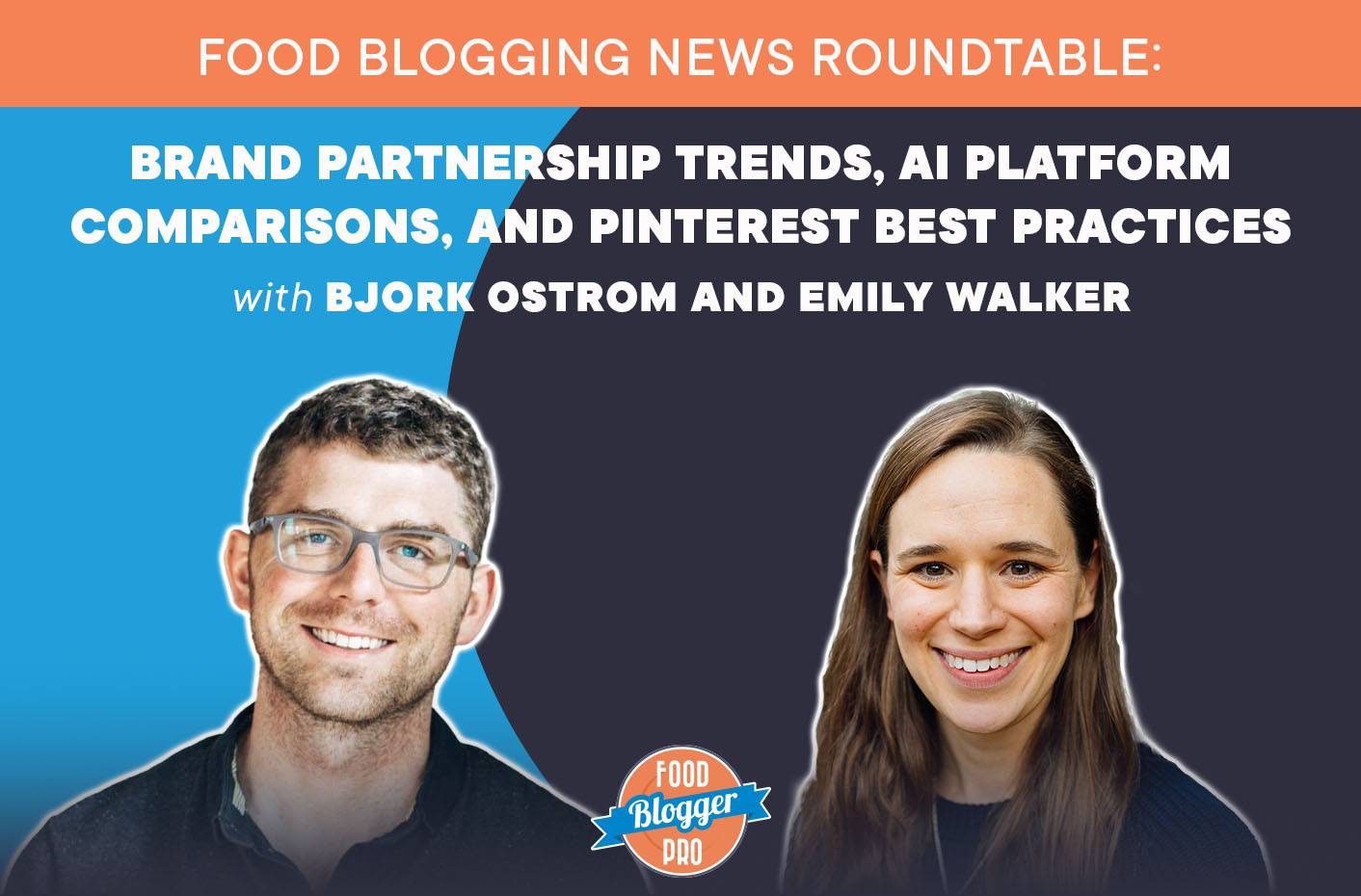
Welcome to episode 548 of The Food Blogger Pro Podcast! This week on the podcast, Bjork is sitting down with our very own Emily Walker to talk through the updates shared in our latest blogging newsletter.
Last week on the podcast, Bjork chatted with Lexi Harrison. To go back and listen to that episode, click here.
Food Blogging News Roundtable: Brand Partnership Trends, AI Platform Comparisons, and Pinterest Best Practices
In this episode, Bjork and Emily break down exactly how to navigate the “Big Three” AI tools (ChatGPT, Gemini, and Claude) and explain why building deep brand authority is your best defense in the changing search landscape. If you want to future-proof your business, doubling down on your niche expertise is no longer optional — it’s essential.
They’ll then shift gears to practical platform strategies, covering why Pinterest is suddenly obsessed with your site’s user experience and the specific metrics that actually drive YouTube growth. Whether you are planning your holiday marketing or just trying to streamline your workflow, this episode is packed with tips to help you adapt without sacrificing quality.
Three episode takeaways:
- The “big three” AI assistants aren’t all the same: Bjork and Emily break down the key differences between ChatGPT, Gemini, and Claude. It’s not about picking just one; it’s about knowing which tool has the right “personality” and strengths for the specific content task you’re tackling today.
- Brand authority is your new SEO superpower: With AI changing how people search, keyword optimization isn’t enough anymore. You’ll hear about why doubling down on your niche and proving you are the expert is the best defense (and offense) in the era of AI-generated answers.
- YouTube and Pinterest are craving different things right now: Stop treating all visual platforms the same! Pinterest is prioritizing user experience and site functionality, while YouTube is all about watch time and that crucial first click. Plus, Bjork and Emily chat through why consistency is still king for growing an audience through video.
Resources:
- Subscriber to the Food Blogger Pro newsletter!
- Shoot Emily an email if you have any ideas for articles you want covered in the newsletter!
- ChatGPT Vs. Gemini Vs. Claude: What Are The Differences? — Search Engine Journal
- ChatGPT
- Claude
- Gemini
- Episode 541 of The Food Blogger Pro podcast: Maximize Efficiency with AI (Without Losing Your Voice) with Trey Griffin from Raptive
- Episode 446 of the Simple Pin Podcast: How to Get Discovered On Pinterest
- The Role Of Brand Authority And E-E-A-T In The AI Search Era — Search Engine Journal
- The Creator-First Holiday Marketing Guide for Brands — Later
- Top 5 Tips for Food Bloggers on YouTube — Food Blogger Pro
- Episode 511 of The Food Blogger Pro podcast: The Cost of Content and Why Carla Lalli Music left YouTube
- Google Keyword Planner
- Semrush
- Genius Link
- Follow Food Blogger Pro on Instagram
- Join the Food Blogger Pro Podcast Facebook Group
Thank you to our sponsors!
This episode is sponsored by Member Kitchens and Raptive.

Member Kitchens allows you to build a thriving membership community on your own-branded platform — no tech skills required. Members get dynamic meal plans, automated shopping lists, and much more, all within an ad-free mobile app.
Getting started is simple. Member Kitchens imports your existing recipe library, so you can start selling subscriptions quickly and start thinking beyond site traffic.
Ready to add a new revenue stream to your business? Visit memberkitchens.com today to start your free 14-day trial.

Thanks to Raptive for sponsoring this episode!
Running a creator business is a constant balancing act between making great content, keeping up with platforms, and earning enough to keep doing what you love. That’s where Raptive comes in. They’re the team behind thousands of the internet’s top creators, and they help you tackle it all: growing your traffic, boosting your revenue, and protecting your content in an AI-driven world. Raptive offers tailored growth strategies covering SEO, email, and audience development.
Ready to level up? If your site gets at least 25,000 monthly pageviews, you can now apply to join their creator community by visiting raptive.com.
Interested in working with us too? Learn more about our sponsorship opportunities and how to get started here.
If you have any comments, questions, or suggestions for interviews, be sure to email them to [email protected].
Transcript (click to expand):
Disclaimer: This transcript was generated using AI.
Bjork Ostrom: This episode is sponsored by Member Kitchens. Let’s talk about real results. Member Kitchens creators, actual food bloggers, and social media chefs are adding an average of $2,500 each month to their revenue, with some consistently surpassing $10,000. These aren’t hopes or guesses. These are documented numbers from creators transforming their brands into thriving, sustainable businesses today. How? Member Kitchens offers a fully branded platform that looks and feels like you, your recipes, your style, your unique message. Members get dynamic meal plans, automated shopping lists, and much more. All within an ad-free mobile app they’ll rave about. Getting started is simple. Using AI, Member Kitchens imports your existing recipe library so you can start selling subscriptions quickly. Plus, before you launch, an expert will personally review your app to ensure it’s ready for the spotlight, ready to see results for yourself. Visit memberkitchens.com today to start your free trial, and you can get a special discount by being a listener to our podcast. You can use the promo code FoodBloggerPro for 50% off the first two months.
Ann Morrissey: Welcome back to another episode of the Food Blogger Pro podcast. I’m Ann from the Food Blogger Pro team, and in this episode we’re bringing back Emily Walker, the Associate General Manager of Food Blogger Pro to the podcast to chat with Bjork about the latest and greatest news shared in the blogging newsletter that went out last week. Emily and Bjork will chat through the differences between the big three AI platforms like Claude, Gemini, and ChatGPT, best practices for Pinterest, and how to navigate holiday partnership trends and develop brand authority. If you enjoy the style of the episode and want to hear more like it, let us know. Your feedback helps shape what we create next. And now, without further ado, I’ll pass it over to Bjork.
Bjork Ostrom: Emily, we’re back.
Emily Walker: We’re back. Good to see you.
Bjork Ostrom: It feels like it’s just yesterday, but it wasn’t. It was a month ago that we had this conversation. Do you want to give people a quick recap of what this is, kind of the rhythm behind it, and then if people actually want to follow along with the newsletter version of this, where they would go for that?
Emily Walker: Absolutely. Yeah. The holiday season time flies, but we’re back in December and we just sent out our blogging newsletter on Thursday, December 4th, so you may have seen that in your inbox and thought, I don’t have time to read that. No one has time to do anything this time of year, or your inbox. Looks like mine does after Cyber Monday, and it just got lost. So we are here to recap the latest and greatest news in the blogging world. Hopefully add some additional insight or context to some of the news articles and just provide a different way for you to consume the news. And if you would like to receive the blog newsletters in your inbox, you can just head to foodbloggerpro.com. You can opt in on the homepage to receive the newsletter. And yeah, we are hoping to do this every month. And so this will be our last one for 2025, but if you tune in January, we’ll be back. And if you have any thoughts or news articles you’re just dying for us to cover, you can always email me [email protected] and we will try and get to it. Yeah, that’s the gist.
Bjork Ostrom: One of those things where as creators, we’re always having to balance creating. So you want to be able to consistently put content out, but we talk about this idea of getting a tiny bit better every day forever. Part of that is the education piece. From a creator standpoint, how do you get better at photography? How do you get better at developing recipes? How do you connect with people better? And then there’s the industry tools, industry norms, things that are changing. These are kind of in that third category of, Hey, there’s a lot going on in this world. You are a creator. A lot of us are professional creators and any other profession, you have tools. We just did a big kitchen remodel. They had some really amazing tools to take the side of the house off and build a kitchen. And if they would’ve been using the same tools that were available 15 years ago, it wouldn’t have been as effective. Some of those are consistent throughout. You’re always going to have the hammer, you’re always going to have a nail gun, but a nail gun today is going to be better than a nail gun 15 years ago. Similar in our world as professionals who are creating content, the things that are evolving and changing allow us to do our job of creation content creation better, whether as the technician who’s wanting to make sure that you are creating something accurately and a post is structured in the best way possible for SEO, or hey, there’s all these tools, chat, GBT and Gemini, Claude, we’re going to talk about that in the first article.
Emily Walker: How are you using them?
Bjork Ostrom: And how are they different? So that’ll be our transition into article number one.
Emily Walker: Yeah, man, going from ripping a house off to AI tools is,
Bjork Ostrom: We’re going to cover it all.
Emily Walker: Yeah, we sure are. Welcome to Food Blogger Pro podcast. Yeah. So the first article that we covered in our newsletter is comparing ChatGPT, Gemini, and Claude, the differences between them, and then analyzing which one is best for various purposes. I mean, I don’t know about you, but I don’t use these tools extensively. However, I am fairly loyal to ChatGPT, simply because that’s what I started with.
Bjork Ostrom: Do you use the web version of it or do you use the app?
Emily Walker: I use the web version.
Bjork Ostrom: Yep. I use the app. I love the app. But yeah, I’m the same. 95% of my LLM chat interface conversation is within ChatGPT.
Emily Walker: And do you pay for it?
Bjork Ostrom: I pay for the $20 a month account. Just this morning. This is kind of a side thing. One of the frustrating things is the current version of ChatGPT can’t read a scanned PDF. It used to be able to do this, I dunno if you’ve ever done this, but I’m like ask Lindsay around the 10 character traits of Bjork, and one of them will be scanning documents. That’s one of my character traits, scanning documents and shredding documents. It’s like number eight and nine. So we will scan documents, and I’ve been really methodical about like, okay, you have the cars folder and the cars folder. There’s all the cars we’ve had through the years, and then there’s the Subaru Ascent and IQs, the documents from the maintenance we’ve had. Now I’m getting rewarded for that work because you can then put those into an LLM and have comprehensive understanding of all of those. So like, Hey, remind me of when we had the work done on the ascent, blah, blah, blah, blah. But ChatGPT is not very good at, well, it just can’t scan a document unless you upgrade. This is getting back around your question to the Enterprise version apparently, which I don’t know. I didn’t even look into how much that is. But Claude, and this kind of gets into some of the things that the article talked about, the differences between these. Claude can do that and it does it pretty well. So I actually pay for Claude as well, and we’ll use it for a little bit more like technical things. This talks about the idea that it’s a little bit better at code related stuff, which I’m not doing a ton of, but in this instance I’ll bring that PDF into Claude, ask it to parse the information, give a recap. I bring it back into ChatGPT. And I’ve also been doing a lot of projects where they’ll have a separate folder and for different areas and items. So I’m a ChatGPT loyalist as well. Claude would be the 4% usage, and then Gemini would be 1%. But I’ve heard people talking about how the new version of Gemini is actually pretty great. So what did this article find and what did it highlight as some differences between them. It tested, did some prompt testing and used all three platforms to figure out for SEO purposes, research purposes, writing and other tasks, which one was your best bet? And I mean, they all have their strengths. So I think depending on how you are currently using these, I’d recommend reading it to figure out how it will best suit your needs. But one of the examples they used was the SEO one, where they put the prompt, what are the top three technical SEO factors I can use to optimize my site? And they shared the responses from each platform chat. GPT did a great job. It mentioned site speed, core web, vitals, crawlability, indexation, site structure and schema markup, and then gave some how to optimize actual to-dos under each one. And then it also said, if you want put your website here, and I can give you more specific technical SEO stuff. And so for an SEO prompt like that, Claude and ChatGPTwere the winners. They mentioned specific tools, actionable steps, Google. So Gemini. Gemini wasn’t quite so strong because as you might imagine, it stayed in the Google universe. So the tools that it mentioned were things like Google Search Console, which obviously is helpful but may not be the most unbiased.
Bjork Ostrom: We have some advice, use one of our tools.
Emily Walker: Right?
Bjork Ostrom: Yeah.
Emily Walker: So anyways, it broke down kind of the strengths of each in terms of writing research and stuff. But I think it’s also just a reminder that I think if you started using these tools when they started, you might be stuck in the like, oh, I can use it to help me do research and writing, but having it do more complex things like helping you fix some coding on your site. Sometimes I’ll pull code from Food Blogger Pro and be like, if it’s broken or whatever, put it in there and be like, what is wrong?
Bjork Ostrom: Yeah, totally.
Emily Walker: And that is now one of my favorite ways to use these is not in doing the tasks that I enjoy, which are research and writing and that kind of thing, but I don’t enjoy coding. I don’t necessarily enjoy figuring out how could our, I dunno, broken links or site speed be fixed, help me with that kind of thing. So yeah, for those ChatGPT seem pretty strong. And so did Claude.
Bjork Ostrom: Yeah. Well, one of the great things about a couple other ways that I’ve been using it, and we’ve been using it, so you can create projects which are personal, and then you can create custom GPTs, which would be accessible to, and we talked about this on the podcast when we went deep with Trey, thank you. And we’re talking about projects and custom GPTs and stuff. One of the ones that we’ve done is we want to make sure that we have a process for reviewing recipes. And so we want to make sure as an example, that all the ingredients that are mentioned in the ingredients list are then included in the instructions at some point. So we’ve created a custom GPT that’s shared with our small team that people have access to if they want to do that, or if they are doing that and want to double check that the recipe looks that way. Another one that I’ve done completely unrelated to anything that we’ve ever talked about on the podcast, other than maybe taxes. So we’ll donate items to Goodwill. I’ve been on a massive purge lately. I’m like, I don’t need.
Emily Walker: This is this season.
Bjork Ostrom: I don’t totally, I don’t need this JCPenney suit that I got literally 15 years ago that doesn’t fit anymore, but I would still wear, I finally went and got a nice suit. Anyways, so I did this massive closet overhaul. This is going to be the rest of the episode. I know you said you want to keep these short and tight, but you’re like, we’re only one in, I promise this will be the last thing on this. So I’ve been taking pictures of everything that we’ve donated, and I’ve created this project that has the Goodwill donation value, PDF in it. And what it will do is I used to go through and keep track of this stuff. How much have we donated and how much is it worth?
Emily Walker: You are so much more organized than I am.
Bjork Ostrom: Only in certain categories, but then what it will do. So this weekend did a drop off. I had eight photos, and what I do is I’ll take the photo and then I send ’em to my desktop, and my desktop is the action item place for me to work through stuff. So then I take those, I just put ’em into the Goodwill project, create a new thread, and then it does it, and it’s super accurate. It’s really amazing. Its ability to look at something and take the value of it. So if it’s a $10 thing, it’ll be like, Hey, this is probably $3, and then it creates it into a spreadsheet, and then I just copy and paste it over.
Emily Walker: No, I’m the type of person when I go through the Goodwill, drop off, drive through, they’re like, would you like a receipt itemizing your donations? And I’m like, no. And I peel out of the parking lot.
Bjork Ostrom: Yeah, you actually don’t stop moving when you’re going through. You just throw the stuff out the window and then peel out.
Emily Walker: Done with these things.
Bjork Ostrom: Yeah. But I think point being with this article is it’s an important reminder that these different products are good at different things. And one of the things that we need to do is understand when to use them. And we’ll probably have a home base, like you talked about for a lot of people I think right now is chatt. If you’re a developer, maybe you’re in Claude a little bit more. But over time, I think we need to continue to be aware of the benefits, the downfalls, the opportunities within each of these products, and use them kind of like we do Word or Excel or PowerPoint where we kind of switch between them. And we have different ways that we are using these different tools. But I think always to be thinking about what is one of the ways that either I can do a thing that I’m not doing now that this would be really good at doing the recipe review as an example. We’re doing that, but not as methodically as a tool like this would do, or what is it? The thing that it could just replace that I’m currently doing in order for me to do something that’s more human, more valuable, a podcast versus me spending time entering Goodwill items in on a spreadsheet. That’s probably a better value add. So, great article in the newsletter, and we’ll link to it in the show notes as well.
Emily Walker: Yep. Okay. Next up, this should be a short and sweet one, just a really good kind reminder of best practices on Pinterest from our Pinterest expert, Kate, all from Simple Pin Media and just some technical best practices to set you up for success. I know that this time of year, December, January can be a really big time on Pinterest. I also know Pinterest is kind of a wild, wild west right now. And so take this all with a grain of salt, but control what you can control. And so make sure that your pins in sight are at least set up for success. So image size for your pins should be a thousand by 1500 pixels or a two by three vertical ratio. If you’re posting videos to Pinterest, they can be anywhere between four seconds to 15 minutes, but she recommends under one minute. I cannot imagine watching a 15-minute video on Pinterest.
Bjork Ostrom: Pinterest, Pinterest.
Emily Walker: Yeah, that’s been done. And then also outside of Pinterest, you want to make sure when people get to your site that it’s functional. So you want to make sure that there are no broken links that someone doesn’t come to your site and is disappointed because they’re not taken anywhere. And then also slow load times can really impact the success of your pins. I mean your site also, this is SEO best practices, but a good reminder that it impacts Pinterest as well. And then once you’ve nailed down the technical side of things, more user experience stuff. So the image that you use in your pin should also appear on the landing page. You want to limit popups, intrusive ads once people get to your site post consistently, and then focus on high quality content over quantity. So don’t feel like you just have to turn stuff out, but post consistently, which I feel like we say for almost every social media platform.
Bjork Ostrom: A few things that I think are important to point out here. There’s always this world that we are balancing as creators around the technical and the art, like the art and the science and the information that’s always really great to hear is the science. And this post, it looks like she did in partnership with the Pinterest education team. So it’s like this is from Pinterest. They are saying this.
Emily Walker: This is reliable.
Bjork Ostrom: A two-by-three vertical ratio, so a thousand pixels by 1500 pixels. So it’s essentially a long vertical image, a minute or less for videos. These are really great best practice broken links, slow load time, that’s going to hurt your site regardless. So we know that this one gets into a little bit of the art piece, which is this image consistency. I think also this idea of, especially when you talk about you click on the images, that image is then available on the site itself. Broadly speaking, within marketing, there’s this idea of marketing match. So you have this ad copy, it shows up somewhere for us, it’s not technically an ad, but we’re kind of advertising in our world a recipe. When people click on that, is it going to be reinforced that they’re in the right spot when they land on that page, this idea of marketing match, and I think it’s what they’re getting at here, and it ensures confidence that somebody, yeah, okay, I’ve landed on the right spot. I think where it gets a little hard from a UI/UX perspective is the idea of too many pop-ups and ads. That’s where it gets into, in my opinion, your own personal gut. What’s your gut on? How much do you want to ratchet up ads? How aggressive do you want to be with ads? You can maybe be pretty aggressive, maybe there’s no downside from an SEO perspective, but there definitely is a downside from a user experience perspective. But to what degree is that going to keep people from coming back again? It’s really hard to know the data on that. So that’s where it gets into the art side of, Hey, is it better to have a popup that somebody sees every single time they come to your site so you can get more emails maybe, but also it creates a worse experience. I don’t have a great answer on it other than we usually fall kind of in the middle, so we’re not going to have the leanest ad stack. We’re also not going to have the most aggressive ad stack. We will try popups, but we’re always a little bit like, do we want to do this? We recently did the gated print option for Pinch of Yum, but always kind of straddling that middle line of user experience versus value extraction optimization. To use the most corporate term that I’ll use on the podcast.
Emily Walker: It’s also about your goals. If your goal is as much money from your ads as possible, then you go for those popups. If you’re in a season where you’re like, I really want to see what I can do on Pinterest, then maybe you limit ’em for a little bit. If you’re in a season where you want to maximize email signups, then maybe it’s a popup, and those things can ebb and flow as well. I think what you want to avoid is I clicked through to something from Pinterest once, and there was a couple weeks ago, and there was a full screen popup ad, and I was like, escape, escape. And it just kept, I was like, okay, well, that’s that.
Bjork Ostrom: You’re not going to go back there,
Emily Walker: Right? Yeah. I don’t even know if I could tell you what the site was because it was so immediate and it was so intrusive. So yeah, just what are your goals in this season? And if it is maximizing everything on Pinterest, then follow these steps as you can.
Bjork Ostrom: That’s great. We’ve talked about this before, but I think it’s important to revisit article number three, the role of brand authority in E-E-A-T in the AI-search era. This is from Search Engine Journal.
Emily Walker: Yeah. We won’t belabor this because like we said, it’s been kind of the theme of the last few of these podcasts we’ve done, but good reminder that in this new kind of AI powered search era, it’s not as, I mean, ranking still matters, and I think it will for the foreseeable future, but you also want to become the trusted resource for these AI tools that we were talking about earlier. So the experience, expertise, authority, and trustworthiness matter, because obviously you want your audience to feel that way about you, but you also want these LLMs to feel that way about you. And so when someone asks them a question, they know that you are a trusted authority for cooking of ice, for recommending recipes, and what can you do to increase the odds that you are the food blog that they cite in their answers?
Bjork Ostrom: Yeah. I think of a great example of the best case scenario of this. My friend who Kanye West’s team reached out to him and he was like, how did you find me? And they’re like, ChatGPT. That is a really great example of somebody who has establishing themselves in all of these experience, expertise, authority. They’re trustworthy in the world of design.
Emily Walker: Wait, what does he do?
Bjork Ostrom: He’s a designer, like a web design, graphic design.
Emily Walker: Oh, cool.
Bjork Ostrom: Yeah,
Emily Walker: Random.
Bjork Ostrom: And yeah, super capable. I don’t know to the degree he had an NDA type stuff, so I don’t want to go too deep into it, so it’s going to be just kind of mysterious.
Emily Walker: Yeah, we don’t want to anger Kanye.
Bjork Ostrom: Yep. No, definitely not.
Emily Walker: If you’re listening, Kanye, if you’re thinking about starting your food blog,
Bjork Ostrom: Just
Emily Walker: Ignore us. Please don’t reach out.
Bjork Ostrom: Or in a service industry, a super specific example, our daughter Lena, has this Christmas dress that’s been passed down through generations and it ripped somehow. So it’s like, what’s a sewing place near me? All of these, they’d probably look at ratings and location, and Casey talked about on the podcast like, Hey, best food blog, SEO experts. Okay, he’s going to show up as number one. But then what does that mean for a recipe creator when you’re monetizing with traffic? Because one of the things it talks about here is a lot of the times you can’t identify this as a traffic source. It’s just like people doing research, it’s information. I think sometimes we think about it as like, and then somebody’s going to search for a recipe and they’re going to get the recipe within ChatGPT, which I think definitely can happen and will happen and has been happening. But I think there’s also the potential of somebody talking about, I’ve used both of these examples on the podcast before, somebody saying, I’m trying to figure out ways to help my kid to eat, my toddler to eat better, and what are the resources that you’d have? Okay, we can think of some – Yummy Toddler Food that would be an example of a site that if they’ve established themselves as an authority, that would come up as a resource and an expert.
Emily Walker: Yeah, I think the same for if you’re a registered dietician and you provide a lot of nutrition advice or eating for certain diets like diabetics or chronic kidney disease or whatever it may be. You could position yourself as an expert that then ChatGPT or whatever would pull from you, and then someone would go to your site if you’re cited or even just name-dropped in the responses.
Bjork Ostrom: And one of the things they talk about here that I think is great is a lot of times it’s almost like word of mouth kind of where you’d be talking to somebody and they’d be like, oh, do you know this Pinch of Yum recipe? You should check out their site. That’s not going to register. That conversation isn’t going to register in Google Analytics, obviously,
Emily Walker: Right?
Bjork Ostrom: Similarly, you’re having a conversation with Chat GPT or Claude, and you’re trying to figure something out, and you’re referenced. What this article talks about is people then might take that and go do, I think they called it the discovery engine and then the conversation engine. I forget what it was specifically that they talked about, but take that information and then you would take it over to a search engine. To take that a little bit further, I think the hard part with it is still the unknown around how does a recipe, which is a lot of the ways that people are transacting right now on the internet, which is like, I create a recipe and I monetize that recipe via ads or affiliate or sponsorship. What does that look like? But I think the other takeaway that I had here as I read through this article is the importance of niche, the broader that you are in your content category, I think the less likely that you will show up within some of these engines as an expert or authority in a certain subject. People are usually doing subject based searching. And so I think it’s just another example of why having a, for us, it’s food and recipe content businesses. We’re going to show up when people are searching for that in these LLMs, and it’s the value of niche. Another example of that and another example of EEAT showing up in other places other than just traditional surge.
Emily Walker: And just real quick to wrap this one up, practically, what can do? Show your face, share your story, demonstrate your experience, and know-how in the kitchen, keep your content and your recipes updated and accurate. And then use helpful schema like recipe metadata. And then also, obviously getting cited in news articles always helps. So I know we’ve mentioned this all before. Good reminders of what you can actually do. That’s great. Yeah.
Bjork Ostrom: Love it. Before we continue, let’s take a moment to hear from our sponsors. Running your business can feel like a constant balancing act between making great content, keeping up with platforms, and actually earning enough to keep doing what you love. That’s where Raptive comes in. They’re the team behind thousands of the Internet’s top creators, including Pinch of Yum, and they help creators grow their traffic, boost their revenue, and protect their content. In an AI driven world, Raptive creates tailored growth strategies, helping with SEO email and audience development. They’re serious about supporting real human made content, and now it’s easier than ever to join. If your site gets at least 25,000 monthly page views, you can apply to become part of Raptive’s creator community and get the kind of support that scales as your business grows to learn more or apply. Visit raptive.com. Thanks again to Raptive for sponsoring this episode. This next article is from Later, kind focusing on social media content scheduling. They’re talking about the holiday season as it relates to brands, but also mention creators a lot within this article as well.
Emily Walker: Yeah, so the article was mostly about holiday marketing, and I know when you listen to, this will be middle of December, but I thought there was a lot of evergreen – pun, holiday, pun intended. Love it. Information in here. So they surveyed, later surveyed creators, and they surveyed brands about their holiday marketing campaigns, their budget struggles, timing of things, and I thought there were some interesting takeaways. One of them is they asked brands and creators what channel was most important for their holiday campaigns and creators overwhelmingly, over 60% said that Instagram was the most important. While only about 30% of brands agreed with that, brands weighed Instagram and TikTok almost equally. They also said 21 said 21% of the brands said that Facebook was the most important channel, while only 4% of creators agreed with that. So kind of the takeaway for me is that if you are reaching out to brands, pitching yourself for holiday campaigns, but also anytime of year, if you mention Facebook, mention your following on Facebook strategy for Facebook that you could stand out from the crowd that maybe leaning so heavily into Instagram could be doing you a disservice because the brand might not necessarily agree with that as much as you might think.
Bjork Ostrom: Yeah, it’s a great example of we live in our own worlds. We have these preferences. I think especially in the world of food, we probably lean towards Instagram if this was just food creators talking about social media platforms. And my guess is that number would even be higher, 70%, 80%. But for a brand, they’re going to be looking at things very differently. And I think it’s an important reminder if you are having conversations with brands about working with them as sponsors, one of the most important things you can do is just ask like, Hey, what are the most important channels for you? What does success look like in this campaign? Where do you spend most of your time as a brand? All of these questions will help fill the picture out for how they operate and how they think of things. And seeing if you can then find ways to align with that to say, oh, email’s a really important channel for you. Okay, what would it look like to sponsor our newsletter? Or we’ve seen that even within Food Blogger Pro, as we’ve had conversations with different brands, we’ve noticed, hey, they have different preferences for how they want their message to show up and where they want it to show up. And it’s a constant reminder for me to get outside of my own head to get a better understanding of the priorities for other people.
Emily Walker: And I would say the other big discrepancy was on YouTube that brands said that 15% of brands said it was their most important platform, and only 4% of creators agreed. So I think if you were looking to differentiate yourself, YouTube and Facebook seem like there’s the biggest opportunity, but like you were saying, in terms of the format of content, the other thing that they looked at was long form short form videos, static posts, and they said, long form videos and static posts, especially like carousel posts on Instagram, can be a better fit for certain products or brands that require more context or explanation. I think of maybe a kitchen tool or something like, Lindsay recently did that better than Boon. That might not be conveyed in just a picture or a short form video. How are you using that? How does that connect to this recipe? But a longer form video or swipe through carousel posts of how you use it could be a better fit. So I know short form video is all the rage, but thinking through when you’re reaching out to brands, what might actually be the best way to explain their product, and might it be something different, like a long form video on YouTube can help set yourself apart.
Bjork Ostrom: Yeah, that’s great. And I think it’s another example of critical thinking as it relates to content, and one of the ways that you can think critically is what is the outcome that you’re trying to get? And if it’s comprehension of a thing, then the longer form is probably going to be better. If it’s just numbers, if the number of views a four second dance video with a Better Than Bouillon cube maybe might get more impressions, but is that actually going to be more successful? Then we’ll pitch that maybe next go around.
Emily Walker: Oh my, please do.
Bjork Ostrom: But will it be more successful and people actually making a recipe with it? Maybe not.
Emily Walker:Probably not. Yeah,
Bjork Ostrom: Probably not. And so I think sometimes we can, and I think of podcasts in a similar way. The number of podcast views or listens that we get is going to be lower than if we really focused on building viral videos on Instagram. But the connection that you have with people is different. And so there’s all these considerations around where you’re creating content, how you’re creating content, and part of our job as content creators is to think critically around what the outcome is, what our skills are, what platform we best produce on, and then being strategic about how we do that.
Emily Walker: Yeah, and last thing I’d say from that article is just as I known this as bonkers as we are just kind of entering this Christmas holiday season, but when you think about what you would like to accomplish in next holiday season, if you are proactively reaching out to brands, which we recommend, you would want to start doing that in Q2, which is, I mean, it seems wild in April may to be thinking about that, but that’s really when these bigger brands, and I mean really any size brand starts thinking about this. I thought this was pretty interesting that the portion of brand influencer marketing budget allocated to the holidays is, I mean, 26 to 50% of the budget, 38% of brands, half their budget is going towards the holidays. So they plan really far in advance.
Bjork Ostrom: Essentially what you’re saying is 40% of the brands have 50% of their budget in Q4.
Emily Walker: That’s the majority of their spending. Pretty much to not have said that in a more complicated way. So
Bjork Ostrom: Thank you. There’s so many percentages.
Emily Walker: I mean, have you noticed that with Pinch of Yum that you start hearing from brands that early?
Bjork Ostrom: It’s a really interesting position for us because we are super reactive for sponsored content. We’re not doing a ton of outreach. We don’t work with an agency. It’s me doing the calls with brands if somebody reaches out. And so a lot of times what we’ll get as it relates to Q4 is people who I think are needing to spend through their ad budget, Hey, we have this, there’s, well, there’s two categories for us ongoing. Hey, we have a partnership that lasts a year and we have three to four pulses. Instagram, there’s an email. Those are, you talk through it and you have a deal, and it’s like, okay, we’re going to deliver these over the year of which Q4 is going to be a really important one. So that would be one example long-term with a focus on Q4, that will always happen before Q4. And then we have the, Hey, we have some money left in our ad budget. I think that’s what’s happening, or our social marketing budget. Somebody will reach out and say, could you get this done in two weeks for the holiday season? Here’s what it would look like. And it kind of is this rush job where you kind of are getting through it. You book the video crew, you come up with the respir development, and so we see both one really long-term ongoing, and then one is like, Hey, can you get this out? And sometimes it’s just like, we’re just too busy. Or you have experiences where it’s somebody like, Hey, we really want to get this out around Thanksgiving. And then it kind of ends up somebody slow to get back, and then it ends up being Friday after Thanksgiving. That wasn’t this year, but we’ve had situations like that, and it’s like, oh, that’s not very fun. And also, there’s always the question of, would it be better for us just to focus on editorial non-sponsored content and work on the blog to grow traffic? We don’t have a perfect answer to that. And I think a little bit of it is ensuring that we always have this system in place if needed, if traffic goes away or whatever it might be. So we see a little bit of both last minute, but also kind of the longer term stuff.
Emily Walker: Interesting. Cool. Okay. Last is a Food Blogger Pro blog post, and this is all about YouTube and just tips and strategy for YouTube. And the blog post was updated and went live on Thursday, December 4th. And so it’s on the site if you want to read the whole thing, but I updated it and there’d been a lot of changes, so we wanted to highlight some, I thought one of the most interesting takeaways is that YouTube itself has shared how they kind of approach their algorithm, and they said, we don’t pay attention to videos, we pay attention to viewers. So don’t try to make an algorithm happy. Focus on making videos that make your viewers happy and the way that they are. The data behind that is how long are people staying on your video? Watch time? Watch time is huge. So it’s similar to when you’re making a reel or a TikTok, the importance of a hook at the beginning. The same is true for YouTube, and I think sometimes we forget that if you’re putting out a 15 minute video, you think, oh, people are in it for the long haul, but your loyal followers are for sure. But if someone is stumbling across that video just on their algorithm, you still need to hook ’em really fast and deliver on it.
Bjork Ostrom: It kind of goes to that marketing
Emily Walker: You need to keep it interesting the whole time because YouTube will reward you for that.
Bjork Ostrom: Yeah. Mr. Beast talks a lot about this, his obsession with YouTube where he talks about just a year of watching YouTube videos, like locking himself in a room and watching YouTube, and you see that in his videos. If you watch Mr. Beast’s video, it’s like there’s a super strong hook. He also talks about the importance of thumbnails, and I know that we talked about that as well in this article. And then it’s like, man, the pace at which these videos move, not that it has to be frantic, but it just has to be really quick. It’s similar to a movie. If you go and watch, especially an action movie, the cuts are two to three seconds. It’s like it moves really quick and it’s hard to create a video that’s really engaging and compelling for 10 minutes, 15 minutes, and it requires either a really compelling personality, really compelling videography, the cuts and the edits, and it’s like that’s not easy stuff to do, which is why everybody’s not a YouTube star.
Emily Walker: What
Bjork Ostrom: What are some of the other things that interest, oh, yeah, go ahead.
Emily Walker: I was just going to say the interesting interview with Carla Lalli Music earlier in the year, I think about her presence on YouTube and how much time, money, and effort went into every single recipe video she created and why eventually she left the platform. I know we’re not inspiring you to get started on YouTube, but it’s an interesting listen.
Bjork Ostrom: It’s hard, it’s miserable. It’s a lot of work and a lot of money,
Emily Walker: But brands really care about it, so maybe do it also.
Bjork Ostrom: Yeah, right. But I do think this has come up multiple times in different iterations on the podcast, which is like there are tactics on any of these platforms, and it’s like how long should a video be and what camera is the best one to use? But also there is the art of creating one of these videos that is really difficult to do for multiple different reasons, totally possible, but it’s art in a similar way to learning a musical instrument and writing a song. I think sometimes though, we forget that it seems like it’s easy because you’re uploading the file and then you do all the tactical things, but it’s similar to uploading a file to Spotify and then publishing it. There are best practices for uploading a file to Spotify, I’m sure, and getting onto playlists and stuff. But really it’s like the song and then the tactics are the multiplier. So I think it’s a good reminder that it’s both of those things, and I think some of these are art considerations within this article. Even just the piece on thumbnail design, there’s some kind of art consideration within that, and just generally engaging content is more art than tactic. But then once you have that, if you layer on some of these tactics, it’s like, wow, that becomes really an incredible multiplier on this good piece of content that you’ve created.
Emily Walker: We were talking about earlier, same on YouTube, that if you are going to put in all the effort to create this content, aim to be consistent with it. Fall into a regular cadence for posting once a week, once a month. I mean, whatever’s feasible for you, but stick to it so that viewers know when to tune in. And that might look like batch filming your videos, or one of the ones I love is developing videos as a series, so like holiday cookie, baking cookie, 12 days of cookies, cookie number one, so that people know to come back and watch the second and the series and the third and the series, and you can put them in a playlist, which helps viewers discover them many years from now if they want. We’ve talked about the importance of having effective thumbnails for your videos so that if people go to your channel, they all look the same and share the vibe of your platform, the vibe of your videos. And we give some examples in the article links. I think this is often overlooked in YouTube that you can, there are lots of places you can put links in YouTube in the description box, in the little cards that pop up in the video at the beginning or the end, but you want to encourage viewers to subscribe in those links. You can link to a relevant video, or you can include external links to your recipe, but you want to have them at the end because otherwise they’re going to click away. And then that’s not great for watch time. Watch time. But yeah, just some things to think about with links in your YouTube videos. Similarly, SEO also matters on YouTube, so you want to make sure that you’re using keywords strategically. You can look in Google Keyword Planner, Semrush, or even just the YouTube search bar, start searching and see what populates. But don’t forget about SEO on YouTube, and we go into that in a lot more detail in the article. And then we round out the article just by talking about how to improve your watch time and also how to use the YouTube analytics to figure out what your watch time is.
Bjork Ostrom: That’s great. Yeah. Takeaways. I think watch time above everything. Create engaging content within watch time. If you kind of double click on that, it’s like thumbnail to get people there delivering on the hook and the thumb like a hook in the beginning, and then delivering on that throughout. And then I think the other thing that’s important that I’ve heard people talk about as it relates to YouTube is within the analytics, like you mentioned, looking at when are people dropping off, going there, and letting that inform future videos to see if you can develop a little bit of a sixth sense around, Hey, this is why people are not watching anymore. One quick additional note here. We use Genius Link. We have a couple podcasts where we’ve talked about this idea of deep linking as it relates to affiliate links. And for anybody who is doing affiliate links within YouTube or really on any social platform like Instagram, it’s important to put a pin in that idea of deep linking. Go back and listen to the podcast where we did that. But Genius Link often talks about YouTube as an important platform where people are using deep links in order to ensure that people essentially, that are using clicking on the link within the mobile app, hop out of the mobile app into usually Amazon, the app, the native app, as opposed to the browser within the social app where they won’t be logged in. So a little extra little technical tip there for any affiliate linking within YouTube. So anything else on this article?
Emily Walker: No, I think that’s it.
Bjork Ostrom: Cool. Super fun to do these. Just a reminder, for anybody who’s not subscribed, go ahead and subscribe to the podcast. The podcast app within Apple recently changed things where if you haven’t listened to a podcast for a certain period of time, then it stops downloading those. Is that right? Even if you’re subscribed.
Emily Walker: Yeah.
Bjork Ostrom: So just a reminder for anybody who is this a subscriber, or I guess it would be anybody who’s not a subscriber to subscribe. If you are a subscriber, keep listening. Otherwise, it’ll stop downloading the podcast, but really appreciate everybody listening in. Appreciate you putting this together.
Emily Walker: Yeah, that would be wonderful holiday gift for Food Blogger Pro, if you would subscribe to the podcast or share it, it really makes a huge difference.
Bjork Ostrom: It does. Yep. And leave a rating or review if you have a second, is also super helpful. Super fun to do these with you. Emily. Thanks for doing the work to put these together. We’ll be back in January with the newsletter and continuing to do our weekly episodes. Anything else as we round out?
Emily Walker: I think that’s it for us this December.
Bjork Ostrom: All right.
Emily Walker: Yeah.
Bjork Ostrom: Happy Holidays.
Emily Walker: Happy Holidays everybody.
Bjork Ostrom: Thanks.
Emily Walker: Bye.
Ann Morrissey: Hey there. Ann again from the Food Blogger Pro team. Thank you so much for listening to that episode of the Food Blogger Pro podcast. If you enjoyed the episode, we would so appreciate it if you could share it with your community and leave a rating or review wherever you listen to podcasts. We’ll be back next week with another episode where Bjork sits down to chat with Rachel Cunliffe of Cre8d Design to chat through Finding your voice and scaling your food blog. We’ll see you back here soon, and in the meantime, we hope you have a wonderful week and happy holidays.