
Listen to this episode of The Food Blogger Pro Podcast using the player above or check it out on Apple Podcasts or Spotify.
This episode is sponsored by Yoast and Raptive.
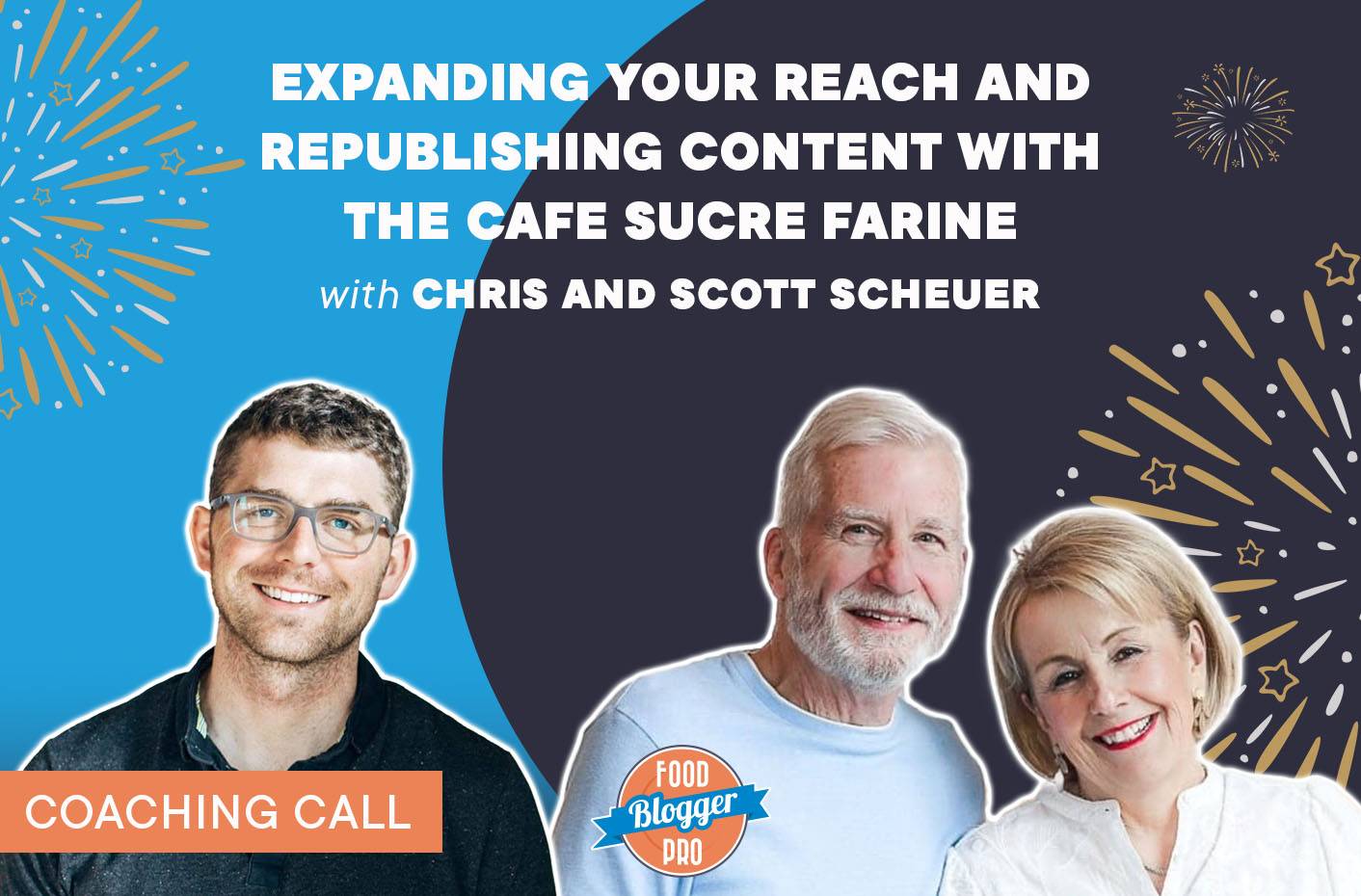
Welcome to episode 551 of The Food Blogger Pro Podcast! This week on the podcast, we’re sharing the replay of a Coaching Call that we released earlier this year with Chris and Scott Scheuer of The Cafe Sucre Farine.
Last week on the podcast, we revisited our Ask Bjork Anything Live Q&A that aired last December. To go back and listen to that episode, click here.
Coaching Call: Expanding Your Reach and Republishing Content with The Cafe Sucre Farine
In this Coaching Call, Bjork is joined by Chris and Scott, the husband-and-wife team behind The Cafe Sucre Farine, their daughter Cait, and daughter-in-law Lindsay! On their site (which they started 14 years ago!), they share food that tastes amazing and actually works in real life through easy, elegant recipes that bring people together and help build meaningful connections around the table.
Their goals for their blog include expanding their reach through social media and email marketing, introducing new team members to their audience, republishing and updating their arsenal of almost 2,000 (!!!) recipes, and figuring out how to prioritize their time.

Here’s a quick overview of the questions answered during the episode:
- Our audience has built a deep connection with Chris and Scott over the years. We want to expand our reach, but not at the expense of the community that has been there from the start. How do we introduce our audience to new team members without alienating them?
- We have close to 2,000 recipes on our blog and haven’t gone back to update or republish any of our content. Where do we start?!
- What are the pros and cons of hiring someone to go through and audit our content vs. doing it in-house?
- What questions do you have about email marketing?
- Between a site audit, republishing content, social media, email marketing, digital products… how do you decide how to prioritize your time?
- Which is better — roundup posts or emails?
- Can you explain the difference between updating a post and republishing a post?
- What’s the distinction between Author and About pages?
- Should we allow AI crawlers to access our site?
- Are Amazon links allowed in emails?
- How do we start and find mastermind groups?
Resources:
- The Cafe Sucre Farine
- Raptive (formerly AdThrive!)
- Dave Ramsey
- Clariti
- KeySearch
- Ahrefs
- Google Analytics
- Episode 518 of The Food Blogger Pro podcast: How Molly Thompson Grew Her Email List from 15K to 100K
- Grocers List
- ChatGPT
- Geniuslink
- Quiet Light
- Curbly
- InfluenceKit
- Rhodium
- Join the Food Blogger Pro Podcast Facebook Group
Thank you to our sponsors!
This episode is sponsored by Yoast and Raptive. Learn more about our sponsors at foodbloggerpro.com/sponsors.

Thanks to Yoast for sponsoring this episode!
Yoast just launched two updates that make it easier to understand how people discover and experience your brand online. Yoast AI Brand Insights, included with Yoast SEO AI+, now scans how your brand appears in both Perplexity and ChatGPT. That means food bloggers can see when they’re mentioned in AI-generated answers, track sentiment, and compare visibility to competitors.
Yoast has also added Site Kit by Google insights directly to the Yoast Dashboard for all Yoast SEO Premium users. You’ll get a quick view of your organic traffic, impressions, clicks, and bounce rates from Google Analytics and Search Console. Connect once, then use these insights—along with Yoast’s guidance—to spot opportunities and prioritize your SEO work.
Use code foodblogger10% at checkout for 10% off Yoast SEO Premium, Yoast WooCommerce, and Yoast SEO AI+ products.

Thanks to Raptive for sponsoring this episode!
Running a creator business is a constant balancing act between making great content, keeping up with platforms, and earning enough to keep doing what you love. That’s where Raptive comes in. They’re the team behind thousands of the internet’s top creators, and they help you tackle it all: growing your traffic, boosting your revenue, and protecting your content in an AI-driven world. Raptive offers tailored growth strategies covering SEO, email, and audience development.
Ready to level up? If your site gets at least 25,000 monthly pageviews, you can now apply to join their creator community by visiting raptive.com.
Interested in working with us too? Learn more about our sponsorship opportunities and how to get started here.
If you have any comments, questions, or suggestions for interviews, be sure to email them to [email protected].
Transcript (click to expand):
Disclaimer: This transcript was generated using AI.
Bjork Ostrom: If you’ve been listening to the podcast for a while, I’m always talking about how creators can better understand where traffic comes from and how people experience their brand. We’ve been talking about that a lot lately. Brand and the team at Yoast, which is the SEO plugin. Many of us, I would say most of us already use, actually just rolled out two updates that make those things so much easier. First, Yoast SEO Premium. So that’s one plugin. The Yoast SEO Premium plugin. It now brings Site Kit by Google Analytics right inside of Yoast. For those unfamiliar, Site Kit is Google’s official WordPress plugin for analytics and Search Console. And this integration makes your data, this is a wonderful word, simple. There’s no extra logins and no bouncing between dashboards. It’s just clean, actionable numbers, easily accessible, right within Yoast. So that’s the Yoast SEO premium plugin, wonderful plugin. It’s one that we use on all of our sites. But second, and also really important, is this concept of brand and specifically brand as it relates to AI. So, a new feature with the Yoast SEO AI Plus plugin. So this is a different plugin, is the Yoast AI brand insights. So this scans how your brand shows up in ChatGPT, and Perplexity. You can see where you’re mentioned in AI generated answers. You can track sentiment and also compare your site’s visibility with other publishers to better understand how AI interprets your brand. Wonderful updates and wonderful features in a set of plugins that are really powerful and are needed for us as publishers to both understand our traffic and our analytics and our numbers, but also understand some of these brand considerations on how our site is showing up in AI. So you can upgrade or download and get 10% off using Food Blogger Pro 10%. So that is one zero and the percent sign, and that’s to get 10% off of Yoast SEO Premium WooCommerce, SEO, for any of the e-commerce folks out there. And Yoast, SEO AI Plus plugins.
Ann Morrissey: Welcome back to another episode of the Food Blogger Pro podcast. I’m Ann from the Food Blogger Pro team, and in this episode we’re rewinding back to a Coaching Call that aired earlier this year with Chris and Scott Scheuer, the husband and wife team behind The Cafe Sucre Farine, their daughter Cait, and daughter-in-law Lindsay. You’ll hear them talk through the goals for their blog, which include expanding their reach through social media and email marketing, introducing new team members to their audience, republishing and updating their arsenal of almost 2000 recipes and figuring out how to prioritize their time. Before we dive in, we wanted to take the time to thank you all for being a part of the Food Blogger Pro community. We hope the upcoming year brings you new opportunities, exciting challenges, and more reasons to celebrate. And now, without further ado, I’ll let Bjork take it away for our final episode of the year.
Bjork Ostrom: Welcome to the Coaching Call. This is the first time, this is an honor. We have a team that we are able to talk to, and I think one of the great things about this is there are a lot of people within Food Blogger Pro who are interested in building a team and building a business and building a team, kind of those things together, working with other people on a project collectively, we oftentimes hear about this idea of the work that we’re doing is really lonely. And a good solve for that is figuring out how do you work with a team? You guys have done that. We’re going to dig into the team dynamics of it. But before we do, Scott and Chris, you can figure out who wants to take the lead on this, but tell us a little bit about your story and the background of how you guys got started.
Chris Scheuer: We started about the same time you did Bjork, about a year later in 2011. I came up to Scott one day and said, I’m just going back a little farther. I’ve always loved to cook. I was a nurse for 40 years, but my passion was cooking. So I would take food to the hospital, food to the neighbors, food to friends, and everyone always said, you should open a restaurant. And I would always say, that is the last thing on this earth I would ever want to do, because I always love to create new things, and I don’t go backwards very often, and it would be terrible for me to do the same thing over and over and over again. So anyways, I had been looking at some food blogs, and I think yours might’ve been one of them. And I said to Scott, oh, I think I’d really like to start a blog just to record my recipes because My kids or my friends would say, could you give me the recipe for that blah, blah, blah, blah, blah that you made last week? And I’d be like, I have no idea how to tell you how to make it because I’m now on to blah, blah, blah, blah, blah on the next thing. And I had absolutely no idea it could ever be a business. I just thought my mom, my friends, maybe family would look at it. And that was about it. And so I said to Scott, I think I’m going to start a food blog. I had no idea. I didn’t know a URL from an HTML, from a hole in the wall. And he was very busy with his work. And so I said, okay, I’m going to buy Blogging for Dummies. So I bought the book, went through it, most of it didn’t work, but when it did, I’d be like, yay, it worked. But Scott said, well, I’ve taught photography. I’ll take your pictures.
Bjork Ostrom: Cool.
Chris Scheuer: And so he knew nothing about food photography. I knew nothing about the internet world. And so we got started there, and then we just went along and I just did whatever we had for dinner that night or whatever I had in my mind and wrote really stupid things. Crazy. No one’s going to ever read this so I can write this. And then about a year and a half, Lindsay, would you say, or two years in, my daughter-in-law came to me and she said, oh, you have a lot of people looking at your blog. She said, why don’t you monetize it? And I said, well, what does that mean? And she said, well, I read some blogs and you can actually make some money on a blog. And I was like, you got to be kidding me. And so she kind of helped me get started, and I would get a check for 20 or $30 a month, and I was like, yes, I’d buy a new prop for the blog. And then we went on from there in 2015, we were at a conference and we met Andy from AdThrive. He was just getting started with AdThrive and we hooked up with him and it became friends, and we weren’t quite up to the page fuse yet that required at the time, it was like two 50, but it wasn’t long. And then we got into AdThrive and we’ve been with them ever since, and it’s just been kind of a crazy but fun ride.
Bjork Ostrom: Yeah, that’s awesome. It’s one of those things where sometimes that 20 or $30 is that proof of concept, and you can start to play the numbers game and you can start to see, okay, what if we made $60? And you’re like, wow, that’s really cool. We did it. What if we made a hundred dollars? And what if a hundred dollars was a thousand dollars? And I think for all of us out there looking to create something in the world, whether the number we’re using is money or visitors or impact in whatever it might be, there’s all different ways that we can track that. But if we can get that initial proof of concept, sometimes that’s enough to fuel us to the next step. And if you do that for 14 years like you’ve done, or that we’ve done those additional little incremental steps along the way, really add up and you can have what is now the case for you, which is a really beautiful, thriving business. Tell us a little bit about everybody’s role today within the company in the day-to-day and what that looks like and maybe what we can do, just a little one minute synopsis of what your role is, and then we can kind of go around the horn. Chris, you can start and then you can pass it off to whoever you want to pass it off to next, and then we’ll go from there.
Chris Scheuer: Okay. I am the recipe developer, chief cook and bottle washer, food styler, and that’s pretty much my end of it.
Bjork Ostrom: Cool. And then who do you want to pass it to? Scott? Scott?
Scott Scheuer: Sure. What I do basically is two ends of things. One is the photography, and the other part is the business end of things. I had a mantra way back 14 years ago, in order to make money, you’ve got to spend money. And so basically what we did, especially for the first five or six years was we just, anytime we made any money at all, we just simply turned it over or put it back into higher quality cameras or more props or things that Chris could use and stuff. And so that’s one of my hats. And then my other hat is pretty much the, it’s basically the business and the photography. Those are the two big things.
Bjork Ostrom: Awesome.
Cait Shores: Linds. Can, lemme see.
Bjork Ostrom: You got to pass it off.
Lindsay Scheuer: Can you hear me?
Bjork Ostrom: Yep.
Lindsay Scheuer: I have done a little bit of everything. When our daughter was born 12 years ago, Chris started giving me little tasks to do during nap time, but currently I answer and respond to comments, do roundup blog posts, and I’m making videos for the blog. And then my new thing that we’re working on now was figuring out email marketing, just diving into that
Bjork Ostrom: Great. Cait?
Cait Shores: And so I’m the newest member they had been saying for years, I’m Chris and Scott’s daughter. They’ve been saying for years, you should come work for us. And I like to cook, but I do not have a brain, my mom does. And so I was always confused as to what they were talking about. And then the stars kind of aligned in January towards the end of January, and I was like, I think I’m ready. I have no idea what it is that you want me to do, but
Bjork Ostrom: You’re willing to do it.
Cait Shores: Yes. And I’m the one who got us into this. I was like, I’ve just enjoyed this massive learning curve. Food Blogger Pro has been amazing and helping me learn about the various aspects of it. Yeah, so I’m just kind of along for the party at this point. My kind of strengths and background is just a lot of organization and strategy and that kind of thing, so that’s what I naturally bring. And so what I’ve been doing, but who knows, you might talk to me for a year from now and I’ll be doing something totally for them.
Bjork Ostrom: Yeah, probably the way that the internet moves and changes. Okay.
Chris Scheuer: I’ll say,
Bjork Ostrom: Yeah, go ahead.
Chris Scheuer: Cait sells herself a little short. She has revolutionized how we do things.
Bjork Ostrom: Cool.
Chris Scheuer: We call her the boss.
Bjork Ostrom: Yeah, it’s on her business card.
Chris Scheuer: Yes.
Scott Scheuer: Basically what you’re looking at is a company that is five bodies than one brain.
Bjork Ostrom: Sure. The interesting thing within it is there are multiple component parts of any team, any business. And what I’ve noticed is I’ve had conversations with lots of people through the years is we all have these things that we are good at, that we are interested in. And if you can bring those together and you can all work on the thing that you’re respectively interested in or even margin within our lives and within our own team as we’ve navigated family considerations. And Lindsay alluded to kind of starting early on when you had, was it your daughter? Yeah. We have a 4-year-old and a 6-year-old. And so there’s this constant state of flux and we’re kind of needing to reinvent every year, what does our focus look like? What does our schedule look like? What does our job description look like? And when you’re working with the team, if you can find the people who have the interest in a certain role, the margin within their day to address that, the skills and abilities to do it, and you can start to find the matches for those, that’s really great and can create a really cool cohesive team. And it’s really amazing to be able to do that with family also, potentially complicated sometimes as well, but Lindsay and I do it, it’s part of our day to day and it’s rewarding in that we have a never ending list of things that we can talk about and ideas that we can explore. So excited to talk to you all about some of the questions that you queued up. This does a really good job of filling out the picture for me. I would say the last question that I have for you before getting into these specific questions would be just to paint a picture at a high level around what success would look like for you if you kind of look ahead 3, 4, 5 years, and it’s different for everybody. All these conversations that we have, we’re all kind of working within the same field in the same medium. We’re creating videos, we’re creating content, we’re maybe developing recipes, but the outcome that we want from that is always very different. And so I’d be interested in hearing from you all as you reflect on what does success look like, not three months from now, there are some of those things that we’ll talk about, but more so 3, 4, 5 years from now.
Cait Shores: Cait, why don’t you start? I think we’ve alluded to it a little bit, but just to give anyone who’s watching or listening an idea. So it’s been my parents up until now and Lindsay has been doing whatever they needed and then now it sort of feels like this feels kind of like 2.0. And so I think as I look at what could potentially happen in 2.0, it sort of feels in a way the sky’s the limit, especially as we’re kind of at a point in their blogging life that we can add people to help us. And
Bjork Ostrom: You mean just from a resources perspective, you could afford to hire people?
Cait Shores: If we really recently looked into getting someone to help us think about how can we do the email piece better? And I think it was a couple of weeks ago, you said something about how oftentimes it’s good to be able to be the generalist and then pull in the specialists for these different areas. And so I think we all see that. And dad, he always says, you got to invest money to make money. And part of our future. I think as far as goals go, and Mommy, you can speak to this more than I can. I think it’s just really growing the social media piece. We over the next year, hopefully going to grow our email list more intentionally. Really at the end of the day, it’s providing people with things that can help them in their daily life. That is, whether it’s how to bake bread better or how to make a salad that doesn’t bore you to tears. I think that’s really the bigger goal. All of this feels like icing on the cake at this point because they never planned to do this. We never planned to do this, and here we are. I think we all look at it like that.
Bjork Ostrom: And that’s super helpful context. Chris and Scott, on your end, do you view this as like, Hey, how you’re working within the business right now is how you want to continue to work within the business? Or do you like the idea of moving more into almost like a owner seat where maybe you’re less of an operator within it and you have a monthly call with Cait and Lindsay and maybe other leaders within the business and look at the day to day, or would you say, Hey, it’s actually really great right now in terms of how much work it is for you and what you want that to look like moving forward?
Chris Scheuer: I think right now it looks really good. We’re both 73 and so we know that this isn’t going to last forever.
Chris Scheuer: We had wondered
Bjork Ostrom: My mom just celebrated her 71st birthday yesterday. So
Chris Scheuer: Yeah, we’ve had a wonderful, wonderful time doing it. And I mean, I still am so full of ideas. I have too many ideas of new recipes and just things
Scott Scheuer: I’ll attest to that
Chris Scheuer: Things to create. It’s a problem to have. It’s not like I’m running out of juice, but I do find it everything takes a lot longer and I’m not sure if that’s because of age or because now everything just has to be done better like the post.
Bjork Ostrom: Yeah, I think that’s what it is. I don’t think it’s because of your age. I think stuff just has to take longer because it has to be better than it was five years ago or 10 years ago. It’s true for us as well.
Chris Scheuer: And just all of the, even writing a post now, it’s much more labor intense than it ever was before. But it’s good. I mean, I’ve never been, you’ll laugh at this. Cait asked me when she started doing research, she said, well, what SEO tool do you use? And I said, I’ve never done keyword research in my life. I’m learning to.
Bjork Ostrom: Yeah. Well it isn’t bad. Yeah. I mean we do a little more it now, but we are not keyword research people. Well, that makes
Chris Scheuer: Me feel a lot better.
Bjork Ostrom: Yeah, part of it is, my guess is if you started to create content that was based on keyword research that suddenly your job would become less appealing. Part of what you’re like a creator, you’re an artist, and the more constrained that would be, the less enjoyable your job would be. And so you can still create inspired content is what we would call it, as opposed to researched content. It’s just the discoverability of that is maybe going to come more through social or your existing audience as opposed to a high match, high volume keyword. And you’ll probably hit upon those. You probably have.
Bjork Ostrom: But it’s not because you researched them and saw it as an opportunity. It’s because you wanted to create the recipe. You created that recipe, it was good. And then so people made it, shared it, had success with it. So great. That’s helpful context. Let’s jump into some of these questions here. I’ll read through these and then you can add any additional items on your end. So the first one, you just talk about being in a transitional phase, moving from the original creator-led model, where it’s Chris and Scott, to a team approach that now includes Cait and Lindsay. You said your audience skews older and has developed a deeper connection with Chris and Scott over the years, which is something that’s also created unique opportunities with partners like iv, which is cool. And then our goal is to expand our reach and grow the blog, but not at the expense of loyal community members from the start. What’s the best way to introduce new team members to, oops, and I just lost it here. Introduce new team members to the writers. Is that right? Essentially the audience to new team members.
Chris Scheuer: Yes. Yes.
Bjork Ostrom: Let me pull that up again. And that’s the right updated questions, right? We had talked through. Okay, cool. Any additional context that you’d give for that or is that up
Chris Scheuer: Until pretty
Bjork Ostrom: Well?
Chris Scheuer: Yeah, up until now, Cait has just kind of come on and we’ve been talking about maybe just introducing more of the team. I mean, I talk about Lindsay in my posts. I talk about Lindsay answering comments and that kind of thing. But we have just come together and met and just decided it would be great to actually have the readers know the whole team and they’ll be doing more and more things in the future. So we were just trying to exactly see what would be the best way to do that.
Bjork Ostrom: Sure. And would you Cait be publishing content or is it just like you would be showing up or Lindsay, obviously you’re showing up as you interact.
Cait Shores: I think in a way, I think what we’re thinking about it or how we’re thinking about it is that we just kind of want to broaden the scope a little bit. Obviously still recipe creation and all of that kind of thing, but also looking at, I mean you can see this kitchen behind them, they designed that just giving some behind the scenes looks at things and kind of getting to know mostly them, but then us also dipping in and out of there. I guess I foresee that maybe in some email newsletter style type things and an occasional recipe or through social. It might be occasional recipe, but it more just kind of getting to know as we’re realizing with ai, we need to be a little bit more front and center as the people behind the blog. How do we do that? Because it’s been a fairly, other than moms very personable writing a fairly formal interaction with readers. So we want to be able to do that well. But it is, I mean we’ve realized, my husband’s in finance and so as he’s kind of run some numbers, he’s like, there’s something special about your readership that wrapped appetizers are,
Bjork Ostrom: Yeah, people coming back. There’s probably certain disposable income that would be available within a reader group as well.
Cait Shores: See. I think it also just might be you don’t have many bloggers that are in their seventies and I think people really enjoy reading about people in their kind of general age bracket. And so that’s also
Bjork Ostrom: Totally
Cait Shores: A unique piece.
Bjork Ostrom: Yep, for sure. Is there something that you are fearful of with it or is it more of the opportunity, I’m trying to understand a better, yeah. Is it more of defense around how do we not screw something up or is it more like how do we fully take advantage of the opportunity?
Cait Shores: I think what you would say, what you guys would say is it’s probably that we don’t want to screw something up because I came on, I mean for years they’ve been saying, we want you, we’d love you to come, we’d love you to come work. And then as I got into it, I was all of a sudden I realized, oh, they’re really not doing much of anything on social media or SEO or keyword research or any of these other things. It kind of in a way feels like they have built this amazing thing just by doing what they love, which is awesome. And I think that comes across in the readership, but also so we lose sound. Also use it so much that we kind of break it.
Bjork Ostrom: Yeah, that’s great. And Scott, can you still hear okay, did it cut out a little bit or are you back? Yeah, it just fine.
Scott Scheuer: It popped out but it’s back again.
Bjork Ostrom: Oh, go ahead Scott. You can fill that out. Go ahead.
Scott Scheuer: I think the whole thing is just that as we added, Lindsay’s been with us for almost 10 years now, but Cait coming on and us just looking at this team, the whole team aspect it, we were kind of monochromatic in the way that we approached the blog. It was the income. We did stuff for KitchenAid and for other companies at the very forefront 14 years ago. And we tried that whole route and stuff. And it basically came down to the point that Chris really enjoys the creative aspect of putting recipes together. That’s the one thing that just fires her up every morning she comes down here and she’s singing in the kitchen, humming, humming a tune. And that’s, and what we realized was with looking at the future of blogging and looking at the future of online businesses, we had to widen it out and that’s the reason for Lindsay and for Cait, for us to just open this up and begin to widen this out so that we have diversified our portfolio basically.
Bjork Ostrom: Yeah, widening it out, meaning other platforms, not
Scott Scheuer: Just the blog. Yes. As opposed to just advertising that RIV check and that ad that Amazon check every month, we just realized that if it’s going to continue, host us, even if it’s going to continue, it’s going to have to look different and it’s going to have to reach people in different ways that we haven’t done before.
Bjork Ostrom: And I think the other piece maybe as the last consideration within it, it’s kind of a different version of what you’re saying is just discoverability is going to change. There’s just search on Google just for the first time dropped below 90% in terms of ownership of search on the web. There’s an entire generation of people who are leading their searches on social media platforms. I was talking to my brother-in-law and I was like, you got to get a Roth IRA set up. And he is like, oh, I know what a Roth IRA is. I was like, you do? He’s like, yeah. I was like TikTok finance. I was like, okay, that’s how you’re learning about Roth IRAs. He’s not reading articles, but there’s a TikTok influencer. And so The two ways that I could view the transitional phase piece, it’s almost like there’s the transition with introducing new characters within the cast. So there’s that and there’s also the transition into, it’s almost like an evolution. It’s showing up on other platforms. I think the introducing other voices, I think the risk of doing that is really low, the more transactional it is. So somebody has to send an email, and they have a question as to what’s most important in that instance, unless it’s something like personality-driven meaning, Hey, I’ve been following you for 10 years, what you’ve done is super meaningful. It’s helped me cook more in the kitchen. Our family’s different because of it. I think there’s a certain level of, if it’s you, Scott or Chris responding to that as more meaningful, but any type of transactional email, Hey, can I use butter instead of flour? No, you can’t use butter instead of flour. That’s just not an ingredient swap that can happen, but people might ask it. That type of information I think is, we all know that’s low risk. And what’s most important with that is just like, are you getting back to somebody quickly? Quickly? Is it the correct answer? That type of transactional information, I think as much as possible, if you can audit everything that you’re doing and lift all of the burden of anything that’s not personality driven off of you, Chris or you Scott, and so the majority of the things that you’re doing are the highest and best use value in our world. The Chris and the Scott is Lindsay, and so Lindsay’s in very few meetings, she’s not on calls with brands. We have an executive assistant that checks her email every morning and is monitoring her email where she’s showing up is on Instagram. She’s occasionally interacting with people in dms, she’s developing recipes, she’s doing Instagram stories even within the video shoots. She’s not the one editing them, but she’s being recorded. And so one thing that might be interesting, if we’re looking at the category of transition, which is the transition to the personality component, it’s like how do you remove as much of this stuff that’s not Chris and Scott showing up on the internet as possible to allow you to be the ones who are, it’s your personality, it’s you showing up online and to alleviate for the team to alleviate the burden of all of the one-to-one interactions that are happening. My guess is you’ve kind of already done that. You’ve thought about that a little bit. Some of that’s already been done. The transition around introducing a new team member who would suddenly be showing up on Instagram, who would be showing up on a blog post, that to me feels like something that you’d want to be slower with and be more considerate around and also have a story that’s attached to it to allow you to understand for the audience, to understand what’s happening. Because I do think within any personality driven business, which is what I hear you talking to Cait a little bit, it’s like it’s not just a business. What makes it unique is Chris and Scott, and it’s the fact that you are showing up, you are creating the content, people are following you. And to paint it extreme picture, if suddenly I published a post on it, it’d be like, oh, that’s not value add. That’s subtractive to have me publishing a post on it.
Chris Scheuer: It may be the best thing ever.
Bjork Ostrom: Well, maybe it is. Maybe that’s the outcome of this conversation is a new business partnership. But to your point, Cait, what I heard you saying a little bit was part of the value is Cait, is Chris and Scott as a married couple creating beautiful content in their seventies and showing up on the internet in a really unique way that you’re not seeing a lot. And what I heard you saying also, and you can tell me if this is correct, is you are pondering a little bit, does it create a different vibe if suddenly you are publishing content alongside that? Am I accurate in kind of soundboarding that?
Cait Shores: I think that’s definitely been the thought that is being pondered along, but also as I’m listening to you talk, I’m like, well, I mean yes, that is what we want to preserve. But also the reality is in another five years they might be like, you know what? We’re really tired now.
Cait Shores: And I just want to come up with a recipe and we’ll have recipe testers testing her recipes. And I think the goal over the next five years or however long they want to do this, I don’t exactly know what that runway looks like. They’re super healthy and take great care of themselves is to allow them to pull back as they want to. And so being in this transition period just looks like continuing to put them forward and letting them be the face of the blog, but also as you said, slowly bringing Lindsay and I more to the forefront so that when they’re ready to pull back in various areas, it doesn’t feel coming off a cliff. And
Scott Scheuer: The one thing I think that’s unique Bjork here is if we were a traditional food blog and we added new employees, then there is a big introduction part that has to go on and stuff like that because to be able to connect that new employee to this already existing entity, I think one of the things that I think we should leverage is the fact that these people are our people, that they’re part of the family, which kind of creates a family atmosphere. And our blog has always been family related, it’s been church related kind of family ties and stuff, and Chris’s stories always tie in our family, and so now our listeners and our viewers are getting a chance to actually see the family. So if we approach it from that angle, I think we have a good chance of making that transition period a little bit easier than the average blog would.
Bjork Ostrom: Yeah, I think family dynamic is huge. Even in my conversation coming in, it’s like, okay, let’s figure out who is everybody, okay, Lindsay sister-in-law, Cait daughter, like, okay, I can see this being a cohesive thing now where it’s easier to tell that story. I think part of it is picking the story and the path that you want to take and then saying, okay, how do we best communicate this moving forward? Because another path you could take is you could say, this is just speaking super generically, but if you feel like, Hey, we’ve surveyed our audience. The demographic that we are speaking to is people in their sixties and seventies who are in a stage where they are excited to make recipes to host, get togethers to host their family. That is the mindset of your audience and therefore that is the brand that you have. One of the paths forward could be figuring out how to preserve that as the brand. That’s one path. The other path could be this is a family business. What we talk about is our family, and that’s the personality element of it, knowing that there might be a little bit of a reinvention of who you are speaking to.
Chris Scheuer: I like that. I like that.
Bjork Ostrom: And I think in that path you are kind of letting go of trying to hold onto and preserve the audience in the exact state that it is. You just know that there
Chris Scheuer: Just maybe broadening it,
Bjork Ostrom: You’ll broaden it. Yeah, for sure. And it seems like that would be the ideal path given the path of family and working as a family, family voices, things like that, as opposed to saying, Hey, we want to have the mindset of understanding our audience, what the audience’s problems and needs are and creating a brand around those needs regardless of who the authors might be or the creators. Does that feel accurate? Does that question make sense?
Chris Scheuer: Yes.
Bjork Ostrom: Before we continue, let’s take a moment to hear from our sponsors. Running your business can feel like a constant balancing act between making great content, keeping up with platforms, and actually earning enough to keep doing what you love. That’s where Raptive comes in. They’re the team behind thousands of the Internet’s top creators, including Pinch of Yum, and they help creators grow their traffic, boost their revenue, and protect their content. In an AI-driven world, Raptive creates tailored growth strategies, helping with SEO, email, and audience development. They’re serious about supporting real human-made content. And now it’s easier than ever to join. If your site gets at least 25,000 monthly page views, you can apply to become part of Raptive’s creator community and get the kind of support that scales as your business grows to learn more or apply visit raptive.com. Thanks again to Raptive for sponsoring this episode, this, and so I think if you are picking the path of this is going to be a family business and the creators that are creating on this site are family, then you just decide, and there’re going to be some downsides with that. There’s no way to have it be the same version of what it is today, 10 years from now without letting go of some of the things that are true today that just won’t be true as time moves forward. But also there’ll be some really great things, some upsides with it. And you see that with a lot of the one that I think of is there’s a finance guy, Dave Ramsey, could potentially be polarizing depending on finances in the world, but you’re starting to see that within his business right now where there’s other personalities that are coming in, one of which is his daughter who is very different than who he is in terms of how she creates content. And so She’s not going to be talking to probably as many truck drivers as Dave Ramsey did, but she’ll still have an audience. And so I think very different industry, but I think there are some similarities in your world that will exist as you think about your path forward. And it’s not like none of it feels like it’s near future, but it’s probably stuff that’s helpful to start to slowly work towards. My question for you would be how do you imagine that first showing up? In what ways would you, Cait or Lindsay, I know Lindsay already kind of on the site in some ways. Can you see the step one of how that would evolve?
Chris Scheuer: That’s a good question. Well, I think we’ve, we’ve started it, I mean just like we did a Mother’s Day gift guide and I did a picture of Cait and Lindsay and said, this is my daughter and daughter-in-law and I’m going to have five picks and each one of them is going to have five things just to start introducing that. But we’ve also talked about just doing an email and just talking about Cait joining the team and what her roles are and that type of thing.
Bjork Ostrom: Yep.
Cait Shores: Yeah, we talked about almost doing a new chapter kind of email with where it links to our about pages for both of us. And so to me, I guess it’s either that super slow organic rollout of we’re just kind of included and it just ebbs and flows or it’s like this, Hey, this is kind of where we’re going. This is the team, and then start moving that direction. So I don’t know which is better or if that is better than the other, but yeah.
Bjork Ostrom: Yep. I think the hardest spots to do it would be when it’s a replacement. Chris used to be doing this and now she’s no longer doing it. Not that it’s bad, but I just think that’s where it would be felt the most. I think if it’s additive, like, hey we weren’t really doing emails and now we are and they’re coming from Lindsay, that to me feels there’s not going to be a revolt around that. It’s like, oh, this is a thing that we previously didn’t have now that we do have. And that’s great. I think
Scott Scheuer: That’s a point, actually,
Bjork Ostrom: I think maybe the easiest place to look if I had coming out of this question, if I had to pinpoint two things, it would be how do you remove all of the different things for you Chris and you Scott, that are around the work that you’re doing that are either stuff you don’t want to be doing or transactional or process components that have to be done in order for content to be published. How do you get somebody else to be doing those? So the only things that you are doing are the content creation things that you want to be doing. So that would be one. And then the other piece would be just have the introduction for you Cait or you Lindsay, be additive introductions, things that previously weren’t happening that now can be happening.
Chris Scheuer: I like that
Bjork Ostrom: On social email, even on the site itself. Maybe it’s a named series or a roundup or something that previously wasn’t happening that now can be, and I don’t think that you would feel a huge pushback from that.
Scott Scheuer: Lindsay. Lindsay, just as a point of information, she has been doing roundups for us, Linds, two times a week for the last How long? Five years?
Lindsay Scheuer: Five years.
Scott Scheuer: Years, yeah, at least. But
Lindsay Scheuer: I did the idea where you said to call it something or because I’m just kind of writing in Chris’s voice right now and it’s not necessarily obvious that it’s me doing it, but maybe it’s family favorite recipes or something and I don’t know,
Bjork Ostrom: It could be under the umbrella, but it would be its own brand that would exist under, it could be on the social channels, it could be on the site, which I think helps it set apart a little bit so people aren’t confused as much, but it would still be somebody else creating content to move things forward.
Chris Scheuer: Great. We had even talked a little bit about possibly Cait and Lindsay doing something on social media teasing like little reels that would tease for the recipe that’s coming up next week. And so that would be a way again, to introduce them. My mom’s created this recipe, we’ve been testing it and here’s a little teaser.
Bjork Ostrom: And I would say it could even be one angle you could look at it is like, Ooh, is this going to impact things or people not going to like the idea of somebody new showing up. I think because of some of the family connections, it could actually be like, oh, this is intriguing. These are new people, but it’s not like a virtual assistant. It’s like, this is Cait, their daughter. That to me, there’s some intrigue, novelty, I think for people that would draw people in as opposed to it feeling like an outsourced thing that can sometimes happen if it’s somebody completely disconnected. So I think it could be a beneficial thing as well.
Cait Shores: Yeah, I like the differentiating which brand, which path we want to take. That’s helpful.
Bjork Ostrom: Cool. Let’s talk through question number two here. Just talking about prioritizing different areas that you want to double down on. So I’ll read the question in entirety. How do we best approach the areas we’re wanting to double down on now that we have a team approach and more time, you talk about an audit, email strategy, affiliate links, hiring out versus doing in source a lot of content that you could be thinking about auditing old content, hurting from an SEO perspective. Anything that you would surface out of that list of questions, maybe we could hit three of those that feel like the most sticky right now.
Chris Scheuer: Just maybe a little bit of background. So we have close to 2000 recipes on the site, and this is bad, but I have never updated anything. I just have gone forward.
Bjork Ostrom: You’re a creator, it’s what
Chris Scheuer: You’re doing, but there’s a lot of stuff that, I mean most of it has recipe cards, but even some of it going way back doesn’t even have a recipe card or keyword or anything like that. And so where do we start with that Cards? I know that
Bjork Ostrom: Adding a recipe card would be my answer, adding a recipe card to the recipe.
Chris Scheuer: Of ’em do have that, but I mean where do we even start to filter through that? And we looked at clarity and we were really interested in if you could explain a little bit more of that, how that works.
Bjork Ostrom: So I could give you a specific use case of how you could use a couple tools To really quickly potentially see some traction. So within a keyword research tool, Keysearch, Ahrefs, SEMrush, we use Ahrefs, you can go in, it brings in all of your content and what Ahrefs does is it crawls the web in a similar way that Google does. So it has an understanding of the content that’s on the web, but it also has an understanding of generally where is stuff showing up on a search page. And what you can look for when you are doing within one of these tools is you can say, show me any of my content that is in keyword position, meaning where it’s showing up in the search result page in keyword position five to 10, and then you can reverse chronological order or chronological order that based on search volume. So now what you have is you have a list of all the content on your site that is in position like five to 10, I forget what the default numbers are that they use for that. And then you are seeing the ones that have the most potential search volume that are in those positions, five to 10. What that’s telling you is it’s a little bit of an indicator of here’s some opportunities if you improve this piece of content to show up higher in a search result. And so you could take from that, those 30 the posts or 10 to make it easy, the top 10 posts within clarity if you were using that as a tool. But there’s a lot of other tools you could use within Clariti. You could create a project that would have those 10 posts and you could, as a creator and as somebody who’s an artist who has opinions on what a good piece of content is, you can look at that and say as an artist, plus as somebody, and maybe this would be you, Cait, Chris, and Scott, you probably know as well, technical SEO considerations. So what are the technical SEO best practices? And as an artist, what do I feel like would improve this piece of content? You go through the process of looking at those 10 posts and saying, how do we make this better? And then you put on your marketer hat and say, as publishers, how do we market this piece of content? To me that would be how I would approach it, and you can kind of repeat that. And so your process is analyzing where the opportunities, it’s spinning up a project. It could be a spreadsheet, it could be Clariti. We use Clariti because we were using a spreadsheet and we felt like it was easier to do within Clariti. So then now you have a project, you know what you’re going to do with those pieces of content, how you’re going to improve, and then you market them and you’re marketing them via email, via social media. You’re marketing them on your website. So that’s a simple three-step approach that I would take when you’re looking at older content that you’re wanting to improve and a lot of times the greatest return on your time from a traffic standpoint, you might not enjoy it as much. Chris being a creator, going back to these old pieces of content when you have a hundred that you want to create that you don’t have time for. But from a revenue traffic standpoint, a lot of times the greatest return is on improving something that’s right on the cusp of high discoverability on a platform like Google or that is an awesome recipe that you just haven’t marketed a lot to your existing audience. I think that’s the other piece. So
Chris Scheuer: You’re saying don’t worry too much about that old stuff that’s just sitting there, that really is maybe on page 29 of Google?
Bjork Ostrom: No, I would as well think about that. So this was just one, this would just be like if you were looking to gain more traffic, I would say if you we’re doing this on a monthly basis with Pinch of Yum, we’re like, Hey, that post that Lindsay wrote about the Hot Dog Cafe when she was a fourth grade teacher is meaningful for us, but nobody’s looking at it. And so what we’ll do is we will just unpublish it. So it actually still exists within our WordPress database, but it’s not on the site and it’s a little bit of site hygiene. So if you have something that’s not getting any traffic, it’s
Chris Scheuer: Not would for people that would show us in Clariti, that would show us or where would we be?
Bjork Ostrom: Yeah, Clariti or Google Analytics. So Clariti brings in Google Analytics data, Google Search Console data, and WordPress data, and it makes it really easy to sort through that and to create a project based on that data. So an example of how you would do that within inclarity is you would sync everything up and then you would look at the pieces of content over the past year, you’d look at page views and you’d reverse chronological this time, so you’d see like, oh, actually this piece of content has 11 page views over the last year. You’re not super attached to it. You don’t want to revisit it and republish it, and so what you would do is you would just either delete or you would unpublish it, deleting meaning it removes it from the database on publishing it, meaning it’s in your database, but it’s not user facing and it’s just best practice for content because it’s something you wouldn’t be necessarily proud of if somebody came across it. It’s almost like I envision if you have a store and you have a storefront and what you’re doing is you’re selling, it’s like a boutique shop let’s say, and it’s a clothing store and you walk in and there’s something that’s a little bit dusty from five years ago, it kind of impacts the overall feeling of the shop itself. And so there’s always this curation that I think can be happening. There’s also the general belief within the world of search is that you have these bots and these spiders that are coming and crawling your site. You don’t want them to be crawling content that you don’t want to be discoverable or to be considered significant. So I do think that it’s smart to remove older content that you wouldn’t publish today or want on your site.
Cait Shores: Sense to my question about hiring out versus doing in-house. I think because we are kind at the beginning of this 2.0 stage, it feels like there’s so much to do. That’s where I’m thinking about 2000 posts, and
Bjork Ostrom: I would say it’s
Cait Shores: If that’s something that we might need to be hiring out, where do you
Bjork Ostrom: I think the risk would be if you hire out, somebody’s going to come in without the 14 years of context that you have around the content, and I think there is some inherent risk in somebody who doesn’t have the mindset or the historical knowledge or kind of the care and consideration around the content. For us, the approach that we’ve taken is we partner with people who advise, but we’re not partnering with people who are doing the actionable step on publishing or deleting. We’re making the ultimate decision on it, and we just know that it takes longer. There’s a lot of stuff that we could be making quicker progress on if just somebody else was coming in and doing it, but just our preference being a personality driven site and being okay moving slower is we want to get expert opinions, but we don’t want to have somebody who is outside of our day-to-day coming in and making decisions on content being changed, content being deleted, but we’ll get advice on it. And you guys are with Raptive, is that right?
Chris Scheuer: Yes.
Bjork Ostrom: Yeah. I can send an email to our contact or you guys probably work with somebody too. They have some resources to partner with sites to help advise on some of this decision-making, and I don’t know.
Chris Scheuer: I actually just got an email from them today about them helping us with seo, so we’re going to have a call coming up with them.
Bjork Ostrom: Great. Yeah, that’s the type of stuff where they’ll be able to produce a list and there’ll be some tools internally that will help you understand, well, that’ll help shape your opinion on what you would do, remove or not remove. Sure. I would say there’s going to be people who approach it scientifically, but that’s not what this is. It’s not like pure science what you’re doing. It’s also art, and so it’s the marrying of those two things that I think is most important to have educated, helpful information, but then for you to be the ultimate decision maker on the portfolio and canvas that is your site and your content.
Chris Scheuer: That makes sense.
Bjork Ostrom: Is there anything within email that would be helpful to talk through? Because I know that was one of the things you had talked about as well.
Lindsay Scheuer: We’re actually just starting work with Allea at Duett about email marketing.
Bjork Ostrom: Okay, perfect.
Chris Scheuer: Up until now, Bjork, all I’ve done is send out my RSS feed, and we’ve realized that we need to do a lot more than that.
Bjork Ostrom: So
Chris Scheuer: We’re excited about that.
Bjork Ostrom: Yep. The great thing about email is that it’s going to earn more like you maybe see that within the Raptive dashboard or hear people talk about that, especially as they get better at first party data and tracking it is just more advantageous to have email. The other piece is, I just had the interview that I did with Molly from What Molly made. She talked openly about from her site, she’s making 15 to 20,000 just from email traffic, and she’s sending out two to three emails a week. She has a process for it. She has onboarding emails that she sends out, and she’s getting email subscribers from social. She’s using the tool called Grocers List where people will comment, that comment will send a dm. The DM will either allow people to click to go to the site or to sign up for the email list.
Chris Scheuer: Oh, that’s awesome.
Bjork Ostrom: And she has some great strategies that she talks about, so that’d be a good podcast to listen to. And the consistency of email versus a Google algorithm update where if your top three search posts drop out of the rankings, that could be really significant revenue impact. There are those things that can happen with email, but generally speaking, you can consistently send three emails a week and you know that if you get 400,000 people from that this month, there’s a really good chance you’ll get 400,000 people next month from that email list.
Scott Scheuer: So, more stable.
Bjork Ostrom: Totally. Yep. So super smart to be thinking about that, and I think you guys will find success with it as you get into it, which is cool. The biggest thing is just figuring out what the resource is that initially gets people onto your list. The thing that Molly talked about in the interview is she surveys her audience, so she gets an idea of what the problems are from that audience and the way that she does that. She has a survey, you could use Google Forms. She takes that, and then she puts it into ChatGPT and asks, Give me a synopsis of the five problems that people are most consistently talking about experiencing. So then she has an idea from her audience, here are the problems that they’re having, and then on social, she’s creating content specific around those problems and then creating a resource to help people with that problem. Hey, if you’re struggling to figure out what to get on the table for Thanksgiving dinner and you’re hosting your family of over 10 or more, I’m going to help you understand how to do it without a huge amount of stress. And so there’s this PDF that gets people to join the email list. The other thing that’s really nice about some of that stuff is it allows you, Scott or Chris wouldn’t necessarily have to be the ones doing all of that. You can remix the content that you already have. It’s kind of like you’re writing the songs, Chris, and one of the opportunities is to create the playlists from the songs that you’ve written. The playlists are also valuable, but you don’t have to create the playlists. It’s just like, Hey, here’s the greatest Thanksgiving hits. Okay, great. You’re not having to rewrite those just already exist. It’s just packaging them and offering them. That’s the valuable thing. Anything else around the prioritization with the team stuff? I have time here if you guys are good to keep going.
Chris Scheuer: I think we’re good.
Bjork Ostrom: Cool. Cait, you look like you’re kind of pondering or you’re looking
Cait Shores: Ahead. I was just rereading the question to see if we had left anything out. I think that was it. It really, I’ve got a call next week with the person who’s been helping out with social media that has been very basic because they didn’t have the bandwidth to be able to give them what they need. I think I wish I’d already had that conversation. I feel like I could talk to it. It’s a little bit more but yeah, no, I think, I guess really just in terms of prioritization, when you’re thinking about audit, email, social, creating digital product, how do you think about, what do you do first when you haven’t been doing with any of that?
Bjork Ostrom: Oh man. I mean for us it’s imperfect. It’s like you hear a podcast or read an article and you’re like, oh, maybe we should do this, and then you do it and it’s maybe not the best use of your time. I don’t know. I don’t, I don’t have a great answer on the best way to make sure you’re working on the thing that is the greatest return. What I would say is the best use of your time is going to be around the things that you are most likely to do. So If you find yourself gravitating towards SEO because you really love keyword research and you want to learn more about that, that probably is an indicator of that being a good use of your time to figure out how to get better at that, or email marketing or short form video as an example. And this is for all of you individually. I think what you naturally gravitate towards is going to be, as long as it’s within the context of valuable things within the business, that’s probably going to be the best use of your time. And so we’ve been very comfortable with what we do, leaving a lot of opportunity on the table and just sticking to the things that we feel like there’s value there, but also that we aren’t naturally gravitate towards. But it’s sometimes kind of painful to know like, oh gosh, this is a really valuable thing that could be happening and that you could do happen. There’s other people who are having a lot of success with it and just being like, we’re good. Or you could hire for it. You could build a team. That’s another path. But I think part of what we’re always having to do is just being comfortable not doing things. But I think the path that you guys have, Yeah, path that you guys have generally feels like you are thinking about it, right? I think if I were to remove all the considerations around what I know about you and I would just say with any business, what would you be focusing on? I would say the things that you’re focusing on makes sense. Email, like building your email list, figuring out how to send consistently and how to send valuable content. I would say maybe the opportunity that doesn’t exist or it does exist, but there’s the most that can be made up is just discoverability on social platforms, like short form video and short form video with a specific call to action. It’s maybe to a post or signing up for a thing, or it’s almost like the marketing component of the recipes that are being created and that being email and social media as the channels that I think could have the strongest marketing for you moving forward.
Chris Scheuer: One last thing that we didn’t talk about that we were just unsure about was up until now, we’ve been doing roundup posts for twice a week to kind of pull up the old content, and it seems like most people now are doing Roundup emails. Can you kind of explain which is better? It seems to me like maybe we’re weighing down the site with these roundup posts rather than doing it via email.
Bjork Ostrom: I would say my quick opinion, not gospel truth by any means would be your time from a roundup perspective would probably be better served creating really strong category pages as opposed to roundups. And so it’s like a page versus a post within WordPress. A page would be something that would continue to exist, you’d continue to add to it. You’d have sections and maybe subsections and it, I think roundups would be, are helpful within the context of a certain need. Thanksgiving is coming up, it’s Christmas Super Bowl, but I would ask the question, what is the roundup solving for the reader for the,
Chris Scheuer: We’ve been doing that, we actually work it around the seasonal holidays or whatever people need, but I guess my question is, is it better to do that in an email versus a host?
Bjork Ostrom: Sure.
Chris Scheuer: I noticed Lindsay does email kind of little roundup things where she’ll share.
Bjork Ostrom: Yeah. I don’t know if one is better than the other. I think it’s just the context within what you’re doing it. If you said to me, we’re going to do these twice a week regardless what’s going to be better? I would say email. And the reason that I would say email is because I think unless there’s something really differentiating about a roundup post that it could potentially be something that people wouldn’t as spend as much time with as opposed to a new recipe. Unless it’s something specific like, Hey, this thing is coming up. Here’s some considerations you could have around, again, Thanksgiving or whatever. But I would say if you are publishing those to your site and you’re wanting to have a cadence around new content, personally, I would say if I had to place a bet and the bet was five years out, what would be most impactful? I think it would be more impactful to take time that you are currently spending on Roundups and dedicate that time as improving preexisting content that has the opportunity to go from good to great, and then to have roundups be dedicated to emails. And so on your site, the rhythm is around new content republished, improved piece of content.
Chris Scheuer: That brings up one other question. Republishing versus updating.
Bjork Ostrom: Sure. Yep. I think the one thing that would be worth considering within republishing is there’s no, within the world of search, there’s opinions and one of the opinions on republishing is to be cautious around a changing the publish date of a piece of content. So as not to try and trick Google, to think something that’s actually an old piece of content is new, unless you’ve done so much to that piece of content that it essentially is new. And so there’s a plugin that you can install, which if you are going in and updating a piece of content, number one, you can check it and say, don’t change the date modified. There’s two dates within WordPress. There’s the published date and the date modified. And so you can say, don’t change the date modified if it’s a really small a spelling error or something. And then if you are,
Chris Scheuer: And what is that plugin?
Bjork Ostrom: I forget the name of it. You could follow up. Yeah, I can check it,
Cait Shores: Have a
Bjork Ostrom: Post it the forum or say it again.
Cait Shores: Okay. Mom, don’t you have one that does that?
Bjork Ostrom: You did, yeah.
Cait Shores: Or maybe we just talked about it. We could have just, we talked about it. Yeah.
Bjork Ostrom: Okay. If you are wanting something to show up on the top of your blog role, the idea is you should probably do that from a development perspective, not from a changing the date of the original post. Again, unless it’s so new in how you’ve created the content that you’d consider it a new piece of content.
Chris Scheuer: But you wouldn’t change the URL?
Bjork Ostrom: I wouldn’t change the URL. No.
Chris Scheuer: Okay.
Bjork Ostrom: It’d be important not to change the URL. One of the things we have done with Pinch of Yum is we have two pieces of content, carrot cake cupcakes. We had an older one that wasn’t as great as well, and then we had a newer one, so we redirect the old one into the new one. But we’re careful to, we’re really careful whenever we’re changing a URL just because of, as good as Google says that it is with redirects and whatnot, there’s always some impact that happens. Cool. Are we good?
Chris Scheuer: Yeah. Alright. Thank you so much.
Bjork Ostrom: This is great. Let’s hit some of these last kind of practical and technical questions as kind of rapid fire at the end. Okay, great. Just to get through everything if you guys are okay with that.
Chris Scheuer: Yes.
Bjork Ostrom: Okay. About page versus Author page. This is just kind of wondering the distinction between the two.
Cait Shores: Basically, we’ve had an about page for a long time, but all of a sudden reading about this and we’re like,
Bjork Ostrom: Yeah, so we’re just in the middle of doing this with Pinch of Yum, too. We’re not best practice. This is one of the things that we’ve been dragging our feet on. And literally just yesterday, it’s like, here’s the new version of the author page. Basically it’s like it gets confusing the more that a site becomes one person. So if the site is Chris, then the about page and the author page, it’s like, wait, how is this? It’s kind of about Chris, but then the author page is also about Chris. But I think once you start to introduce multiple authors, it gets a little bit more clear because the about page is about the site overall, which would also include information about maybe a little snippet about each author. And then the author page is literally somebody who is authoring a post or a page. It would show up on the byline when you publish. You’d be like, learn more about me here, as opposed to here’s about the site. It’s more easier in a corporate environment where it’s like about Coca-Cola. Okay. And then authors are the people who are contributing on the Coca-Cola site. So the about page, generally speaking, should be about the site and any contributors, here’s what you can find here. Here’s how long we’ve existed. Author Page would be like, here’s about me the actual individual. And what you’re trying to do with both of those is essentially establish credibility. Here’s why I am a trusted source on the internet, AI crawlers. So just this idea of, do you say yes or no? Is CM Casey Markee?
Cait Shores: It is, yeah.
Bjork Ostrom: Okay. Yeah.
Cait Shores: We’ve listened to so many things and it just feels like
Bjork Ostrom: It goes back and forth,
Cait Shores: Says no.
Bjork Ostrom: Yeah. The idea being Casey saying, leave it open so people can crawl your site Raptive or web host saying No, block those. Yeah. We haven’t blocked any AI crawlers. I don’t feel like there’s a good answer on it. It’s like the reason it feels ambiguous is because it is, And you kind of have to place a bet. And is your bet that the one scenario that I could see potentially playing out is that there is some class action lawsuit brought by Raptive or by some Creator Collective that says, Hey, these crawlers are using our content, and we’ve been trying to not allow them to use our content by including these things to keep them from using our content. They continue to use our content, and therefore we are do a large sum of money. I think that would be the one thing that I think about where it’s like, by letting these bots continue to crawl our site, these LLMs or whatever you want to call ’em, we are essentially opting into that. I think that’s really, really low probability that that would be a variable that would play out. My general sense with it is it’s all too mushy right now to know what is that Google says that there’s a separation, but then there’s also been stuff where it’s like, oh wait, actually that is causing a bot to not crawl when it should be. And so we’ve just opted to leave it open. Okay.
Cait Shores: All right. Good to know. Glad it wasn’t a straightforward answer that we just hadn’t figured out yet.
Bjork Ostrom: No. Yeah, it, it’s really ambiguous. Amazon links and emails. This was just recently changed within the last, I don’t know when, three to six months that Amazon started to allow that to happen. So you have to have the correct disclosure and stuff like that within the email, but you can do that. We had this weird exception for eight years where we somehow got ahold of somebody at Amazon and had this separate agreement for a separate Amazon account that allowed us to do affiliate links and emails. But now it’s generally acceptable that you can have that. One thing that I would point to, we did an interview, we actually use a tool called Geniuslink right now, but it does really intelligent routing on Amazon affiliate links to the respective countries. If somebody’s in Canada and they click on a Geniuslink link, it will reroute them to Amazon and Canada. Oh,
Scott Scheuer: Oh, Canada, yeah. Yeah.
Bjork Ostrom: Makes sense. And the other thing that’s really important with that too, is if you start to do linking on social, a Geniuslink is really good at deep linking. And the issue that happens on social if you share an affiliate link is on Instagram stories. If somebody clicks on an Amazon link, it’ll open the window in Amazon’s browser and you won’t be logged in. And so obviously the conversion rate is super low on that. So that would be a good tool to check out. And
Chris Scheuer: It’s called Geniuslink.
Bjork Ostrom: Geniuslink. Yep.
Chris Scheuer: Okay.
Bjork Ostrom: Yep. And then mastermind group. Talk to me about that. What’s the thought with that?
Cait Shores: I just think having a group to learn from and bounce ideas off of and whatnot is always good for this. This being an online situation, I’m not exactly sure how to do that. We’ll go to Tastemaker and January and that hopefully will lead to some helpful relationships, but it’s just a constant learning.
Bjork Ostrom: Totally. Yep. The ones that for me have been most successful is just me creating them. So I have a group of people that I know are in close proximity to me. This was pre-COVID, and then babies for us resulted in us not doing this anymore, but we get together for lunch with this. It was three other guys every six weeks or every two months. And I saw that they were all in St. Paul, Minnesota. And I reached out and I was like, Hey, do you guys want to get together? And it was awesome. Super helpful. And one had a men’s fashion site. Another, it was the founder of Quiet Light Brokerage, which is a online brokerage for businesses. And then the third was my friend Bruno, who had a site called Curbly, and then now he does InfluenceKit. And we would just get together, no agenda. You just automatically start talking about stuff that’s been happening. So I would say reaching out to people, making those connections. I can also introduce you if you’d be interested. I’m a part of a group called Rhodium, and it’s varied internet entrepreneurs, people who do software agencies, but that’s a great group. Then if you are a part of it, I think it’s a paid thing. If you are a part of it, you can then join a subgroup and they have one that is a content subgroup. I mean, actually not a part of that one, but people who are really, it’s travel sites. It’s like a Disney site. It’s people who are creating content and doing it at scale. So I’d be happy to introduce you to the founder. The Facebook group is free, but it’s like a group. And then if you want to join the Slack group and then one of the subgroup that meets, I think it’s like a hundred bucks a month.
Cait Shores: Okay, gotcha.
Bjork Ostrom: That’s what I would say with Mastermind groups off the top of my head.
Cait Shores: All right. Sounds good.
Bjork Ostrom: That’s a lot. We covered a lot of stuff we didn’t cover a lot. Yes. I’m going to go take a nap, and the AC turned off you’re way through, so I’m just little sweaty right now. But it was really great to connect with you guys and you’ve all done such great work. And Chris and Scott, it’s super inspiring to see what you’ve done over a decade plus and
Chris Scheuer: Well, you helped us in the beginning.
Bjork Ostrom: Yeah, well, it’s
Chris Scheuer: Listen to your, or we would watch your income reports and we’re like, well, look at this.
Scott Scheuer: And before the babies, when Lindsay was doing the classes up in St. Paul or Minneapolis and stuff at the old factory.
Bjork Ostrom: Oh yeah, yeah.
Scott Scheuer: That first place you guys had, we came up there for that and stuff. And you and I had some online talks about
Bjork Ostrom: Raptive.,
Scott Scheuer: About Raptive. I remember when it was AdThrive.
Bjork Ostrom: Yep, yep. And it was before we were using AdThrive, right?
Scott Scheuer: Yeah.
Bjork Ostrom: Yeah. And you were like, you should really start using this company called AdThrive. I’ll check it out. Talk about a company that’s had had a significant journey from and starting it, and it’s been fun to see there. Yeah, incredible. That’s great. Yeah. Cool. Well, I’ll hit stop recording here on my end. We can do one more. Thank you so much, Bjork. Yeah, we’ll be on our way. Thank you.
Chris Scheuer: This has been so helpful.
Bjork Ostrom: Great. Thanks.
Ann Morrissey: Hey there, Ann again from the Food Blogger Pro team. Thank you so much for listening to that episode of the Food Blogger Probe podcast. If you enjoy the episode, we would so appreciate it if you could share it with your community and leave a rating or review wherever you listen to podcasts. We’ll be back next week with another episode where Bjork sits down with Liane Walker of Foodie Digital to chat through starting your Substack and how she optimized her SEO when her site traffic was cut in half. We’ll see you back here next year and in the meantime, we hope you have a wonderful week and a very happy New Year.