
Listen to this episode of The Food Blogger Pro Podcast using the player above or check it out on Apple Podcasts or Spotify.
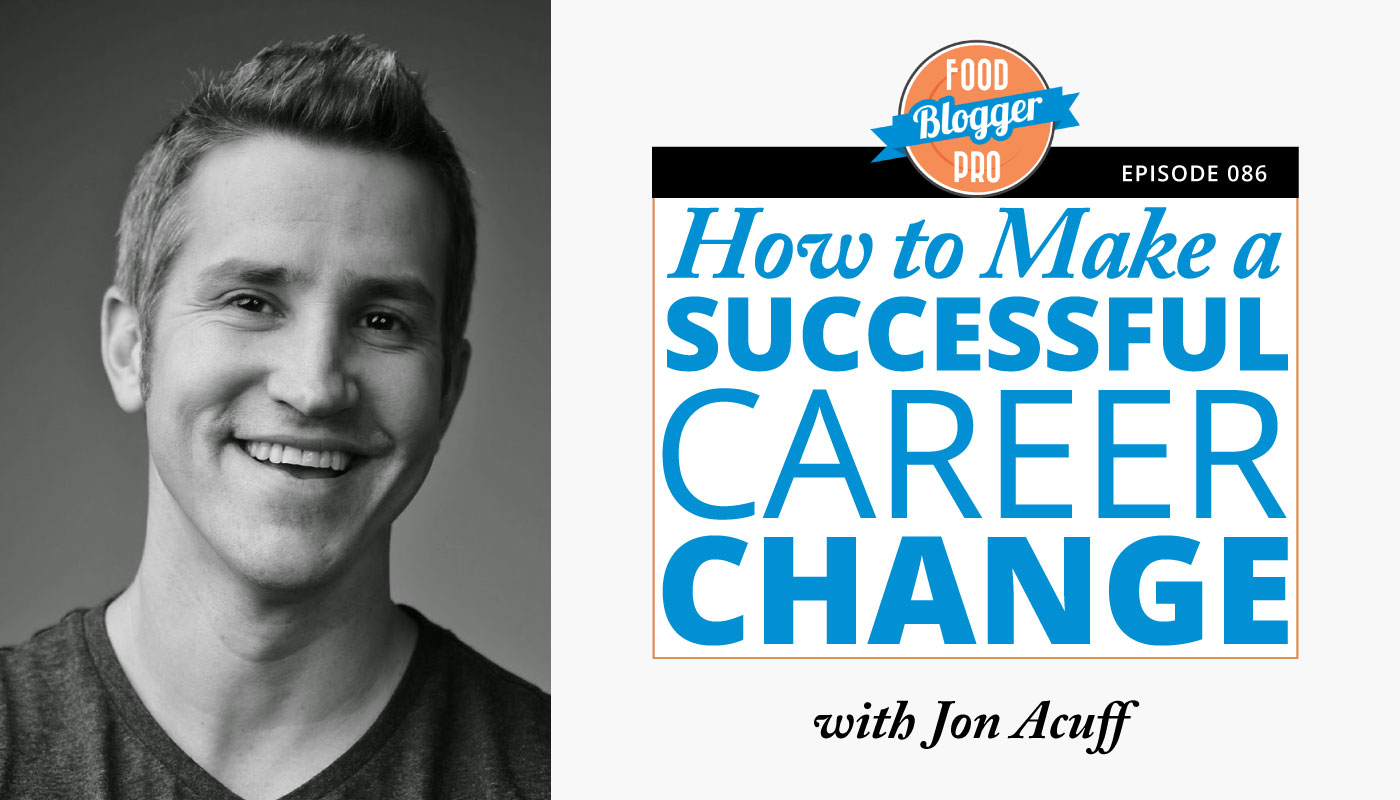
Welcome to episode 86 of the Food Blogger Pro podcast! This week, Bjork chats with Jon Acuff, a New York Times bestselling author who helps you work a job you love.
Last week, we heard the story of Her View From Home, a website cofounded by Leslie Means that brings in over 9 million views every month and pulls content from a network of 450 contributors. To go back and listen to that episode, click here.
How to Make a Successful Career Change
While many entrepreneur-motivators will promote the strategy of quitting your job first, then figuring your new career out later, Jon Acuff takes a different stance. In his most recent book, Do Over, Jon talks about preparing yourself for a new career well before you ever need to actually start one.
Jon’s books have helped thousands of people reinvent their Mondays, transition to a new career, and start Do Overs in all areas of life.

In this episode, Jon shares:
- What a Do Over is and how you can track their effects
- Why you shouldn’t quit your day job
- How to utilize your time without sacrificing your family
- What you need to have in place to be prepared for a Do Over
- Why hustle is a key component, even if you have everything else
- What a Career Savings Account is and why you need one
- The best way to build relationships and be remembered
Resources:
- Jon’s books including Do Over and Quitter
- Powerhouse by James Andrew Miller
- Jon on Twitter and LinkedIn
If you have any comments, questions, or suggestions for interviews, be sure to email them to [email protected].
Be sure to review us on Apple Podcasts!
Transcript:
Bjork Ostrom: In this episode we talk to Jon Acuff about a new type of savings account that you should start investing in today, what Elon Musk and Jennifer Lawrence have in common, and the number one thing that’s been working for Jon in his online business. Hey everybody, it’s Bjork. I’m excited to talk to Jon Acuff today. A little bit of a story here actually with Jon, so Jon is a Wall Street Journal bestselling author. He is a speaker. He’s a blogger. He’s an all around good guy. My connection to Jon goes back a few years, that was actually in 2010, we didn’t actually meet but I just read one of his books.
I was just a few years into my first real job out of college and I read a book that Jon wrote called Quitter. It had a huge impact on how I viewed my job, and my work, and my career. I really suggest everybody check that out, as well as his latest book which is called Do Over. Today we’re going to be talking about concepts from all of the books that he’s written. I’m super excited to share some of those concepts and those ideas with you today. Without further ado, let’s jump into the podcast interview with Jon. Jon, welcome to the podcast.
Jon Acuff: Thanks for having me.
Bjork Ostrom: Super excited to have you here. We’re going to talk about a lot of different things but one of the things that I wanted to focus in on is the title of your most recent book, and that is Do Over. I’ve read your books, and I love your books. I love the concepts in them. They’ve had a huge impact on me, so I’m excited to talk about those. Let’s focus in on Do Over real quick. Let’s jump into it. What is a do over?
Jon Acuff: I think a do over is any time you go through a change. It can be a change you initiate or a change that just happens to you. For instance, I’ve been telling authors if they want to figure out are people reading more, walk down an airplane aisle and count devices versus books. If you’re not terrified, you’re not paying attention. That’s a do over, in the same way that taking a new job is a do over. Reading a book is a do over, listening to a podcast. To me, I use do over as a phrase to describe any time you experience change.
Bjork Ostrom: One of my favorite things to do, and you just described it, when we travel is to walk down the aisles of the airplane to look at people and what they’re doing on their device. Because I feel like it’s like a little focus group. Let’s focus in on Do Over in that specific arena. Let’s say you’re working with an author, they’re scared because it doesn’t look like people are reading books as much as they are playing Angry Birds or Madden Mobile. Once you have that realization, what does that look like next? How do you get into processing through that and making decisions based on that?
Jon Acuff: I think you have to translate information to action, if you’re going to really change things. It would depend on the circumstance. Something like that I would do my best to get a couple other points of information. I would talk to a couple of experts that maybe were in my circle, or outside of my circle. I would really try to get as much knowledge as I could before I did anything. Then I would do something, and then I would measure the impact of what I did. A lot of times we never keep track of what we’re doing, so we never know if something is working or not working.
Bjork Ostrom: That’s such an important thing, isn’t it? We are in the web space and a huge part of it is monitoring and tracking how people behave online. It’s like we make these changes but we don’t really know how that impacts things. We’ve been trying to get really good around metrics. Like if we change this button color to orange, it’s a bad example because it’s a small change, but does that have an impact or not? With a do over, how do you track that stuff? What does it look like, especially when it’s less concrete things like maybe seeing the impact that reading a book has or something like that?
Jon Acuff: Here’s what I’d say. I think you track it, but you also don’t have to track it. You can do some predictive math. For instance, we used an author as an example, I know an author that said, “Hey, I’m rushing to get my book out because I’m speaking at this event and I’d really like for it to be for sale then.” I felt like, man. I think he’s cutting corners on quality. Let’s do the math. I said, “How many people are going to be at the event?” He said, “300.” I said, “Okay. A good day is if you sell 10% of the audience. That’s a pretty good day. I’ll do that and I speak 50 times a year. Let’s say you’re twice as good as me. You’re a great salesperson; you sell 20% of the audience. 20% of 300 is 60 books. Are you really willing to jeopardize the whole quality of the entire book for 60 sales?”
When you do it that way you go, “Ugh, no way.” This is a supersmart guy. It wasn’t like I was working with some dummy. This is a really smart guy, but I just don’t think we like to get in there and do the math of that. One of my goals this year is to read 24 books. I picked out a bunch of the books; they’re on a separate shelf. In order to stay faithful to it I post a short review on Instagram with a hashtag so I can see, and everybody else can see, the progress. That’s how I try to put some math around what I’m doing.
Bjork Ostrom: It’s some type of math, or some type of metrics, around what maybe would otherwise be ambiguous or hard to track goals. Whether it’s reading books, or whether it’s making a change on your website, or making a change in your career. Speaking of, you have had a lot of phases through your career. I want to hear you talk a little bit about, and I’m curious about, some of the biggest do overs that you’ve experienced. In doing so, maybe you can tell people a little bit about your story.
Jon Acuff: My background is corporate marketing. I was really fortunate to have positions on the brand insides of companies like Home Depot, and Bose, and Staples, and Auto Trader. Big national brands. Then I think my first big do over is, a radio personality named Dave Ramsey offered me a job in Nashville. This was a big deal because it was the first time I would be full time being a personality, if you will. You go on Instagram and somebody’s job title is Public Figure and I’m like, “No. You’re an Instagram model that takes pictures of yourself in bathing suits. You’re not a public figure.”
It was the first time that I got to really focus on that and learn from his team. That was the first big do over. Then three years after that the next big one was deciding, “You know what? I want to try this on my own.” You can’t be an entrepreneur at a 600 person company, it just doesn’t work. Leaving that position and the safety of that was my next big do over. That was almost four years ago.
Bjork Ostrom: Can you talk a little bit about what that moment was like, if you can place yourself back in the decision making process? Because I think a lot of people that listen to podcasts like this or that are interested in building a brand, or a blog, or a following online, are interested in that transition. They’re maybe in that in between. Take us back to that. What were some of the fears that you were facing, or some of the questions that you were having to work through?
Jon Acuff: Any big decision is hard, even right decisions. Actually, especially right decisions. Yeah, it was a hard decision but it was slow. I got lots of counsel. There were a million factors and it hasn’t been easy, by any means. I think it’s dishonest to say, “Oh, it’s just been a breeze.” It hasn’t. It’s been a lot of work, but I haven’t regretted it. There hasn’t been a day where I’ve been like, “Ugh.”
I think in any transition it’s bad when sometimes we ask the question, “What will I lose if I go?” You’ve got a job and it’s like, “Well, it’s a corporate job. I got great benefits, what would I lose?” We very rarely ask the question, “What will I lose if I stay?” My wife and I asked a million questions. I got counseling. I know we love the impulsive Jerry McGuire, I had one eureka moment and I’m out the door, kind of situation but those don’t end well. It was really deliberate. It was really slow. It was really thought out. It was financially prepared for. Every kind of box you could check.
Bjork Ostrom: It probably wouldn’t have made a great movie in that it was methodical, and there weren’t any super dramatic moments where you go out with guns blazing.
Jon Acuff: No, people were disappointed. That’s what’s funny. My brand is a share everything brand. There was enough people that I noticed that were like, “I want the full story.” I would just say, “Well, just post your salary online and I’ll tell you that.” They’d be like, “Well, but that’s private.” “Well, so it this.” I always say, “In the absence of the story people write their own.”
Bjork Ostrom: Yes. For sure.
Jon Acuff: I think there was way more drama that people expected than there was in reality.
Bjork Ostrom: Our story is very similar in the sense of the time, at least from what you describe it sounds like, and the intentionality with it. Lindsay does 95% of the content for Pinch of Yum. I focus on our membership site, Food Blogger Pro, but she focuses mostly on that. That was our main focus at the time. It took one year where we were 75% with our normal jobs, 25% working on our side hustle. Then it was 50/50. Then it was 25/75 the other way. It was just a slow and steady transition that was really a boring story line in terms of becoming an entrepreneur, so different than what you hear so often.
For us it was very comfortable. We knew that we were crossing the bridge slowly, which was just the way that we needed to do it and I think was good. A lot of that comes from some of the concepts that you wrote about in Quitter. This idea that, hey, first what you want to do is do a really great job with the job that you have, and work into that being a great job. Can you talk a little bit about the concepts of Quitter and how those apply maybe in the process of doing a do over? Would those connect?
Jon Acuff: The core theme of Quitter, which some people didn’t like because based on the title people thought, “Aha! Here’s a book that’s going to tell me-”
Bjork Ostrom: How to quit my job.
Jon Acuff: “Screw my job, I’m out of here.” The first chapter is Don’t Quit Your Day Job. The book is very much about being deliberate, and being measured, and having patience, and working in the side of your life. If somebody said to you, “I want to be a pro food blogger,” you would probably say, “Well, do you blog before work? Do you blog at lunch? Do you blog after work? Do you blog weekends?” If they said no, you’d go, “Why do you need to quit your job? You still have to use all that margin.”
That’s what was at the heart of the book, was that sense of be good where you are. Ultimately, if I could sum it up, the book is a plea from me to get pulled to an opportunity versus push your way. Like wedding photographers. “I had a really great June. I’m sure every month will be the same. I’m going to quit my job.” They push their way to an opportunity versus wedding photographers that do it slowly on the side, to where the opportunity gets so big it pulls them there and they start to go, “I’m losing money by staying at my job. I never thought I’d say that, but the opportunity is so big I have to leave. I’ve been pulled there.” That’s what the book’s about. The heart of the book is building your way to a pull situation versus being impulsive and pushing.
Bjork Ostrom: Yes, I love that. I think that so many people need to hear that. Because it’s not the sexy story that is so often portrayed in media, where it’s the Elon Musk, where he spends every last dollar that he earned from PayPal to start SpaceX and Tesla. He’s living on borrowed money to be in the department. That happens, but there’s also-
Jon Acuff: Which, by the way, is nonsense. Here’s the thing, that dude gets $100,000 every speaking gig. Whenever somebody goes, “Oh, I had to borrow money.” No, you didn’t. You could have called up any tech conference in the world and said, “Hey, I created PayPal. Can I come speak for $20,000?” They would have been like, “Come!” That’s the problem. There’s a lot of entrepreneurs that trade on myth. You got to grind 24 hours. I saw this famous entrepreneur dude the other day and he was like, “If you want to be rich don’t work 9:00 to 5:00. Work 95 hours a week.” 95 hours a week boils down to five days of 19 hours a day, or 13 hours for seven days. I’m just like, “That’s ridiculous!” The problem is we love the hype, but the hustle is often very different.
Bjork Ostrom: I’m excited to share, I don’t know when the podcast interview will come out, but my friend and somebody you know as well, Andy Traub, who speaks very honestly about that as well. I think it’s really refreshing to hear that, and important because so often what we’re looking at is a highlight reel of people’s life. Not even a highlight reel, but a made up story of somebody’s life. I think it’s so refreshing to hear a little pushback on that and say, “That’s not always what it is. It’s not as glamorous.” It’s still possible to make that transition to be an entrepreneur and to find, potentially who’s not an entrepreneur, but to find your dream job, but so often the story isn’t as glamorous as it seems.
Jon Acuff: No, it’s not.
Bjork Ostrom: Very intentional, but not as glamorous. One of the things that you said, and I’m curious specifically with this concept that I want to hear you talk about, is we talk about hustle and how important that is. We talk about working in the margins of the day. We talk about breakfast, and lunch, and dinner. Breakfast time like when you’re getting up, working over lunch, and then evenings. It wouldn’t be that you have to work while you’re eating. What does that look like in terms of balance? You can’t work 95 hours a week. You know that you want to make this transition and you have to do it in the margins. How do you balance that, especially if you have a family?
Jon Acuff: I think there’s two dangers. Here’s how I think. People love to think in extremes, so they think there’s only two options. You see this all the time. The sales extreme is people create a product and they go, “I don’t want to bother people and become one of those obnoxious salesman,” so they don’t do anything. They think their only two options, if you think of the extremes of two poles on either end, one is don’t say anything about the thing you made to become an obnoxious horrible person that constantly sells. There’s a lot of area in between those two extremes. It’s the same with balance. When somebody goes, “I don’t want to become a workaholic,” usually they have a long way to go before they’re a workaholic.
Bjork Ostrom: They’re potentially using that as a …
Jon Acuff: As an excuse, and it’s such a noble excuse. “I don’t want to abandon my family.” “Oh, you’re being lazy for your kids? Sure.” Usually in a situation like that I’ll go, “I’m not saying ignore your family.” You don’t win favor with your wife if you cancel date night to hustle. Nobody likes that. What I’m saying is get up an hour early while the family is asleep and work on your thing. That might mean going to bed half an hour early, watch half an hour less TV. Your kids aren’t up from 5:00 to 6:00 most of the time. When somebody tells me, “I’m trying to balance,” that’s really easy. The other thing is if you have a day job, a traditional day job, we’re not talking about concepts that the whole world gets access to. We have great opportunity here that other people don’t have opportunity with.
Bjork Ostrom: What do you mean by that? I’m curious to hear you talk about that.
Jon Acuff: As somebody who lives in this country, even a country like Australia which has amazing entrepreneurs, anybody who tries to strive and get ahead is seen as arrogant. It’s called tall poppy syndrome. When you have a tall poppy, you knock it down. Because it messes up the uniformity of the field. I have so many friends from Australia that are like, “Yeah, in America it’s different. When you hustle it’s celebrated. In Australia, you’re seen as cocky.” Even just financial opportunities we have. I have an airport here. I have the ability to get on free wifi everywhere I go.
If you’re in India, you don’t have that same opportunity. For me, I would say to that person, “If you have a traditional office job, your family’s not with you at lunch. Your kids are in school.” If you told me, “Well, I don’t want to ignore my family,” I’d say, “Oh, you have lunch with them every day at your day job?” Then you’d say, “No.” Then I’d say, “Well, there’s five hours. You could do a lot of things with five hours.” I just think so much of that is just an excuse.
Bjork Ostrom: It’s everything is gray in terms of saying work, life, balance. It’s not either or. There’s so much gray space in between where, like you said, you can get up early, you can work for an hour in the morning. That isn’t taking away. It’s self sacrifice, not family sacrifice. That lunch hour, or whatever it would be. I think that’s an important thing to point out, so I appreciate that. You have your three main books in the career category: Quitter, Start, and then Do Over. I’m curious, with those three books did you know that you wanted to move through these in a certain order, or as you wrote those, thought about those, created those books and those concepts, did the next one almost have to be written after you wrote the one before it?
Jon Acuff: No, the only one that has to be written is the one that will come out in the fall. When I release that one everyone is going to be like, “Oh, okay. Duh.” I probably had a dozen people online go, “I bet you your next book should be called blank,” and they guessed the name already. I think there are smarter authors than me that maybe that works for, but my books are usually I’m in a situation and the book that I need doesn’t exist, so I write it. I see if other people need it, too. With Quitter it was I went through that experience. It took me three years, and so then I wrote a book. Then Start, same thing.
Then do Over, I went through a huge do over. Everywhere I looked other people were going through their own. Graduating from college is a do over, it’s a massive do over. Leaving the military is a do over. I always tell people, “You’re not going to die at the job you have right now. You’re not. You’ve got 40 years, 50 years. You’re gonna change. Have a manual on how to change really well. Because it’s coming for you.”
Bjork Ostrom: I would love to jump into that, and talk about some of those things at a high level. Let’s say somebody is going through that process; they’re entering into a do over. I would guess there are certain types of do overs. In broad speak, what are the different types of do overs that happen? You talked about specific examples, but could you categorize those?
Jon Acuff: I think in the broadest terms there’s what I call a voluntary do over, and an involuntary. I had a friend who just moved. He and his family moved down to Florida to take a new job, that’s voluntary. On the flip side of that is involuntary, where I worked at a big company and one day they laid off an entire line of middle management. Just laid them right off. It was a down economy, it wasn’t personal. That was an involuntary do over. The person that got laid off didn’t come into work thinking, “I bet today is my last day.” That was an involuntary do over.
On the broadest scale of things, there’s those. I would say there’s also positive and negative. Because you can have a really positive involuntary where you get some opportunity you did not see coming. You’re at a conference, you talk to the right person by accident and, “Oh, my gosh.” You can have a negative voluntary do over, where you’re deciding to stay stuck. When somebody tells me, “I hate my job so much,” and I go, “How many resumes did you send out this week?” and they go, “Zero,” you’re deciding to stay stuck. That’s a negative voluntary situation. That’s 70% of America right now. Those are the big buckets, but if somebody said what are the two largest categories? Voluntary and involuntary are the two largest.
Bjork Ostrom: If somebody’s coming up to a do over, whether voluntary or involuntary, does the path to walk through that look different or is it pretty similar?
Jon Acuff: It looks different in that involuntary can be really quick. Sometimes it can be really quick, where all of the sudden there’s no job. Where with voluntary, you might have more time. I had a friend, a graphic designer said he recognized that if he didn’t learn to design for the internet he was going to become a dinosaur and lose his job someday. He voluntarily, over time, positioned himself as a web person, learned how to do that. He had a longer runway. If you’re going to start your own company, you can save up money, you can save up resources. I would say there’s similarities in the sense of, whether you’re voluntary or involuntary, you need relationships. There are some things that regardless of the shape or size of the do over are the same, relationships being one of them.
Bjork Ostrom: Can you talk a little bit about relationships? Maybe with doing that you can talk about this concept of a career savings account. I think that’s such an important concept. Individually people understand each one of those things, but when you combined them all together it is a pretty cool concept.
Jon Acuff: The heart of do over is the career savings account. I came up with it because I recognize that most of us spend 18 years getting ready for college and then we graduate, and the next thing we get ready for is death and retirement. I thought, if you have a heart problem, you go to a therapist. If you have a health problem, you go to a doctor. If you have a financial problem, you go to a financial advisor. If you have a career problem, we don’t even really have a great industry that services that. The other thing is I was able to transition and people were like, “Oh, no. It’s going to be terrible.” Jenny and I had really saved our career savings account and I was like, “No. I’ve got this saved up.”
I realized the four things you need, the investments if you will, are relationships, skills, character, and hustle. You need all four. None of those are unique. Nobody on the planet is like, “Jon Acuff is the first person to say skills mattered.” I’m like the one millionth person, but you need all four of those. One example is, if one’s missing they all fall apart. The example I sometimes say is, let’s say you have tremendous relationships, tremendous skills, tremendous hustle, but your character takes a hit. You become Tiger Woods. It’s crazy town to me right now. The golf commentators are like, “It’s so weird that he’s not good at golf. It’s so weird.”
I always want to say, “Is it really? Because his life blew up. Is it possible that impacted the other parts of him?” The other thing is he hasn’t won a major in nine years. If you do something in a row for nine years it’s not a surprise. Now, do I think there’s a second chance for him? Of course. Is there redemption for all of us, and needed? Of course, but you’re crazy if you think one part of your savings account could go empty and it won’t impact the others.
Bjork Ostrom: That would be an example of the character. In the book you talk about this equation where it’s like relationships plus skills, plus character, multiplied by hustle. I’m curious to know why hustle is a multiplier, as opposed to just an additional addition on that.
Jon Acuff: I look at hustle like fuel. Let’s say a car analogy, say you had an amazing car but no gas. It doesn’t matter. Whenever somebody goes, “Oh, he’s got so much potential,” that’s usually the kiss of death. Because it usually means he’s got so much potential but he won’t use it. He won’t use it. We just saw the Super Bowl. Physically speaking, Tom Brady is not the most gifted natural athlete. Cam Newton is built better for football. There’s a lot of football players that are taller, that are stronger, that are faster, but don’t hustle like Tom Brady. That’s why it’s a multiplier, because I look at it as it’s a necessary fuel. It’s over used on the internet without a doubt, but I still think it’s important.
Bjork Ostrom: It reminds me, there’s somebody that I graduated with who is one of the smartest people that I’ve ever met. He would ace every SAT, ACT, every test. Super, super easy for him, almost so much so to the point where it became apparent that he didn’t need to work and didn’t need to hustle. Just to watch the longterm implications of that are so obvious. Because you can have these raw skills and abilities, and if you don’t apply them and use them then it doesn’t pan out. Just the opposite could be true where somebody, the example you gave, maybe doesn’t have the same raw skills and abilities but can apply that hustle and use it as a multiplier. All of these things go into a career savings account. Can you talk about why you need to build up a career savings account? Then what do you do with it once you have it?
Jon Acuff: I think the reality is, I say it like this, it’s like having a surfboard for a wave. A wave without a surfboard is a terrifying thing. A wave with a surfboard is a lot of fun. Here’s an example. The other day we found a plastic bag of disposable cameras. We’re cleaning out a closet, had no idea what was on them. We were like, “Oh, let’s take them over to Walgreens.” We take them over and the guy is like, “Hey, we don’t do that here anymore. We send them out, it’ll take a couple weeks.” We were like, “All right.”
I just started to think, every Walgreens in America, every CVS in America, most grocery stores had a full time staff member that ran a photo machine. They got them back to you in an hour. Thousands and thousands of people that serviced those machines, that worked at the store, all lost their jobs when people said, “You know what? We’re done with disposable cameras.” What I mean by having a career savings account is in a great situation you go, “Well, that’s perfectly okay. Because I have 50 relationships I can lean on. I have skills that I have been developing. I have character that’s been built up in my community. I have hard work.” You go spend that on something new.
The worst time to network is when you’re desperate to network. Here’s another example. In the book Powerhouse, which is about CAA, the largest talent agency in the world, they were hungry. They just started and they realized, “You know what? We’re going to send gifts to our clients when something good happens to them, or it’s their birthday.” Then they were like, “You know what? We’re going to send gifts to all the other actors on the same movie set. It won’t be the same size gift, but even if they’re not our client, we’re going to send them a gift.” That was brilliant. Because they knew down the road the person you’ve been nice to 15 times is going to remember that. They didn’t need the client that second, but when they did need them they wanted to have already invested in that relationship, and be able to spend that equity. That’s what a career savings account does.
Bjork Ostrom: It seems like one of the ways I can imagine it being applied the most is within the relationships category. Maybe what it is for me is that’s potentially the weakest area of my account, is the one that I need to invest in the most so I can see the most opportunity for that. I’m curious to know specific to relationships. We know what it looks like to build an actual savings account, so we work more, we get a better job that pays more. What does it look like to do that with relationships? How does that actually pan out, and what does it look like? You gave the example of gifts. How about for somebody that’s working at a 9:00 to 5:00 job?
Jon Acuff: That’s easy. It looks like going out to lunch with people. One of the easiest things you can do is remember what matters to people. Our culture right now is so me focused. We’re so self obsessed that all you have to do to blow somebody’s mind is that when they casually tell you something over lunch like, “Yeah, my son’s got a big track meet this Thursday. We’re all excited about it.” All you have to do is put that in your calender, and a reminder on Friday morning that says, “Ask Carol about the track meet.” Then on Friday morning you get a notification that goes, “Hey, go ask Carol about the track meet.” You send them a text and they’ll go, “Wow! Thanks for asking.” That’s what I mean. It’s really about being deliberate and not waiting for great relationships to happen naturally. It’s about being deliberate. It’s about remembering what matters to people.
Bjork Ostrom: Yeah, and so often it’s being a friend in order to get a friend. It’s like, “Well, what are the things that would mean so much to me if somebody did those for me?” Not looking for somebody that will do those, but being the person that does it. It seems so obvious but it’s such a great example of doing something that most people aren’t willing to do. I’m just on the early edge of this but it’s been so nice to start doing this, is in Evernote I’ve started a people notebook. Then whenever I check in with somebody or have a conversation, what I’ll do is I’ll just go and jot down a few different notes about them. It’s nice because I know either the next time I have an official meeting or check in with that person, I can go back and review that. If there is something that comes up, like I had a friend whose sister just had a surgery, then I can put something in the calendar and, like you said, remind me. That’s been such a great super basic system, but it’s been super helpful for me and has made such a difference. I love that idea.
Jon Acuff: Totally.
Bjork Ostrom: Let’s talk specifically a little bit about the skills section. Skills, does that look like personal development? Is that developing skills like you said with graphic design, and working towards a new industry? How do you go about refining those?
Jon Acuff: I think there’s a couple ways. A lot of companies have educational programs or dollars they’ll spend to help employees get better. I would say most people either don’t know about them or they go unused. I remember at Auto Trader I applied for every one of those I could, ones that weren’t in my department. I was the only one who wasn’t in customer care that went through a customer care training. It was amazing. I learned so much from people outside of my discipline, and I built relationships. It can look like that. It can look like taking a course. It can look like reading a book. It can look like remembering what skills you have. Most people, if you go, “What are your unique skills that make you hirable?” You go, “Oh.” They don’t know. Versus saying, “Okay, let’s sit down.” That’s part of why there’s multiple exercises in Do Over that help you identify the skills. Most people don’t think about skills until it’s time to put their resume together. Great people do it. I have this business course that I do, the 90 Days of Business Hustle, for entrepreneurs. There’s somebody in there and she does multi level marketing. Which can be awesome or terrible, just like anything else. I know some people that do it so well, then I know there’s obnoxious people. Whenever somebody says, “Do you dislike it?” I always think it’s not an either or; it can be great or it can be terrible. Blogs can be the same. This woman, she’s 34 years old, her network of people, the people under her if you will, her team made $160 million dollars this year. She’s taking the course. Now I know for a fact there’s a lot of people that are making $100,000 a year going, “I don’t need to learn any more.” She made $160 million and is like, “What’s next? Where can I grow? What do I need to do?” That’s what I mean by skills. You keep adding.
Bjork Ostrom: She is at that point because she has done that all along the way.
Jon Acuff: Oh, this isn’t the first time. This is the thousandth time, probably.
Bjork Ostrom: Is smart enough to know that that’s one of the reasons why she is there and continues to do that, which I think is great. You talk in Do Over a little bit about this idea of attitude and expectations. One of the things I’ve been thinking a lot about lately as I process life, and business, and all of those things, is who am I trying to model after? Who am I trying to be like? Then who am I comparing myself to? There’s a fine line between those, but I think there’s a difference. I think comparison always makes me feel a little bit less. Like, “Oh, I’m not as good as I could be,” or, “they’re so awesome,’ or, ”they’re so incredible and I’m not at that point.”
Then there’s also this flip side of it. These, I think, concepts touch on that line where it’s adjusting your attitude and expectation where you’re using people as role models, but you’re not comparing yourself to them. You talk a little bit about this idea of attitude and expectations in Do Over. I think that overlaps with some of the things I’ve been thinking about. I would love to hear how you process attitude and expectations, and why that’s important to understand those.
Jon Acuff: I always tell people, “Choose your attitude, don’t change it.” Changing it takes so long but choosing it, you get to do that today. You might have to do that a thousand times the first couple times, but you get to choose how you’ll treat people, how you’ll treat your job, how you’ll respond to customers, all those different things. Then expectation, I wrote about that because there’s a popular quote that says, “Happiness is reality minus expectations.” I understand the heart of it but I don’t like it, because it’s telling you not to have expectations. That’s impossible. One, it’s impossible. Two, expectations are hope.
What, just don’t hope? Don’t desire? Don’t have vision? Don’t dream? I’d much rather say adjust your expectations, which to me means being honest about your situation. There’s a lot of people right now that don’t like their job. Maybe they’re like, “Oh, I wish I could do this other thing.” Well, unless the company hired you for that and they’re not letting you do it, your expectation’s wrong.
When I wanted to do creative writing and I worked at a company that hired me to do technical writing, I couldn’t say, “Boy they really tricked me. They won’t let me do my creative writing.” If you had a day job and you were like, “Man, I’m so mad this bank won’t let me do my food blog.” I would be like, “Why would they? It’s a food blog. They hired you to be account manager of the Saint Paul area. That’s stupid.” That’s what I mean by expectations, is being honest about what they are. Then if you don’t like them, to work to change them. I always tell people, “Every bad boss is saying the same thing, ‘I dare you to get a better job.’”
Bjork Ostrom: Can you talk a little bit about attitude, the difference between choosing and changing?
Jon Acuff: Changing feels like waiting to me. I’m going to change. It’ll be a process and I’m gonna really work on it. Versus choose, you go, “Okay.” It’s like whenever you have a waiter that seems mad that you’re there, it always bothers me. Because I want to say, “I’m just here to give you money. I’m just here to give you money, that’s all I’m trying to do.” That waiter hasn’t chosen. Here’s an example of that, and this is from my wife not from me. She came up with this. I travel for work. There’s a lot of people that travel for work. I used to be like, “Oh, I’m so sorry,” to my kids. “I got to leave.” She eventually was like, “You’re giving them your guilt and sadness.”
Bjork Ostrom: Interesting.
Jon Acuff: She said, “You feel guilty and you’re asking them to hold it.” She said, “Stop. They don’t even know they’re supposed to be sad until you keep teaching them that.” She’s 100% right.
Bjork Ostrom: That’s so smart. Yeah, that’s really cool.
Jon Acuff: There’s a lot of parents that do that, where they go, “Oh, I’m so sorry.” The kid’s like, “Oh, I didn’t even know. Okay, if you want me to be sad I’ll be sad.” I asked my daughters friend the other day, “Hey, where’s your dad?” She was like, “I don’t know.” I was like, “When’s he come back from the trip?” She’s like, “I don’t know.” She wasn’t like, “Oh, no. I’m wrecked.” She was just like, “I’m a kid.”
It’s like a kid who grew up at the beach. They don’t understand not going to the ocean five days in a row. That’s what you do. Versus a kid who grew up in the mountains. Of course we had ski school. What, you didn’t have ski school? Kids are flexible. I now choose that when I take a trip it’s not a sad thing, it’s a great thing. I choose that when we go to Disney I say, “Hey, we’re able to pay for this because of that trip I took to Tulsa. These are connected. This is part of work. You have to work hard.” I choose those things. The hope is that you choose them enough that they come automatically at some point.
Bjork Ostrom: It’s the difference between a slow evolution of a feeling, or emotion, or a thought, to in this moment saying, “This is the new way that I feel about this,” or, “this is the new thing that I believe about this. I believe that travel is great, and I’m going to tell my kids that when I leave.”
Jon Acuff: This is our narrative. I’m controlling the narrative.
Bjork Ostrom: That’s great.
Jon Acuff: Yeah, so that’s what it’s about.
Bjork Ostrom: I want to spend these last few minutes that we have here to check in, talking a little bit about your journey specifically, Jon. You’re good at using some of your stories and your personal experiences to communicate to other people, and then influence their life, and their decisions, and where they’re going. I’m interested to hear you talk a little bit about that, knowing that these past four years have been your entrepreneurial journey 100%. You were doing that in some way, shape, or form always before that, but I’m curious to hear a little bit about your story now in these past four or five years as you’ve transitioned. Specifically one of the things I would love to hear you talk about is what did you take from your previous jobs and your previous career working for other companies, and then apply it to what you’re doing now?
Jon Acuff: I try to take some generosity. I remember I had a great boss at Dave Ramsey’s company. If he gave you a bonus he’d give you money for tax, too. The sucky thing is you get taxed really high on a bonus, so a $1,000 bonus and you end up with a much smaller check. I thought that was a little thing that was like, “Oh, that’s neat. I want to be generous some day.” I didn’t like when people were unclear to me with what they needed, so I try to be clear to the people that I hire and work with. Like, “Here’s five go by’s.”
Bjork Ostrom: What’s a go by?
Jon Acuff: When I was in advertising the worst comment a client could say is, “I don’t know what I want but that’s not it.” You’ve eliminated one option of a million I didn’t have to go guess. Versus a go by is where I say, “Here are ten logos I like.” Each one of those is called, go by this logo. Go look at it. This is the kind of thing I like. That client is way better because they go, “Hey, here are ten things I like. Do something similar.”
I took that of, how do you communicate? How do you do the work? It’s super lazy to go, “I don’t know what I want. You figure it out.” Versus saying, “Hey, I know exactly a general idea. Here’s what I need.” I took stuff like that. I think too, you figure out stuff you don’t want to do and ways you don’t want to be. You go, “You know what? This is hard. I don’t want this to be the experience for people.” One of my big missions is when people want to leave what I do, I want to launch them not turn my back on them. It’s really hard for leaders to understand that’s a good thing.
I had a leader once, I didn’t even work for this company. I was with him one day and one of his top guys came up and said, “Hey, I’m going to this other job. I’m going to go do this thing.” The guy said, “Oh, that’s great.” He worked it out to where this guy would do one month of work with him in the summer. I said, “Why did you do that?” He said, “Well, I can get 0% of him or 20, and 20 is way better.”
I know a youth pastor, for instance, that his senior pastor was like, “Hey, what do you want to do? What’s your dream?” He’s like, “Well, I want to do this software thing for parents to help them with teenagers.” He was like, “Well, clear your office out because that’s not what we do here.” That’s the church. I want to be the kind of leader where when my assistant, who I think is amazing, some day goes, “You know what? I want to try other stuff,” that I go, “That’s awesome. You were so helpful and it was so great. Will you stay a week to help the next person? You were awesome and I’m so glad that you’ve decided to do something else. I’m so proud of you.” I want to be that kind of leader.
Bjork Ostrom: I think that stuff is noticed both on a small scale and a large scale, and I think more than we know it leaks out. Whether that’s in just people talking about that, or people silently observing and seeing how those interactions play out. I think that’s great. What are some of the things that are working for you right now, Jon? For those that aren’t familiar, you have a blog, you have your social media accounts, you have some courses that you’ve done. You’ve talked about those a little bit, but what are the things that you feel like, “Hey, this is something that is really working?” Not that it could be applied directly to the people in the food and recipe space, but there’s lots of other people that listen to this podcast as well. I’m curious to know from an entrepreneur and also somebody who has built a business online, what’s been working?
Jon Acuff: Facebook ads. They’re like magic. It’s the closest thing I’ve found to printing money. I am in love with Facebook ads.
Bjork Ostrom: I’ve heard a lot of people talk about that, and talk about how it’s not going to be like that forever. Take action on it while it’s working and while it’s hot. With Facebook ads, those are for I’m guessing the paid for content that you have, classes, or courses, or things like that?
Jon Acuff: I have classes that I’ll run ads on. Yeah, I don’t think it’ll be like that forever, but I think there’s always waves. There’s always things that go through. I think treating clients well. I’m realizing simple stuff, like when I go speak at an event, that’s the bottom of my funnel. If you think about a funnel, the top of my sales funnel is free content on Twitter, or free content on Facebook. The middle is probably like you bought a book. Then further down is you took a course. Then the very, very bottom is you hired me. You put your reputation on the line, put me on your stage in front of your people.
That’s a big deal. Usually I’d be like, “Hey, here’s a thank you note. Thank you so much.” That person just fades into the distance. Versus going, that person will now get a free copy of every book I ever write. I will check in with them, I will do that. Just little things like that. I asked my speakers bureau, I think this is a good question to ask, “What are other people doing that I’m not? What are smart people doing?” The way public speaking works is that they send you what’s called a hold. Say that computer company A is like, “You know what? We need a speaker.” The speakers bureau, who is your agent, will say, “I’ve got five speakers that are perfect for you.” They’ll send you the five speakers info and then they’ll say to the speaker, “Hey, dude. Hold January 4th, don’t book it. Hold it for us.”
Some of those you get and some of those you don’t. I asked, “Okay, what do smart people do?” They said, “Well we got a guy, and the second he gets a hold he shoots a short iPhone video saying, ‘Hey, I’m so excited. I just got the hold from Jill, that’s awesome. I’m actually a big fan of your product. I use it in my own house. Here it is, see it’s in my house. Can’t wait, hope we’re able to work out together.’” He gets more gigs than other people. Little things like that, I think, can do wonders.
Bjork Ostrom: It’s another version of the gratitude or the little extra work in the relationship category. Where it maybe takes a minute, two minutes, but it just makes a huge difference. It’s being intentional on moving forward on that and doing that.
Jon Acuff: Being detailed. The problem is it’s all the stuff we know. It’s very rarely a knowledge issue. When somebody is like, “How do I lose weight?” You eat less and move more. Like, “No, it can’t be that. It has to be more difficult.” It’s not. It’s unfortunate how simple it is. Because if it was harder, then you wouldn’t have to do it.
Bjork Ostrom: The hard part oftentimes is setting up the system, or being organized enough to move forward on that and put it into practice. Which isn’t always an easy thing to do.
Jon Acuff: There’s a lot of hard parts, don’t get me wrong. There’s definitely hard parts but they’re not impossible.
Bjork Ostrom: Jon, really appreciate you coming on the podcast today, sharing on a lot of different things and going in depth in a lot of them as well. There’s so much more to talk about, though.
Jon Acuff: I’m just worried about Elon Musk.
Bjork Ostrom: We haven’t figured that out yet. We didn’t solve it, but that’ll be for part two years and years from now when we have a better idea of where he’s headed.
Jon Acuff: The reason he did that, the reason politicians do it, is they want to be relatable. The social science of that is fascinating.
Bjork Ostrom: When you say relatable when they do that, meaning when they do what?
Jon Acuff: For example, Jennifer Lawrence. Beautiful actress. She likes to say in interviews that people call her fat. If you Google ‘people call Jennifer Lawrence fat,’ the only person saying that is Jennifer Lawrence. The problem is, she recognizes she is not relatable to you. She wants her fan base to feel like, “She’s just like me.” That’s the vibe right now. “Oh, we’ve got a squad of friends. They’re just like me.” She tries to say, “I get where you’re coming from. I’m just like you.” You want to go, “You haven’t been like me for ten years. That’s great, that’s awesome. I didn’t go to the Cannes Film Festival on a private plane. We’re different.”
When Elon Musk says, “I had no money,” he’s trying to say, “I’m just like you.” “No, you’re not. You’re building a space program to launch rockets. I work at a cubicle.” We have this weird thing in our culture where we want to be relatable to people. It’s isolating when you’re not, and so to sometimes exaggerate, there’s so many different ways. There’s entrepreneurs that are personalities, and some of them have 200 person staff. They don’t talk about it a lot because then you’re a company. Not just like, “I’m just like you. The internet gave me options.” Like, “Okay.”
Bjork Ostrom: It’s important to point that out, because I think if you aren’t intentional about thinking through what’s actually being said and what’s behind that then it can be discouraging. Because it seems like this person has some special sauce that they’re applying to what they’re doing that you don’t have, and so often there’s so much more to the story.
Jon Acuff: I think it’s important to always say, “What does that mean?” When somebody tells you some motivational advice or a tip or whatever, to go, “Oh, yeah, but what does that mean?” Did they say it because they were looking for clicks? They call it narrative bias when somebody goes, “This happened to me. Buy my course and it will happen to you.” No it won’t. When you sell somebody that way, you’re overlooking everything about that person. I don’t know where you live, or your connections, or your personality, or your strengths, or your weaknesses. I can’t promise that’ll happen to you.
That’s why I’ll never write a book about how to get speaking gigs. Because the truth of it is a big part of that was I worked for a famous guy who made me more well known. I could write a book about how to deliver a speech, because in that situation I am more like you. I might be naturally funny or whatever, but the mechanics are the same. We’re doing the same thing. I don’t have anything special.
Bjork Ostrom: It would be building a story that is so intricately woven to get somebody to where they are, that nobody else could weave that same story. It’s saying, “Here’s exactly how I did it,” but it’s so hard to replicate that. Because there’s probably so many nuanced changes along the way that have resulted in that person getting there.
Jon Acuff: The honest truth is the person didn’t follow those steps. They weren’t premeditated. Some of them might have been. Some of them were, I get that. The reality though is what happens is we often go and try to find steps to something that happened more organically than we want to admit. We look back and go, “Oh, yeah. I kind of did that on purpose.” Then we create a system that we ourselves didn’t even use. We didn’t know what we were doing. Anybody who tells you, “I knew where I was going to be in ten years,” you’re a liar.
Bjork Ostrom: This is a tangent, but I’m interested in it because I think about it a lot. Warren Buffett talks about that with investing. How he’s this outlier, and there’s certain investors who try and build what he does and do the same thing, but so often there’s people in the investment community that have had success through the years and then look back and say, “Here’s how I did it,” but the reality is there has to be somebody who has ten years of investment success. Just like there has to be somebody who has a winning streak in a certain sport. That’s just the way that the odds work out, but in order to go back and say, “Here’s exactly how I did it,” doesn’t always make sense. Because so many times it has to do with odds, and chance, and nuance, and all of those things.
Jon Acuff: I don’t know, it’s fascinating.
Bjork Ostrom: It is. It’s super fascinating. We could go on and on. I want to be respectful of your time, but before we wrap up Jon, I want to give you a chance to talk about where people can find you, follow along with what you’re doing. Also, where people can make sure that they can get a notification or get notified when you release your next book, which is coming down the line.
Jon Acuff: All my books are on Amazon, and everywhere else books are sold. If you only read one, Do Over would be the one I recommend. Then I’m JonAcuff on Twitter, JonAcuff. Then same on Instagram. My blog is Acuff.me, so my last name .me. I’m starting to really get into LinkedIn. I’m feeling LinkedIn.
Bjork Ostrom: I saw that you did a post on that.
Jon Acuff: Dude, they’re such different people than what I bump into on Twitter. My network grew 35% in the last week. I know we think like, “Oh, it’s a dorky old persons Facebook.” That’s fine. It’s still crushing it. I love that people think Facebook is for your aunt. I’m like, “Well, your aunt is buying stuff, so enjoy Snapchat.”
Bjork Ostrom: We’ll link to your LinkedIn profile on the show notes. Is that all right?
Jon Acuff: Yes, 100%. I am generous with accepting all.
Bjork Ostrom: Cool, sounds good. Jon, thanks so much for coming on. It was really fun to chat with you.
Jon Acuff: Yeah, thanks. I had fun.
Bjork Ostrom: Yeah, I appreciate it. That’s a wrap for episode number 86. Hey, if you want to check out any of the resources that Jon mentioned, or any of the books that Jon has, or any of the accounts where Jon can be found, you can go to FoodBloggerPro.com/86. We will have all of the podcast notes there, as well as a transcript of the podcast itself, so go ahead and check that out. Thanks so much for listening to this. Everyone, I just want to do a little plug here for a podcast review. If you have a minute, if you’ve been enjoying these podcasts we want to continue to keep them free. One of the ways that we do that is by making sure that we get downloads so we get exposure.
We don’t have any type of economic exchange here other than attention, and the best way to get more attention for this podcast is for that to show up higher in search results. The best way for that to happen is to get ratings in iTunes, or wherever you listen to the podcast. If you have a minute, I would really appreciate it if you would jump onto your podcast listener, or aggregator of choice, and leave a review for the Food Blogger Pro podcast. It would mean so, so much. Thanks so much for listening; make it a great week. Thanks guys.
I really enjoyed this podcast episode! I related to it because I’ve had many “do overs” in my career by choice and not by choice, this is just something that happens in life as we get older and how we move forward with what kind of attitude is so important. Just bought Jon’s book on Amazon and I look forward to reading it, thanks Bjork for bringing engaging and dynamic people to the podcast!